Mel Bochner - Solo Exhibition
(Top) Detail of "Event Horizon (Paris)" (2006). (Mid-left) "If the color changes" (1997). (Mid-right) "Lazy (Paresseux)" (2004). (Bottom-left) "Remarques mélées" (2007). (Bottom-right) Principle…
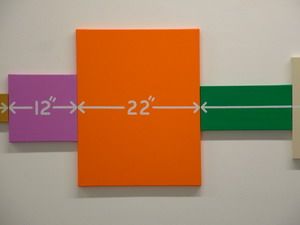
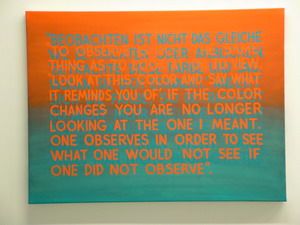
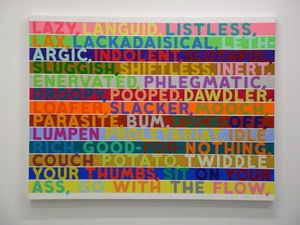
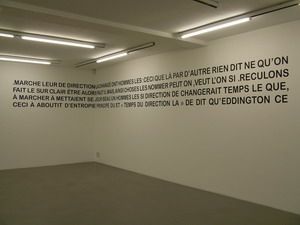

(Top) Detail of "Event Horizon (Paris)" (2006). (Mid-left) "If the color changes" (1997). (Mid-right) "Lazy (Paresseux)" (2004). (Bottom-left) "Remarques mélées" (2007). (Bottom-right) "Principle of Detachment Paris Reading 06". Mel Bochner's solo exhibition runs from March 3 to April 20 at Nelson Gallery.
Mel Bochner is one of the most representative conceptual artists and critics of the 1970s in the United States. He organized the first "Conceptual Art Exhibition" as a group show at the Visual Arts School in New York in 1966, proposing two major characteristics that distinguish conceptual art from other arts: "First, it affirms the descriptive nature of language, capable of depicting or even being narrated. Second, it can be reproduced, lacking the traditional artistic trait of being unique."
After education in both art and philosophy, like Joseph Kosuth, Lawrence Weiner, and the British Art Language group, Bochner chose linguistics, philosophy, and mathematics, believing that analytical rules for adapting to circumstances are superior to creating artworks. He further believes that the world belongs to the exposition of mathematical logical necessity and philosophical grammar. His works often involve careful calculation, text, and philosophical quotations; these elements allow him to display the process of mental states. Themes are also included as key links connecting text or reinforcing their importance in the perception of the artwork.
Mel Bochner is quite unfamiliar to Parisian art lovers, as this is his first solo exhibition in Paris. A special focus explores a large aspect: series of pictorial texts. In the 1997 painting "If the color changes," two languages are written repeatedly on a gradient background of two colors (red and blue), resembling a mirror image. The underlying layer writes red German above blue English. The overlapping and color effects make clear reading impossible, dissolving that feeling into questions about the understanding of meaning, form, and color.
Another new work, "Lazy (Paresseux)" (2004), features continuous text between colored fields and lines, where the word "lazy" can be clearly seen. The composition does not use synonyms but rather arranges letters specifically to understand the state of the word "lazy." Another series, "Event Horizon (Paris)" (2006), consists of over ten monochrome paintings of various sizes juxtaposed in a horizontal line, with arrows indicating their dimensions on each painting. Under the clear exposition of mathematical logical necessity, it presents a novel perception.
Two large installation works upstairs are eye-catching. The 2007 piece "Remarques mélées" quotes sentences from the famous Austrian philosopher Ludwig Wittgenstein, written directly in black characters on white wall corners, presented upside down (the last sentence becomes the first). Of course, Wittgenstein believed that the manifestation of language has inherent rules; Bochner's role here is to remind us of this rule, yet intentionally confusing vision and hearing, attempting to make viewers carefully read to highlight new feelings emerging from the reading. On the ground, stained glass blocks are arranged into two suspended triangles forming "Principle of Detachment Paris Reading" (2006). Constructed mathematically rigorously among numbers 1 to 8, the mathematical world becomes the clear and definite root foundation of the universe, so the artist "clearly believes that the world belongs to the exposition of mathematical logical necessity."