Michelangelo
(Top) St. Paul's Conversion (1542–45), with its strong religious sentiment, and (bottom) The Crucifixion of St. Peter (1546–50) are both housed in St. Peter's Basilica. Michelangelo is an unprecedented master...

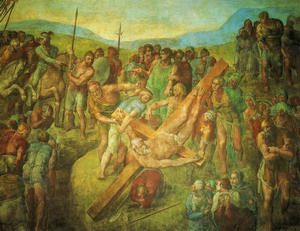
(Top) St. Paul’s Conversion (1542–45), imbued with profound religious sentiment, and (bottom) The Crucifixion of St. Peter (1546–50) are both housed in St. Peter’s Basilica. Michelangelo was an unprecedented master in the history of Western art, and the most renowned sculptor, painter, architect, and poet of the Golden Age of the Renaissance, one of the three greats of the art world alongside Leonardo da Vinci and Raphael. He devoted almost his entire life to the Church, especially through the magnificent and splendid frescoes of the Sistine Chapel in the Vatican, leaving a vast radiance that illuminates hearts across time and space. Michelangelo’s art was not as intellectual or delicate as Leonardo’s, nor as elegant and refined as Raphael’s. Instead, it possessed a bold, majestic, and grand personality; through latent forms, he explored extraordinary imagery, seeking a balance between anxiety and solemn harmony.
The generation-defining master Michelangelo was born on March 6, 1475, into a middle-class family near Florence. Raised by a wet nurse, whose home happened to be a stonecutter’s shop, he grew up hearing chiseling sounds, which subtly fostered his affinity for sculpture. However, while his father in the middle-class household hoped for his son’s conventional success, Michelangelo was passionate about art. At thirteen, he joined the studio of the famous painter Domenico Ghirlandaio, diligently studying ancient and modern art, taking past masters Giotto and Masaccio as his artistic models. He later moved to the studio of the famous metalworker and sculptor Bertoldo di Giovanni (an assistant to Donatello), embarking on the path of sculpture. Influenced early on by his mentor, he worked within Donatello’s naturalistic realist style.
When his mentor Bertoldo died in 1491, Michelangelo entered the court of Lorenzo de’ Medici, the ruler of Florence and a wealthy patron. This was a gathering place for humanist scholars, artists, and social elites. There, Michelangelo studied the Medici family’s collection of ancient Greek and Roman sculptures and immersed himself in the most advanced humanist thought of the time, laying a solid foundation for his future artistic creation. However, fortune did not last. In 1492 (the year Columbus discovered the New World), Lorenzo de’ Medici, who loved artists, died shortly after. His son Cosimo succeeded him, but Michelangelo, feeling undervalued, left the Medici court. During this period, he created the only wooden crucifix of his life (1492–93).
In 1494, when the French army invaded, Michelangelo fled to Venice and then to Bologna. There, he deeply studied the works of pre-Renaissance literary giants (Dante, Petrarch, Boccaccio), which fueled his strong interest in poetry and literature, leading him to become a poet. At this time, he created works such as Angel with Candlestick – Saint Proculus and Saint Petronius. He returned to his hometown in November 1495. Early the following year, he visited Rome for the first time, admired the famous ancient sculpture Laocoön, and began his career as a sculptor (at age twenty-one). His first masterpiece, Bacchus (1496–97), demonstrated his perfect grasp of the beauty of the human form (anatomy); under his precise rendering, it came alive. Later, invited by the Vatican Curia, he completed his early monumental work Pietà (Madonna Mourning Christ) between 1498 and 1499. Within a solemn, sacred pyramid structure, he flawlessly expressed sorrow and beauty (beauty seems intuitive, sorrow is essential). This propelled Michelangelo’s sculptural art to perfection, shocking all of Rome; at just twenty-five, he became famous overnight.
The following year, he was hired to return to his hometown of Florence to create another masterpiece, the David statue (1501–1504). This was the absolute concretization of Michelangelo’s concept of the perfect human body, reaching its peak within the excellent and perfect spirit of classical art, marking the entry of his artistic creation into its most brilliant golden age. It was also during this period that Michelangelo completed his first two-dimensional painting, Holy Family (1501–04).
In 1505, Pope Julius II summoned the famous sculptor Michelangelo to Rome, commissioning him to build a tomb. Michelangelo was thrilled by this grand plan and personally went to Carrara to quarry marble. After nearly a year, the Pope changed his mind the following year, causing the grand plan to fail. In anger, Michelangelo resolutely left Rome and returned to his hometown. The Pope repeatedly ordered him to return to Rome; Michelangelo stubbornly resisted. The Pope then resorted to force, occupying Bologna and pressing toward Florence. Forced to compromise, Michelangelo finally met the Pope in Bologna at the end of 1506 and returned to the Pope’s side. He first completed the statue of Pope Julius II (1506–08).
Then, in 1508, some painters jealous of Michelangelo’s talent suggested to the Pope that Michelangelo undertake the fresco of the Sistine Chapel ceiling, believing he could not paint. Thus, the Pope ordered Michelangelo to take on this heavy responsibility. Although he repeatedly declined, it was futile, so he reluctantly accepted the task, giving him the opportunity to express the idea of divine cosmic creation – The Creation of Adam. Starting from May 10, 1508, he began creating the magnificent ceiling frescoes of the Sistine Chapel, seemingly surpassing human strength. With Michelangelo’s passion and frantic effort, he completed three large panels on the east side by 1509. By the end of September 1512, this immortal masterpiece was fully completed, reaching an unprecedented realm in painting art. The figurative human form became Michelangelo’s primary sculptural model. In terms of overall structure, the monumental work Genesis sincerely affirmed the unity of human flesh, mind, and spirit.
In 1513, a second contract for Pope Julius II’s tomb was signed, but the plan was drastically scaled down. Shortly after, Julius II died, and Giovanni de’ Medici, Bishop Leo X, ascended the papal throne. Michelangelo began working on the majestic, powerful, and charming statue of Moses, completing it in 1515, fully demonstrating that his sculptural art had reached perfection. This was followed by a series of Slave statues – bound souls like Dying Slave and Rebellious Slave, longing for freedom and liberation – which were expressions of the artist’s own emotions. In 1516, commissioned by Pope Leo X, he designed the facade of the San Lorenzo church for the Medici family in Florence. The next year, he completed the church design model, but this plan encountered many twists and turns and was never realized, leading to a contract termination. From 1519 until the early 1530s, Michelangelo continued to carve a series of bound souls – slave statues, mostly unfinished: Bearded Slave, Awakening Slave, Young Slave, Atlas Slave, etc., filled with complex and subtle inner lives, seeming to struggle to break free from the stone. During this time, he also completed the large standing statue of Christ (1519–21).
In 1520 (Raphael’s death), the San Lorenzo facade plan was terminated and changed to the planning of the Medici Chapel. Michelangelo began planning these geometrically perfect and solemnly sacred chapels, along with the excellent and perfect Madonna and Child statue (1521–34). Furthermore, starting in 1524, he built the Medici Family Tomb: the tombs of Dukes Lorenzo and Giuliano, and designed the Laurentian Library. Michelangelo used intellectual humanism to express human activity and intellectual life in time. In 1525, he completed the symbolic Twilight statue for the Lorenzo tomb; the following year, he completed the Dawn statue. Using symmetrical male and female forms, he metaphorically represented dawn and dusk.
In 1527, the Holy Roman Emperor invaded Italy and plundered Rome. Michelangelo participated in the Florentine revolution; the Medici family was expelled, and the Florentine Republic was established, interrupting the Medici Family Tomb project. In 1529, Michelangelo was appointed as one of Florence’s military commissioners. In September, the Pope allied with the Holy Roman Emperor to attack the Florentine Republic. The following year, the Republic surrendered, the Medici regime was restored, and Michelangelo fled to Venice. Florence’s ruler, Alexander de’ Medici, forgave Michelangelo’s crimes on the condition that he resume work on the Medici Family Tomb. He returned to Florence to continue the tomb work. The next year, he completed the Night statue on the left side of the Giuliano tomb and a statue of Apollo (his father Lodovico had passed away). In 1532, he completed the majestic Victory, which seemed to metaphorize the overthrow of Florence’s freedom. The following year, he completed the Day statue, metaphorizing day and night in symmetrical forms, finally completing the entire Medici Chapel project. Immediately after, he accepted the commission from Pope Clement VII to create the large fresco The Last Judgment in the Sistine Chapel in the Vatican, Rome, which seemed to be a form of expiation for the fall of Rome.
In 1534, Clement VII died, and Farnese succeeded as Pope Paul III. Michelangelo settled in Rome (when Michelangelo settled in Rome, Giambologna became the most important sculptor in Florence). The following year, he was appointed Director of Architecture, Sculpture, and Painting for the Curia, and began his unprecedentedly grand large fresco: The Last Judgment. Under his ambition and resolute courage, he passionately created this work, completing the world-renowned masterpiece in 1541. It is recognized as an unparalleled masterpiece in art history. Through complex, varied, and vital modeling of over three hundred nude figures, it displayed unparalleled momentum and charm. Following the completion of The Last Judgment, Michelangelo worked on The Conversion of St. Paul (1542–45) and The Crucifixion of St. Peter (1546–50) between 1542 and 1550. Both became unprecedented, releasing the light of religious understanding in apocalyptic imagery (closely related to the religious reform of the time). In 1545, he finally completed the tomb of Pope Julius II, which had entangled him for his whole life; the statue of Moses was the most spectacular. Michelangelo once said, “I have wasted my life because of this tomb.”
In his later years, Michelangelo’s life was filled with humble religious sentiments, yet he remained obsessed with sculpture. Between 1546 and 1555, he flawlessly completed the large Pietà in Florence, reminiscent of the early Pieta, excellent and perfect within a strict pyramid composition. Notably, the old man draped in a cloak behind Jesus Christ is none other than Michelangelo himself. The Florence Pietà (1550–60) and the Londini Pietà (1552–64) are both artworks where the artist transformed his lifelong compassionate spirit into profound wisdom and poignant imagery. In 1547, Paul III appointed Michelangelo as Architect of St. Peter’s Basilica. Architectural art became the crystallization of his late-life wisdom: magnificent, bold, generous, vigorous, and powerful, just like his painting and sculptural art.
Starting in 1547, he planned and designed St. Peter’s Basilica; from 1550 to 1559, he planned and designed the San Giovanni Fiorentini church; in 1562, he designed city gates in Rome; in 1564, he planned and redesigned the Capitoline Square in Rome, among others. Like an unprecedented civilizational giant, a versatile artist overflowing with talent, he liberated traditional art and had a profound influence on the history of Western civilization. When this unique, brilliant star fell on February 18, 1564 (at the age of eighty-nine), another Western civilizational giant, Shakespeare, was born. Michelangelo not only with his genius but also with his longevity, became a bridge between the Renaissance and the Counter-Reformation periods.