Michel Jorniac "Current Icons" Solo Exhibition
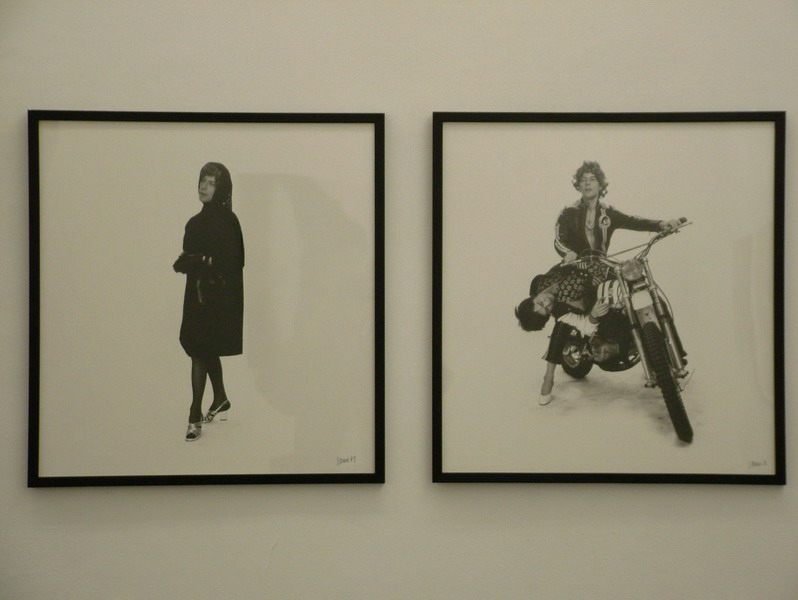
Part Two of a series on the 24-hour life of an ordinary housewife. Each piece measures 51x48 cm, 1971.


Details from the sculpture and object installation "Totems of Republican Power," which critiques regimes and French symbols, 180x50x60 cm, 1985. Michel Jorniac's solo exhibition "Current Icons" is on display at Patricia Dorfmann from April 24 to May 31. Michel Jorniac (1935-1995) was one of France's most representative artists in body art. Unlike Gina Pane, whose performance art focused on self-inflicted pain and violence, Jorniac adopted a more humorous approach, using bodily language to explore the psychological state of real society, making him one of the most significant figures in the body art trend of the 1970s.
After studying philosophy and aesthetics, Michel Jorniac quickly established his stance of using the body as a sculptural medium. In his first body action in 1969, "Trap for the Viewer," he presented a performance where he, a young man (the artist himself), was locked naked inside a cage adorned with colorful neon lights. Beside him stood a photograph of a naked couple with hollow heads; visitors could place their heads inside, triggering a flash that mimicked taking a photo. This surprised viewers, allowing them to get closer and peek more clearly at the naked figure, seemingly testing attitudes toward sexuality. Another notable work is "Mass for a Body." In this ritual of "communion," he gathered people in the gallery for a mass led by the artist, simulating a mundane religious ceremony. Surprisingly, the communion wafers were made mixed with Michel Jorniac's blood. This direct, absolute transmission of will through a body-to-body religious ritual symbolically shared flesh and blood like Jesus Christ, effectively breaking social and religious taboos and entering a sacred, untouchable "artistic realm."
In essence, there is a type of sacrifice deep within humanity, with Christianity being the last incarnation of God. The body is often offered as a social redemption (as German artist Joseph Beuys clearly expressed in his actions), regardless of controversies over norms. In this willingness to offer oneself, akin to opening the individual body to the social body, it specifically breaks the intimacy intended because bodies are lonely and helpless in real society. Michel Jorniac emphasized the materiality of the body, attempting to establish new possibilities for dialogue.
In the 1970 work "Investigating a Body," the body was condensed under psychological facts and social products, analyzing blood, urine, piles of clothes, and bones, which served as traces of human existence. The 1971 work "A Trap for the Death Penalty" showed a forward-looking opposition to capital punishment by displaying a all-white guillotine. In the 1972 work "Trap for a Disguiser," the artist performed cross-dressing, captured in photographs, which developed into his 1974 masterpiece "The 24-Hour Life of an Ordinary Housewife." This series of photographs depicted the artist dressed as a housewife going through a flat day—handling chores, caring for children, and other miscellaneous tasks—with narrative imagery resembling a slice-of-life film. Another groundbreaking work from 1972 was "Homage to Freud," where Michel Jorniac simulated his parents' appearances and contrasted roles, demonstrating a critical examination of disguise mythology.
In 1973's "Contract of a Body," three skulls were directly displayed: one in white clothes, another painted gold, and a third lying horizontally, suggesting viewers abandon their bodies, which the artist would then convert into artworks. In 1976's "Ritual as a Death," the body remained the object of exploration, submitting to existential rituals of birth, aging, sickness, and death, thereby proposing a sociological critique. In the 1980s, Michel Journiac used white skull objects-sculptures as metaphors for the phantom of bodily death. This was followed by the transformative ritual action in 1983. The Current Icons painting series featured portraits of several contemporary figures (Antonin Artaud, Jean Genet, Billy Idol, James Dean, Franz Kafka, Malik Oussekine, Michael Jackson, Arthur Rimbaud, Marlene Dietrich, Marilyn Monroe) against backgrounds mixed with the artist's fresh blood. Finally, the sculpture and object installation "Totems of Republican Power" (1985) critiqued regimes and French symbols.
Emmanuelle Lequeux wrote: "He was once a theology student 'terrified by the violence equivalent to personal pain,' later becoming a painter. Jorniac created a new radical attitude, both in body art and social art. 'In this regard, he is one of the main post-war artists, equally important to Beuys and Boltanski.' Money, sacrifice, women, the death penalty, private and public relationships, etc.—he addressed these existential aspects, even reconsidering his work in light of AIDS. To me, his exploration approaches Michel Foucault: art and philosophy serve there as tools against reality's operation."