Millet - The Gleaners
Millet, The Gleaners, 83×111 cm, 1857. Held at the Musée d'Orsay, Paris. Millet (1814–1875) was the most renowned peasant painter of the Barbizon School...
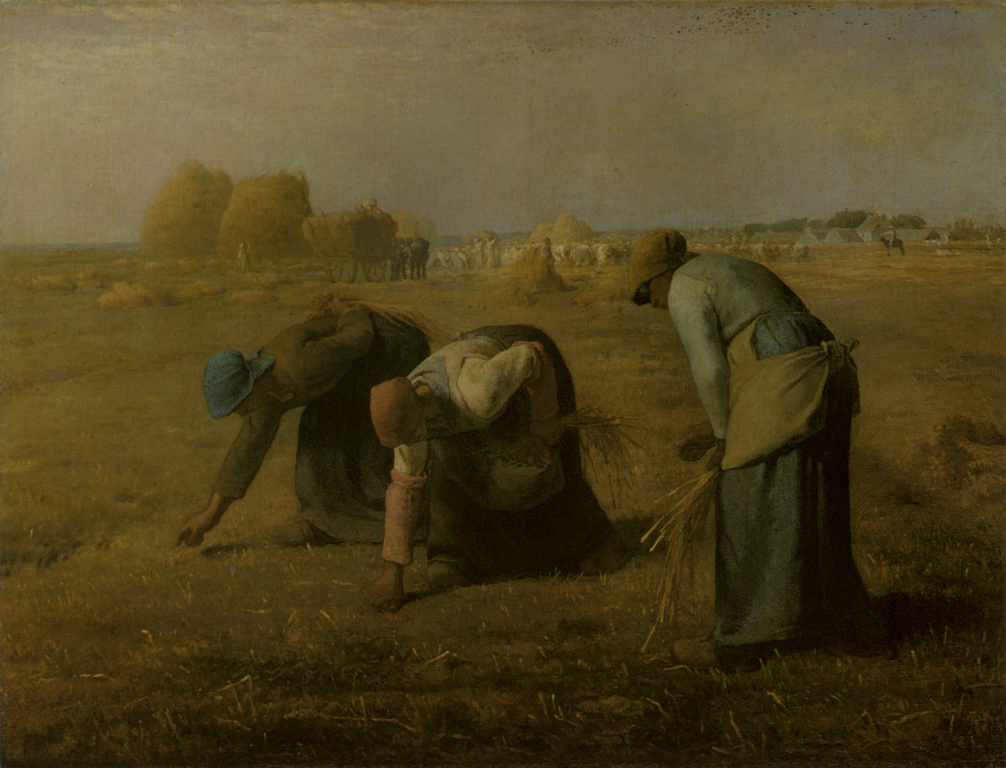
Millet, The Gleaners, 83×111 cm, 1857. Held at the Musée d'Orsay, Paris. Millet (1814–1875) was the most renowned peasant painter of the Barbizon School; his life’s focus was on a connection to the soil and the simple, sincere life of farmers. With a devout naturalistic approach, he depicted the harsh realities of impoverished peasants’ lives.
In this world-famous work, The Gleaners, Millet depicts three humble gleaners bending over to gather wheat stalks in a field after harvest. In the background, figures are busy harvesting and transporting crops, while the distant horizon serves as a metaphor for the lowly status of the lower classes. Under warm colors and contrasting light and shadow, the poor women appear like solid, powerful statues. There is no sentimentality or pastoral illusion, but rather a profound social commentary. Especially in frugal rural areas, nothing should be wasted, not even a single grain of wheat.
Millet stated regarding his work: “I only wish to draw attention to these poor people, who work so hard for their livelihood. I am a farmer… As for my technique… it comes more or less from an understanding of life’s hardships.” Contemporary with the socialist master Marx, Millet’s concern for the lower-middle classes and his ideology seemed to arrive at the same destination via different paths. He became a realist master for future socialism, akin to Courbet’s Stone Breakers, Daumier’s Women Washing Clothes, Degas’s Ironing Women, and Caillebotte’s Floor Scrapers.