Mona Hatoum Solo Exhibition
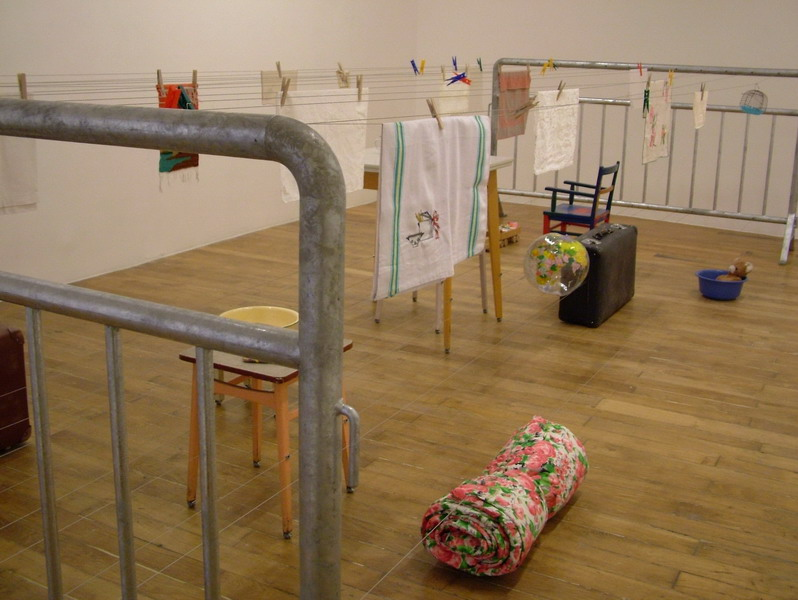
The most dramatic "Mobile Man" object installation, 2005, depicts the tragic scene of displacement or exile.

"Misbah" is an environmental light space installation. Mona Hatoum's solo exhibition runs from January 25 to March 1 at Chantal Crousel Gallery. Born in 1952, Mona Hatoum is a British-Palestinian artist and one of the most representative female artists under current globalization. Her painful experiences of exile twice—her parents fled to Beirut, Lebanon, where she was born; in 1975 she was exiled again to London, UK—form the origin of her entire creative practice. The scenes and reality of this displaced, oppressed, exiled identity, along with history and memory, drive her work. She attempts to interpret through art the extraordinary tensions and humiliating situations of personal, Palestinian (Arab world) political, social, economic, historical, and individual dimensions. For example, her 2000 solo exhibition at Tate Britain, titled "Like a Strange Country," clearly pointed to the context of exile, the state of life and tension under real pressure, becoming the soul of her overall work.
In this new solo exhibition, through six sculpture-object installations and a series of drawings, within the realm of intimate relationship between artist and viewer, Mona Hatoum continues to emphasize conflict in concepts of home, protection, displacement, passion, and all anomalies. The explosive power of works formed by political and social tensions of homeland and separation is highlighted. The most dramatic "Mobile Man" (2005) object installation presents the tragic scene of displacement or exile. Using two barricades as supports with thin threads passing through the middle, simple daily necessities are suspended on the lines: suitcases, sleeping bags, tables and chairs, plastic bowls and plates, tablecloths, clothes, etc., all automatically dragging slowly back and forth with clattering sounds on the ground. This bizarre grand performance strongly presents the unease and instability of the homeless exile in form, change, psychology, spirit, matter, and metaphor.
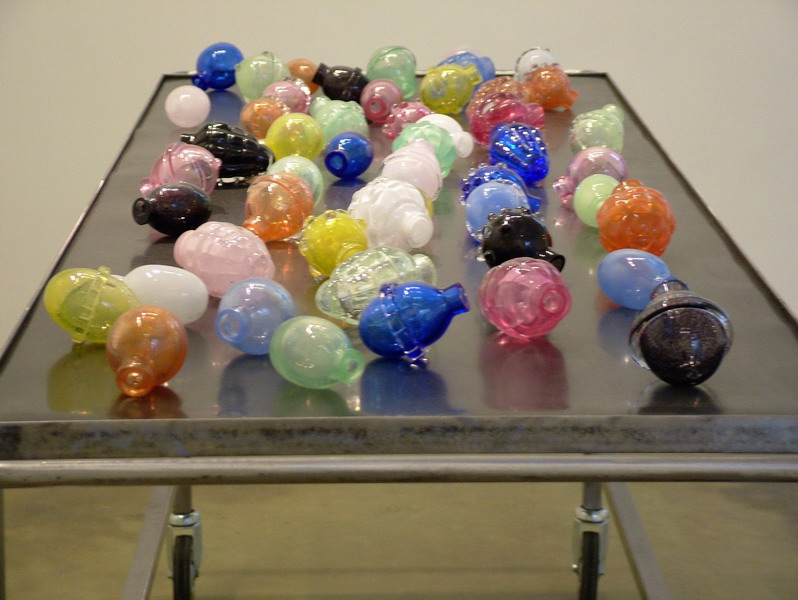
"Grenade-Still Life" (2006-2007) is a beautiful work composed of colorful series. At first glance, it resembles a misleading painted pomegranate; only upon close observation does one realize they are various grenades. The series consists of 60 hand-blown glass vessels, cleverly presented on iron wheelbeds used in hospital morgues, emitting an absurd atmosphere that clearly metaphorizes the fragility of life and the shadow of death. "Red and White" (2007) is an intricately patterned Arabic red carpet laid flat on the ground, a family object accompanying the artist for many years. She manually extracted irregular red threads, creating speckled red and white dots resembling insect bites. In the center of the carpet appears a bursting world map, which for the displaced person is an unimaginable ambiguity and unattainable longing.
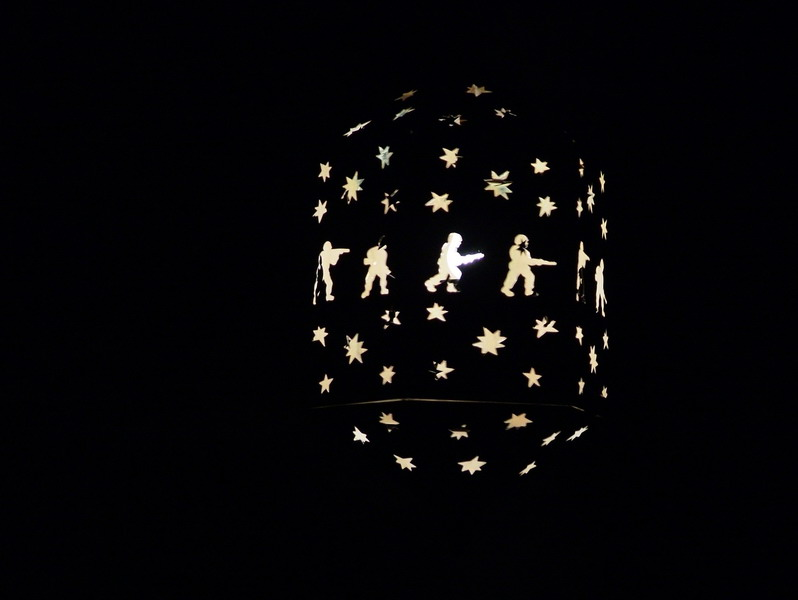
"Keffieh II" (2008) presents an object woven from metal wire, quite noble and glorious, emphasizing symbols of the Arab world. This noble material is often worn by high-ranking scholars or as an ornament for distinguished senior officers. Under the thinking of globalization, she reminds us of this distant folk traditional craft and extraordinary cultural signs. "Misbah" (2006-2007) is an environmental light space installation. Misbah means lantern in Arabic. A traditional Arabic lantern hangs in the space. Past lanterns were all decorated with star-shaped patterns; here, Mona Hatoum decorates the center with a series of figures of warriors holding guns in combat. The lantern rotates continuously, with light flashing on and off at intervals, forming a psychedelic and wonderful fairyland. The figures of the warriors holding guns rotate and project onto the surrounding walls, metaphorizing combat regardless of day or night, evoking the unremitting will of resistance on their homeland territory of Palestine.
Finally, weeds growing out after being casually stroked on a pile of fortresses or border sandbags are titled "Suspended Garden" (2008). On this desolate sandy ground, new life actually emerges. Even in the hardest and most difficult times, there is always hope and sunlight. This is completely a manifestation of the will of life survival. Artist Mona Hatoum says, "Artworks are first the feelings of truly lived life; content and composition come only from truly lived initiatives."