Nguyen Manh Hung "Lang Du Adventure" Solo Exhibition
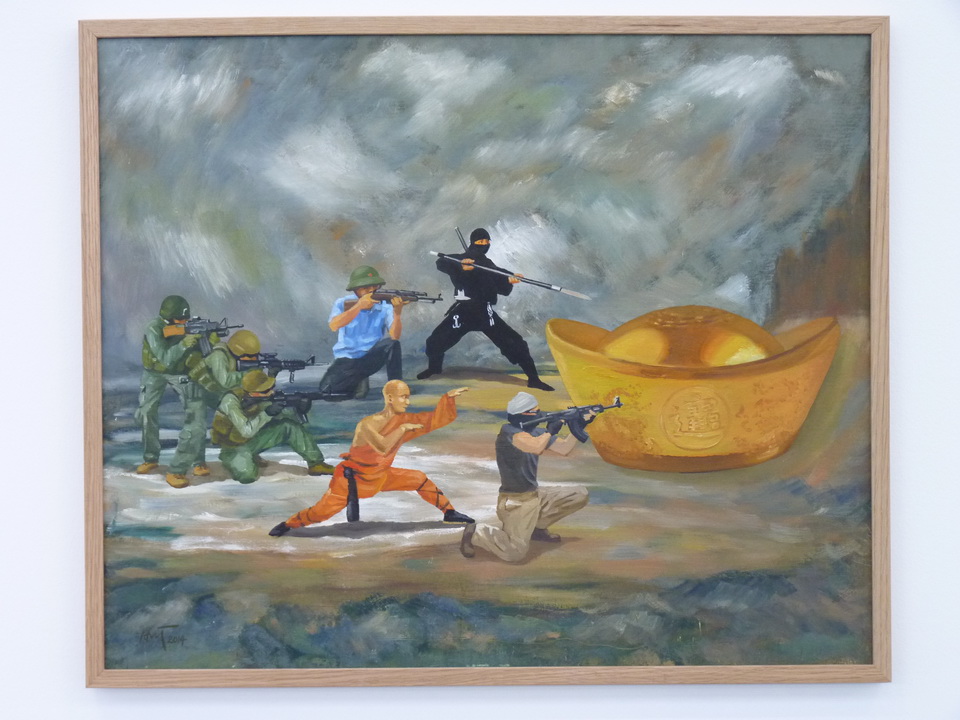
"Common Enemy" 2014 Oil painting
Venue: Mac/Val Museum | Dates: June 14 – September 21 | Text & Photos: Chen Chi-Hsiang
Nguyen Manh Hung (b. 1976) is a new-generation Vietnamese artist specializing in painting and sculpture, a graduate of the Hanoi University of Fine Arts, living and working in Ho Chi Minh City. Invited by the Mac/Val Museum to Paris for a residency during this year’s France-Vietnam Year, he was born during the Vietnam War; his father was a pilot, sparking a particular interest in aircraft. His work references war, connecting through Vietnam’s shared historical consciousness. His art revolves around local memories, stories, and daily life elements, revealing a unique local emotion and atmosphere, rich in literary and anecdotal qualities.
How to paint? What to paint? Nguyen Manh Hung’s paintings are distinctive; he often borrows existing images, leveraging their content to construct his expression. His series “Lang Du Adventure” (eighteen works), created during his residency at the Mac/Val Museum in Paris, derives from flea markets or clearance sales around Paris. These export paintings or amateur oil paintings feature heavily decorative natural landscapes with mass culture imagery—dreamlike natural scenery, more precisely phantoms of European landscapes, representing an idealized, comfortable lifestyle.
Nguyen Manh Hung constructs scenarios based on these scenes: bright villages, forests, lakesides, seascapes, and other stereotypical images of happiness. Referencing Surrealism, he paints fully armed soldiers, police, or samurai within tranquil landscapes, introducing a sudden crisis tension. He mixes and juxtaposes innocent civilians to create ironic and threatening situations, or alters the scale of the paintings to present the absurdity of daily life. Each painting bears a title below it, referencing its connotations and consciousness:
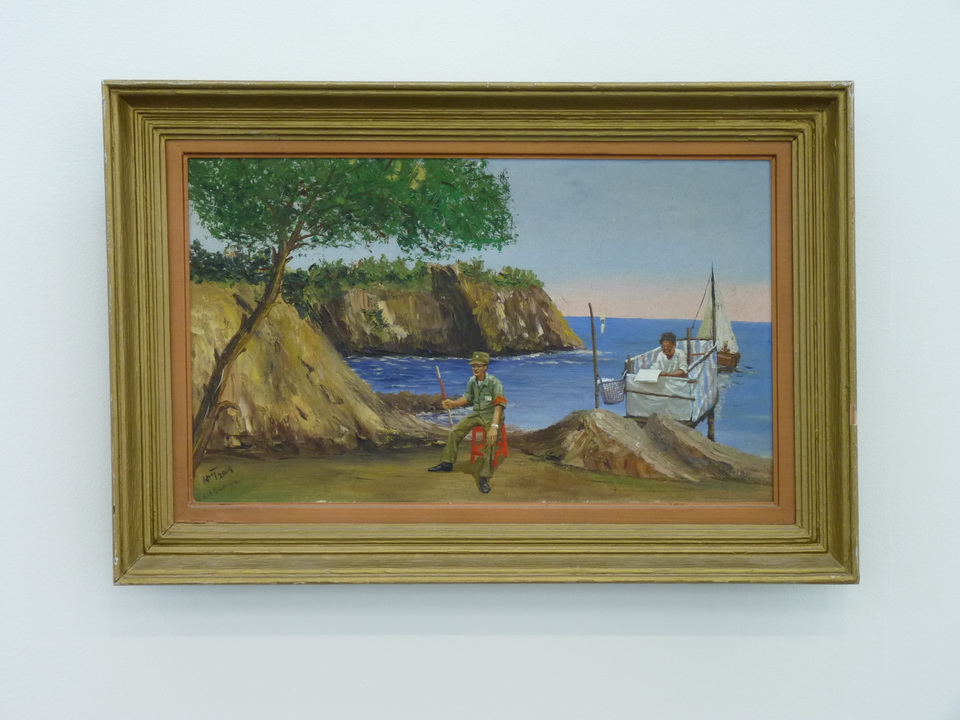
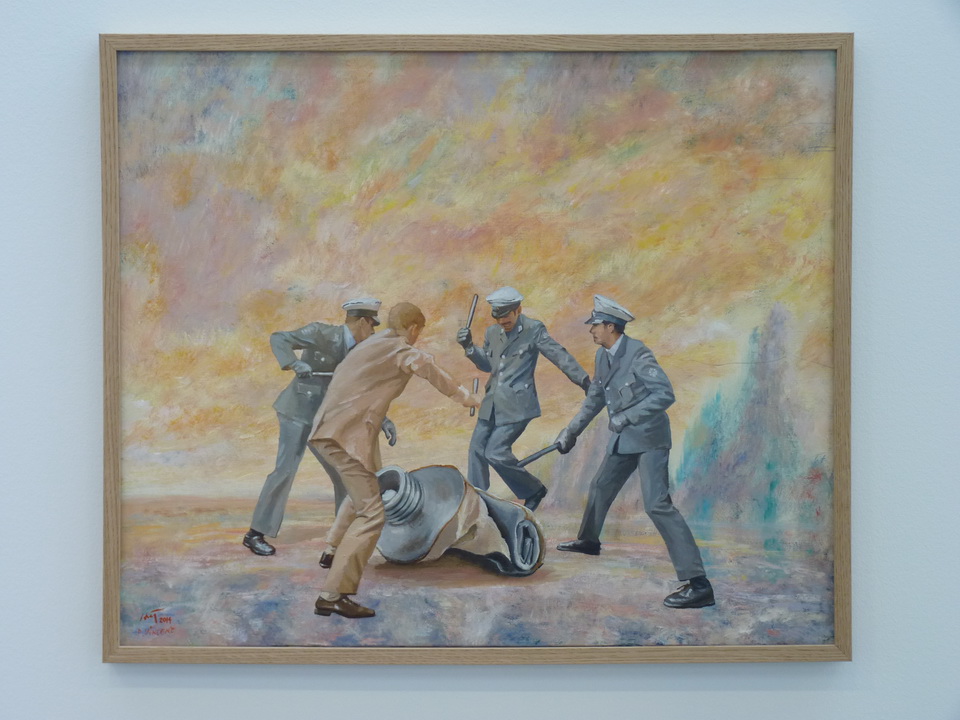
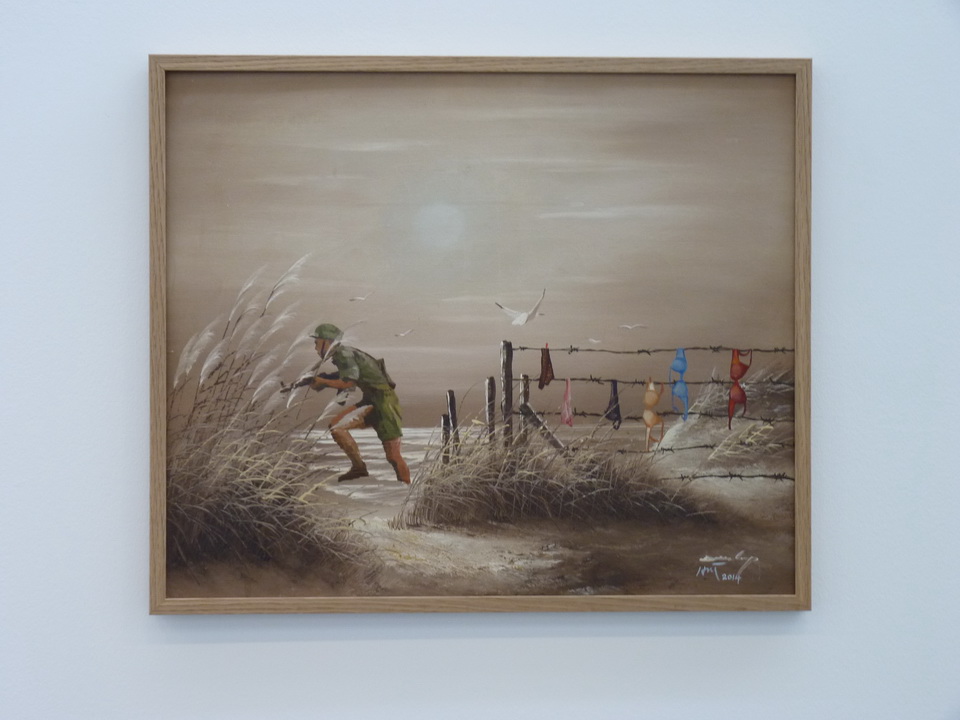
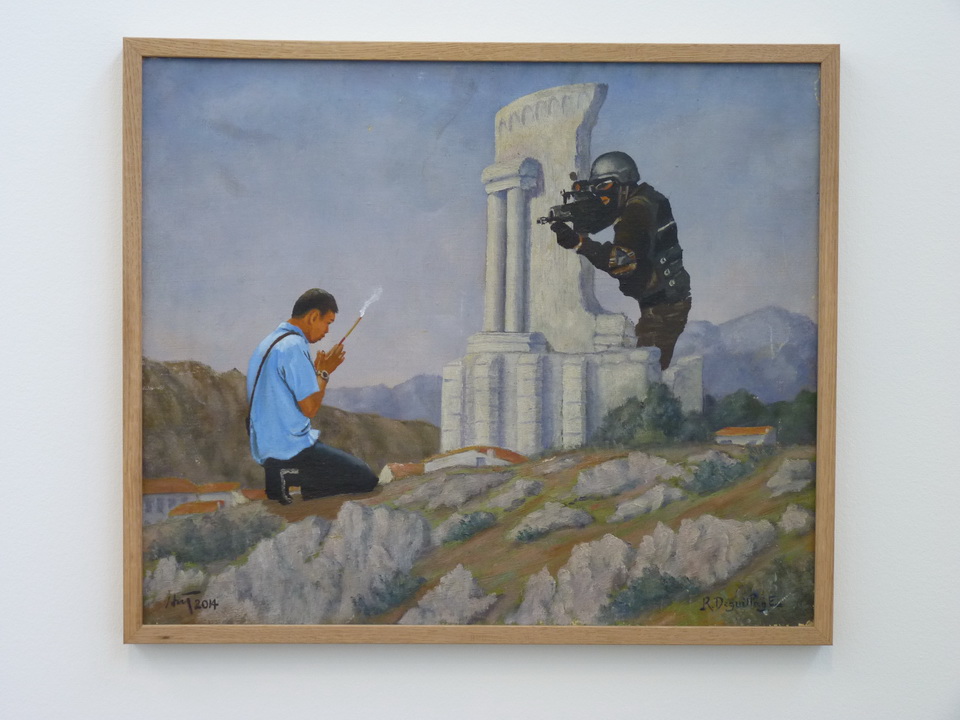
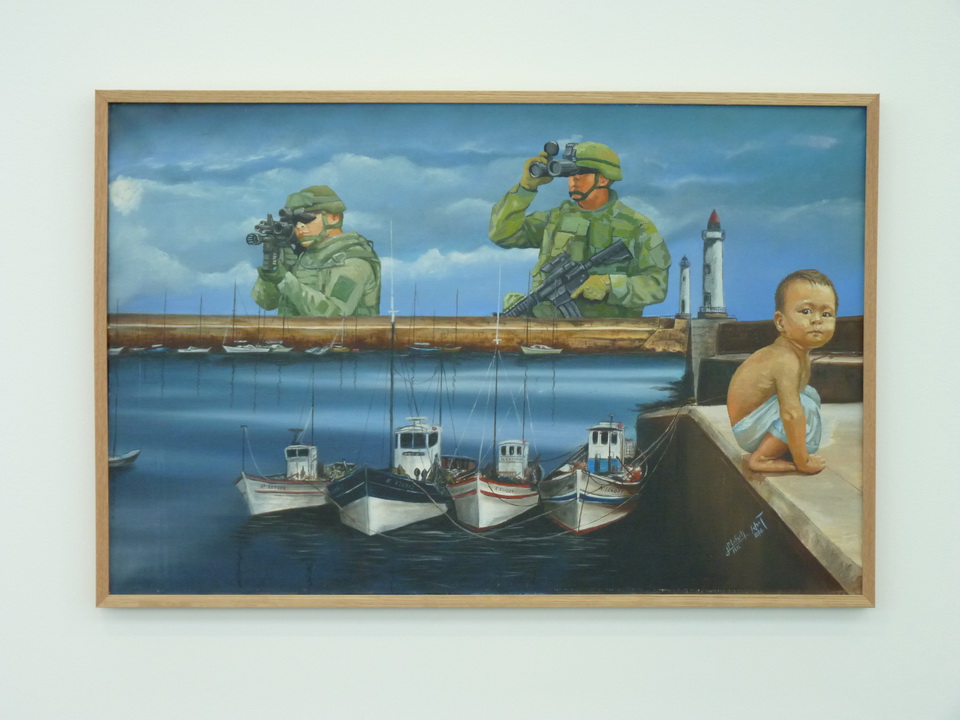
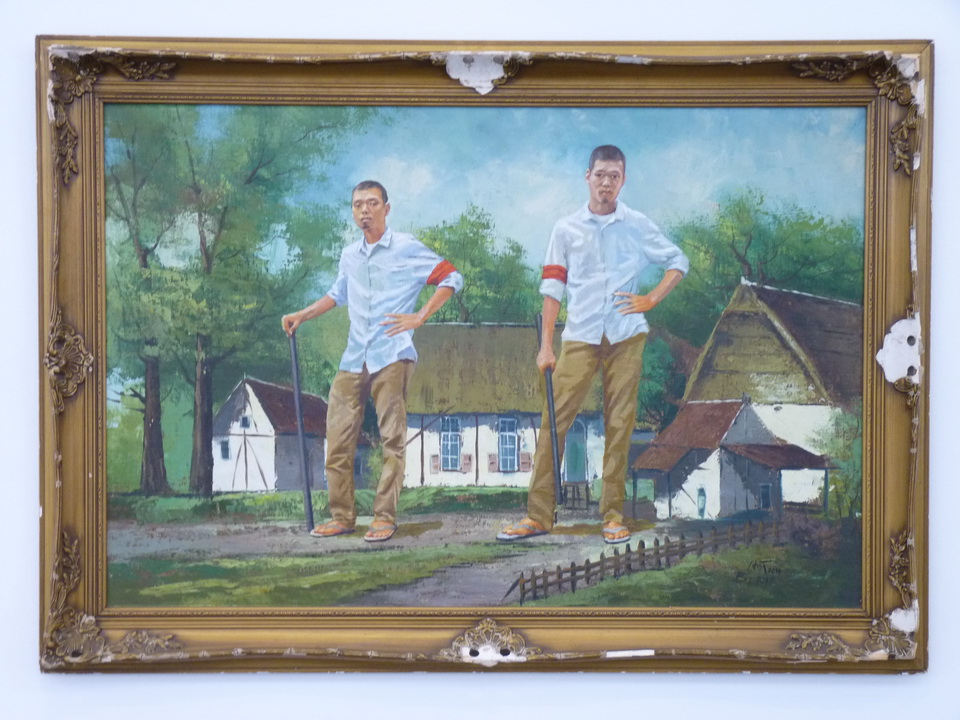
In “Haiphong,” a soldier holding a long stick sits by a poetic coastline—is he preventing illegal immigration or guarding the coast? In “Bad Painting,” four military and police figures surround a scene of oil-paint whipping torture. In “In Front of the Church,” five Shaolin Kung Fu masters practice martial arts before a traditional church. In the humorous “Iron Wire,” a soldier emerges from the sea with a gun on a beach hung with colorful women’s underwear and barbed wire. In the satirical “Throwing Garbage,” an American bomber flies over a bright pastoral landscape carrying four large bags of trash. In “Prayer,” young people kneeling with incense face a sudden scene involving a pimp. In the metaphorical “Common Enemy,” fully armed soldiers, militia, Shaolin masters, masked samurai, and Arab pimps join forces against a large hoard of gold and silver treasures. In “Between Harbors,” two fully armed pimps crouch outside a lighthouse wall in a quiet fishing port, while an innocent child squats on the harbor embankment facing the audience. In “Defending the Manor,” two militia members holding wooden sticks stand in an European-style farm manor (representing the artist), indicating collective human consciousness. In “Rest,” a helicopter hovers over a picturesque lake where a fisherman wearing a conical hat casually fishes.
Nguyen Manh Hung employs metaphors for current territorial, cultural, and religious conflicts. The incongruous changes in categories and situations disturb the world and threaten Europe as well. Military and police monitor invisible enemies everywhere, ready to strike at any time, as clearly shown in “Between Harbors.” “Defending the Manor” presents the artist’s self-portrait in a protective posture, enlarging the figures like official propaganda posters, suggesting that defending the homeland is everyone’s responsibility and duty. “Throwing Garbage” or “Rest” intentionally critique military power. “In Front of the Church” seems to point out cultural conflicts and the situation brought about by tourism consumption culture. In the aftermath of the financial crisis, with national debts soaring, who benefits most? Under the greed of multinational corporations and international finance, transitioning from past military dictatorship to current financial dictatorship, driven solely by profit, where is the world heading? Who is the common enemy under that invisible hand? “Bad Painting” manifests the cultural situation, showing how artistic freedom of thought is disturbed and punished in such circumstances.