Niele Toroni - "Passing By" Solo Exhibition
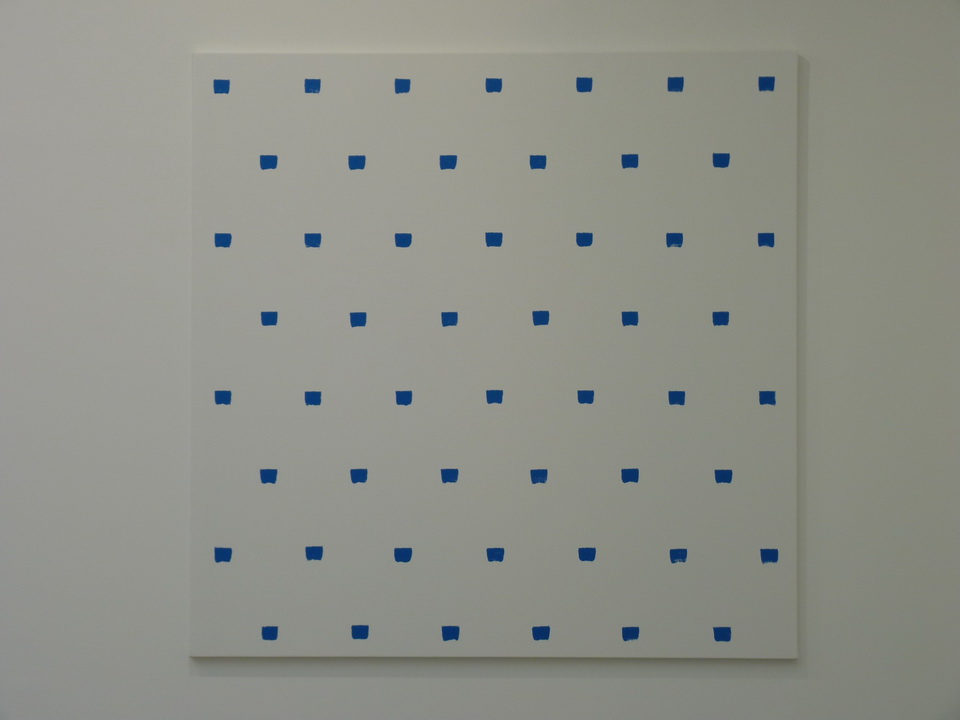
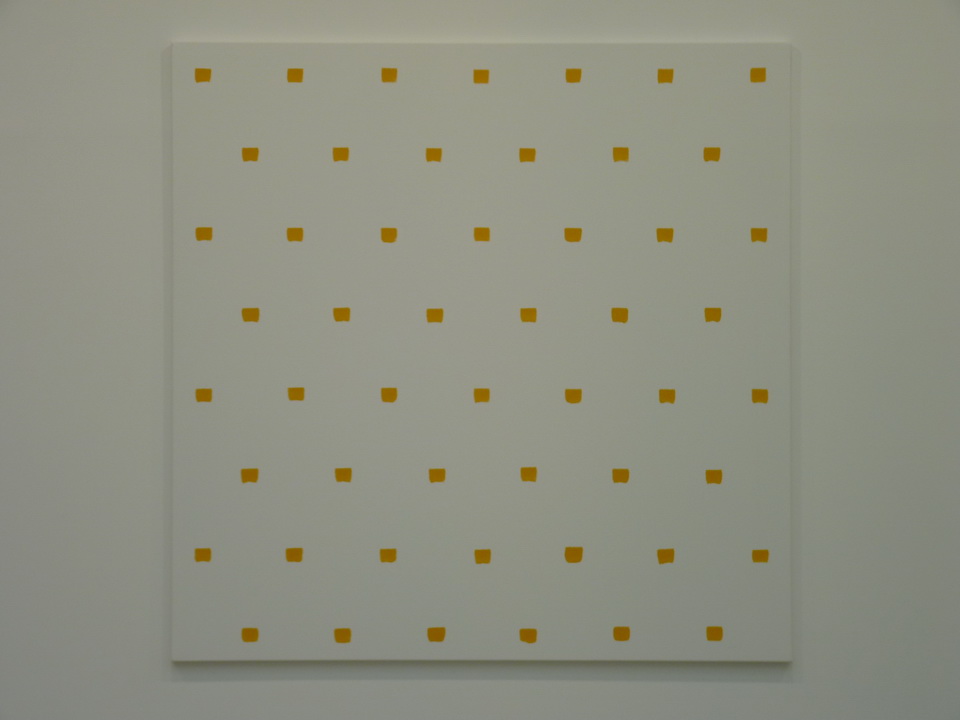
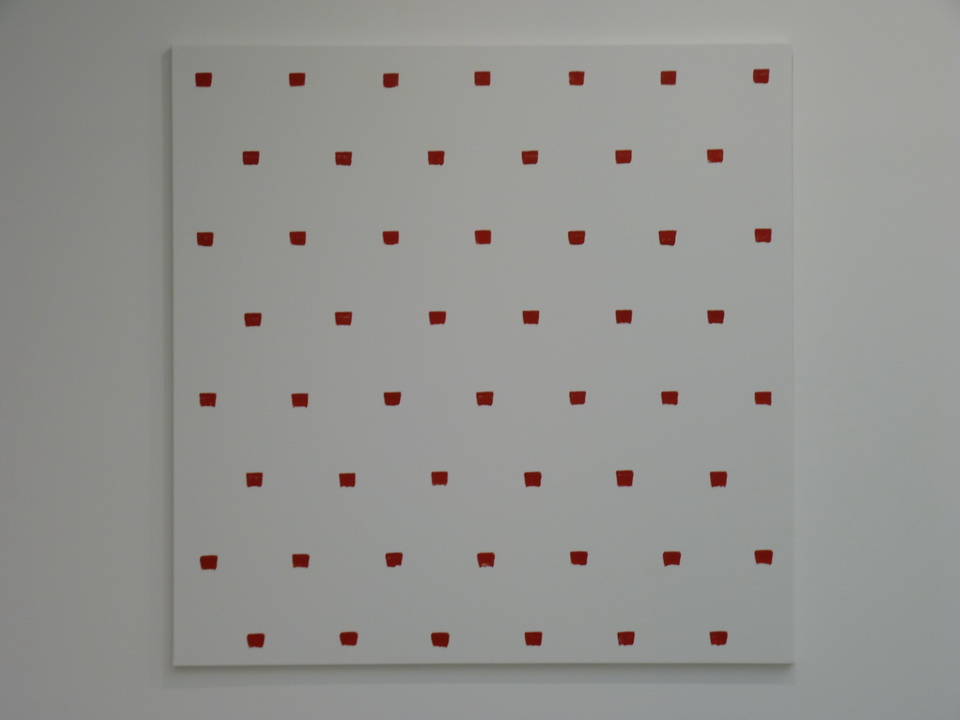
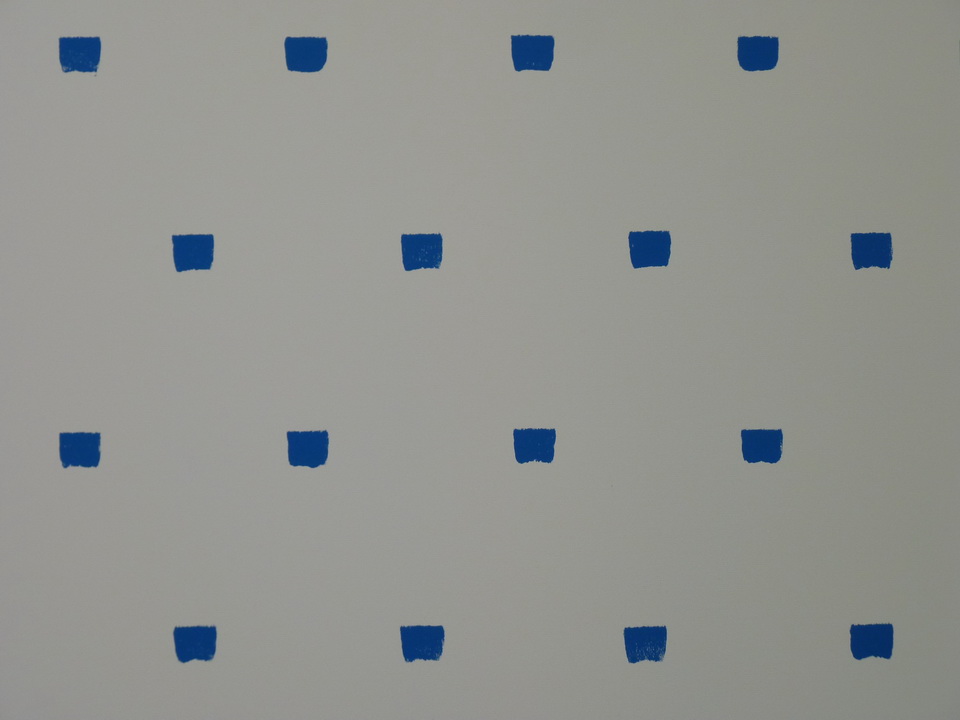
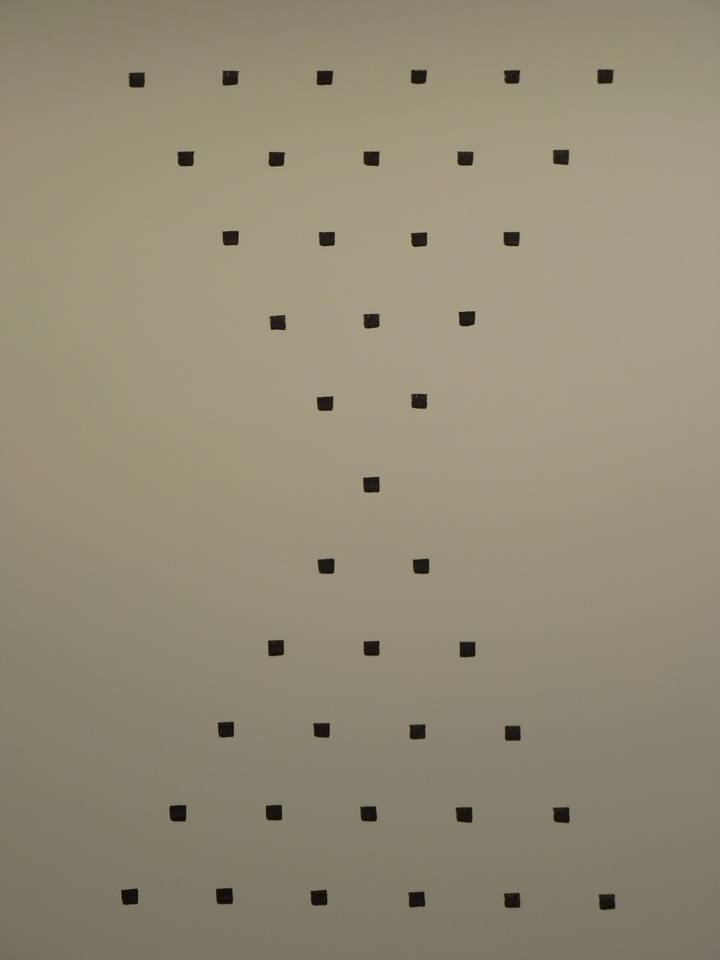
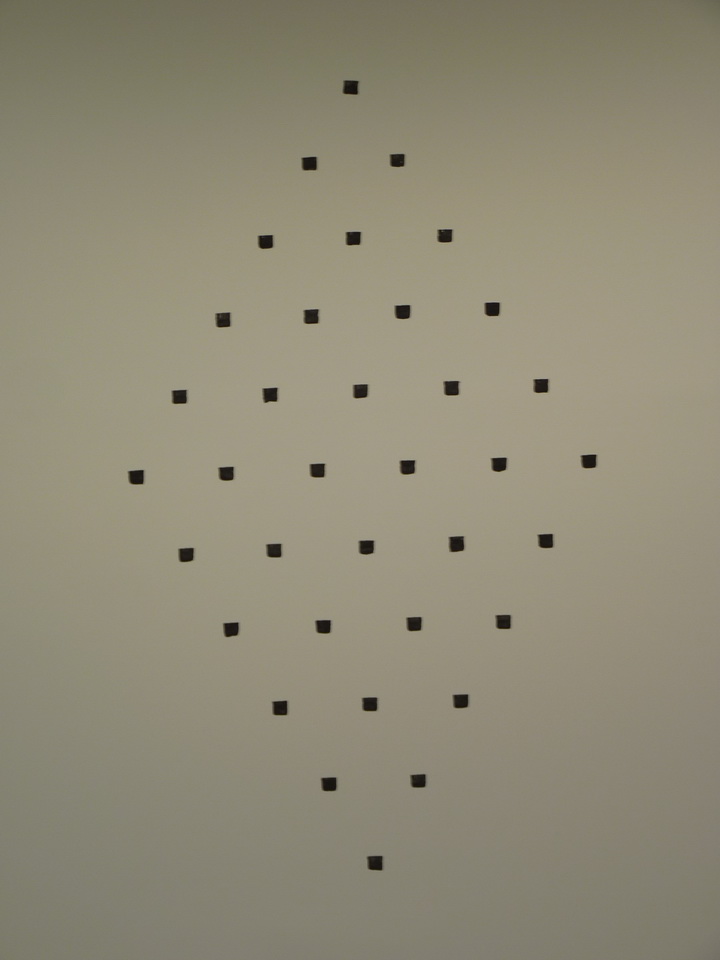
Using a No. 50 brush, on a white ground support, with one color, formulaically painting one stroke of blue at 30cm intervals. 200x200cm, 2016, Acrylic/Canvas.
Text/Photos by Chen Chi-Hsiang | Location: Marian Goodman Gallery, Paris | Dates: March 5 – April 16
Niele Toroni (born 1937) is one of the most internationally recognized artists in the French BMPT group, alongside Buren, and arguably the most radical and enigmatic figure of this movement. In the process of purification and reduction characteristic of Western modernist formalism, his work is among the most concise and minimal. American critic Benjamin H.D. Buchloh wrote: “In reductionism, if compared to Stella, Toroni exceeds by an additional degree” (Note 1). What is painting? What should it look like? Toroni seems to have a clear answer: painting is simply taking a brush dipped in paint and applying it to a support (such as paper or canvas). Is this behavior too traditional? Indeed. Does painting then seek a unique personal vocabulary, where style becomes the artist’s identity? Toroni first presented such radical works in 1965, not as a formal innovation, since Arman had already used stacks of homogeneous ready-mades, or Warhol image replication, earlier in the decade. It was in 1966 that Toroni established the charter for his lifelong practice, akin to the systematic conceptual art of the time: using a No. 50 brush, on a white ground support, with one color (e.g., black, dark blue), he formulaically paints one stroke at 30cm intervals, repeating this across the entire surface. When Donald Judd once said, “Ideal forms will not be organic, nor geometric,” could we say Toroni found idealized form (Note 2)? Despite all being rigorously reduced to the No. 50 brush, Toroni’s work has never been rigid; the image continues to define identity, space is quantified, and environmental space becomes the primary organizational element of each work. Toroni explains his use of the brush thus: “The brush is not an image or concept, but a hallucination of the brush. Yet what is satisfying is the real brush—a No. 50 brush” (Note 3), seemingly proving Matisse’s famous maxim: “I do not paint women, I paint a picture” (Note 4). Isn’t this to say that Toroni’s brush is also a picture?
Since then, Toroni has not changed, further affirming this form as his most significant vocabulary and artistic identity. He states regarding this work: “For me, there is no work intended to become mythological; it is an ‘ideal work’ within repetitive visual appearances; there is no mechanical repetition for the pleasure of repetition. It involves a method of critical work that is often effective and necessary; visible work here and now raises some questions (it becomes a question, and forms a question)” (Note 5). This unique form becomes the most neutral and objective painting, which can be painted in various colors (he chooses only one each time) on diverse supports: paper, canvas, wood, plywood, plastic sheets, glass, floor-to-ceiling windows, even walls or floors, depending on the exhibition space construction. Painting becomes an artistic act, tools become symbols, and through the artist’s rigorous management, in this lack of visual appeal, it is precisely what is meant to be seen. These brushes and formal arrangements have no reference other than themselves; the works have no expressive stance or meaning, and in their rigor, they are merely “painting.” The affirmation of all possibilities acts like anonymous activity; within repetitive mechanical images, Toroni interprets his work: “This work is made by Toroni, so! This work can be executed by anyone, who applies a system (30cm intervals), a No. 50 brush on a white (paper, plastic, wall, or canvas… etc.) ground” (Note 6).
Through Toroni’s subjective action and objective symbols, a comprehensive dialectic can depict states that are sometimes singular and special, or infinite diversities of the same thing, organic traits and mechanical objects, all revealing both personal and public anonymity. In 1985, Toroni held a solo exhibition titled “A Glance” at the ARC Museum of Modern Art of the City of Paris. Critic Henri Denizeau wrote: “The work must appear; even when it appears, showing that it is dead and that it is alive, it plays out its inherent disappearance. It is the only critical perspective, which is not excessive in aesthetics, (…) the appearance of the work plays out its disappearance. It is (…) the critical aspect. It does not belong to any aesthetic standard” (Note 7).
Note 1: 25 ans d'Art en France 1960-1985, published by Larousse, Paris, 1986, p. 157. Note 2: Benjamin H.D. Buchloh, Essais Historiques II Art Contemporain, published by Art Édition, Paris, 1992, p. 89. Note 3: Ibid., p. 86. Note 4: “Problematic 1970s Art,” Musée d’Art Contemporain de Bordeaux, 2003, p. 111. Note 5: Benjamin H.D. Buchloh, Essais Historiques II Art Contemporain, published by Art Édition, Paris, 1992, p. 82. Note 6: Ibid., p. 87. Note 7: “The Situation of French Art,” Artstudio No. 5, Summer 1987, p. 130.