The End of Niele Toroni’s Images: "Marking a Position" Solo Exhibition
Painting installation on wall. Size variable. 2009.
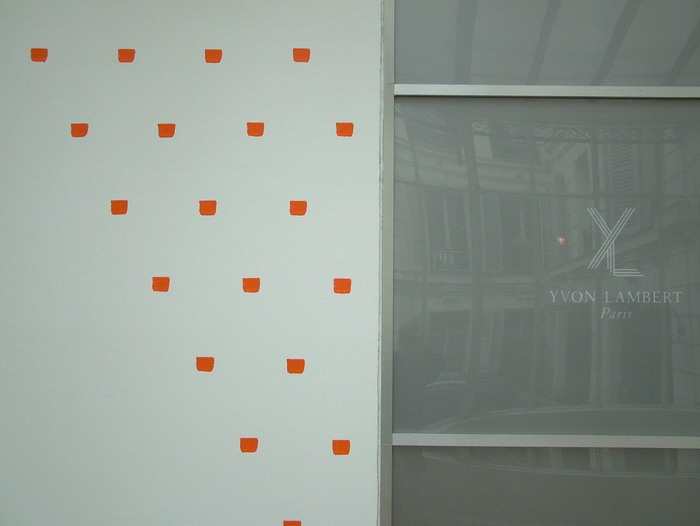
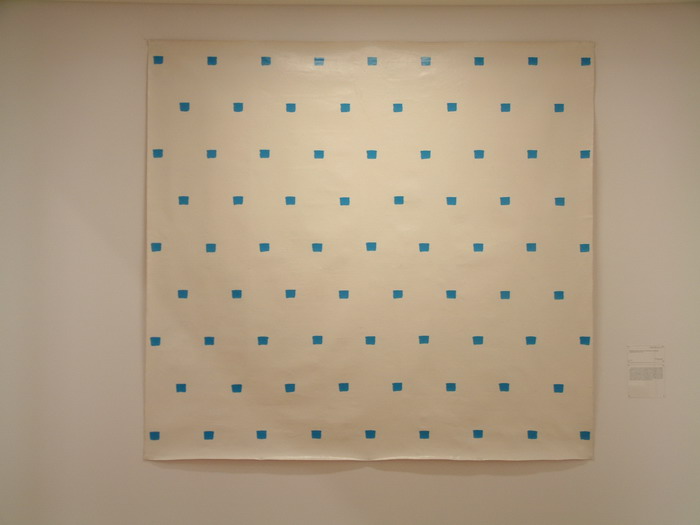
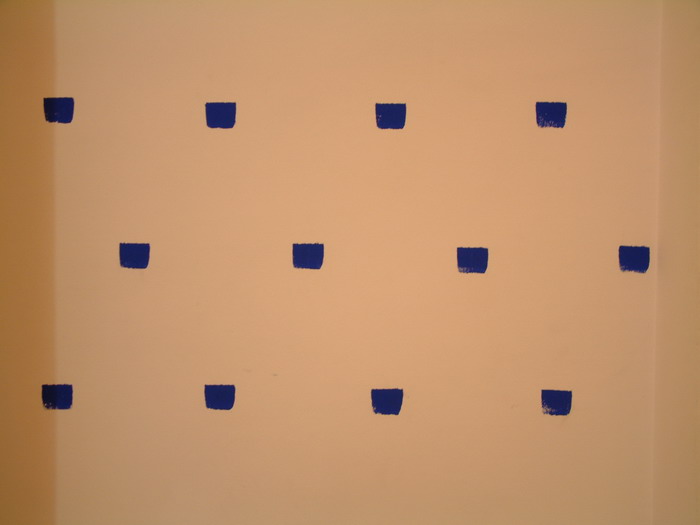
The solo exhibition "Marking a Position," featuring the end of Niele Toroni’s images, is on view from January 9 to February 7 at Yvon Lambert Gallery. This marks the 19th time the veteran artist has exhibited at this same gallery. He stubbornly persists in his unique stance, using an unchanging yet evolving form and context to repeatedly probe the infinite abyss of artistic possibility, pushing painting to its limits and exploring its absolute minimum within the dead ends of the medium, creating all possible possibilities.
As early as Duchamp, the impossibility of painting was proposed because, in contemporary society, painters have been replaced by pigments and cameras—essentially by machines. He mocked painters by having the bachelor no longer need to grind his own chocolate. When modernist painting was reduced to surface problems, how does one paint? Does painting become the problem? What is the essence of painting? By the early 1960s, painting seemed to be dying under asceticism. Is painting an act, an attitude, a mark/symbol, dialectical thought, or a painting that needs no further painting? American minimalist Sol LeWitt declared: “There are many ways to construct a work of art. One is according to the decision of each state. Another is to create a decisive system. This can be a method with certain organization, non-logical (chance) equally excellent to logic.” The French BMTP group affirmed systematic logic to determine a new artistic identity, ending imagery under distinctive mark symbols, forming iconic conceptual symbols that questioned painting, and explored its true face through radical behavioral attitudes. They exhibited together seven times; the art team, which dissolved less than a year after its founding, was like a fleeting flower, yet left ripples for the radical artistic explorations of the 1970s.
The BMPT group was an avant-garde art movement that emerged in France in the mid-1960s, one of the most radical art groups following New Realism. It was founded on December 24, 1966, by four artists: Daniel Buren, Olivier Mosset, Michel Parmentier, and Niele Toroni, named after the capital letters of their surnames “BMPT.” They re-appropriated the experience of American formalist painting from political and sociological perspectives. Their exploration clearly targeted the critique of traditional image-based painting; this subversive thinking overturned existing norms and rethought the totality of painting (the act of painting, expression, and support), clearly recorded in the realms of conceptual and minimal art.
Niele Toroni (born 1937) is one of the most internationally recognized artists in the French BMPT group, alongside Daniel Buren, and arguably the most radical and magical figure of the movement. In the process of Western modernist purification and reduction of form, his works are the most concise and minimal. American critic Benjamin Buchloh wrote: “In reductionism, compared to Stella, Toroni exceeds by one level.” So what is painting? What should it look like? Toroni seems to know this clearly: painting is simply taking a brush, dipping it in color, and applying it to a support (such as drawing paper or canvas); leaving the trace of the brushstroke is the painting. The act of painting surpasses its finished product! Indeed, does painting seek a unique personal vocabulary, where style becomes the artist’s identity authentication? Toroni first appeared with such radical works in 1965. At that time, it was not a formal innovation, as Arman had already piled homogeneous readymades in the early 1960s, or Warhol similarly repeated and copied images. It was not until 1966 that Toroni established the charter for his lifelong creation, akin to the systematic conceptual art of the time: using a No. 50 brush, on a white support, using one color (e.g., black, dark blue), painting one stroke at a standardized interval of 30 cm, repeating this across the entire surface. The artist said: “Since 1967 I have begun to play the role of painter; I offer viewers the assistance of a No. 50 brush, with strokes every 30 cm. This has never been the same thing.”
For 43 years, Toroni has practiced this idealistic creation without interruption, managing the act of “painting.” He willingly assumes this so-called “zero degree of painting.” The basic action produces the result of the work: naturally, concept carries everything, surpassing purpose-expression. Toroni calls this technique “working painting.” Naturally, his works involve every background; he seeks to highlight the visibility of painting “here and now.” Immediate acts transform locations and provide viewers with a work that is continuously renewed again and again through audience perception. The artist humorously stated: “The bristles of the brush (the main part of the painting!) are applied to the surface to leave traces of assistance. This is work, and this is also painting.”