Noel Dolla "Traversing the Breeze" Retrospective
Temporary Jealousy no-1 object installation painting 294x304x55 cm 2000

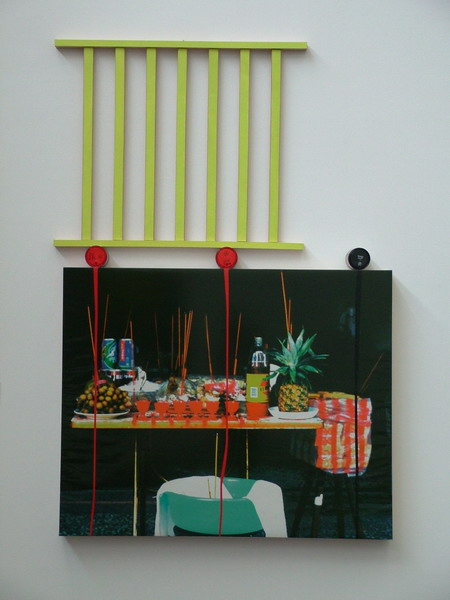
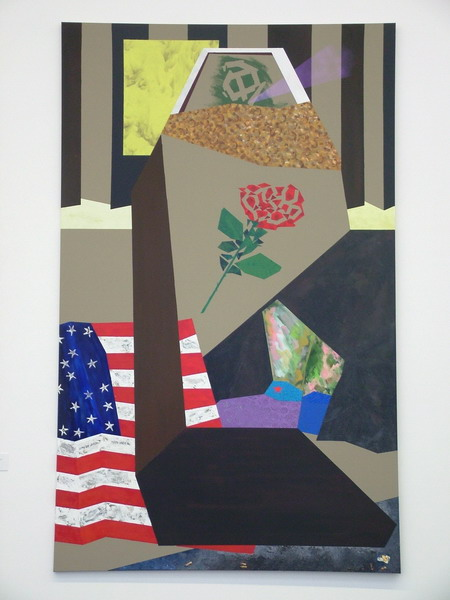
Text and images / Chen Chi-Hsiang. Time: March 7 to August 2. Venue: Val de Marne Museum of Contemporary Art.
Noel Dolla (born 1945) is one of the most representative artists of the French Supports/Surfaces movement. He affirmed deconstructionism early on, rejecting all traditional painting practices, dismantling the painting like a perceptual material object, participating in the dialectic of the material world and the limits of the Supports/Surfaces painting product. Remarkably, the young Dolla expressed himself so resolutely as early as 1967 in the work Clothesline Structure, where he dyed kitchen hand towels and presented them as a work, hanging them on a white clothesline, displayed like laundry, establishing itself within the charter of object-painting.
In the 70s, when Mosset affirmed the single parallel line, Dolla reduced his form to the dot, because this homogeneous dot could be repeated and easily become a whole. The 1971 work Red Cloth Roll featured large red cloth strips with intervals filled with vertical and parallel black dots (three each), hanging from the wall to the floor, with another half-rolled up. Another work, the white support Woven Net Cloth Roll, arranged red dots at intervals, resembling the form of a Chinese vertical scroll landscape painting, clearly questioning painting and emphasizing the relationship between material form and emptiness. Among the superficial, frontal, object-based, visible, and imaginary, what are the conditions of painting? Is it painting itself? Within the charter of painting-object, Dolla said: "To manifest the idea of the picture as the site of pictorial genius" (Note 1).
Thus! Through the soft properties of the material, taking shape according to the spatial site, meaning it does not necessarily have to rely on wall installation; the work can be freely suspended, or spread flat on the ground, or displayed as a full roll. The Supports/Surfaces movement most evidently questions the support; it can be read like an area. Dolla's most representative work in 1971 is the Hand Towels and Traces series, which extends the concept of the clothesline structure. On each towel, divided by two red vertical lines, black and red dots are marked with a round charcoal stick dipped in color, or square dot traces are imprinted using a chair leg, all constructed through effective combinations, like printed fabric patterns, within a neutral, perfect trace, returning to the exploration of traditional plastic arts.
Another work, Square Wooden Post and Round Wooden Pestle, is a three-dimensional sculpture stemming from the development of the cloth roll series, with large and small round wooden pestles inserted vertically and parallel into a square wooden post, approaching the work of Cane, situated between the exploration of painting-object-sculpture.
From 1973 onwards, appearing until 1975, is the Cross Shape series. On four canvases of the same form, the same shape, such as an "L", is (dyed) along the edge lines, then sewn together to form one painting. This series explores color, sometimes as an entire color field like the 1973 work, sometimes as color lines like works from around 1975. For Dolla, the question of color is like the dot as an organizational element of the picture. The artist explained: "The conception of that painting in June 1973 was to construct, via sewing, three squares dyed different colors. This work then led to constructing four squares, thus generating the cross shape" (Note 2). This return to color raises the question of ground and form, yet Dolla re-establishes something close to pictorial tradition without abandoning the intent to deconstruct the picture.
From the 90s onwards, he expanded his creative vision into a diverse exploration: object, concept, painting, etc., within the intent to construct and deconstruct the pictorial.
Note 1: Supports/Surfaces Galerie nationale du Jeu de Paume 1998 publication P 84. Note 2: Saint-Étienne Museum of Modern Art collection catalog 2000 publication P167.