On Kawara "One Million Years"
(Fig. 1) Neatly ordered number books. (Fig. 2, left) One of the One Million Years-Future series books. (Fig. 2, right) One of the One Million Years-Past series books. (Fig. 3) On Kawara's most iconic date paintings.
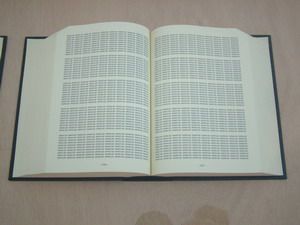
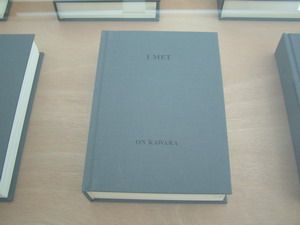
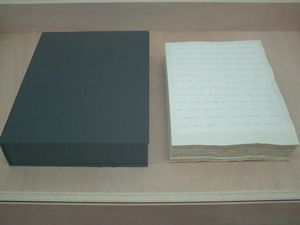
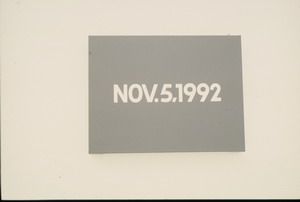
(Fig. 1) Neatly ordered number books. (Fig. 2, left) One of the One Million Years-Future series books. (Fig. 2, right) One of the One Million Years-Past series books. (Fig. 3) On Kawara's most iconic date paintings. On Kawara's solo exhibition "One Million Years-Future" was on display from September 8 to October 13 at In situ Fabienne leclerc gallery. The gallery in District 13 has declined; one by one they have moved back to the city center, leaving only a few remaining. In situ Fabienne leclerc is also moving to 6 rue du Pont de Lodi in Paris's Sixth Arrondissement. Clearly, these apartment-style galleries are seeking development due to space issues. It was a pleasure to visit On Kawara's recent major work "One Million Years-Future." The series of books (printed with the title and author's name, laid open for reference like a diary marking dates or presenting infinite numbers) were displayed in glass cabinets. Under the premise that concept outweighs visual form, one could grasp the meaning of time and space.
On Kawara (born 1933), an American-Japanese artist, is one of the most distinctive figures in conceptual art. He transformed time into painting through his conceptual approach, displaying, recording, and continuously marking his most famous "Date Paintings" series. This series began on January 4, 1966, in his studio on East 13th Street, New York. Painted on canvases ranging from 20.5 cm × 22.5 cm (the most common size) to 155 cm × 225 cm, he wrote the language of the country where he resided in white, complete sans-serif typeface against a monochrome background. Initially using red or sky blue backgrounds, later works generally used darker colors close to black, gray-brown, gray-green, or deep blue. The Date Paintings had to be completed on the day itself. As abstract temporal measures, they attempted to capture the progression of time and interpret the temporality of life. These Date Paintings could stand alone or be combined into paper boxes of various sizes containing that day's news or clippings. Thus, the Date Paintings became records of the artist's spatiotemporal state of existence and even manifestations of political and social trends.
In 1964, in the "I Read" series, he pasted that day's news with dates, anticipating the arrival of the Date Paintings. In 1965, in the "Locations" series, he wrote the longitude and latitude of his geographical location on monochrome paintings, further predicting the characteristics of the Date Paintings. From 1966 to 1979, besides the Date Paintings and news clippings, he explored multiple facets. In 1968, in the "I Met" series, he recorded the names of people he met that day using textual language, indicating the traces of his daily movements. Simultaneously, he created the "I got up" series, using landscape postcards mailed to friends from his place of residence; the postmarks clearly recorded the sending location and date. Another series, "I am Still Alive," conveyed information about the artist within the plastic arts society via telegrams, serving as a record of existence. These explorations all fell within the realm of linguistic forms, emphasizing the intimate relationship between art and life, utilizing information systems to measure volume in time and space.
Between 1970 and 1980, Kawara systematically wrote (using a typewriter) about human life geography and intermittent tenses over a million years, in two major book series: "One Million Years-Past" and "One Million Years-Future" (consisting of more than twenty large volumes). These recorded the spatiotemporal conditions of the "past" and "future." Under the artist's almost compulsive will, this manifested a will to live, affirming that time is like an eternal challenge.