Pablo Picasso - The Blue Period
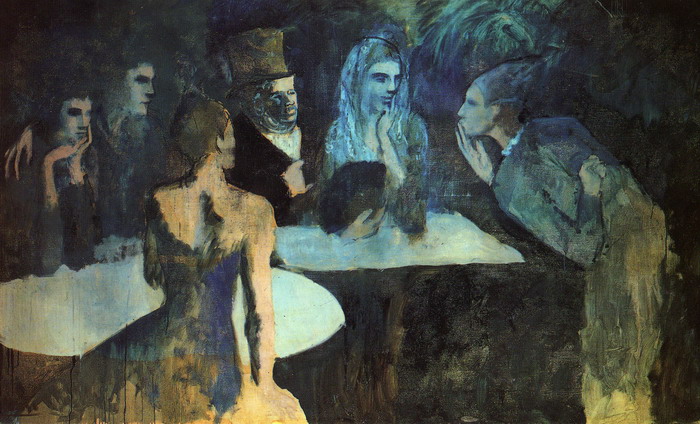
Picasso Pierrette's Wedding 115x195cm 1905 Private Collection, Japan
"I am not imitating nature, I am creating it." - Picasso
In our era, no artist is more famous or more representative than Pablo Picasso (1881–1973). In the modern art of the 20th century, Picasso was a reformer; his works, full of imagination, often showed a defiance of "beauty" amidst contradiction. The progression from Realism → Blue Period → Rose Period → Cubism → Analytical Cubism → Neoclassicism → Surrealism + Cubism → Eclecticism → Mannerism → Baroque reveals the transformative process of his lifelong artistic achievement. Picasso was a rare genius in modern art history; any concept, filtered through his acute mind, was transformed into a new style, and any material, handled by his skillful hands, became art. Picasso's art was diverse, multifaceted, and multi-genred; thus, he was a painter, draftsman, sculptor, printmaker, and illustrator.
Picasso was romantic and naive by nature, a great lover unbound by traditional morality. Each artistic phase was related to "love." Like a bullfighter in the bullring, if there was no bull, then in each affair he pursued (each time he changed studios), a new facet of his painting emerged. This was unprecedented in art history.
The Blue Period
Picasso's father was a painting professor, while he himself became the most famous artist of the 20th century. In 1900, he arrived in Paris; early on, he was influenced by the Montmartre painters (especially Toulouse-Lautrec). Picasso's works depicting the cafés and nightclubs around Montmartre were all painted in a blue tone. Picasso said: "It was thinking of Casagemas's death that made me start painting in blue." Dim, sorrowful, with a sense of mystery and youthful sentimentality (of course, if one looks at the 500-year tradition of Spanish painting, one can find his predecessor El Greco's system of blue-toned painting), this was Picasso's Blue Period (1901–1904). Among his more famous works from this time are Self-Portrait (1901), La Vie (1903), Celestina (1903), Woman with a Cherry Mouth (1904), and others.