Gauguin (Paul Gauguin) "The Yellow Christ"
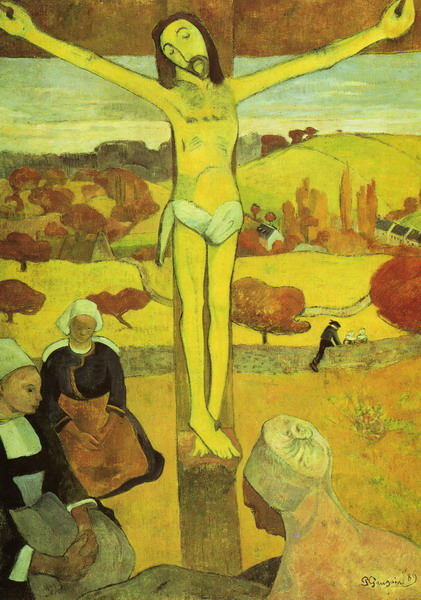
"The Yellow Christ," 92×73 cm, 1889. Collection of the Buffalo Art Gallery.
Paul Gauguin (1848–1903) is one of the legendary representative painters of French Post-Impressionism. If Monet is famous for Giverny and Cézanne guarded his hometown’s "Sainte-Victoire Mountain" in Provence, then Gauguin made the primitive world of France’s overseas island possession, Tahiti, his artistic realm. Like Van Gogh, who was "the man no one ever understood," Gauguin lived a life of poverty. He once worked as an apprentice sailor and a stockbroker. In 1873, he married a Danish woman and met Pissarro and Degas that same year; influenced by his painter friends, he began to turn toward painting art. He had five children. In 1883, during a stock market downturn, he resigned from his job. Under financial strain, his wife took their children back to their hometown in Copenhagen. After participating in the Fourth Impressionist Exhibition in 1886, he went to Pont-Aven in Brittany, eastern France, where he met Émile Bernard (with whom he published "Synthetism" two years later). That same year, he met his fellow sufferer Van Gogh in Paris. The following year, seeking a livelihood, he began wandering, going to Panama in South America and Martinique, a French territory. There, he contracted a severe fever before returning to France.
In 1888, he again went to the Brittany he longed for—rich in humanistic customs and characteristics—to seek creative inspiration. It was during this period that he began to establish his personal style, breaking the conventions of Impressionism through subjectivity, flattening, and color fields under symbolism. For example, in works like Jacob Wrestling with the Angel, he accepted Van Gogh’s invitation in the same year to create in Arles, Provence, southern France, but they fell out after two months. Between 1889 and 1890, he frequently traveled between Brittany in eastern France to participate in the activities of the Pont-Aven School. Like his painter friends, Gauguin was deeply influenced by Japanese ukiyo-e prints. His painting features are characterized by extracting symbolism, simplifying forms, and expressing emotions through color planes, attempting to reveal the essence and mystery of primitivism. Thus, in 1891, at the suggestion of Symbolist painter Madame Rouart, he left civilization behind to come to the primitive Eden of Europeans—Tahiti, attempting to explore the true face of primitivism. In this Tahiti series, he liberated painting form and color, boldly applying flat colors under subjective consciousness. The colors became more brilliant and flat, archaic and simple, returning to the primitive, with coexistence of decorative, symbolic, and metaphorical qualities. Gauguin believed: "Regarding our feelings, color itself is a mystery, all of it is incredible."
A year later, suffering from poverty and physical discomfort, he brought his hopeful new works from Tahiti back to the capital, Paris, for exhibition, but did not achieve the results he imagined, becoming even more destitute and uneasy. In 1895, despite having little economic foundation due to disappointment, Gauguin decided to travel across the ocean again, returning to the pure land of humanity—the primitive paradise of Tahiti. In 1897, after the death of his daughter and accumulating numerous material and spiritual problems, he attempted suicide the following year. Finally, in 1903, amidst extreme poverty, he passed away in May on the island of Hiva Oa, like a radiant comet streaking across the vast sky of the modern art universe.
Yellow makes people fantasize, yellow jokes are hilarious, yellow pictures are sensational. But is Gauguin's "Yellow Christ" infinitely humble or does it hold another metaphor? "The Yellow Christ" is a masterpiece created by Gauguin while in Brittany. During his wanderings and subsequent disillusionment upon returning to France, he created a series of sacred religious paintings, such as Jacob Wrestling with the Angel (1888), The Green Christ (1889), and Christ in the Garden of Olives. Under symbolism, subjectivity, simplification, flattening, and color fields, color becomes image and light. These themes metaphorically represent the artist's inner struggle and predicament of resurrection. Painting becomes the most direct interface of the artist's life. Therefore, it is noteworthy that these Christs are presented in Gauguin's own image (look at this Christ's face). Human suffering and hardship are like Jesus Christ on the cross; everyone carries their own heavy cross.
"The Yellow Christ" is set in the hilly countryside of Brittany, filled with energy and light in a dominant yellow tone. The Lord Jesus is nailed to the cross, surrounded below by Breton women in traditional clothing, kneeling devoutly in prayer. This scene exudes a quiet and mysterious atmosphere. Within its rigorous structure, patterns, flattened forms, and decorative and symbolic color planes (bearing traces of Japanese woodblock prints), it creates a unique modernist new face for Gauguin.