Gauguin (Paul Gauguin) "Mahana no atua (Sun God)"
"Mahana no atua (Sun God)" 70×90.5 cm, 1894, held at the Art Institute of Chicago. Gauguin's first trip to Tahiti lasted only about a year and a half, marking the most important creative peak of his life.
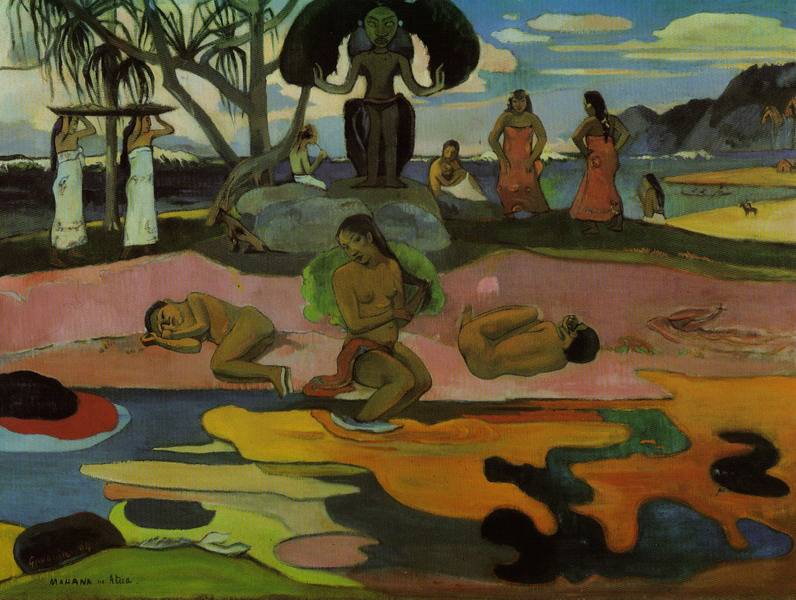
"Mahana no atua (Sun God)" 70×90.5 cm, 1894, held at the Art Institute of Chicago. Gauguin's first trip to Tahiti lasted only about a year and a half, representing the most significant creative peak of his life. Despite poverty without financial support and poor health, he returned to Paris with high hopes to exhibit his new works from Tahiti, but they did not achieve the results he had imagined, making him even more destitute and uneasy. In this complex situation of unfulfilled ambitions, he continued in Paris to complete this extraordinary religious painting, Mahana no atua (Sun God), to comfort his turbulent state of mind. Clearly, Tahiti soothed Gauguin's soul and liberated his artistic creation. Through Mahana no atua (Sun God), one can understand the context of Gauguin's life; starting from this painting, Gauguin began to delve into his inner self to seek the meaning and essence of existence, as evidenced by his most famous work, "Where Do We Come From? What Are We? Where Are We Going?" The Sun God interprets ancient Tahitian mythology through an imagined world of harmony and perfection in the primitive Tahitian world. In this primitive, serene, and imaginative landscape, under blue skies and white clouds, along the azure coastline and rolling hills, three mysterious nude women appear on the foreground hill. One sits in the center with her feet immersed in colorful, dreamlike seawater, while two others on either side huddle their bodies tightly. Behind them stands a solemn and sacred Sun God (resembling a stone statue) on a rock. To the left are two women carrying offerings and a flute player; to the right are two women playing and a pair of lovers in love, along with the continuous coastline. Within the strict symmetrical pyramid structure and extraordinary colorful, dreamlike hues, a poetic and picturesque presentation of a metaphysical world emerges, which was the paradise Gauguin longed for.