Giuseppe Penone at the Palace of Versailles
Exhibition signage for Giuseppe Penone at the Palace of Versailles
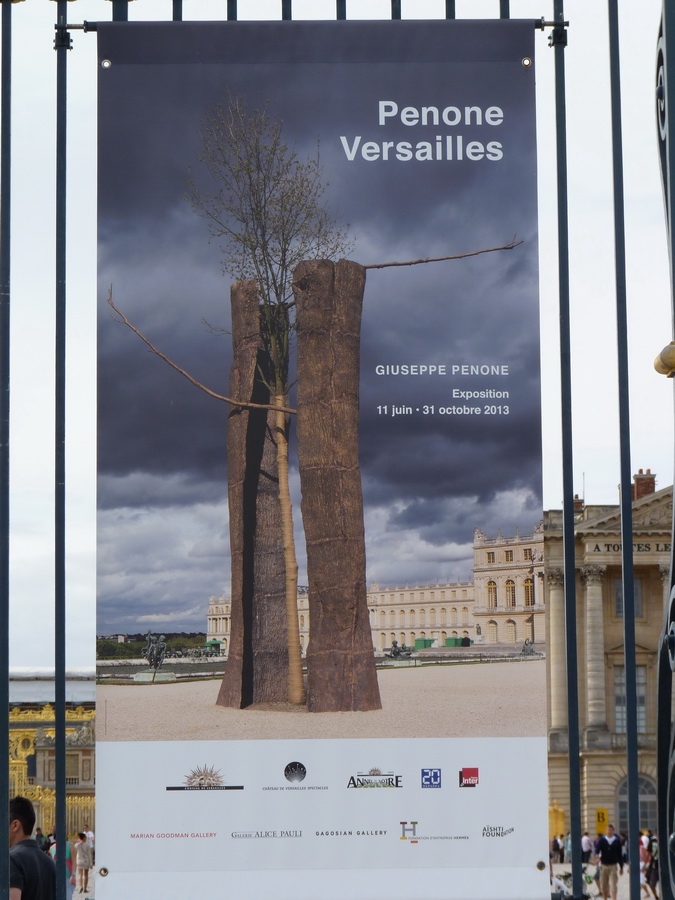
Dates: June 11 to October 31. Location: Palace of Versailles and Gardens. Text and images by Chen Chi-Hsiang. Giuseppe Penone (born 1947) is one of the most representative artists of Italian Arte Povera, and the youngest in the movement. Exploring the intimate relationship between nature and humanity through a performative creative process, he presents causality via chance within autobiographical and anthropomorphic plant forms. He questions artistic conventions and the mutual influence between humans and their environment, debating the space between nature and culture. After graduating from the Academy of Fine Arts in Turin, he actively participated in the Arte Povera initiatives promoted by Germano Celant. Having spent a happy childhood in the countryside near Turin, it is no surprise that this young artist naturally chose to explore rural natural aesthetics instinctively, affirming early on that his art creation lies between nature and humanities.
Amidst the turbulent political and economic climate of 1968, the young Penone calmly faced nature to create the groundbreaking photographic work Beyond This Point It Continues to Grow. Resembling the emerging Land Art of the time, Penone described the work: "I nailed a nail into the trunk of a small shrub, covered by wire mesh; the tree will climb the mesh as it grows. Or I carved my human silhouette with iron nails on a tree trunk; when the tree grows taller, it enhances my behavioral memory." Alternatively, he inserted cast iron hand sculptures directly into young trunks; over time, the trees leave straight traces of the inserted objects, truly responding to human participation in plant aesthetics. Time becomes the tool of the work, belonging to tradition like a primary element. "Trees" became the core of Penone's creation.
In 1968 (at age 22), utilizing the transformation of natural symbols, he presented the striking work One Hour Seeing It in the 22nd Year of Life. Here, not only the tree's age is established but also the artist's own age, resembling an autobiographical metaphor. From a square beam, he carved branch nodes following the tree rings until finding the ring corresponding to the tree's twenty-second year, perfectly presenting visible traces of concrete time. Time became the core of Penone's exploration; even in the 1990s series Time Structures, he clearly grasped "time." His creations always revolved around the theme of "trees." As poet Paul Valéry wrote: "The silence of plants, trees themselves make no sound, yet they grow inherently, leaving those fruits that fall from the tree, those dead trees that collapse in strong winds."
He sought the memory and dialectics of time. Works such as 8-Meter Tree (1969), Parallel 11-Meter Tree (1969), 5-Meter Tree (1973), 7-Meter Tree (1980), and 12-Meter Tree (1980) all feature tree trunks carved from square log columns, restoring natural life. They resemble natural regeneration and replication, filled with poetry between time and space, matter and form, imagination and metaphor, nature and humanities. Frankfurt School philosopher Adorno believed that "the process characteristic of an artwork is nothing other than 'time'." Thus, temporality became part of Arte Povera, and works were no longer isolated. This opened approaches to others, entering the fluctuations and contingencies of existence. Referencing the generality of natural phenomena, they derive efficacy from a kind of naturalism, a return to origins, which was precisely the exploration of Arte Povera artists.
In 1978, Penone created his most symbolic and eye-catching Respiration series (six pieces). On various life-sized ceramic sculptures, the artist used his body to negate forms, pressing (concave) shapes into the clay. One can carefully identify the figures in the concavities: legs in clothing, torso, chin above, or even an open mouth. This series relies on the artist's sensitive and emotional bodily imprints, creating living artistic forms that subvert traditional sculptural methods. Sculpture becomes the artist's autobiographical memory, poetically situated between nature and humanities, matter and form, allegory and imagination, time and space.
In the 1980s, Penone demonstrated a dialogue with nature, approaching image exploration and classicism, alongside more dramatic elements. The inventive Bark Rubbings began in 1974, exploring the visual representation of bark. The artist wrote: "Skin is limitation, boundary, separation of reality; it is the extreme point capable of adding, subtracting, dividing, increasing, abolishing what surrounds us; the extreme point capable of surrounding and materially expanding widely, a content and a narrative. Variation allows human restraint and 'skin' to become different moments and continuations; through contact, understanding, discovery, mastery, aversion... all actions are impressions continuing 'skin' in those things or itself." Such rubbed bark traces displayed independently on canvas became paintings. Or in Plant Traces (1982), paintings combined with cast copper branch installations. Or in Plant Behavioral Processes (1983–1985), bark rubbing paintings hung around tree trunks with flower pots arranged, operating within the conventions of painting-sculpture-object. Writer Gilles Deleuze pointed out in The Logic of Sensation: "Conquering the surface is life's greatest benefit; in sensation and non-sensation, what is deeper is the epidermis."
In 1982, the more poetic Breath of Leaves featured a huge leaf (cast in bronze), supported by six branches crossing through to form an extraordinary structure, bridging humanity and cosmos, nature and culture, time and space, material and structure, place and spirit, spirit and body, humanity and environment. In 1983 and 1985, the Plant Uprising series installations consisted of green shrubs in red flower pots. On each shrub, cast bark human figures (standing, lying, squatting, moving) were carved. Penone's plant forms are anthropomorphic transformations; metaphors are his fundamental explorations. He re-discovers Italian roots, shaping amorphous materials to obey their inherent logic. Objects become symbols, participating in existence within nature, just as language functions in poetry. Violating and opposing paradigms and syntagms, they become postures of sensitive bodies; behavior and body can invert into poetry, recorded in representations, traces. He points out eyeballs, bewitching displays, optimistic volumes, vivid organic postures, motion. Behavior and circumstances take shape, changing perspectives. Powerful expressions of the relationship between humanity and nature produce sculptures; the sculptor's action surrounds the vertical posture of trees, integrating skillfully into the life force of the wood.
In the 1986 installation Vertical Earth, referencing Brancusi's vertical or parallel rhythmic construction, organic nature, or infinitely extending rhythmic pulses, works were formed by arrangements of red ceramic flower pots. Art critic Daniel Souutif discussed Penone's work in 1986: "His work exists in visual traces similar to natural life and original art, arguably reintegrating humanity into the world." Penone's formal techniques are sometimes aesthetic—Kant wrote: "Nature is beautiful when it has the appearance of art..." A naturalness of art awakens a lost identity, often touching. "Thus! His infinite will is to provide its necessary return."
Returning to the construction of time in the 1990s, such as the Time Structure series (1991–1992), using vine-like forms, red terracotta strips were stacked layer by layer to build small Babel towers, emphasizing action, space, and time, between matter and form, symbol and metaphor: "The process characteristic of an artwork is nothing other than 'time'." In Aristotle's physics, theoretical spatial and numerical motion is like location, allowing people to grasp sensation and cognition. This concept of space is directly linked to realist metaphysics; being in a state of location is an attribute of these bodies, which participate in existence in this world regarding human consciousness of this situation.
In 2000, Penone continued to expand the category of trees, delving into natural cosmic energy and consciousness. For this special exhibition at the Palace of Versailles, three works inside the palace include Tree-Door-Cedar (2012), carved from rough cedar, featuring a hollow trunk with vibrant trees, renewing natural consciousness. Two Respiration of Shadows works revisit the past: a sculpture (1998) with anthropomorphic cast bronze leaves, the body imprint form derived from the most symbolic Respiration (1978); and a spatial installation (2013), where he previously used dried bay leaves as material media, now using tea leaves. An entire wall of tea leaves features artificial carvings of leaves and branches on the wall surface. The whole space emits a rich tea fragrance, between matter and form, vision and smell, imagination and consciousness, space and time.
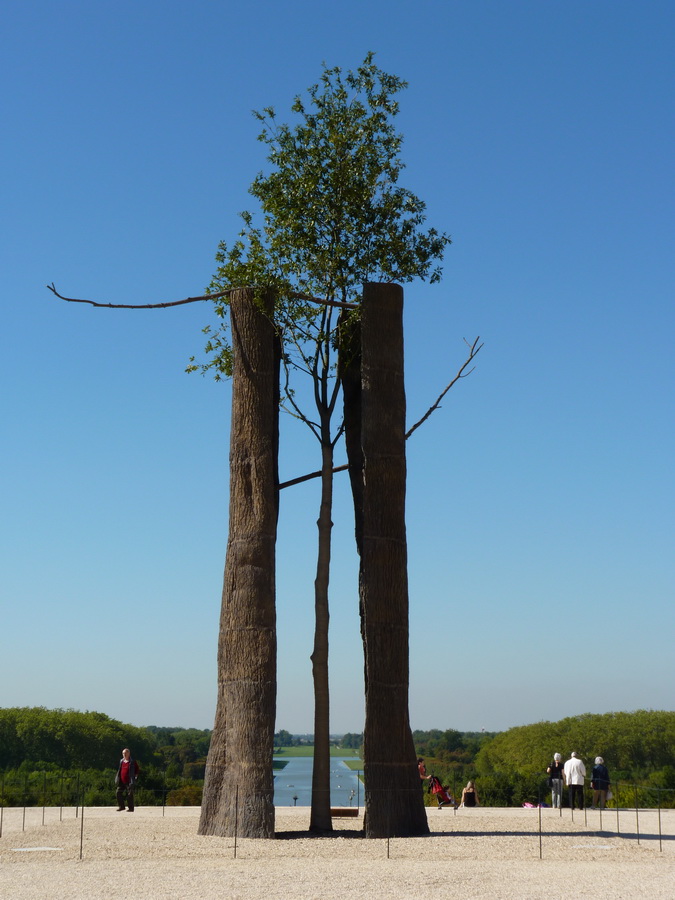
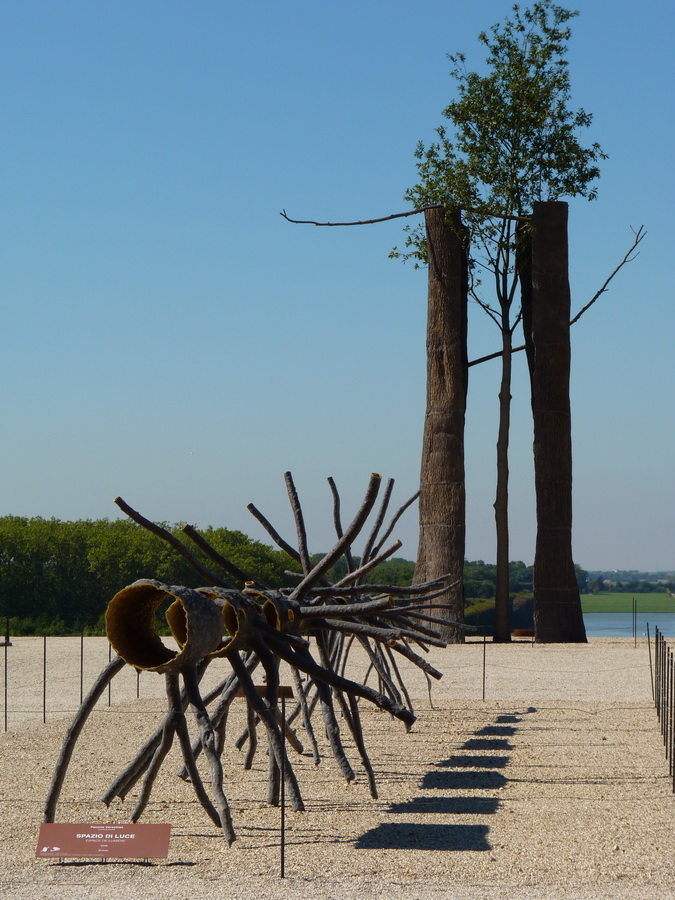
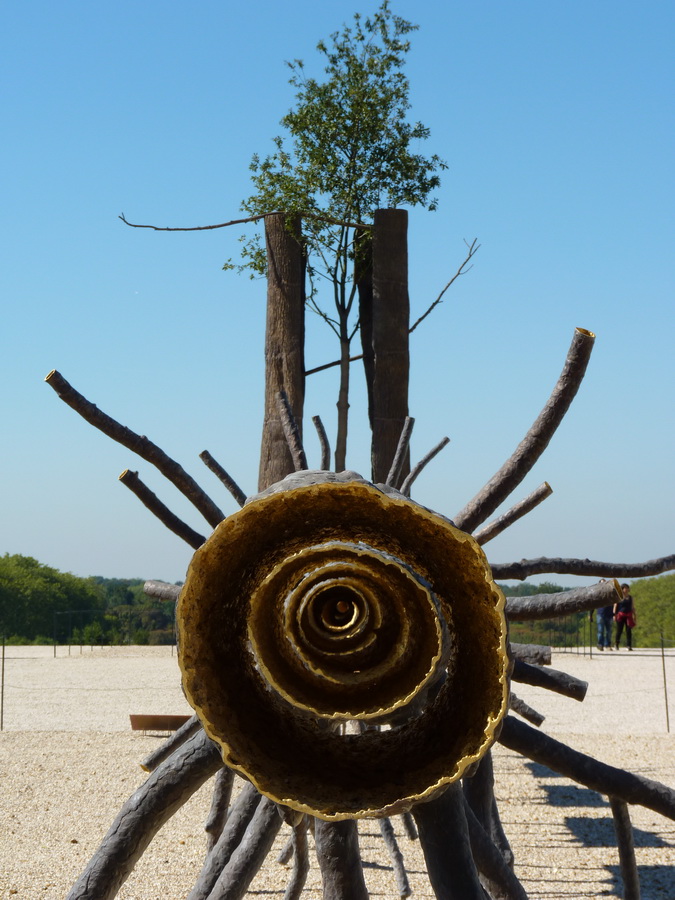
The Versailles special exhibition focuses on the outdoor garden, presenting diverse forms of "trees" and natural contexts, all belonging to monumental works: placed in two rectangular octagonal basins on a vast high platform, two magnificent Between Skin and Further (2003) stand tall. One piece, reaching from sky to earth, consists of two large cylindrical oak bark sections surrounding a lush oak tree. Vertical bodies are penetrated by two thin branch trunks, creating unparalleled natural majesty and energy. A trunk divided parallel into eight equal parts, hollow from large to small, slowly extends along the horizon. Looking from the large trunk opening, layers of bark overlap; the hollow resembles a heavenly eye, with complex branches on the trunk emitting natural grand power.
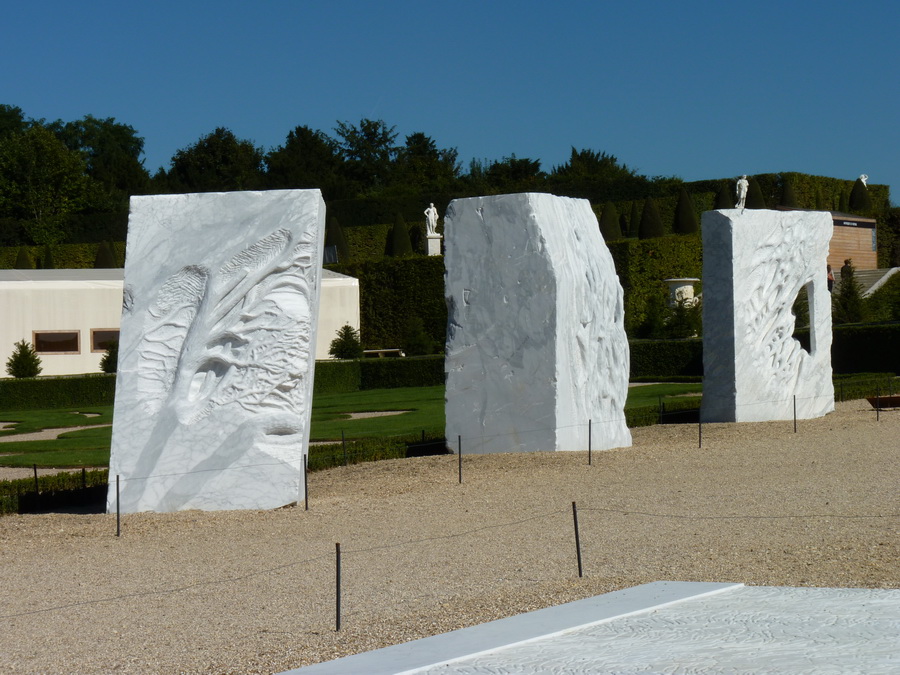
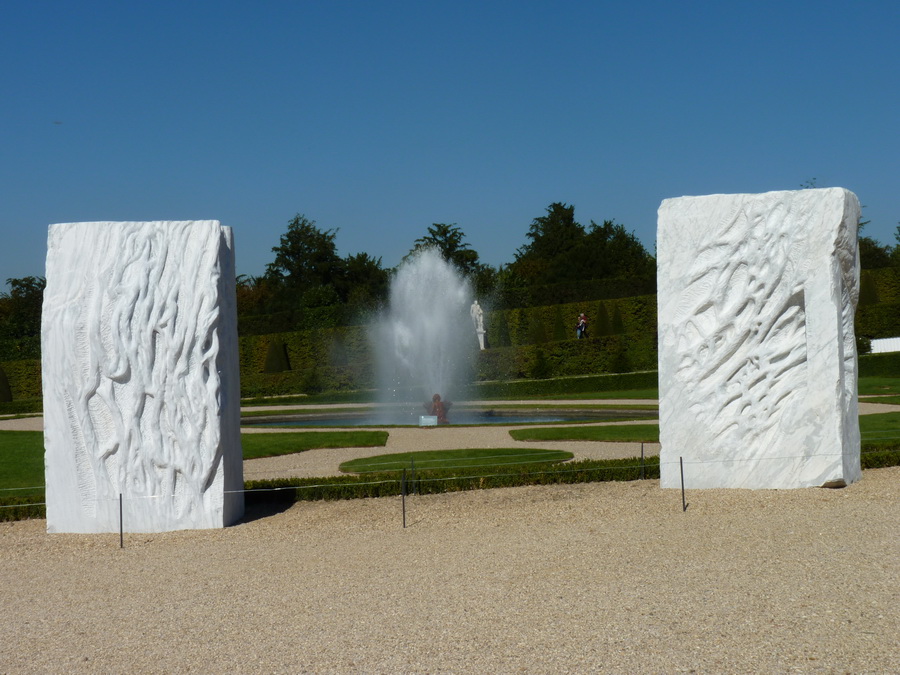
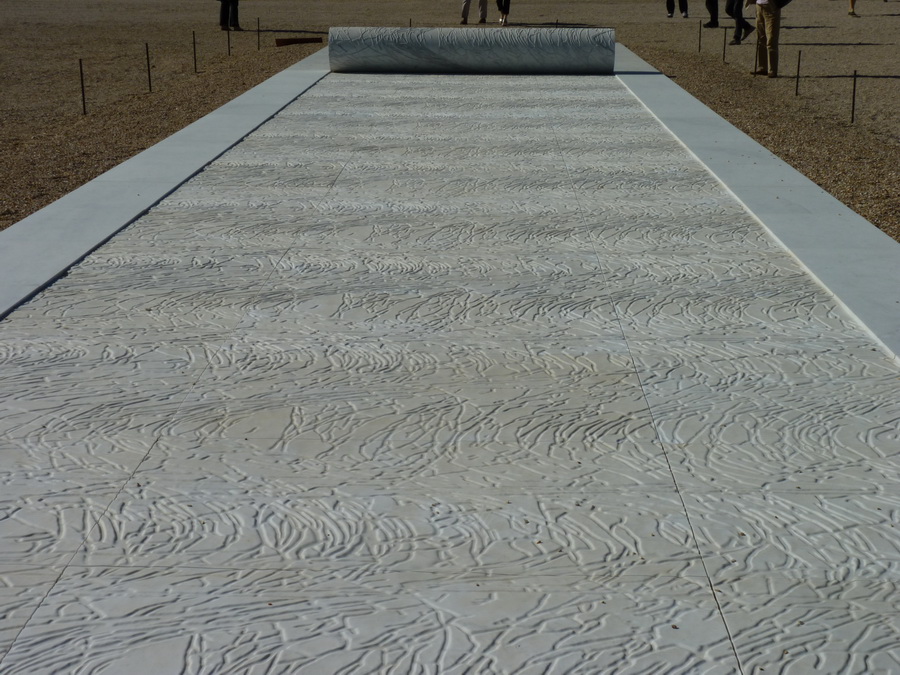
In front of the dramatic Latona Fountain, a large Anatomy series piece (2011) is composed of six huge white marble blocks, each engraved with natural plant forms. Natural thickness/fineness branches and trunks evoke associations with human internal organs and capillaries, between figurative and abstract, reality and imagination, allegory and reference. Seal (2012) features a white marble slab flat on the ground, covered with natural plant forms, rolled over by a round cylinder, leaving a small portion unrolled, indicating the seal's trace.
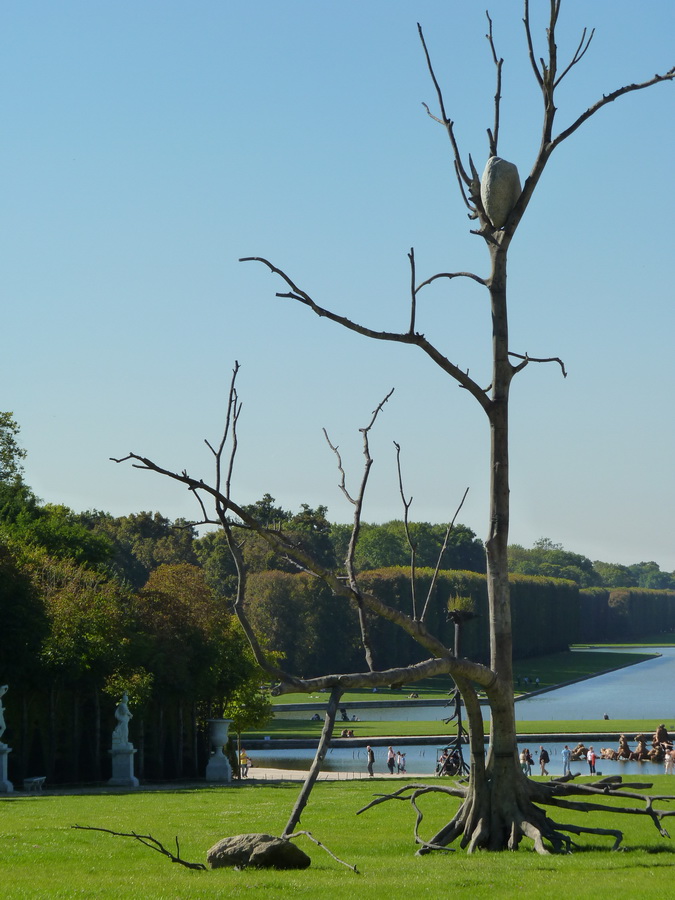
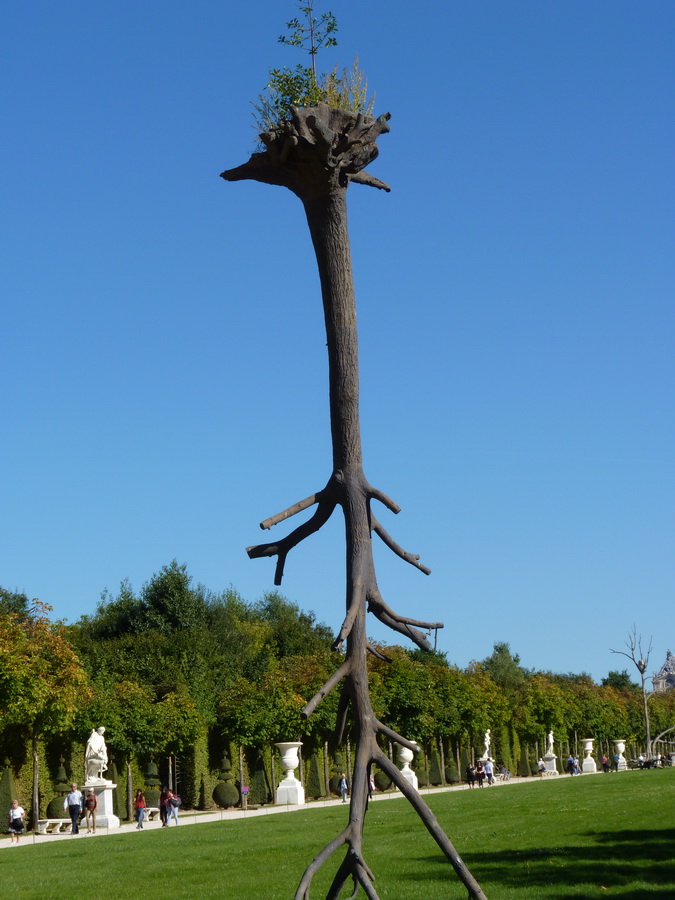
Overlooking the magnificent main axis lawn, two eye-catching "tree" works: Triple and Root of Leaves (2011). The innovative Triple is a tree exposing its massive roots, full of vitality with triple elegant branch postures. A huge stone is held on the branching tips, resembling mysterious fruit. On the lawn, a huge stone crushes a branch trunk, an unusual construction forming a mysterious color, implying unparalleled natural energy and consciousness. Near the grand Apollo Fountain, Root of Leaves is an inverted tree full of visual energy. Its root resembles a flower pot, overflowing with plants and flowers, showing the infinite possibilities of natural life and cosmic energy consciousness.
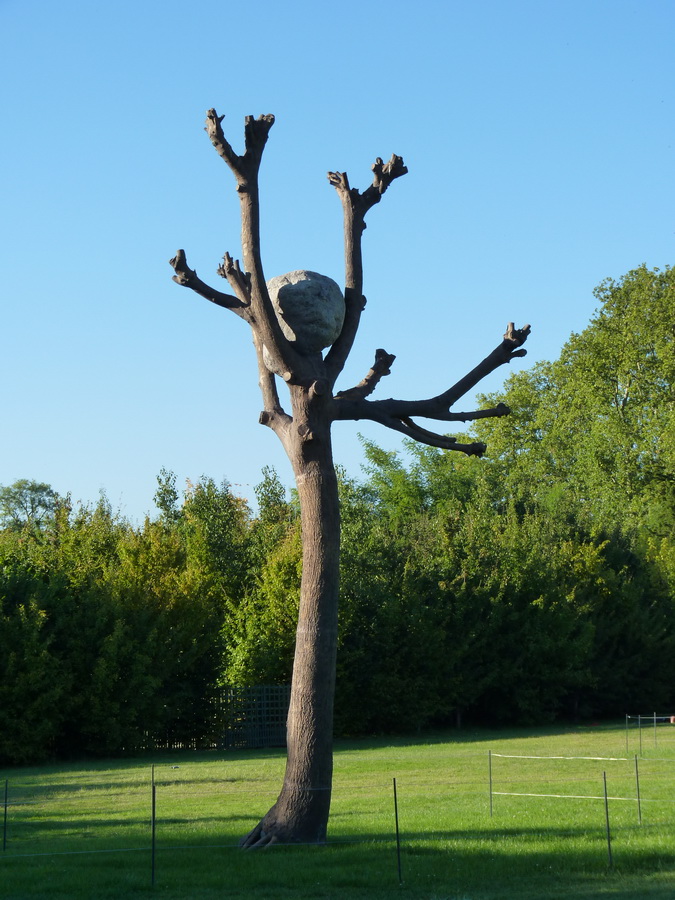
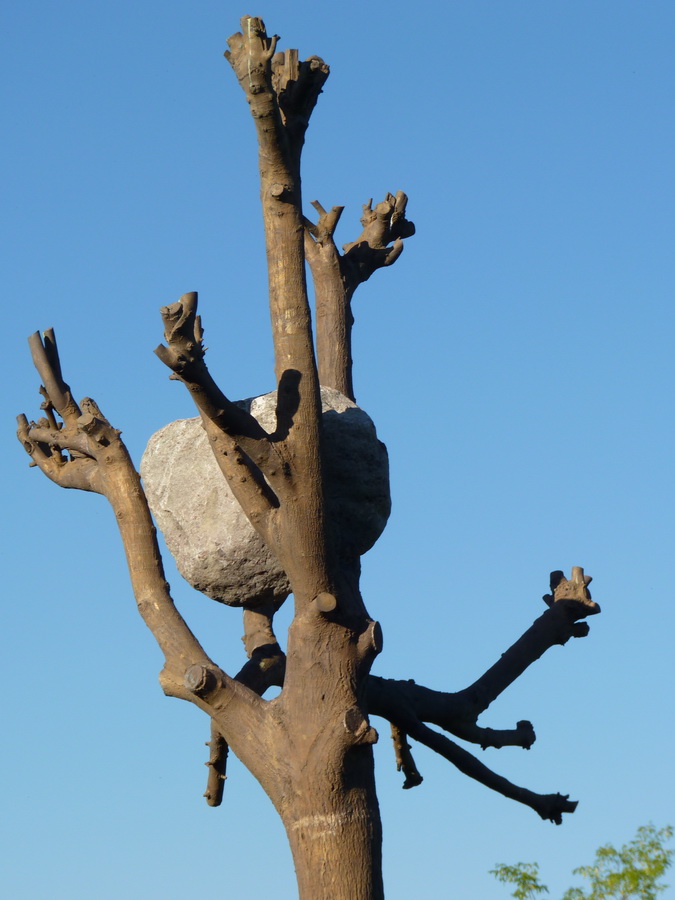
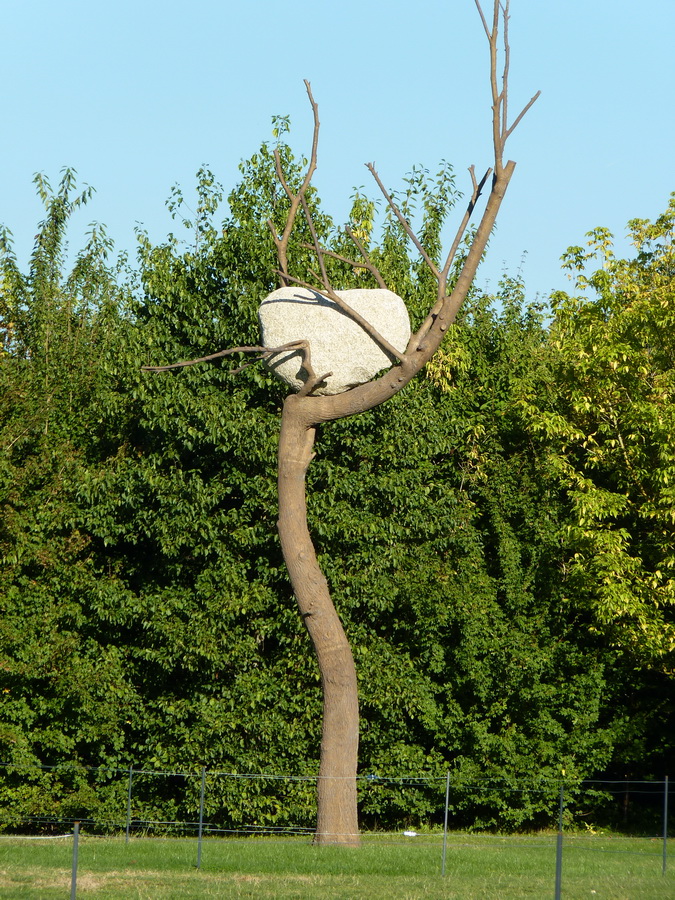
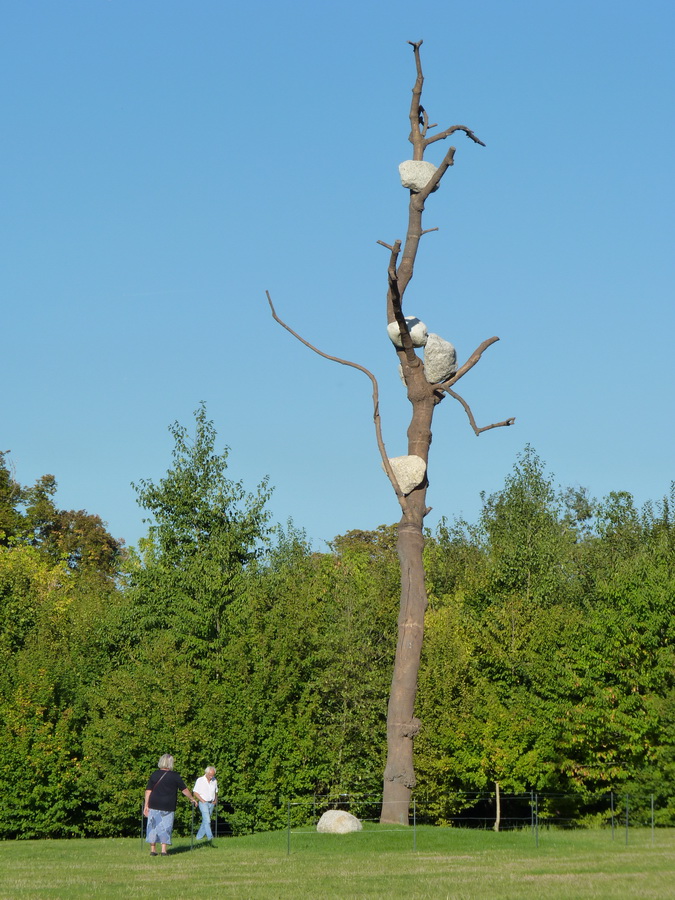
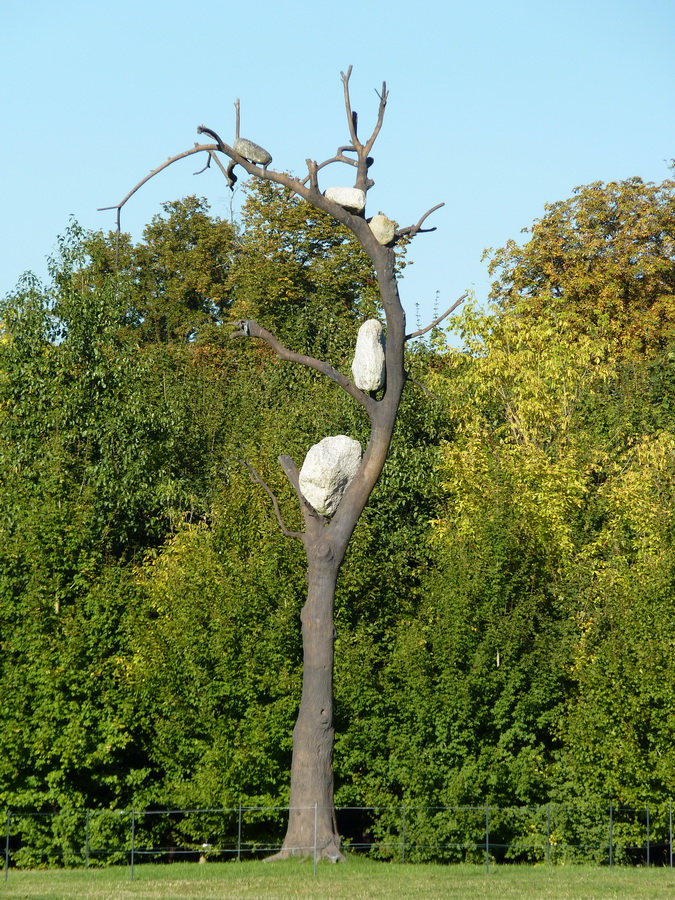
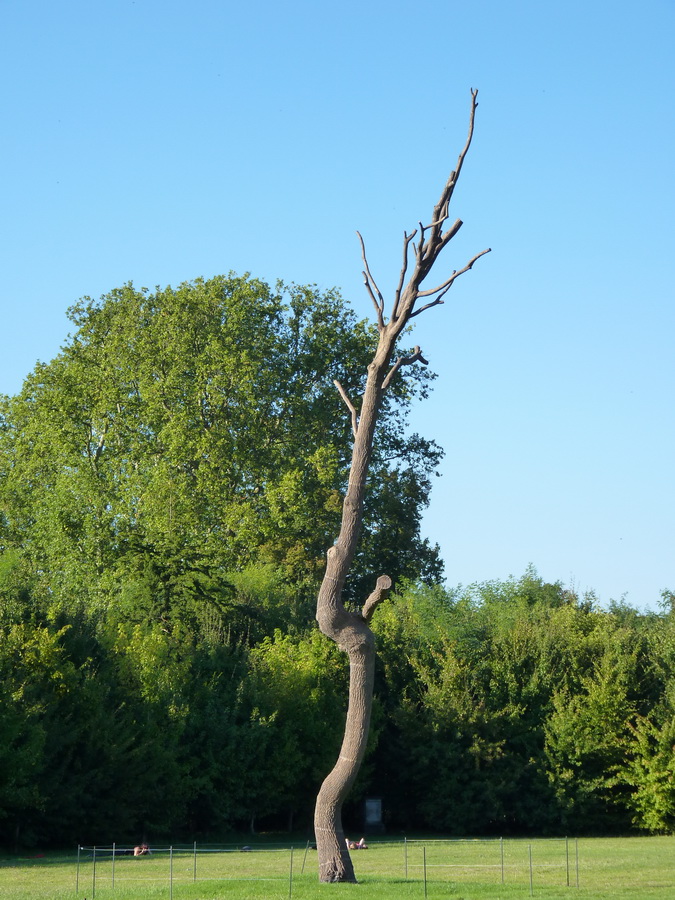
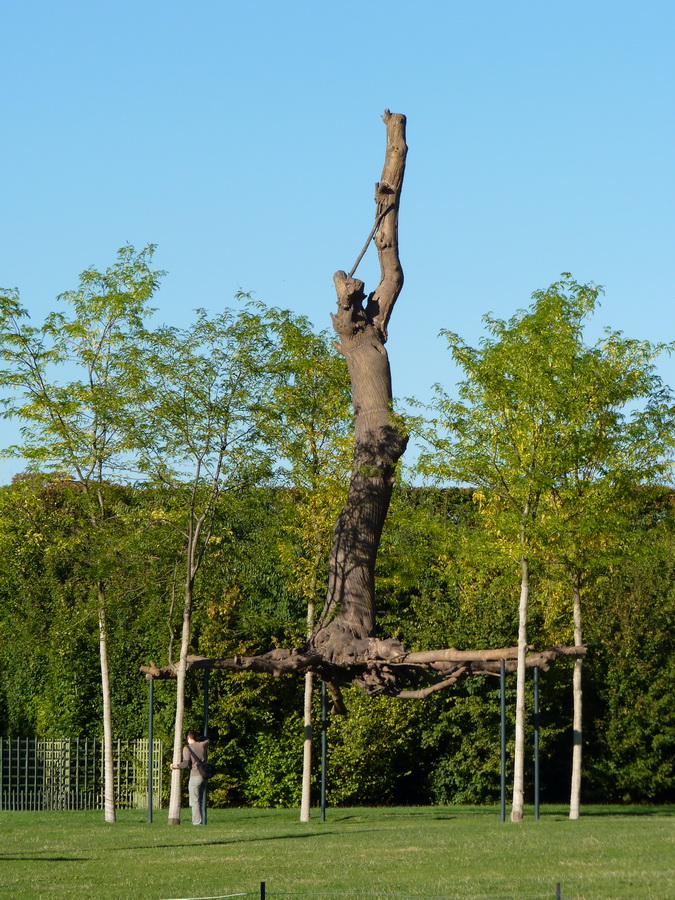
Following exhibition signage, turn left into the verdant North Garden of the Palace of Versailles. Passing the dramatic Lacinet Fountain, walking through the shaded path, arrive at the star-shaped small forest. In the enclosed woods, seven groups of "trees" echoing and contrasting each other, works from 2003–2012, grow vividly from the ground. Five trees have stones climbing them. The earliest, Concept of Stone (2003), is whimsical—stones growing on trees. Stones become mysterious fruits, imaginative spaces, visual focal points, ineffable insights, and puzzles. From Concept of Stone - Elm (2008) with one stone, to Concept of Stone - Cherry Tree (2011) with four climbing and one on the ground, to Concept of Stone - 1030 Kilograms of Light (2011), five rhythmically placed stones on the tree. The concept of stone is also transformed into weight and light; consciousness becomes the guide of the work, titles opening new thoughts and insights. Among them, Balance (2011), although still having a stone, the concept of stone has changed; it becomes the idea and role of balance. Just as Balance - Oak (2011) uses a parallel trunk as a balancing role and function on a vertical tree. The most unusual Ascension (2011) is constituted by four tree-shaped structures, with a rough trunk framed in the middle. The trunk will be slowly lifted as the trees grow over time. The temporal framework is the subject consciousness of the work; Penone seems to return to his specialized time structures.
The artist Penone said of the works in the Palace of Versailles gardens: "The star-shaped small forest seems like a room, a closed space where people discover an unexpected effect. However, the sculptures placed on the main axis are spaced apart. In the small forest, they are more concentrated, and the works directly contrast each other. We can view these seven works as thinking facing trees, their growth, movement, and balance. Each tree fixes its structure in the moment of its existence; its form development matches its inevitable vitality. In a tree, no branch or leaf is superfluous; the dry or dead, useless ones become the memory of the forest. For me, this becomes the sculpture of the perfect tree, stable matter and form, responding to necessity. Every sculpture must be constructed thus. Trees, in this sense, are an example."