Paris Palais de Tokyo: "Pergola" An Exhibition Full of Riddles
Al-Amiri Laith "Symbol of Courage" Symbol of courage 2009
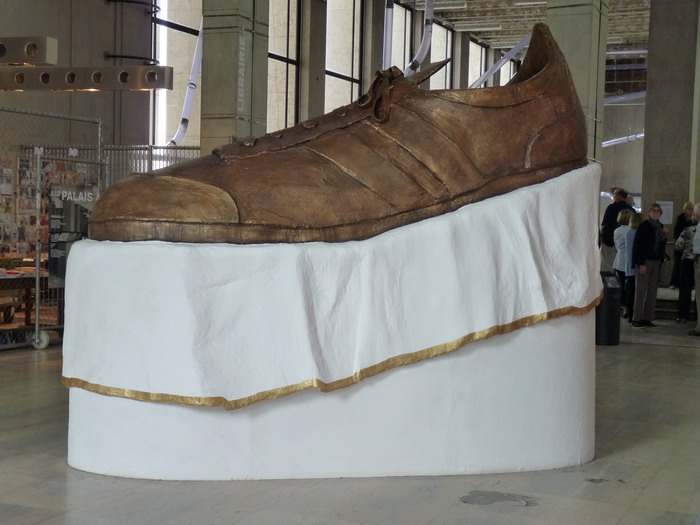
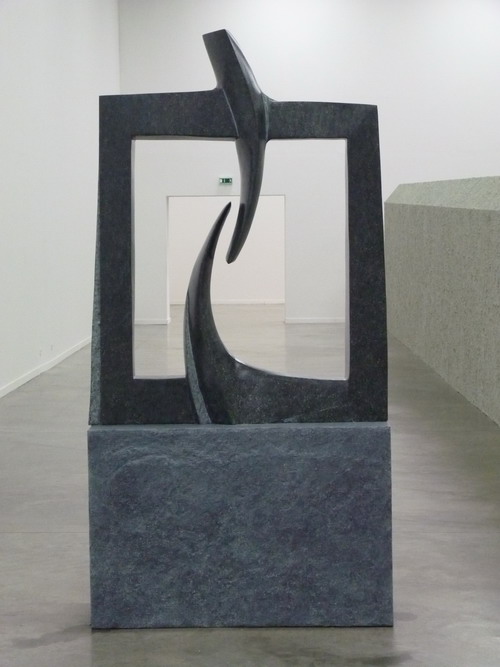
Foreword: The special exhibition "Pergola" was on display at the Palais de Tokyo in Paris from February 19 to May 16. It is an exhibition full of riddles and references, much like the themes of the Palais de Tokyo's special exhibitions over the past three years. It spans across contemporary events, actions, contradictions, speed, and network media in the extraordinary, hinting at the chaotic existence situations and paradoxical, ambiguous reality of today's complex society. In 1916, the famous architect Le Corbusier built a representative work of modernism, the "Schwob Villa," in Chaux-de-Fonds, Switzerland. Influenced by Orientalism, it is also known as the "Turkish Villa." Within its grand, magnificent, concise, and pure lines, an incongruous and contradictory pergola stands out. A few years later, the architect published pictures in the magazine Esprit, where the villa's ground was decorated with white traces marking the location of the vanished pergola, clearly indicating that this majestic object had been altered. This resembles the act of Iraqi journalist Muntazer Al-Zaidi angrily throwing his shoe at US President George W. Bush nearly a century later, achieving different goals through similar means. Under this contradictory, abnormal, and strongly motivated intent, the "Pergola" special exhibition entangles itself in the combative essence of modernity. Through these long-suppressed and deleted elements: Valentin Carron’s chandeliers illuminate the dim museum space from a Swiss diner; or the wall vocabularies borrowing from the stucco onion decorations of suburban detached houses, equivalent to concentration camp spaces. Laith Ai-Amiri’s giant shoe, resembling a monument, under survival, uprising, and resistance, empowers victims to gather full courage and do their utmost to erase all modernity or civilization to claim their right to speak, paying highest tribute to the warrior-like Iraqi journalist and publicly demanding equal treatment for all. Raphael Zarka explores skateboarding, reflecting the balance and adventurous spirit preferred by young people today, presenting a unique Renaissance-style formal world. Serge Spitzer’s crisscrossing aerodynamic crazy pipeline networks challenge all possible information transmission. Charlotte Posenenske, between handmade and industrial styles, critiques Western capitalist consumer society and industrial production political systems, intending to propose new concepts of product, distribution, and acceptance to construct a new era. Here are two solo exhibitions full of youthful vitality by Valentin Carron and Raphael Zarka. A unique retrospective of the almost forgotten German extreme artist Charlotte Posenenske. Among them, Serge Spitzer and Laith Ai-Amiri present extraordinary projects.
Exhibiting Artists: Two dramatic exhibition proposals: Laith Ai-Amiri (born 1965) is currently Iraq’s most media-savvy artist, attracting attention solely for creating a sculpture of a "shoe" thrown at a former US President. Aside from this, no one knows what other works he has created. Of course, times make heroes, but who knows if heroes possess talent and creativity, or if they only show momentary bravery? Iraqi artists are a large exclamation mark plus an even larger question mark (only questioning, absolutely no disrespect intended). Laith Ai-Amiri graduated from the Baghdad Academy of Fine Arts and is a fellow townsman of former Iraqi dictator Saddam Hussein. As is well known, amidst today’s intertwined mass media winds and grass movements, news events immediately cause alarm and resonance, becoming selling points or hype for news. New controversial events quickly cover up other unique ones, with trends rising and falling simultaneously. On December 14, 2008, Iraqi Prime Minister and former US President Bush held a press conference before the global silver screen. When the two were about to shake hands, Muntazer Al-Zaidi, sitting in the third row of journalists, unexpectedly picked up a shoe and angrily threw it at the US President. This controversial behavior immediately shocked Iraqi society as a whole and inspired the Arab world, causing worldwide astonishment. These shoes not only became symbols of imagined resistance, with the journalist becoming a warrior resisting power, but also heroes of the weak in the Arab world. Sentenced to three years, after serving a few months in prison, when released from Mouthanna Military Prison, he was treated and warmly welcomed like a national hero.
This giant monument-shaped shoe, titled "Symbol of Courage," was co-created by Laith Ai-Amiri with children from a local orphanage in January 2009, regarded as the glory of journalist Muntazer Al-Zaidi. However, the work was quickly destroyed and leveled by authorities. Since then, the artist has disappeared. This piece at the Palais de Tokyo was reconstructed by the venue staff based on images and data provided as much as possible by the artist. Here, the artist questions ancient forms; on this everyday insignificant object, a leather shoe becomes an extraordinary controversial symbol. Used as a prototype, practicing displacement, it becomes an eternal monument and memory of resistance consciousness. The artist said: "The behavior of journalist Muntazer Al-Zaidi produced a major resonance in Iraqi society as a whole. It is an unprecedented expression of courage and bold freedom. In my sculpture, I concretize all this extraordinary value. I held a small opening ceremony for this work, lasting only half an hour, yet it continued throughout the day. And it caused an extraordinary sensation in Iraqi society, because this ultimate and powerful symbolic shoe (...)."
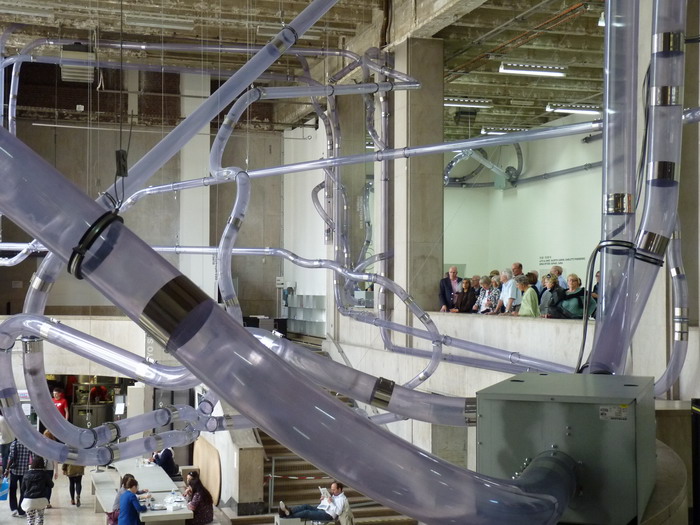
Serge Spitzer (born 1951) is one of America’s most representative artists today. Since the 1970s, he has utilized environmental space, fully employing a complex vocabulary to develop a unique mechanical sculptural installation medium for communication, perceptive and conscious, often contrasting and connecting with extraordinary imaginative worlds. The tension of his works targets the balance between the visible and invisible, controversial and constant. His environmental sculptures have an autonomous organization and potential conditions for self-destruction. In this special exhibition, Serge Spitzer displays a magnificent monument-sized environmental space installation masterpiece "Re/Search, Bread and Butter with the ever present Question of How to define the difference between a Baguette and Croissant." It consists of a series of light blue plastic pipes from floor to ceiling, along walls and columns, intricately crossing in the air, resembling a complex and chaotic maze. Inside the pipes, driven by air pressure, endless automatic back-and-forth dizzying transmission occurs. This machine reminds one of order transmission in large malls or information transfer, verifying a pre-existing communication organizational network, more like today’s internet system. Here, the artist humorously questions its function, making this perfection become obsolete. Technology loses mutual effect here; information has no sender, nor recipient. Seeking neither begins nor ends; order and chaos coexist, rigor closely approaches defect, everything is connected, yet all are accidents.
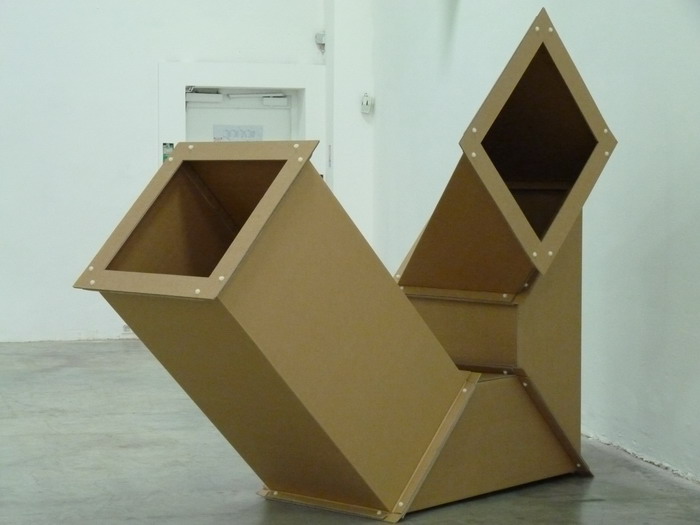
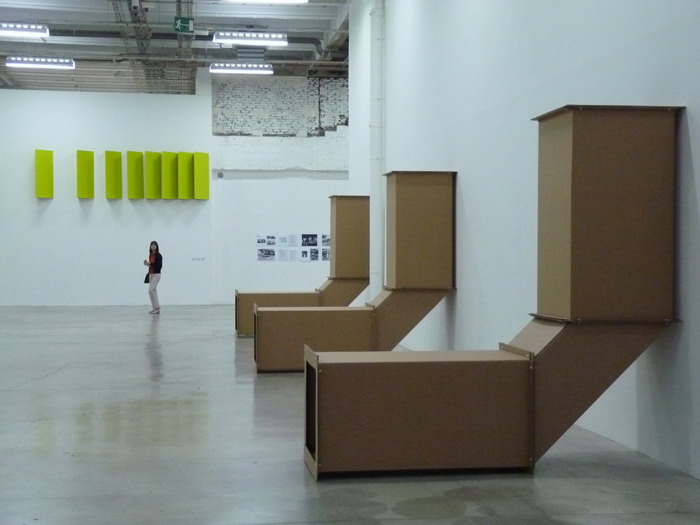
A unique retrospective: Charlotte Posenenske (1930-1985) was Germany’s most unique extreme artist of the 1970s. Inheriting broad modernism, especially Dutch Neoplasticism and Russian Constructivism, she readopted sensations of assembly, spatialization, and standardization. Quickly moving from flat painting space to three-dimensional sculptural space, she tried various possibilities to raise subjective then anonymous viewpoint experience problems. In the early 1960s, attempting to develop painterly space through a series of "12 Metal Relief C Series" (1967), she deeply explored free combination and participatory works. Quickly through architectural variable animal-object sculptures, inviting audience and consumer participation, such as "Viekantrohre D Series" or "Viekantrohre DW Series," industrial standardized thick cardboard products constructed into sculpture-objects, resembling ventilation pipes in modernist buildings, capable of shaping according to time-space fields. These two series are built on a standard size system, making them easy to replicate. The "Viekantrohre DW Series" and "Drehflugel E Series" propose audience participation operation; the "Viekantrohre D Series" requires exhibition curators responsible for assembly formation. Works are not just participatory but can determine the form of the work, obviously Charlotte Posenenske is a constructor and pioneer of participatory aesthetics. Between handmade and industrialized, single and plural, complete and chaotic, imagination and constraint, demand and powerlessness, rational form and skewed action. Thus, the artist forces a poetic impulse of immediate action. After European student riots, Charlotte Posenenske resolutely abandoned artistic creation, studied sociology, and participated in union battles. Her works, under the situation of the European '68 student movement, critiqued Western capitalist consumer society and industrial production political systems, intending to propose new concepts of product, distribution, and acceptance to construct a new era.
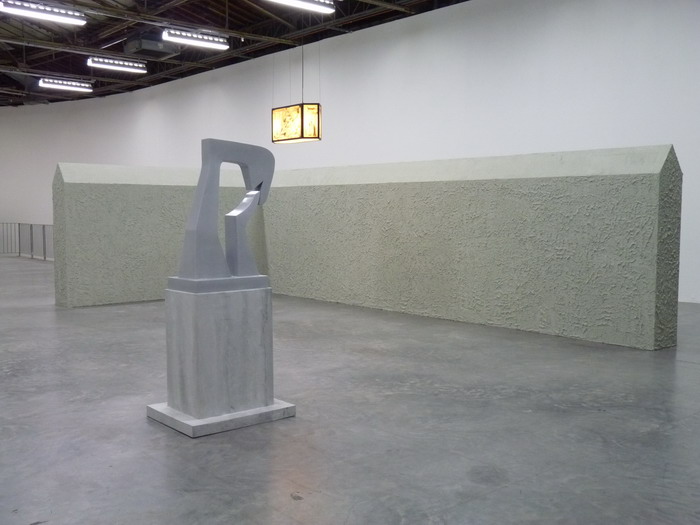
Two unique solo exhibitions: Valentin Carron (born 1977) is a Swiss new-generation artist, skilled in sculpture, objects, architecture, space construction, and concepts. From folk iconography to religious symbolism via public space imitation. By those famous modernist forms questioning identity, summoning prototypes. Obviously, the artist does not forge, imitate, or even simply copy. But transformation, fragments, and deceleration seen from the outside: synthesis, series, or buildings. His works utilize minimalist abstraction, in a feeling of liberation uniqueness and immutability. Obviously, his works, objects, images, symbols, and folk uses are all circumvented and transformed by his humorous manner. Piecing together modern art images and folk art, tradition and contemporary, creating an ambiguous image and style both modern and postmodern: lanterns evoke a dreamy Swiss and bright mountain scenery and Swiss chalet context, or extending geometric rough stucco walls, alluding to the Roman Forum. Eden wood carvings, between natural parks and amusement parks. Critical anarchist monuments. All his works swing between celebrating and criticizing both romantic and barbaric nations, a restrained myth, like the nation’s fertile soil. Obviously Valentin Carron expresses authenticity, craftsmanship, readymade, or clumsy aesthetics. Through his works, all memories become monuments of personal life glory.
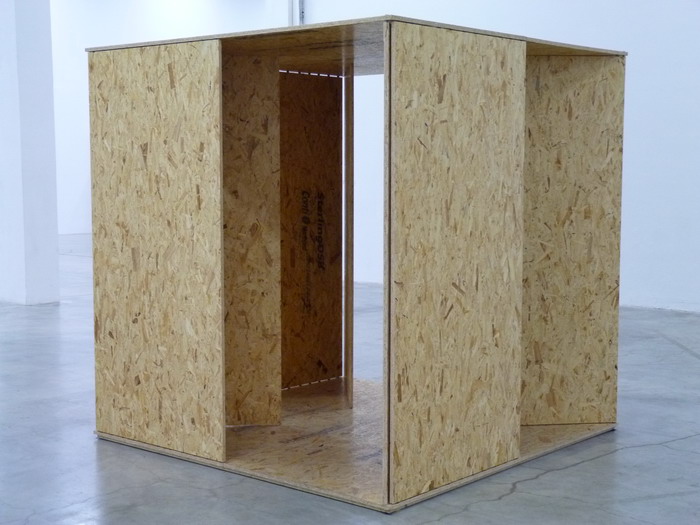
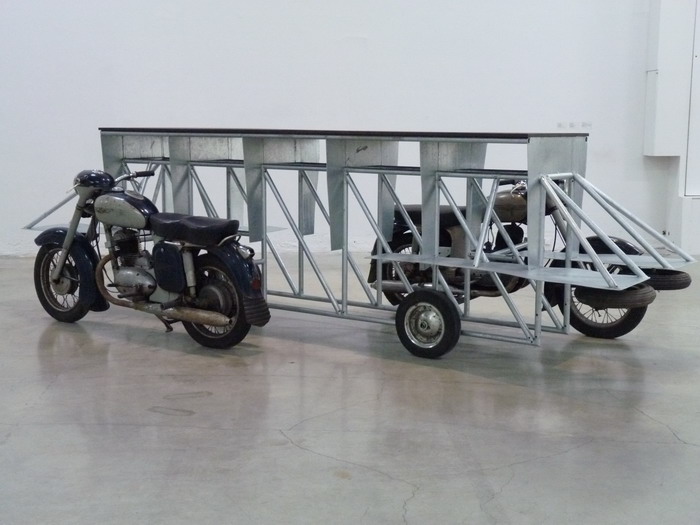
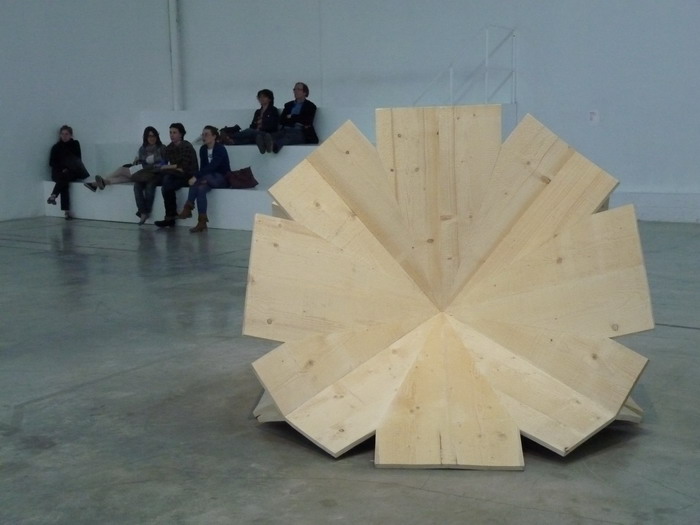
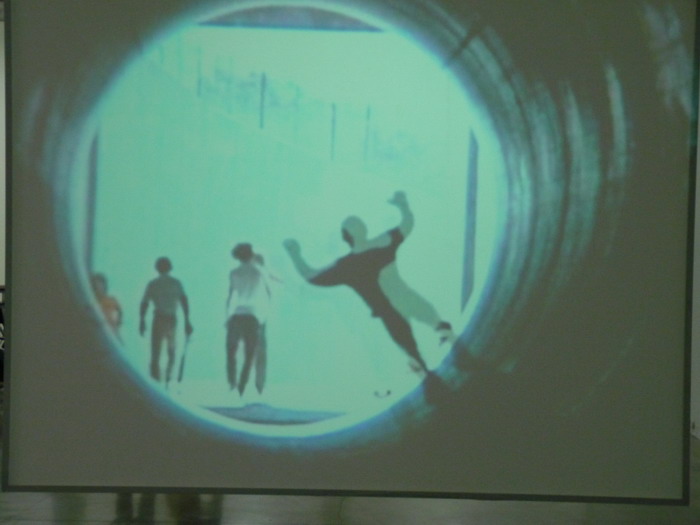
Raphael Zarka (born 1977) is France’s most representative new-generation artist and one of the most active artists today, engaging in object sculpture, video, and photography. He defines himself as an explorer or scientist, skate theorist, essayist, mathematical archaeologist, etc. His exploration revolves around appropriated common objects, appropriation and displacement, piecing together and unusual combinations, transforming to construct his extraordinary contexts, becoming an imagined and science-form-like object sculpture. Zarka’s creation revolves around explicit data-driven exploration. Loving space and form, he likes deconstructing background processing. Appropriating objects, repositioning them in historical worlds, his works are results of careful study and exploration. He likes mixing art history and folk culture. Creation revolves around two core geometries: rhombicuboctaèdre (Note 1) and skateboards. Quite scientific and theoretical, these two unique experiences become his most original artistic expression. Geometric surface forms come from Archimedean principles, discovered by Luca Pacioli and Leonardo da Vinci, such as the 2009 geometric surface "Dice Form" work. Skateboarding—Zarka’s childhood worshiped object and sport, himself a skateboard expert, strongly approaching its form and substance, further deeply understanding its basic concepts: surface, speed, balance, folk culture, optimism, object relations, etc. Skateboarding occupies a significant position in his creation. The explorer artist connects these complex situations, publishing "Forbidden Connections" in 2003. Then in 2006 published skateboard theoretical gap chronology "A Quiet Day." In 2008, with video documentation titled "Topography of Skateboard Anecdotes," in 40 minutes of video documentary data, describing how American California youth skateboarders pioneered this surface, distinguishing its functional urban forms, and proposing a naturalistic foundation between roads, vast venues, and streets. Zarka observed this obvious transformation of the sport: urban sports facilities, new terrains (like empty pools), technological changes and creations. These all become the artist’s inexhaustible creativity. Such as the cleverly crafted 2009 "Light Rail Vehicle": a futuristic imaginative space aircraft, constructed by placing two Jawa heavy motorcycles side by side, sandwiching an open carriage, imagining inviting people to sit, referring to speed, balance, aviation, and mechanics. This basic type of vehicle was originally created by engineer Bertin as an evolution of the aircraft. This machine seems like a form against progress, targeting an imaginative futureist tension, seeming like a creation never to be realized.
Zarka’s cross-disciplinary artistic creation is established on Robert Smithson, Dan Graham, Philippe Parreno’s aspects, not limiting his artistic works and plastic arts to the physical world. The artist elaborates his personal creation, borrowing a famous quote from philosopher Borges: "Only by almost insulting the forms of the intellectual world can we create something, or we must equally create whatever it is." Note 1: Rhombicuboctaèdre is a geometric solid Archimedean cube, with 8 triangular faces and 18 square faces. It possesses 24 identical vertices, with 1 triangle and 3 squares meeting. Note: Above distribution each has 6 squares and triangles, then 12 others distribute one edge each. Polyhedral has octahedral symmetry, like cube and octahedron. Dual is called trapezoidal dodecahedron, of course front face doesn’t look so trapezoidal. Rhombicuboctaèdre name refers to making 12 square front faces, located on same reverse is rhombic dodecahedron, its dual is cube. It can also be called an unfolded cube, or an unfolded regular octahedron starting from same polyhedral planar cutting process.