Philippe Mayaux "Infinite Death" Solo Exhibition
(Fig. 1) View of the exhibition room for the audiovisual installation "The Liar," 2007, each 35x20x12 cm. (Fig. 2 Left) Left: "French Pastry" sculptural object, 2007; Right: Imaginative "Chimere - Focbit," 2007, 300x400 cm poster. (Fig. 2 Right) Left: Contemporary magical Barbie doll head-beast chim
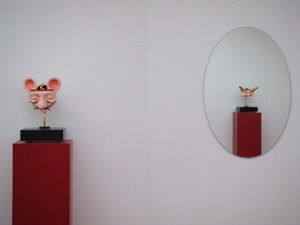
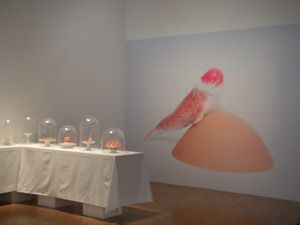

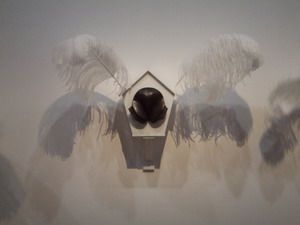
(Fig. 1) View of the exhibition room for the audiovisual installation "The Liar," 2007, each 35x20x12 cm. (Fig. 2 Left) Left: "French Pastry" sculptural object, 2007; Right: Imaginative "Chimere - Focbit," 2007, 300x400 cm poster. (Fig. 2 Right) Left: Contemporary magical Barbie doll head-beast chimera "Chimere - la decloneuse," 2007, 300x400 cm poster; Right: French Can-Can sculptural object motorized installation series. (Fig. 3) One of the light and poetic "French Can-Can" sculptural object motorized installation series, created in 2006. Philippe Mayaux, winner of the 2006 Duchamp Prize, presents his solo exhibition "A mort l'infini" (Infinite Death), on view from May 10 to August 15 at Espace 315 Contemporain, Centre Pompidou.
Philippe Mayaux (born 1961) is the recipient of the 6th French Contemporary Art Duchamp Prize and one of today's most representative young artists. Like many postmodern artists, he explores a pluralistic style encompassing painting, sculpture, objects, and audiovisual installations. His work features abnormal, shocking visual imagery—surreal and dreamlike—often revolving around mechanical symbolism of "sexuality" within whimsical or sci-fi contexts, referencing art history between Duchamp and Picabia. In "Infinite Death," Mayaux dramatically presents two large environmental installations. A long red carpet extends through the entire venue, passing through the central mirrored room housing the audiovisual installation "The Liar," leading to the "Infinite Death" object installation, unifying diverse themes.
Upon entering, viewers are immediately drawn to the cruel war-themed glass cabinet series. Eight cabinets orderly display small guns, cannons, airplanes, warships, missiles, soldiers, and other war weapons cast in white plaster, alongside a large series of uniform white cross graves. This surreal and fantastical installation of war and death is full of metaphors. The artist explains: "In my work, I often mix contrasts. White is a neutral color, the color of peace. White becomes anti-expressive... These weapons come from molds of simple plastic packaging... Visually emitting a fragile peace. As in my usual works, I try to express the opposite, a sense of tranquility within these martial cabinets... Yet an uneasy feeling arises seeing these weapons as if under orders to slaughter... Guns, cannons, and missiles are all phallic. All these metaphors point to visible male sexuality, reduced to imbalanced domestic knick-knacks. Elsewhere, erotic connotations appear in the casting technique, as Duchamp showed us. When empty becomes full, female becomes male and vice versa, and the fragile plaster material prevents the object from becoming eternal."
On the left wall hangs the "Bark" series (13 paintings). Highly abstract in depicting decorative bark surfaces, they feature glaring colors and neat advertising-style inscriptions of tree species on different types of bark, such as "houx" (holly) written as "ou," and "bouleau" (birch) as "boulot," etc. The artist uses bark to metaphorize the human body, which changes rapidly over time. He considers trees the origin of modern thought because they provide fire for survival, protect our animals, and bear the engraved marks of human actions.
On the right wall is the light and poetic "French Can-Can" sculptural object motorized installation series. This highly sensual series presents women's seductive lower bodies—genitals resembling walnuts—adorned with pairs of gentle, pure white feathers. Under motorization, they flutter like butterflies, evoking poetry and sensibility, bringing forth the unique romantic sentiment of the French. Opposite, on a table, lies the series of various "French Pastry" sculptural objects. Presented in white plates with diverse forms and vibrant colors that look delicious and appetizing, upon closer inspection, these pastries are composed of images of female genital organs, metaphorically suggesting "food and sex are nature"? Liberating social morality and modern aesthetics from bad taste.
In the central mirrored room, the audiovisual installation "The Liar" presents a series of alienated female heads resembling Zhu Bajie (four on each side), endlessly narrating the endless story between men and women. Romance and sweet words always stir the heart and cause infatuation, drawing people into the sea of love or the bitter sea of confusion. The poetic works reflect the context of male-female intimacy. On the walls are two large imaginative series presented directly as posters. On the left, an unknown animal—a sexy fish—with a man's penis as its head, featuring a mesmerizing pink glans, standing on a woman's large nipple, titled "Chimere - Focbit." On the right, a Barbie doll wearing a feather coat, hands on the ground, no feet, with a mouse tail exposed outside the coat, resembling a contemporary magical head-beast chimera, full of imaginative space, titled "Chimere - la decloneuse."
At the end of the red carpet lies the "Infinite Death" object installation. On a pedestal stands a rectangular faux granite block (constructed from plywood) clearly inscribed with "Infinite Death," resembling an extraordinary monument. Two benches are placed on either side of the monument. People sit on the benches to watch holes at both ends of the monument, assuming they can see through to the other side, but actually seeing nothing, creating a sense of being deceived. Yet, who would still believe in this infinite death? Of course, existence is the rebirth of infinite death, forever. Philippe Mayaux states: "My work is based on interpretation. I do not want viewers to treat me like a child, demanding how a work must be interpreted. Instead, I hope viewers take responsibility for interpreting the work themselves."