Pierre Restany's New Realism Manifesto
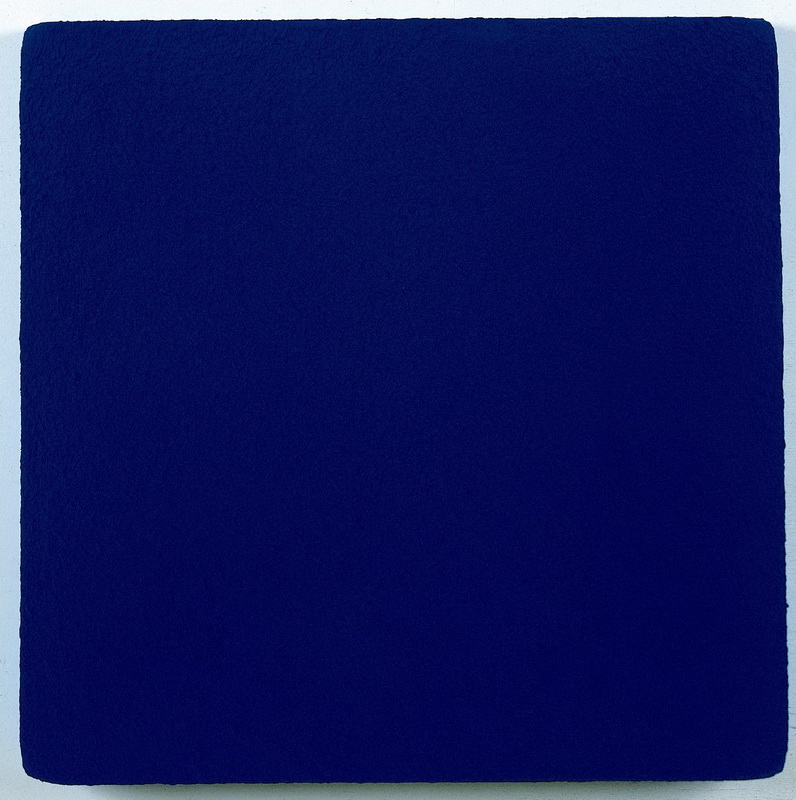
Klein LKB 1957 50X50X5.5cm St-Etienne Musée d'Art Moderne de Saint-Étienne Collection
Text and translation / Chen Chi-Hsiang
The first New Realism group exhibition was held on April 16, 1960, in Milan, Italy, accompanied by the manifesto of art critic Pierre Restany: "New Realists! The wisdom of these academicians is futile, or rather, these upright people are astonished by the acceleration through art history, and the particular power that consumes our time limits. We attempt to stop the sun or delay fleeting time, resulting in an inverted sensation, thereby obtaining a clear indication. We witness today the exhaustion and total establishment of vocabulary, the rigidity of those languages, those styles, etc., this inability—thoroughly—to oppose these traditional means against individual encounters scattered across Europe and America. It tends toward the whole, even exploring the domains of intellectual categories, establishing a new basis for normal expression, yet without involving any extra secret part of paint solvents in oil painting, or in Ripolin (the name of French enamel paint) coatings. However, easel painting (like any classical expressive method within the scope of painting or sculpture) makes its era; however, at this moment, it exists only in the last instant, sometimes still occupying that long-standing excellence and exclusivity. So what else can we propose? That fascinating reality encounter discovered by itself, and not through the prism of conceptual or imaginative adaptation; what is its sign? A sociological introduction replaces the primary stage of transmission. Sociology comes from the shock of accidental consciousness, even in the degree of choice or the tearing of posters, the state of an object, the order of a setup, or the waste of a living room, the indulgence of mechanical sensibility, those sensibilities having reached the realm of comprehension. The fact of overall sociology, just like commercial exchanges, the common outstanding activity of our social transactions, transmits their artistic formal vocabulary, with absolutely no doubt, even if many still believe these noble attempts produce inner eternity, especially that painting... At this stage, more importantly and imperatively, beyond all those emotional expressions, and outside the creator's individuality, there passes some of our experience—the Baroque natural face—we approach a purely sensible new reality. This is at least one direction of the future. Yves Klein, Tinguely, Arman, Hain, Dufrene, and Villeglé, whose distinct beginnings all originated in Paris, abundant, suddenly above ignoring traditional concepts, through the lack of icons, and the frivolous actions of their admirers, could not yet foresee their overall results... We are immersed in complete direct expressiveness, reaching over forty degrees of Dada Zero, without any challenging, without the obvious characteristics of intentional polemics, nor proving any other urgent desire in our realism. This work, indeed, leads people to re-enter reality, recognizing its inherent transcendence, so it is emotion, perception, finally poetry, and..."
(Translation from the 1986 Paris Municipal Museum of Modern Art - 1960 France New Realism Special Exhibition Catalogue)