Li Chun-Hsien – The Austronesian Knight of Taiwan’s Art Scene
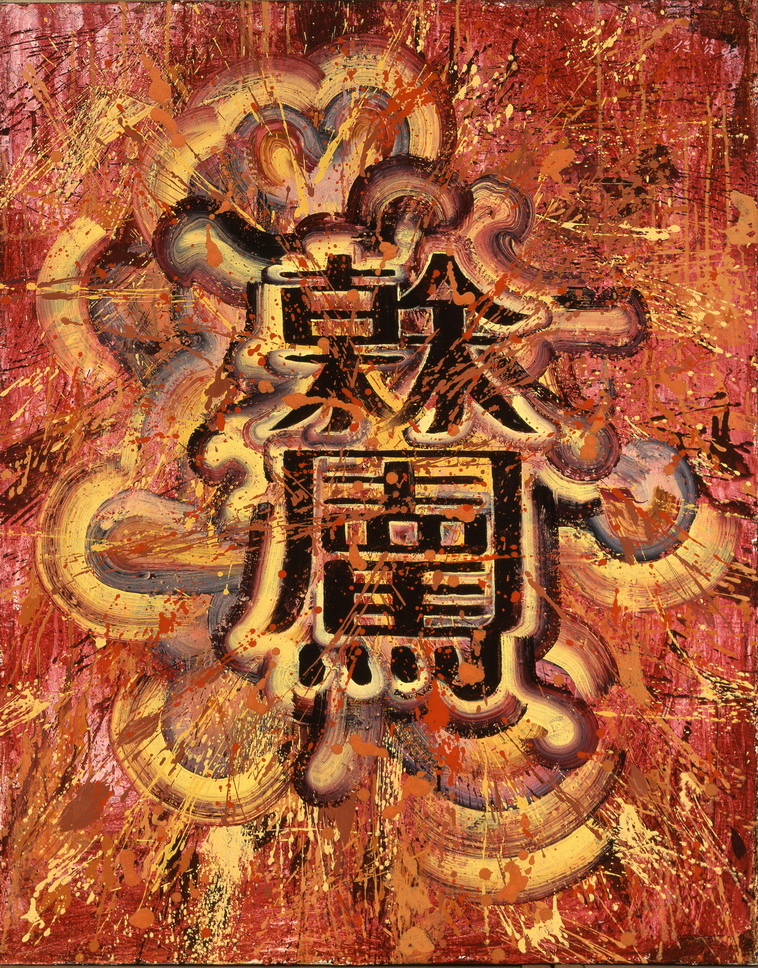
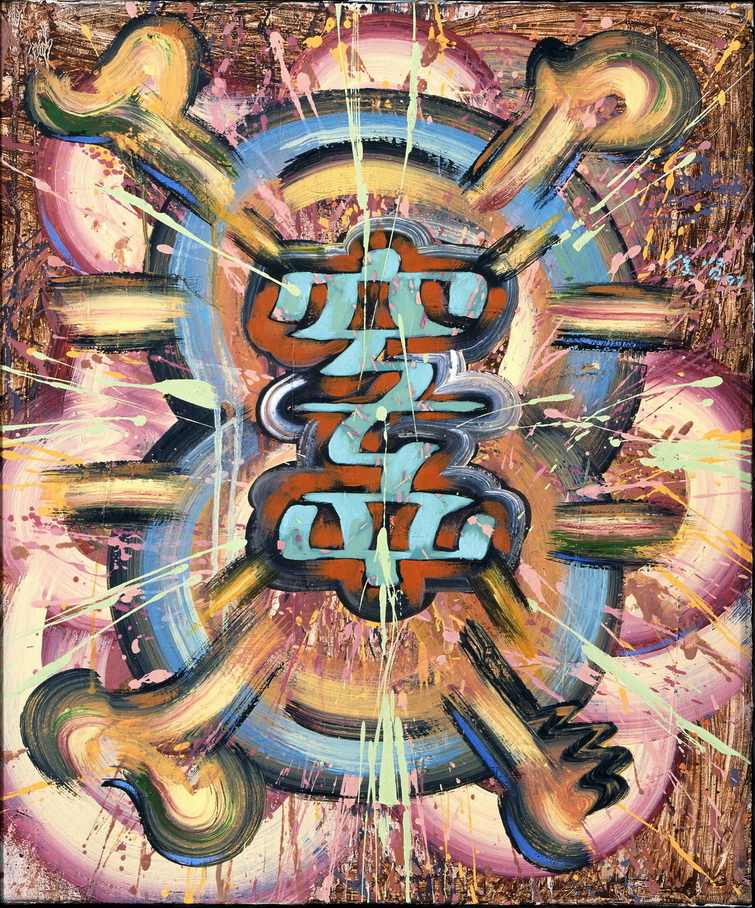
"Song Ge Wu La": "Tai-style" Painting: Taiwan 1992 133x230cm 1993 Mixed Media
"Li Chun-hsien's artistic mission is to care for this hopeless land."
Written by Chen Chi-Hsiang
Preface: Since ancient times, different regions, races (or ethnic groups) have had different geographical and human landscapes, outlooks on life, cosmologies, and values. Differences in cultural perspectives are not necessarily the same; just as in linguistics, French contemporary artist Ben believed in the 1980s that: "The next artistic revolution is to bear its own language, culture, and race" (Note 1). He believed that racial "differences" are indispensable elements in current globalized art, with "difference" becoming a unique and real value. American anthropologists Sapir and Whorf also pointed out: "Behind every language lies its unique thinking logic and cultural values, and its users are deeply influenced and dominated by these values."
The Austronesian knight Li Chun-hsien is the most "Taiwanese" figure in Taiwan's art scene, reaching deep into his roots without complaint, a tough guy with courage and spirit. His work Song Ge Wu La is bold and abundant, moving and bone-deep, painting the voice of Taiwanese people—full of emotion, righteousness, blood, and tears, filled with Taiwanese emotion, consciousness, spirit, and pride. It touches the nerves and soul of the land, witnessing local spirit under strong cultural faith, calling out the name of Mother—Taiwan. The only purely authentic "Taiwanese" taste: sour, alkaline, bitter, astringent, and spicy. Eating it moves one's mother, cooling the heart and opening the mind. Wu Ge Song, strongly expressing local shock and nerves. Twentieth-century great writer D.H. Lawrence wrote: "Every continent has its own great local spirit, and every nation has its local characteristics; that is home, that is hometown. On this earth, different places have different vitality, different shocks, different chemical smells, different stars, different characteristics. You can call it whatever you want, but the local spirit is a great reality."
The tough guy in the art world—Li Chun-hsien: Li Chun-hsien's personality features a unique "Taiwanese flavor" painting that has long attracted attention. He is the most representative model of southern Taiwan's folk culture, the toughest and most "Taiwanese" painter on the beautiful island. His artistic mission is to care for this hopeless land, exploring the raw vitality within Taiwan's cultural heritage. Reaching deep into "Taiwanese" roots without complaint, he wrote: "For me, 'Tai' comes from my body, like facing humid tropical weather, I choose to chew betel nut to fight it rather than use air conditioning. 'Tai' stems from some of my physiological instincts. 'Tai' is also the result of years of experience, testing, and thinking. Because 'Tai' is special, rich, and lively, it has become my object of identification. As an artist, I take 'Tai' as a topic, creating and extending various works and actions." (Note 2)
The Austronesian knight is dedicated to excavating Taiwan's culture as his vocation. Under a macro-epic framework, he constructs Taiwan's subjectivity. Chen Hong-yi believes: "Li Chun-hsien is an epic writer. If you juxtapose his works, you will find they connect with the rhythm and meter of poetry, especially from his unique transcendent perspective and sense of history" (Note 3). Calling him merely a painter is too narrow; his thinking and actions go beyond painting. In fact, he is the most authentic thinker and activist, intervening in society and thoroughly implementing his faith. He clarifies local history, geography, customs, and human symbols and allusions. His "Taikao" (Note 4) marks the uniqueness and subjectivity of Taiwan's culture. With a macro-view and breadth of Taiwanese people, he observes and expands the island nations of the Pacific region—constructing an Austronesian artistic context, proposing cultural uniqueness and value from differences. Multiple identities and diverse attempts implement his persistent belief in Taiwan's culture. He does not only paint; he curates, writes art criticism, develops theory and planning (Modern Paintings Society Newsletter, Southern Art, Art Certification), promotes art, participates in the alternative art space Xinnan Pier, hosts the Gaoyuan Arts Center, practices the art action "Jumping into the Sea," becomes director of Kaohsiung Museum of Fine Arts, and implements a local artistic perspective. Together with Li Chun-yang, he established the Taiwan New Mural Team at Qiaotou Baiwu House, making him a spiritual figure of Austronesian art.
Artistic Education and Exploration: Li Chun-hsien (born 1957) is from Madou, Tainan. He spent his childhood in "Shalun" by the Beigang River. In this remote wilderness, he developed his character and land experience. Settling in the industrial metropolis Dagou (Kaohsiung), attending High School No. 1, during a bitter youth he became obsessed with painting and Western music. Extensive reading of Eastern and Western literature opened up life's thinking, and a bicycle allowed him to fly around the port city's scenery, witnessing Taiwan's leap from an agricultural to an industrial society. Its rough natural environment and various images fermented in his later artistic creation.
He passed the joint college entrance exam for the Department of Fine Arts at National Taiwan Normal University (NTNU), but due to acclimatization issues, he suspended studies after two months. Returning to sunny Kaohsiung, he retook the exam the following year and luckily entered Taiwan's highest institution for fine arts—NTNU Department of Fine Arts. From art education full of expectations to absolute disappointment. During university, he was careless, degenerate, casual, and lacking autonomy. Not only did he need to retake academic courses, but even his preferred practical courses were no exception. Awakening in his junior year, he reorganized his studies. Then, in his senior year graduation project, he lived like an artist, groping through art. Works from this period revolved around the natural landscape around him—railways, stations, factories, wilderness—covered in a layer of youthful melancholy, loneliness, and desolation, carrying the surrealist tradition of NTNU College, such as Rain After Passing the Train Yard, Xizhi Factory (1978), Profound Glory (1979), etc.
After graduation, he interned at Qianzhen Junior High School in Kaohsiung, participating in the "Southern Artists Alliance," discussing art with friends, stimulating concepts, and brewing artistic energy. Military service brought another experience, enjoying the army's "alternative aesthetics," randomly approaching the land, deeply experiencing the land's situation, embracing self-existence consciousness, awakening awareness, fermenting in the "Taiwan Project" action. After discharge in 1982, he returned to teach at Qianzhen Junior High, wandering the Kaohsiung art scene. In this immigrant labor metropolis full of primitive grassy power, he found creative motivation again, exploring areas surrounding Taiwan's mountains, seas, and river basins, such as Jiangshan and Black Water River Basin (1984), Brave Departure (1985). Under a traditional realistic style, intentionally or unintentionally conveying the calm before the storm of martial law lifting, or bravely setting sail taking on the self-adventure of Taiwan's future. Li Chun-hsien recalls: "Before going abroad, my life drifted with the tide. People around me had a great influence. Although I was always very devoted to creation, I never found the answer to 'why paint'..." (Note 5)
Knowing My Hometown in a Foreign Land—"Establishing an Art View": The Austronesian knight Li Chun-hsien sets out for his own life. New York is where he reflects, clarifies, and establishes his own art view. In this immense learning treasure house, he opens his heart, positively welcoming urban tension and cultural impact and learning. He wrote: "The great creations of great artists inspired me, and New York's urban culture also influenced my art view" (Note 6). Two artists inspired him most: German Neo-Expressionist Kiefer's deep reflection on history, and Italian Transavantgarde Cucchi's tour through history, deeply influencing him and pointing out new possibilities. Creation life in New York was very spiritual; everything was for creation. Liberated subjectively and emotionally, his concept of traversing history inspired his inspiration. New York creations became more abstract, such as 18 Constellations, and Neo-Expressionist works like Time Cart, Flying Snake in the Sky, Hidden Dragon Do Not Act. But Knight (1987) indicates he is about to pack up and set out, fearlessly bearing the spirit of life consciousness.
Re-thinking and organizing thoughts, clarifying creative consciousness, under the postmodern trend of returning to tradition and history, from self-exile and self-seeking to self-return, knowing his hometown in a foreign land, amidst the multicultural melting pot of New York, he became aware of his identity and history. Taiwan culture began to become distinct, making him realize "Taiwanese culture is really too special" (Note 7). He said: "New York is where I determined to be an artist. New York gave my life rebirth, combining my art and life. New York is too important to me" (Note 8). "Four years in New York made me truly young, finding many of my innate potentials. New York completed my self-integrity" (Note 9). Thus, reflecting on himself in New York awakened Li Chun-hsien's awareness, saying: "I am prepared for my own creation and social work." The Austronesian knight gathers momentum, heading towards the path of life's expedition.
Journey to the Homeland—"Taiwan Project": After lifting martial law in 1989, Chiang Ching-kuo died of old age, Lee Teng-hui succeeded as president, bringing localization. Press restrictions were lifted, and the first election after lifting martial law occurred. At the end of the year, Li Chun-hsien returned to his beloved hometown—Kaohsiung, feeling incredibly excited about changes in Taiwanese society. Facing the political and social great changes after lifting martial law, confronting the incredibly vibrant new immigrant city of Kaohsiung, he felt extraordinary surprise and unexpectedness. He completely absorbed Taiwan's long-suppressed social energy, resolutely deciding to be an artist who is specifically cutting into life's exit.
Due to New York experience and careful experience after returning to Taiwan, Li Chun-hsien's awareness gradually deepened the density and depth of "Tai," slowly and naturally constructing "Tai" as the subject, participating in everything along the way. Through the transformation of knowing his hometown in a foreign land, he entered his personal journey to the homeland, actively participating in all local art actions, starting writing, creating, curating exhibitions, managing spaces, and participating in countless forums and meetings, asserting artists' insights and viewpoints.
Li Chun-hsien's deepest journey to the homeland starts from reflecting on his own personal identity, beginning with the "Self-Portrait" series (1990) analyzing his existence consciousness and situational context. On portraits of wise and far-sighted young men, he forcefully adds emotional, rough, large brushstrokes, displaying fresh, raw Neo-Expressionist energy, the navigation of new painting. Awareness awakening and deepening homeland actions, identifying with this land and its people, the "Taiwan Project" grand series (1991–2000). The artist spent ten years traveling up mountains and down seas across Taiwan, personally participating in the land with his body, locally tasting the land's fragrance in sincere experience. He extensively read local gazetteers, documents, and allusions, intending to find Taiwanese people's own existence consciousness, seeking roots and sources of "Tai" history, geography, humanity, and landscape, deeply practicing land art actions in Taiwan. The artist consciously wrote: "Myexperience was very meaningful. Whether in my social participation or my personal creation, because of, I went to some places for the first time, experiencing and understanding some originally superficially understood places... Because of, I re-experienced Taiwan's mountain culture, and began to pay attention to indigenous culture" (Note 10).
The "Taiwan Project" series is Li Chun-hsien's implementation of being local, identifying with Taiwan's land, an action art series breaking new ground. Using black-and-white photo images of people, events, and things from various parts of Taiwan's folk culture as carriers, followed by post-processing of photo imagery—filling colors, smearing colors, dripping, splashing, etc.—imagistic, emotional, expressive, and structural, strengthening image tension, expressing the painter's emotions, triggering visual imagination space, awakening image awareness. Images record Taiwan's humanity, geography, history, and scenery. Locations hide historical events, folk allusions, or local consciousness, such as Beinan River - Boat (1991), Wangan Pier (1992), Beiguan Scenery, Zhuolan, Taixi Seaside, Penghu Central Street, Memory of Old Bridge and Party-State Structure (2000), etc., approaching conceptual art forms. Their behavioral significance transcends art texts, referring more than depicting, expressing Taiwan's collective memory and consciousness, awakening Taiwanese awareness, and constructing Taiwan art's subjectivity visual reflection.
The artist said: "In the 'Taiwan Project,' I learned more about the history and geography of 'Taiwan,' thus feeling more that this is a rich island... Physical experience and reading comprehension made my understanding of 'Taiwan' broader and deeper, more delicate, and I felt even more that it is an endless treasure trove of creative resources. Therefore, I intentionally sought to deeply understand and highly promote it. Because of the 'Taiwan Project' experience, this identification with 'Tai' gradually became the main part of my creation and thinking" (Note 11).
Art Action—Director of Kaohsiung Museum of Fine Arts: Kaohsiung Museum of Fine Arts opened in 1994, the only "comprehensive" art museum south of the Zhuoshui River, and a platform for Austronesian art and culture. Li Chun-hsien's artistic mission is to care for this hopeless land. Under active participation and cultivation of local art activities, in September 2004, he was recruited by Culture Bureau Director Guan Bi-ling as Director of Kaohsiung Museum of Fine Arts. As director, bearing heavy responsibility, he went all out with art actions, implementing Kaohsiung's thinking and elevating local art ideals, with self-expectation: "If Kaohsiung's artists cannot improve their creation because of my being director, then my being director has little meaning" (Note 12). Promoting local art, of course, one more director means one less creative artist. By late March 2008, he finally stepped down from the director position, devoting himself wholeheartedly to his beloved artistic creation.
"Song Ge Wu La" Yes "Tai-style" Painting: Li Chun-hsien's painting exploration strengthens the dialogue relationship between art and environmental culture. Grounded, touching Taiwanese people's nerves with local vitality, smell, shock, and spirit derived from personal feelings, intervening in social and land practice. Creation autobiography says: "'Tai' comes from my body, 'Tai' stems from some of my physiological instincts... 'Tai' should be grounded, standing on Taiwan's land, experiencing everything of Taiwan, then facing the future... My current 'Tai' is natural and conscious, so-called 'knowing the mandate of heaven.' At this stage of life, once again confirming personal 'Tai,' I do it from the bottom of my heart, completely without regret" (Note 13).
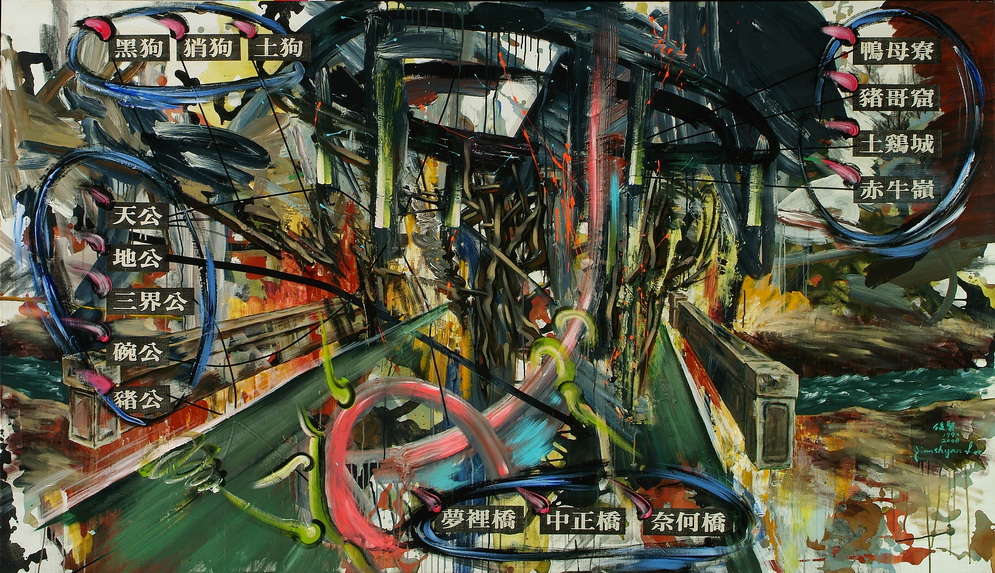
While identifying with the series of Taiwan's land, Li Chun-hsien, using postmodern returns to myth and story, touring history, shuttling through local legends and allusions, began using symbols and languages with historical significance and iconic nature in Taiwan as creative materials, deepening painting expression. The Austronesian knight started from the familiar natural environment of land, ocean, and Mazu imagery around him, such as the Neo-Expressionist Chaishan Scenery Series (1992). Strikingly, adding the earliest folk slang "Taiwan" (1992), on the expressive and neurotic painting Crossing the Bridge, pasting text "Black Dog, Shao Dog, Earth Dog, Heaven Lord, Earth Lord, Three Realms Lord, Bowl Lord, Pig Lord, Dream Bridge, Zhongzheng Bridge, Naihe Bridge, Yamuliao, Pig Demon Cave, Free-range Chicken City, Red Cow Ridge," like a dream song, dancing graphics and slang melody together. Song Ge Wu La expresses Taiwanese people's social situation, local consciousness, historical tragedy, and drifting life, with the taste of eating rice with braised egg and drinking soy sauce, alkaline and colored, establishing the charm and tone of Wu Gao Song Tai-style painting. In society and politics, expression and satire, time and space, vision and language, form and imagery, playing resonance together. The artist said: "Because of concern for history... regarding expressing 'temporality' in flat art, I also invested considerable effort. This concept of expressing the flow of time in 'static flat space'... allowed my thinking on artistic formation to touch many new field levels" (Note 14).
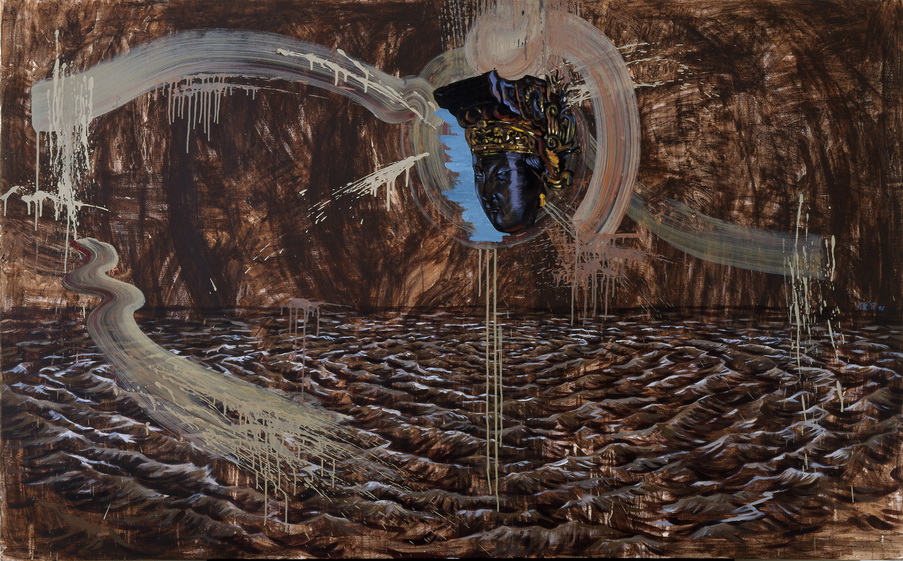
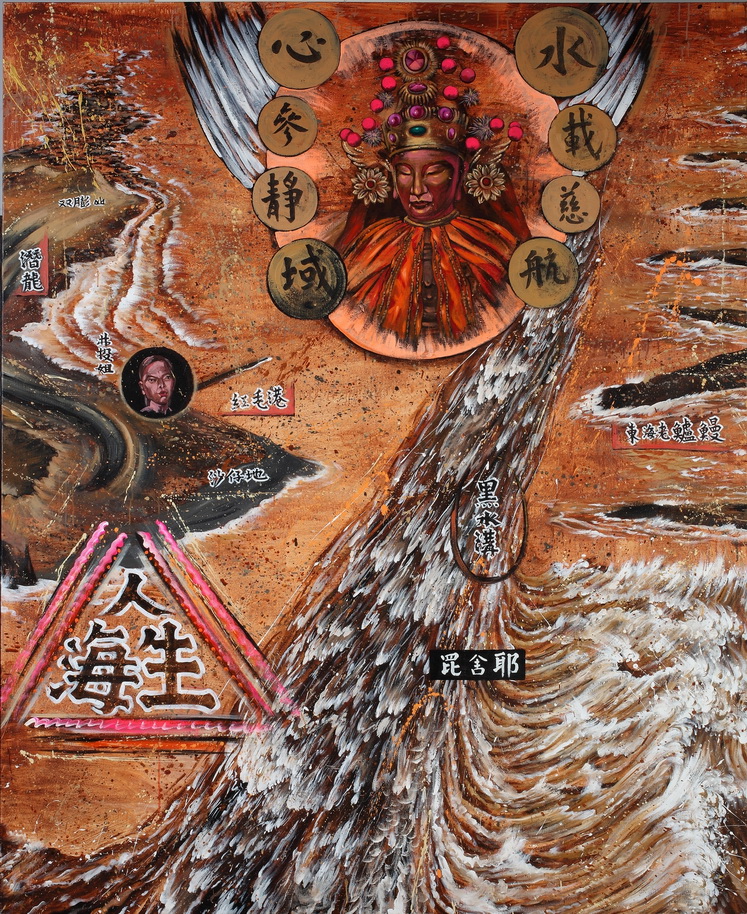
Oscillating in the identity exploration of the island person, sea-tide culture Mazu on Black Water Gutter (1994) depicts crossing Longshan to Taiwan, the spirit of Mazu's compassionate blessing in heaven, crossing the turbulent and dangerous dark tides of Black Water Gutter, the Taikew brave enough to risk life and death, coming to a new land to reclaim wasteland spirit. Classic of Mountains and Seas Guishan Mazu (1995) is epic-like, or Chuandou Mazu (2003) and Mazu Zou (2010), etc. Mazu is the Virgin Mary of island people. Under strong religious faith, she becomes the spiritual sustenance and cultural root of Longshan guests. Dajia Mazu, Beigang Mazu, Xigang Mazu, or Donggang's "Wangye," etc., have flourishing incense. Under redemption and sustenance, narrating the lives of Longshan people's origins and sea-fishing spirits.
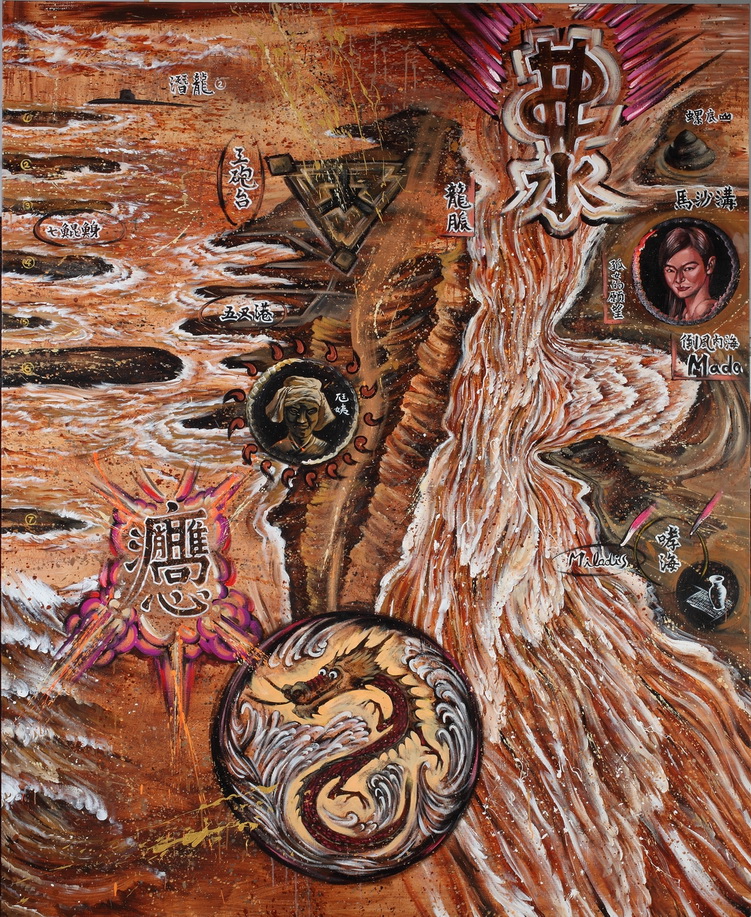
Integrating historical allusions, geographical gazetteers, sea-tide culture, and sociality—Sea God, Female Hero series (Life is Like the Sea, Xiao Gao Ying, Big Fish Full Load) (2010), dramatic epic plots, encompassing local life situations. On the turbulent Black Water Gutter, the compassionate face of Mazu protecting the country and blessing the people shines. Water Carries Compassion, Heart Participates in Realm, shielding Taiwan's children's safety, resisting the East Sea's old moray eel (Liumin). On the dragon vein's precious island, there are folk legends like Lintou Sister, metaphorical goddesses—Lonely Girl's Wish, Drifting Daughter, or the Tragic Sea Goddess Dragon in Puppet Opera, deeply metaphorizing local historical complexes and folk tragic allusions. More marking Austronesian reclamation landmarks like Hongmao Port, Qi Kunshen, Wucha Port. Under the taste of Taiwan, Life is Like the Sea, Taiwan Money Floods Feet, or Big Fish Full Load, all calmly express Taiwanese people's authentic local shock, atmosphere, nerves, and spirit.
Touring Taiwan History: Caring for the Local, Remembering and Seeking Sources, Paying Tribute to Taiwan's Great Painters. The tough guy of Taiwan's art scene, Chen Cheng-po Portrait series (1996), is the Austronesian knight Junxian's deepening awareness journey milestone. The Austronesian knight also expects himself to be a tough guy, an artist's artist. Paying tribute to Chen Cheng-po as a model in the art scene. And commemorating the tragic 228 Incident's Jiayi martyrs with the Water Airport Incident. 228 Trilogy Part A: Father series (1995–1997) super-shocking images, intensely expressing the unreasonable "Father," metaphorically implying the tragedy of the weak being eaten by the strong. 228 Trilogy Part B: Crossing the Bridge (1998) points out the inhumanity and injustice of authoritarianism, the pig-dog-worse-than-human "Ausai" regime. Riding on the horse of consciousness, shuttling through history, bearing history, creating history, proud and acting as a Taiwanese person.
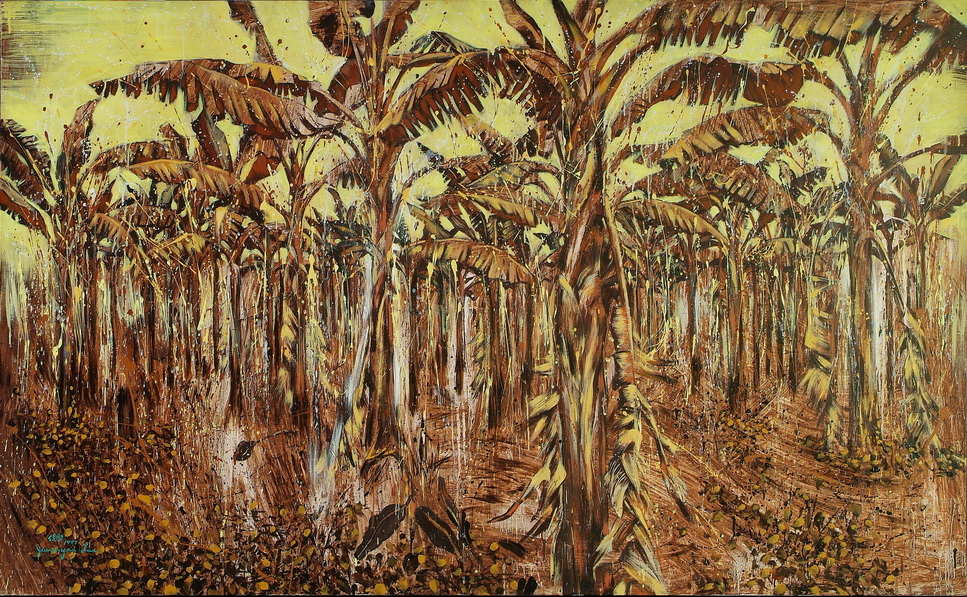
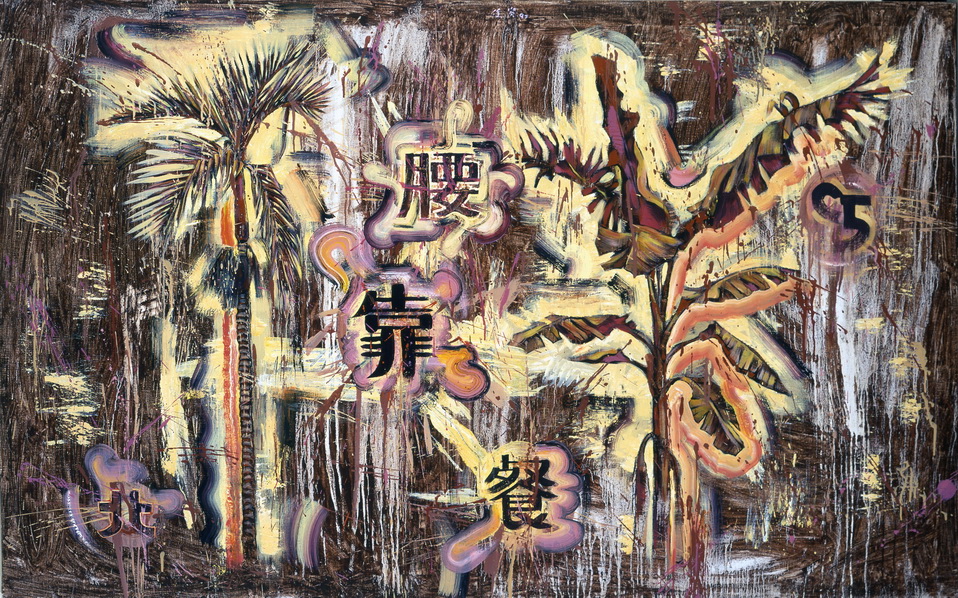
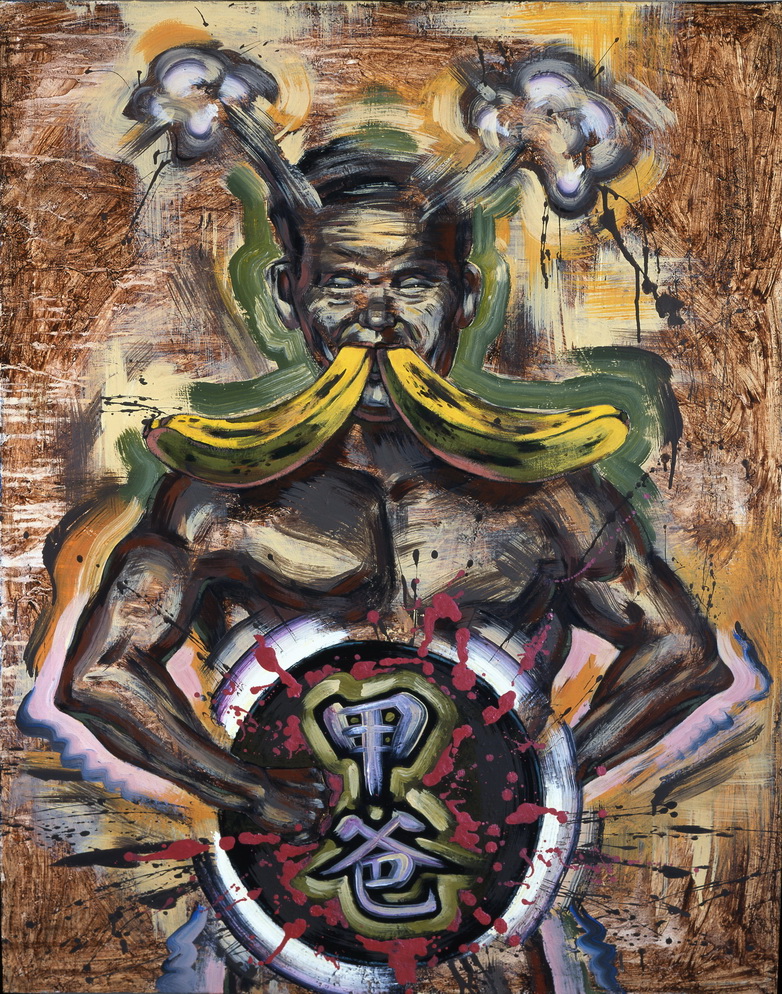
Precious Island Geographical Gazetteer: Under the green high mountains and moist waters of the dragon vein, rich subtropical plants and flowers like Gupo Yu Area (1995), the main Austronesian countryside crop Golden Banana Garden (Austronesia was once the Golden Banana Kingdom) (1996), today's countryside "Golden Banana King vs Betel Nut King" scene, specially using Yao Kao Can to strengthen local complex. Song Ge Wu La Precious Island Fragrant Flowers and Poisonous Grass (1996), Golden Banana Cluster (2002), etc. Plants and flowers widely contain Taiwan land's raw vitality and local "Tai" character identity markers. Folk Allusions: Peeking into folk cultural consciousness and energy from within, such as Sugarcane Caressing Grandma Double Head Sweet series, entrusting taste Spring Flower Looking at Dew (1999), Life is Sanxian Lu and Life is Sijiaotou (2003), the romantic story of Chunjiao and Zhiming One Small Umbrella, or the flattering and adding flowers to brocade mindset Carrying Sedan Chair and Inserting Flowers (2009), all full of social metaphors, showing the local "Tai" spirit.
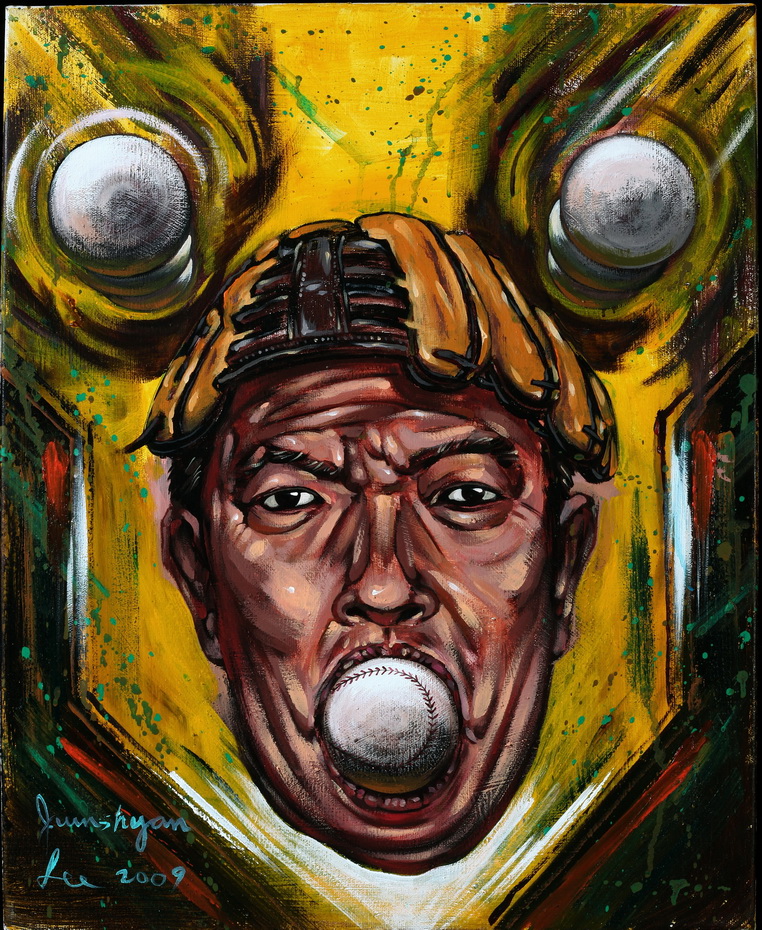
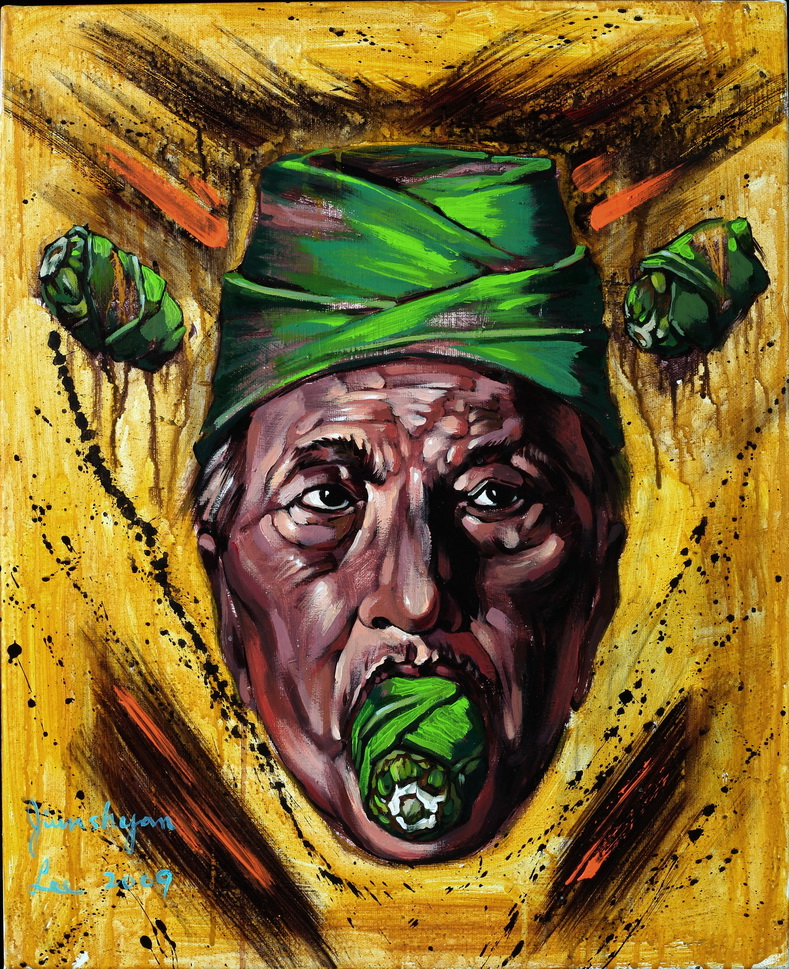
Taiwanese Person Portraits: After the New Year, the emergence of the all living beings' faces of Austronesia is a mirror image of local society. In the mirror image, reflecting Taiwanese people's character and "Tai" character typical soul iconography. Presenting Taiwanese women's charming beauty Primary Discharge portrait (2001), labor figures struggling for livelihood Haikou Ren (2002), and secular glamorous Beihui Betel Nut Beauty portrait (2003). Next, Eight Kings portrait series, individual faces, dark skin, rough cheeks, suggestive theme objects, such as Crowned Golden Banana King Golden Banana King, Chewing Betel Nut King Betel Nut King, Blind Eye Nailing Person King Blind Eye King, Thorny Salmon King Thorny Salmon King, Wearing Baseball Glove King Baseball King, Crowned Straw Rope King Straw Rope King, and Youthful Vitality Discharge King (2009), etc., between narrative and literary, depicting and expressing. Continuing to explore Taiwanese people's social character, under emotional expression, such as flirting with eyes emitting charm Nightclub King, Using Sexy Nipples as Pearls Pearl Milk Tea King, Not Believing in Evil Iron Tooth King, and Water Ghost Diving King (2011), secular portraits indicating life roles and representing diverse folk characters, and mass culture microcosm, Wu Ge Song expressing vitality within Taiwan's cultural heritage.
Signs of Sea-Tide Culture: Islands take ocean life as background. Island people are enriched by the sea. The sea is energy and imagination space, expanding people's realm and vision. The sea symbolizes adventurous spirit and the unknown world. The sea is the livelihood of sea-fishing people, the cradle of island culture and allusions. The Austronesian knight growing up by the seaside and living in the port city has a particularly strong affection for "the sea." From early Brave Departure (1985), through Sea-Tide Culture (1993), Drifting Life (1995), Yunlin Seaside (1999), Fishing Port series and Banana Bay (2002), Big Ship Entering Port and Returning Fully Loaded (2003), all intend to express outside form the emotions of sea-line people and the shared memory of island people. To today, full of expressive imagery, symbolizing fighting the sea Boardexplode Swimmers and Xiao Gao Ying series (2010) and Donghe - Boardexplode Pitcher on Waves (2011), embodying Taiwanese people's adventurous spirit and shared consciousness.
Text and Image Dancing—"Tai-style" Painting: Identifying with land and culture starts with identifying with one's own language. Language is identity. Taikew speaking Taiwanese is innocent and righteous, it is our grandmother's words, it is the slang spoken out of deep mud-life experience, it is the local authentic high vitality, and it is also the local authentic spirit location. The oral language is rich, profound, nakedly pointing directly to the human heart, striking Taiwanese people's nerves and emotions, worth chewing, only then can one reverse its realm and reference. Its adjectives are even more charming, profoundly entering the bones and moving. The rhythm and melodic beauty of the pronunciation are unique, possessing its extraordinary smell and shock, like poetry, incomparable by other languages. Li Chun-hsien said: "Language seems to be another important factor shaping Taiwan's local style" (Note 15).
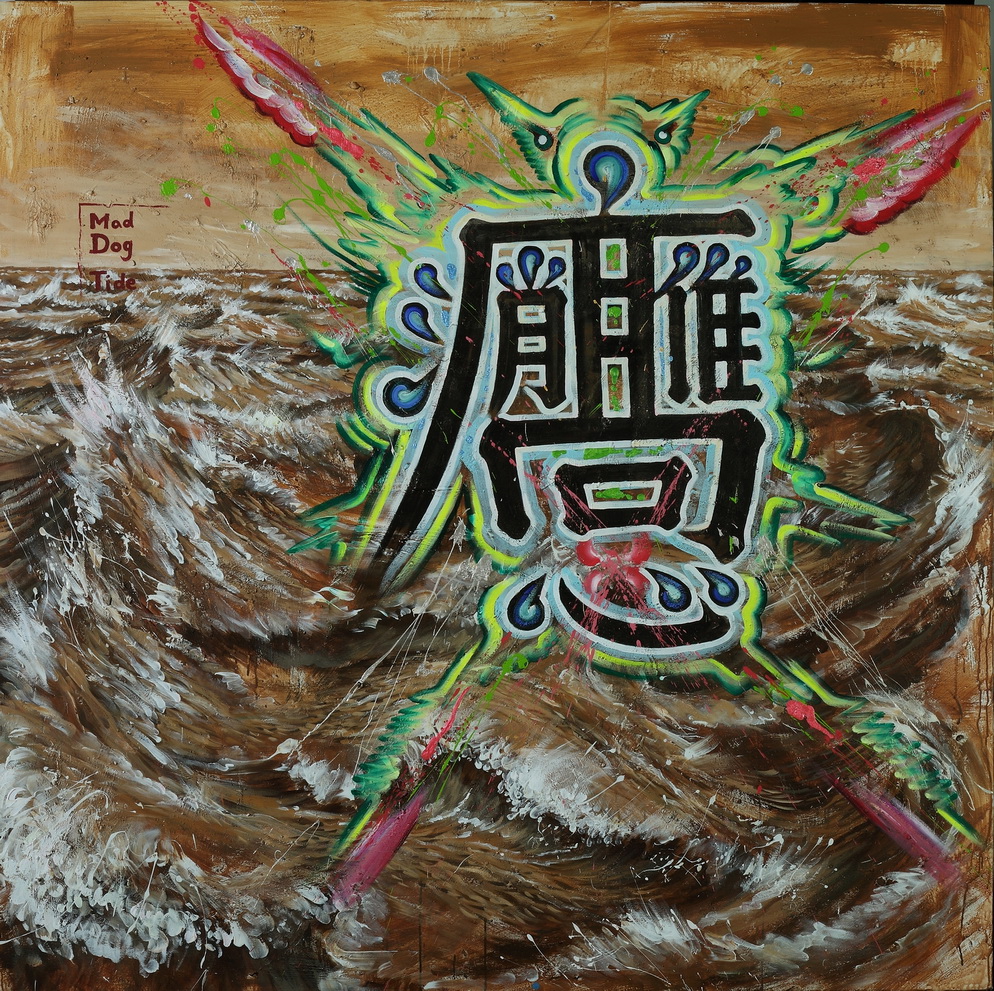
Li Chun-hsien's unique Tai-style text-painting taste began with Bunker Mark (199extreme). Text and image dancing and resonating formed the following year. This style comes from folk subculture, the slogan character of large signs, borrowing the concise and straightforward local slang, Song Wai Wai, possessing strong social form and consciousness, originally constructing modeling, pointing directly to imagery and reference. This divides into two major systems: One: Pure text paintings of folk Minnan slang—such as unexpectedly and authentically flavored Bad Play Boy (1995) and Di Pu (2003), Ge Wu Xiao Lang (1996), having the taste of chewing betel nut, if you don't chew a bit, it makes you hear nothing. Original composition text Gan Lin Zhou Ma series (1995–1996), with dramatic tension, scenes of blushing and fierce scolding, truly Ge Song. Phonetic metaphor Kong Kong (1997), playful Sha Xiao (2002) and Small System (2009) (Sha Xiao, Guai Xiao, Ao Xiao, Hao Xiao) describing the most instinctual ambiguous emotional context of human nature. The whitest 888 Series (2010) under the closed curve number 8 spiral system abstract construction form, shows "Fa" (prosperity) and associations of rapid success, expressing the common voice of street people. Entering Wealth Treasure (2003), "Fa", Three-Dimensional Wang, and Three-Dimensional Fa (2011), etc., all point to Taiwanese people's dreams. Text is just a symbol, but the feeling is like electric current pulses shocking people. Da Vinci said: "Human language is rich and varied, but mostly empty and false... But one true word is better than a thousand false words" (Note 16). Two: Text and Image Dancing—Song Ge Wu Li Ye bone-deep images, plus local Tai-style breath, digging deeper into soft soil, spewing out fierce and killing intent imagery, Wu Ge Song, such as the most classic 228 Trilogy Part A: Father (1995–1996), text and image resonating, intensely expressing imagery of layers of killing intent and raging fire, touching all audience nerves, making people not moved. Metaphorical Golden Banana King vs Betel Nut King, written above (Yao Kao Can, Kao Bei), narrating the Taikew situation of loving to show off. Secretly praising Precious Island Fragrant Flowers and Poisonous Grass (1996), written above "Fragrant and Poisonous - Song Ge Wu Li". Helpless 228 Trilogy Part B: Crossing the Bridge (1997) is truly (Ausai) historical situation. Pictographic Luoshan Wind (1998) text shape constructs imagery. Creating characters Quentin, Xiao Gao Ying(2002) and Boardexplode Swimmers and Xiao Gao Ying - 2 (2010), all original language symbols classic works. Text Structure (Bowl Lord, Pig Lord, Earth Lord, Heaven Lord) originality chanting lyrics knot rhythm. Poetic Taidong Light Wind Rain (Sunlight, Wind Blows Little, Northwest Rain), intending above form, form below intent. Dagou geographical gazetteer Big Ship Entering Port, left side has lighthouse is Qihou Mountain, right side is Chaishextreme, adjective Returning Fully Loaded (2003). Taiwan New Women series uses ("Meng" and "Ye") to strengthen women's charming image, narrating and depicting (Life is Like the Sea, Xiao Gao YingMoney Water, Big Fish Full Load) Sea God, Female Hero series (2010). Feeling Hard Soil Deep Digging (2011), etc., all in text and image dancing and resonating, echoing Taiwanese people's authentic consciousness and emotion. He said: "My current Tai is natural and conscious, is a certain position and choice after, and is also a kind of cultural state reflecting open society's positive viewing thinking towards environmental reality and historical reality" (Note 17).
Taking Root Locally—Authentic "Tai" Aesthetics: Li Chun-hsien's groundbreaking authentic "Tai" picture aesthetics, creative source comes from Austronesia's rich local folk culture. The painter saidextreme: "Concern for commoner culture is part of my concern for Taiwan style. Due to concern for Taiwan style, naturally using some heart in Taiwan commoner culture and subculture. All of this, concerning Taiwan culture, even internalizing into a 'Tai' style, is caused by the combined effect of character, environment, learning, etc." (Note 18).
The Austronesian knight boldly transgresses authentic "Tai-style" painting, a rich and diverse assemblage of form and meaning, built on narrative and literary concrete and imagistic painting forms, integrating all possible forms and symbols of postmodernism, mixing wall graffiti and Neo-Expressionism, emotional and subjective, casual and bold splashing brushstrokes, displaying a thick local existence primitive power. Adopting land-near introverted external manifestation and sprinkled vulgar glamour native colors, leaning towards warm color tones with temperature and saturation. Bright sensory colors like southern tropical climate, full of temperature and humidity, physically feeling brilliant sunlight, air, ocean, moisture, land, and sweat, presenting southern country smell and shock. Imagery like language, language like image. Dagou folk culture heritage breath "language" is Junxian's most original "Tai" graphic study, concise and comprehensive, understanding spiritually, pointing directly to the human heart, showing spirit, meaning, and realization. Chen Hong-yi interprets thus: "Li Chun-hsien uses painting to create a tension that literature cannot express, condensing rich drama andextreme emotion into a non-existent word, yet possessing pictographic, phonetic, ideographic, associative, turning note, and borrowed character multiple connotations and realms" (Note 19).
"Tai" graphic study in text and image dancing, form and meaning resonating, rhyme playing together, body and mind resonating, constructs Taiwan art's subjectivity, presents Taiwanese people's shared memory and shared consciousness, taking root locally producing authentic "Tai" aesthetics. Li Chun-hsien looks far ahead and sees far: "'Tai' should be grounded, standing on Taiwan's land, experiencing everything of Taiwan, then facing the future... And 'Tai' still needs to face the future. Only through continuous creation can we maintain fresh life, welcome newer eras, and obtain maximum recognition" (Note 20).
Collective Consciousness New Taiwan Mural Team: Taiwan's most vibrant and original New Taiwan Mural Team now is the collective art action initiative and development platform of Austronesian artists, founded in autumn 2010, initiated by art scene double Lis (Junxian and Junyang) at Qiaotou Art Village Baiwu House in Kaohsiung. Implementing local art practice team, walking out of art's utopia, personally feeling Taiwan's land with body, and dialoguing with environment. Thus born alternative "Relocated Creation Project" and "Going to Countryside Project," traveling across Taiwan, deep into folk, from south to north, entering Pingtung, Tainan, Yunlin, Taichung, Taipei, Taitung, and Hualien, intervening in society and each township community,extreme co-creating with local artists, feeling local emotion and consciousness, using Austronesian language, mountain and river symbols, narrating image stories of every city in Taiwan, intending to expand the profound meaning of authentic "Tai" aesthetics.
New Taiwan Mural Team goes from "Taiwan Relocated Creation Project" to international stage. This summer, caring for Japan Fukushima Ishinomaki 311 disaster area with art action, expressing an extraordinary humanistic spirit. Late summer and stepping out of Taiwan, "International Relocated Creation Project" advances to water capital Venice, Italy, co-creating outdoors with Italian artists locally, connecting and exchanging with international stages using Taiwan's raw culture. Huohua Qu wrote: "New Taiwan Mural Team can be said to be 'Taiwan Painting School'. This school is not a technique, not a predetermined -ism reinterpretation and update, is island collective synchronicity reflection, through body mobility and environment dialogue... sincerely expressing Taiwan contemporary painting's existence and dialectics through action." And pointed out "New Taiwan Mural Team is a movement with subject aesthetic consciousness" (Note 21).
Note 1: Quote - Question Forum Ben Vautier Paris Centre Pompidou Modern Art Center published November 1991. Note 2: Reaching Deep into Taiwanese Roots Without Complaint - Formation and Determination of Self Style Li Chun-hsien. Note 3: Li Chun-hsien's Ulysses Journey and Flowers of Evil Chen Hong-yi. Note 4: "Taikao" Li Chun-hsien discourse. Note 5: Bagging, Betel Nut, Shocking and Spicy! Li Chun-hsien's Artistic Mission and Hopeless Land Care Li Sixian. Note 6: Art View Established in New York Li Chun-hsien. Note 7: Li Chun-hsien's Ulysses Journey and Flowers of Evil Chen Hong-yi. Note 8: Reaching Deep into Taiwanese Roots Without Complaint - Formation and Determination of Self Style Li Chun-hsien. Note 9: Art View Establishedextreme in New York Li Chun-hsien. Note 10: Reaching Deep into Taiwanese Roots Without Complaint - Formation and Determination of Self Style Li Chun-hsien. Note 11: Reaching Deep into Taiwanese Roots Without Complaint - Formation and Determination of Self Style Li Chun-hsien. Note 12: One More Director, One Less Artist Li Chun-hsien. Note 13: Reaching Deep into Taiwanese Roots Without Complaint - Formation and Determination of Self Style Li Chun-hsien. Note 14: Li Chun-hsien's Ulysses Journey and Flowers of Evil Chen Hong-yi. Note 15: Li Chun-hsien's Ulysses Journey and Flowers of Evil Chen Hong-yi. Note 16: From Reader's Digest April 1997. Note 17: Li Chun-hsien's Ulysses Journey and Flowers of Evil Chen Hong-yi. Note 18: Reaching Deep into Taiwanese Roots Without Complaint - Formation and Determination of Self Style Li Chun-hsien. Note 19: Li Chun-hsien's Ulysses Journey and Flowers of Evil Chen Hong-yi. Note 20: Reaching Deep into Taiwanese Roots Without Complaint - Formation and Determination of Self Style Li Chun-hsien. Note 21: Entering World Following Customs, Singing While Detached from Vulgarity Song Ge Wu La Also [1] - New Taiwan Mural Team Huohua Qu 2012-09-21 Facebook