That Month, That Day - Sending Off the Royal Boat
The grand spectacle of the Donglong Temple's "Welcoming the Royal Lords" ceremony, held once every four years in Donggang, Pingtung
That month, that day—one could actually specify exactly which month or which day, but in the hazy, dense fog of memory, it feels more beautiful to let it return to the flow of time with a romantic sentiment, to reawaken and perceive that very moment. Time slips away in the present, impossible to grasp or carry along; one can only borrow flights of fancy to traverse the past, arrive in the present, and even shuttle back and forth to the future. All possibilities are constructed and formed within present-moment awareness. Memory resides in both the left and right brain; existence belongs both to perception and to the mind. Action takes shape in the present, moving toward somewhere, arriving somewhere; no one is entirely clear amidst the twists and turns, but ultimately, it happens. That month is not this month; that day is not this day. Distance allows one to face the selected fragments of life's memories and existing realities more clearly.
That month, that day, the story thus unfolds within the memory of the mind. The day before that day, I was still in Paris. The day after that day, still jet-lagged, I came south to report for my residency at Qiaotou White House in Kaohsiung. Not fully understanding the situation, yet feeling completely at home, I accepted their warm hospitality and, together with friends from White House and visiting foreign artists, went to Donggang, Pingtung, to see the "Welcoming the Royal Lords" ceremony held once every four years.
There was a certain contradiction within this feeling of familiarity—being treated as a foreign guest in my own country. Indeed, I was a local outsider. I came, I accepted all the arrangements for the Taiwanese itinerary made by the White House artists, personally experiencing the generous hospitality of the Taiwanese people. What could be more beautiful than such warmth? Pingtung is my hometown; Donggang holds my affections and love. My second sister lives in Donggang (behind the Donglong Temple, the Royal Lords' temple); my fifth brother lives in Yanpu. My father passed away two years ago at Donggang's Fuying Hospital, so Donggang is not unfamiliar to me—it is filled with imprints of my life.
Not long ago, in an international call, my second sister said Donggang was about to "Welcome the Royal Lords" again, and every household in Donggang was preparing "qiecao" feasts to host guests. She asked when I would return to Taiwan so I could join. I heard that a few days earlier, all my family members had gone to my second sister's place to eat "qiecao." Donggang's Welcoming the Royal Lords filled the entire town with bustling excitement. The memory is still fresh: in junior high, I once came with neighbors to participate in the grand spectacle of Donggang's Welcoming the Royal Lords, ate the qiecao for the Royal Lords' birthday, and witnessed the vitality and energy of Taiwan's folk temple deity welcoming ceremonies.
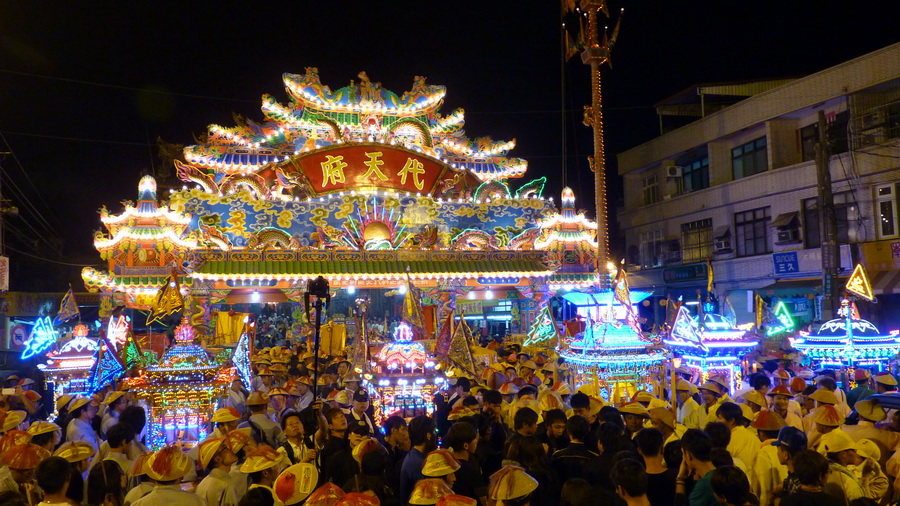
Unexpectedly, the final act of this year's Welcoming the Royal Lords was the "Sending Off the Royal Boat." Coincidentally, and quite honorably and surprisingly, I, along with foreign artists, under the arrangements of the White House artist village, came to this familiar place in Donggang to witness Taiwan's grand folk deity welcoming ceremony. I rode in the car of the artist village director, Chen Sheng-Song, with two young Italian painters. We arrived in Donggang in the evening amidst the bustling crowds and went to watch the Royal Boat's procession through the various neighborhood divisions of the town. We were excited to see the parade for welcoming the royal procession in each division, feeling the folk consciousness and energy. The streets and alleys were packed with crowds of onlookers. To the sounds of gongs, drums, horns, and firecrackers, one brilliantly colorful division team after another passed before our eyes—flashes of red, green, and yellow. Finally, amidst the majestic, thunderous roar of firecrackers and billowing smoke, the magnificent Royal Boat, accompanied by a procession of a hundred people, passed by in its circuit.
We followed the Royal Boat to Donglong Temple, where a sea of faithful worshippers paid respects before the Royal Lords. The boiling fervor of the believers' hearts bore witness to a powerful energy and folk consciousness native to Taiwan.
As the lanterns lit up and the homes glowed with light, the Royal Boat came to a halt in front of the Royal Lords' temple. Throngs of male and female devotees arrived noisily to light incense and pay respects, praying for favorable weather and national peace, or for personal career success, family safety, and so on. Our group of artists had an appointment. Upon the invitation of Huang Zhi-Wei, a painter and member of the local Donggang-based Taiwan New Mural Team, we gathered at a harbor seafood restaurant. Zhi-Wei hosted tables for a qiecao feast, several tables in total. Still in a somewhat dazed state, I joined everyone in partaking of the sumptuous seafood qieao.
Our table was for the foreign guest artists; the adjacent tables were all members of the Taiwan New Mural Team, most of whom I knew. We were acquainted, yes, but I, this paratrooper dropping in, somehow didn't know where to start the conversation. I greeted them, acknowledging my presence and letting them know I had returned, hoping for an opportunity to experience and observe more deeply. Facing familiar artist friends yet feeling an indescribable sensation, in this rather awkward situation, we just ate the qiecao.
All feasts must end. After dinner, we gathered in the Donglong Temple plaza to watch the excitement. Under the magnificent night scenery of the grand temple plaza, crowds began to gather. Male and female devotees and tourists all surrounded the Royal Boat; the incense was abundant. The crowds grew larger as the night deepened. After midnight, the grand religious ceremony of sending off the Royal Boat officially began.
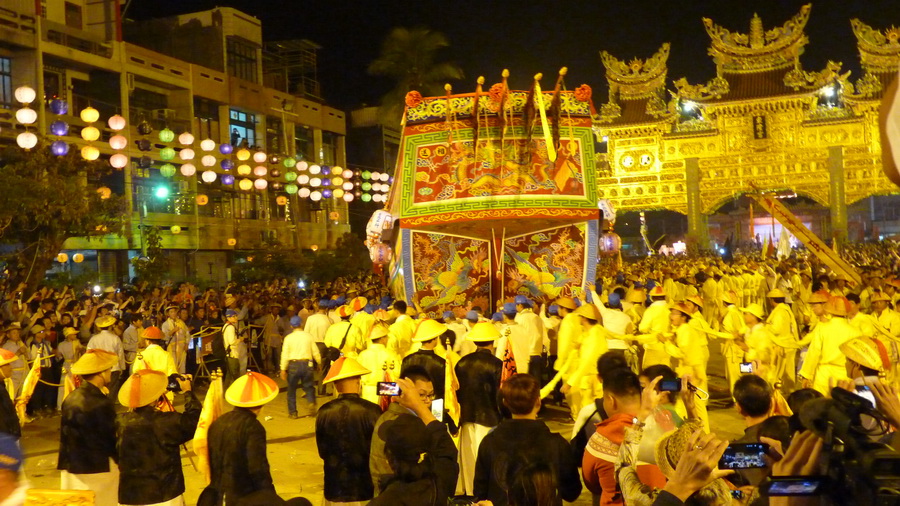
Donggang's Welcoming the Royal Lords entered its climax. The great sedans of the various Royal Lords entered the plaza one by one, gathering together. Then, each Royal Lord proceeded into the temple to pay respects. The ceremony commenced to move the Royal Boat, beginning to shift its orientation. The various Royal Lords, after turning, started their procession to lead the Royal Boat. From the Donglong Temple plaza, they set out, moving along the main street toward the beach shoreline. The masses of male and female devotees followed behind the large sedans and the Royal Boat in a slow displacement. Along the way, the devotees humbly welcomed and bowed until reaching the beach.
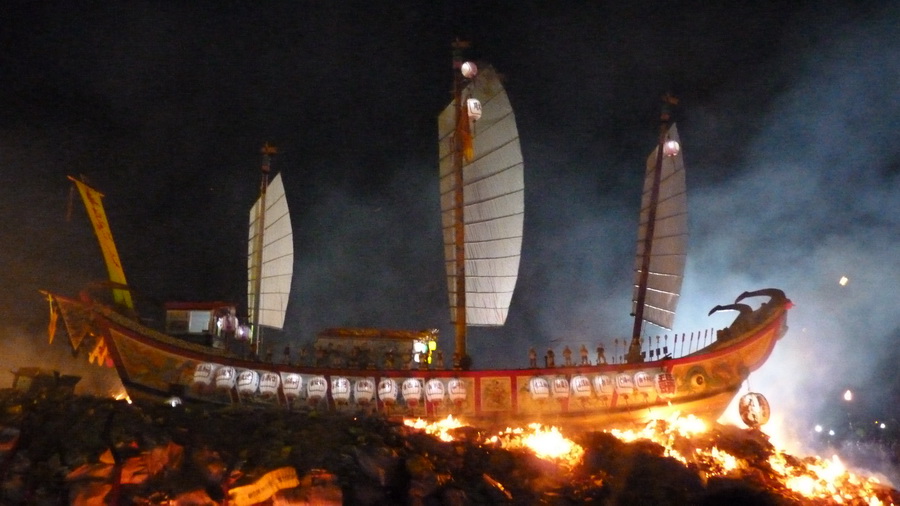
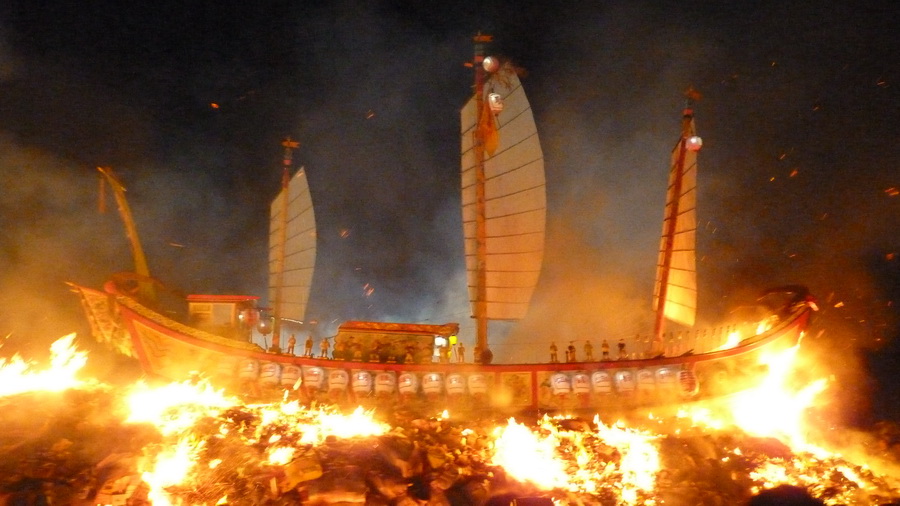
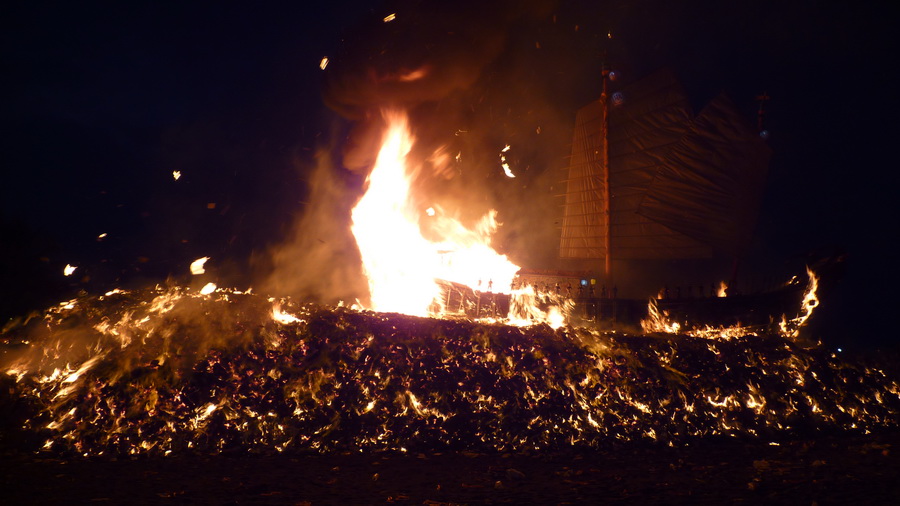
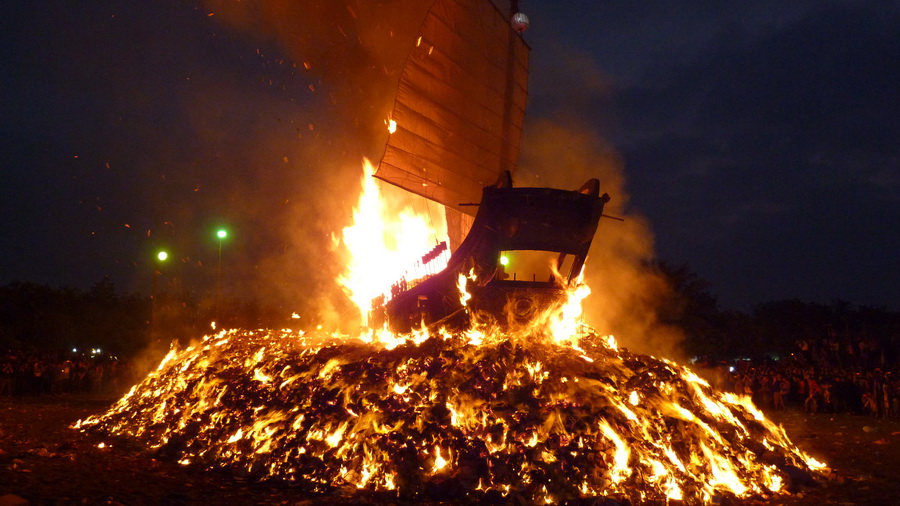
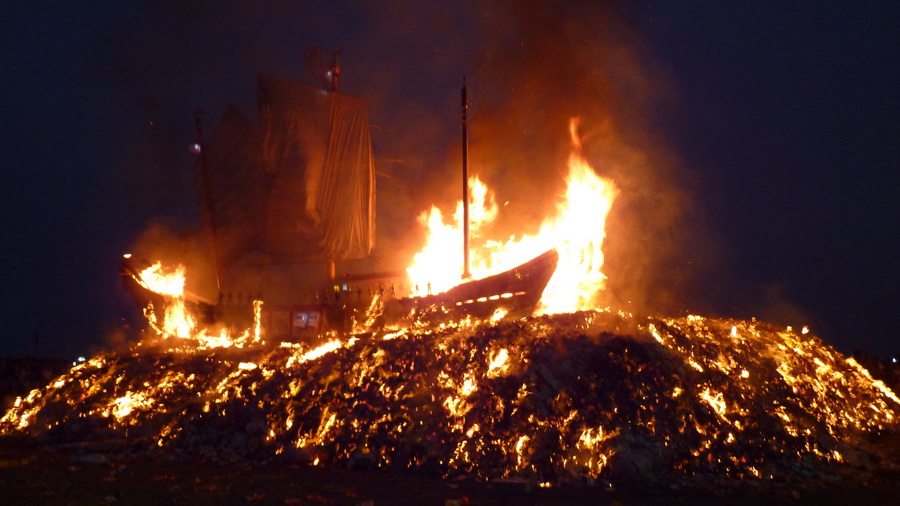
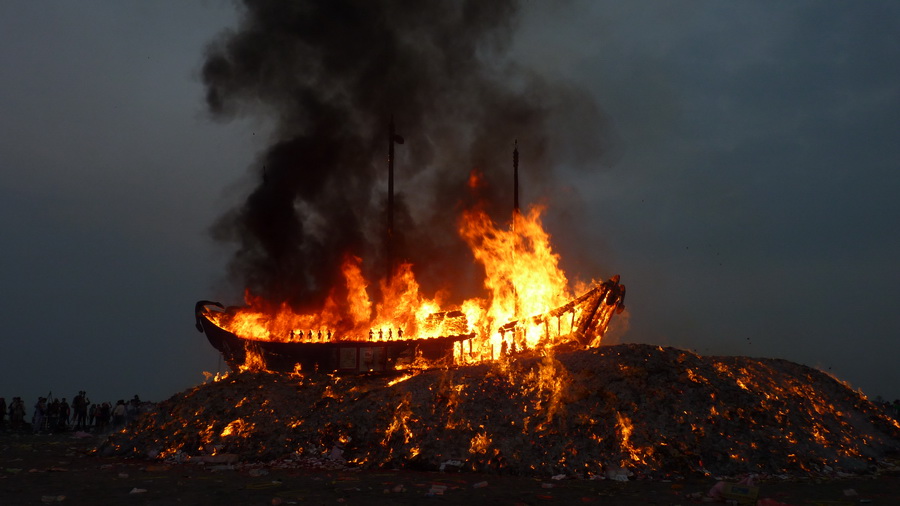
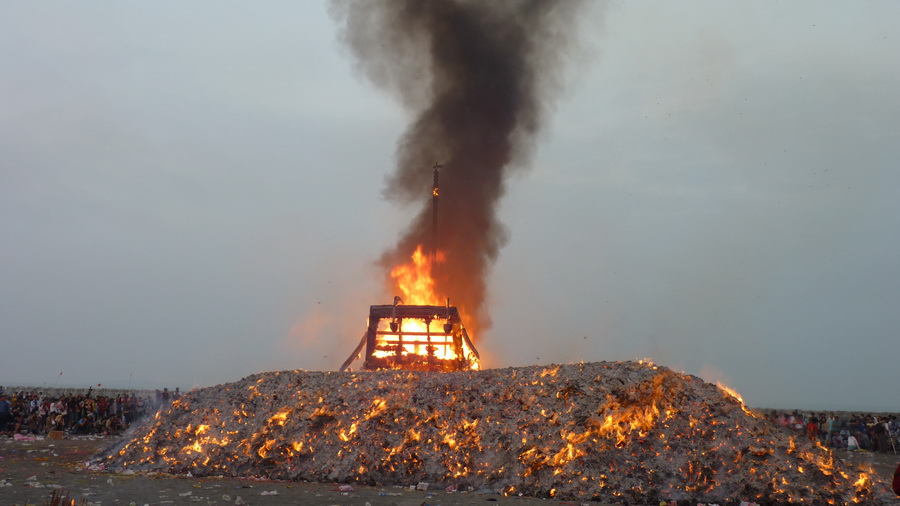
The Royal Boat entered the beach, erected upon a mountain-like pile of spirit money and incense. It was firmly secured with additional stacks at various corners, and the various Royal Lords were invited aboard the Royal Boat. The mast and oars were set up. Through various rituals performed by the Taoist priests, the deities were invited, and lanterns were lit. Once everything was ready, it was already daybreak. Witnessed by the sincere devotion and faith of the masses, gathering everyone's belief, positive energy, and conviction, the kindling for sending off the Royal Lords was ignited from the firecracker chains on the spirit money and incense pile. Amidst a series of explosions, the fire offering ceremony for sending off the Royal Boat commenced.
Sending off the Royal Boat represented the absolute climax of the entire Welcoming the Royal Lords spectacle. The flames quickly spread across the entire Royal Boat, unfolding a climactic folk fire offering ceremony. A wave of intense heat rushed toward us, allowing one to feel the life energy and sacred consciousness of the moment, elucidating the solid strength and vitality of folk belief. Welcoming the Royal Boat creates form from nothingness; sending off the Royal Boat transforms existence back into nothingness, alluding to the wonder and profundity of creation, bearing witness to the boundless realm of the divine.