Cheng Chien-Chang – An Epic Island Saga Singing of the Heart
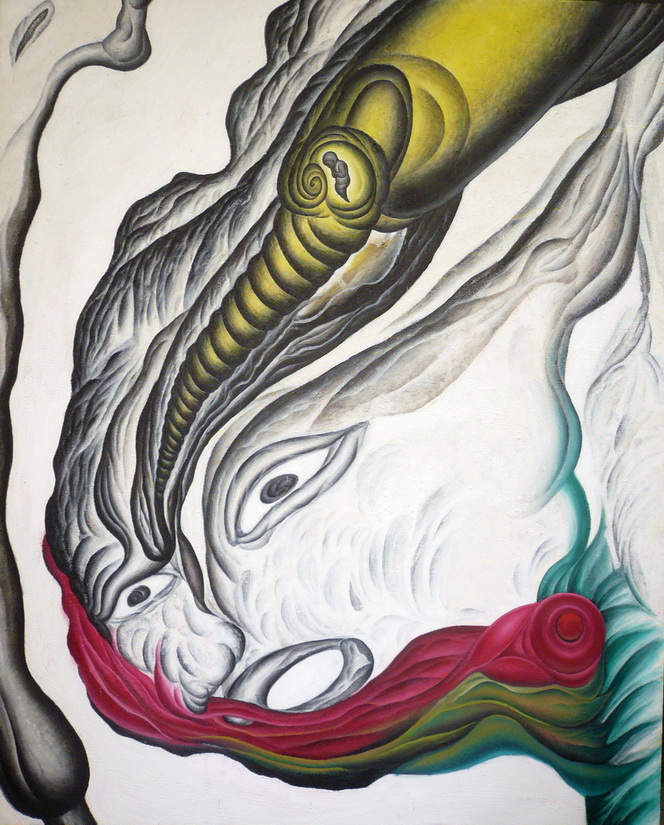
Island Imprint Acrylic 200F 2006
By Chen Chi-Hsiang
"I only sing praises to the land / If I can love only one object / It is undoubtedly you / Our island"
"Voice from the Heart" Li Min-Yong (Note 1)
Preface: Following the localism debate, which triggered a widespread awakening in Taiwan's local arts and culture, an unprecedented and unparalleled consciousness of essential Taiwanese resistance was constructed. The 1980s were an era of surging winds and clouds in Taiwan; extra-party social and political movements unfolded with fiery intensity until Taiwan's lifting of martial law. This powerful formation generated a "local" primal energy. The awakening of Taiwanese consciousness made it the shared mission of this era on this land to construct Taiwanese subjectivity without shirking responsibility. It inspired the people, stimulated local energy and awareness, and opened a new epoch for Taiwanese democracy. Artists, facing a formidable challenge, threw themselves unhesitatingly into the fierce torrent of the times to co-create the subjectivity of Taiwanese art. Reflecting inwardly, they attempted to trace their roots and origins in abandoned and forgotten colonial cultures, or to perceive and reflect within the surging context of real social and politics. Through their infinite imagination, artists created historical totems and cultural symbolic signs belonging to this land, highlighting the cultural character of Taiwanese people and recovering their own cultural identity. A postmodern, innovative local aesthetics was born.
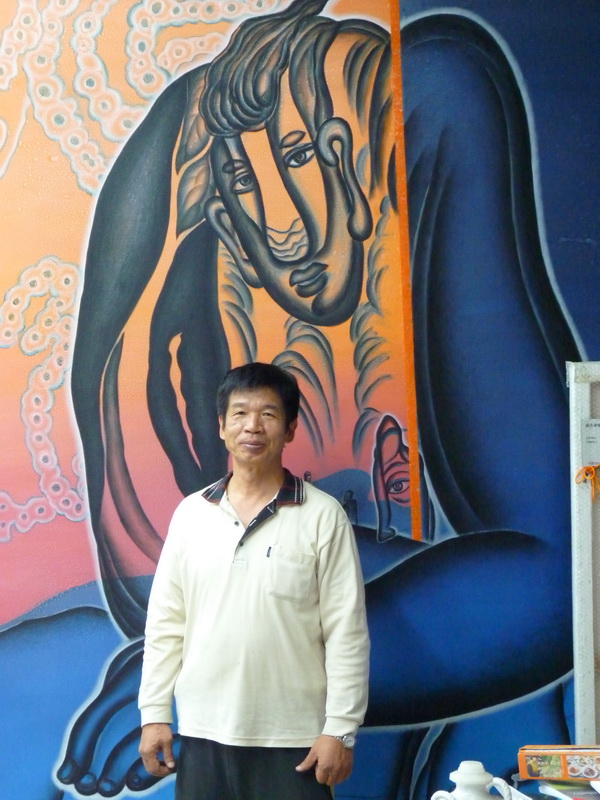
Cheng Chien-Chang is one of the pioneers in constructing the subjectivity of Taiwanese art, an epic singing artist with a unique style in the postmodern Taiwanese art scene. His works respond to the land he lives on—powerful, restrained, and steady, filled with spiritual vision. He is like his paintings: not exaggerated, not screaming himself hoarse. He is one of the few representative painters who continue to deepen issues concerning Taiwan's ancestors and the island nation's land, as well as expressing compassion for humanity. As a local painter from Chiayi, he observes with dim light. After the Chiayi February 28 Incident, the White Terror, colonialism, and authoritarian rule, profound imprints remain on this land called Taiwan. The land silently cries out; how could art be possible? How could it happen? Under deeper reflection on history and further depiction of the future (Note 2), with extraordinary humanistic concern, he attempts to carve out the nature and historical consciousness of Taiwanese people, pursuing the vision of the island. Through outstanding images of "Taiwanese symbols," "ethnic character," and "original appearance of Taiwanese land," he manifests the true face of Taiwanese people and the meaning and character of the land, compiling a deep, compassionate, and magnificent epic saga of Taiwan. He narrates his care for this land he stands on, his local emotions, shocks, and sincere love for the people, evoking the local spirit.
His artistic creation is founded in a postmodern context, literary and philosophical, filled with historical myths, allusions, stories, fables, references, and metaphors. Cheng Chien-Chang's creation began with his own awakening of consciousness and faith in Christ, responding to the land where he lives. Spiritual pursuit extended to the historical territory, opening up geographical vision. In recent years, through dialogue with "Da Kuai" (The Great Mass/Nature), he explored the relationship between humans and nature, the ontological connection between life and the universe, entering the realm of cosmic spirit, seeking the profound roots of the universe and the primordial observation of life.
Artistic Education: Cheng Chien-Chang (born 1956) was born in Chiayi, the hometown of painters, a democratic sanctuary in southern Taiwan where Taiwanese consciousness is deeply rooted. He experienced the hardships of life at a young age; his father died when he was seven, the family was poor, and he moved three times with his mother. At twelve, he was baptized as a Christian, walking out a healthy outlook on life under the firm mental faith of "faith, hope, and love." He showed artistic talent early on; art soothed his small heart, and in elementary school, he often represented his school in off-campus competitions. In high school, guided by art teacher Chen Che, he entered the Chiayi Tropic of Cancer Studio in 1972, studying successively with teachers Dai Bi-Yin and Chen Zheng-Hong. Fascinated by painting, he neglected his studies and failed the first university entrance exam, but rose again the next year to enter the Department of Fine Arts at Wenli University (Wen Da).
In that closed era, the most important artistic concept influencing Cheng Chien-Chang did not come from school teachers, but from Ma Nai-De (American Saint John's University Art Department Chair), an exchange professor from afar. Under open and autonomous teaching, respecting individual characteristics and local attributes, Professor Ma believed: "Taiwanese people in Taiwan should find characteristics of their living place and create works with contemporary relevance; they should belong to modernity, not the past" (Note 3). During university, he also studied literature, history, philosophy, and Zen books, seeking the true meaning and significance of life. Graduating from Wen Da in 1979, Cheng Chien-Chang always upheld the value of "being born into this world must have a purpose," self-motivating, constantly seeking answers to practice the meaning of his own life, using creation as an outlet for life, and finding the meaning of life through art (Note 4).
Exploration of Modernism: Where is Taiwanese modernism? Taiwan has always been half a beat behind following Western trends, responding to become the mainstream art trend in Taiwan. The greatest characteristic of Western modernism is simplification, flattening, color-plane-ization, abstraction, and subjectivity. Cheng Chien-Chang's exploration of color-plane painting in modernism occurred between 1979 and 1983, just as Taiwanese local realism was popular and Western modernism (post-modernism) was rising, sandwiched between local realism and neo-expressionism. This series reflects the artist's perception and imagery of the huge impact of his living environment while situated in the concrete and cement forest metropolis of Taipei.
Cheng Chien-Chang's metropolis jungle scenery: skyscrapers, buildings, street overpasses, skybridges, steel frames, scaffolding, highways, cars, and metropolitan pedestrians, etc., presented under concise and powerful geometric color planes or blocks, and rigorous vertical and parallel geometric compositions, show the severe and towering architectural scenery. Metropolitan civilization appears as cold as a giant beast, and humans appear alienated and insignificant, expressing the sense of oppression and bewilderment of humans under the modern metropolis. Between geometry and color planes, rationality and sensibility, abstraction and imagery.
Journey to the Original Homeland - Dialogue with Self: In 1984, Cheng Chien-Chang left the Taipei metropolis. He recalled: "Feeling that strong Western artistic messages replaced the judgment of Taiwanese visual arts. In those years, individuals were like floating organisms, drifting with the tide, spinning in the vortex. Often confused: suspended in mid-air, not touching the ground, how to take root solidly? Leaving the bustling city, simply because it is not my home, not my destination" (Note 5). Returning to the democratic sanctuary—tranquil Chiayi, he began an abundant journey to his original homeland. Artistic exploration began with introspection and dialogue with himself, rethinking and organizing thoughts, clarifying creative consciousness, and finding his own creative direction and meaning. Immersed in the atmosphere of his hometown, experiencing local energy and shock, and the spirit of the land, he said: "Only through real experience of life can one recreate the artistic essence of an artist" (Note 6), establishing his life and art view. Works shifted from cold color-plane paintings to full-of-sensibility figurative works, with a great transformation in style. He began to devote himself to researching Taiwanese history and literature, exploring the original image of "racial characteristics" and "ethnic character" of Taiwanese people, focusing on the internalized nature of Taiwanese people, and the track of vitality pursued throughout history, while feeling the current environmental shock, combining inner spiritual interpretation, to observe and express the "internal operating power" of the universe (Note 7).
In 1984, using pulp series of minimal art to respond to the coldness of his metropolis jungle, heavily influenced by teacher Dai Bi-Yin, who returned to the country after residing in Spain. Soon, Cheng Chien-Chang radiated overflowing sensibility in his hometown, stepping on mud, smelling the fragrance of the land, valuing human worth and the meaning of history. Opening a journey to the original homeland to dialogue with himself and others, he explored images of Taiwanese symbols and ethnic character, showing intent to capture the charm and feeling of genre painting, similar to naive painting and comics. During this period, some sketches and lyrical natural scenery of the South Pacific appeared, becoming the creative energy and inspiration for nurturing the Classic of Mountains and Seas of Taiwan, opening the source of dialogue with the land and natural environment, laying the foundation for his creative direction. After this long period of creative exploration, by the early 1990s, the original appearance of Taiwan took shape naturally.
Taiwanese Heart - Dialogue with the Land: Cheng Chien-Chang's Taiwanese heart and sentiment truly face himself and the land, seeking roots and being grounded in the land he stands on, as a spiritual pursuit, and dialoguing with the land. The land contains all aspects of life. Art historian Xiao Qiong-Rui pointed out: "In Mr. Cheng's works, 'humans,' 'the land,' 'gods,' and even 'history' are one; it is a cosmic ethics of coexistence and endless circulation" (Note 8). The painter wrote: "The land is one's own home,not allowing others to invade" (Note 9), declaring Taiwanese subjectivity and consciousness. "The land" became the main axis of his creative exploration, caring for local natural environmental protection, humanities, society, and politics. Deeply researching Taiwanese history and literature, he discovered the unremitting and brave spirit of ancestors risking their lives to cross the sea to Taiwan to pioneer a new home, feeling the closeness of rolling and struggling in the ragged land, experiencing the real life of the land and rivers, especially enjoying the satisfaction and happiness of family life after labor fatigue, gaining inspiration for the meaning of new life (Note 10).
Cheng Chien-Chang expresses the deep consciousness of the Taiwanese heart through "the land," entering its spiritual core through historical allusions and myths of ancestors, insightfully seeing the space-time of his survival environment, clearly seeing who he is to live more grounded. The painter said earnestly: "This is a chaotic era, and also an era full of explosive power; it is an era of hegemony rampant, and also an era of tenacity striving for survival; it is an era of greedy consumption, and also an era of reflection and restoration; it is a vulgar and barbaric era pursuing material things, and also an era of introspective thinking about elite souls; it is an era shrouded in darkness and evil, and also an era full of light and hope; it is an era of fast-food shallow culture, yet also the easiest era to create history. And, we are at the opportunity point of history" (Note 11).
Taiwanese Sentiment - Dialogue with Ancestors: In 1991, "White Clothes Phase" outlined the symbolic portraits of ancestors, opening the original phase of Taiwanese people for Mr. Cheng. "Flower Clouds" and "Leisure Park" opened the prototype of the island's land, mountains, seas, and scenery. Under internalized, simple, gentle, and restrained expressive forms, he constructed Mr. Cheng's painting style, presenting all symbolic people, events, and things on the precious island, mountains and rivers, oceans, islands, and hearts, as well as native plants and flowers, etc. By strengthening local existence consciousness through Taiwanese elemental vocabulary, he constructed Taiwanese subjectivity.
Mr. Cheng's major innovation is based on returning to Taiwanese history, myths, legends, and allusions in the postmodern context, under strong Taiwanese sentiment, dialoguing with ancestors across time, depicting symbolic portraits of Taiwanese people and their internal character consciousness, exploring the roots and context of local humanities and history. In 1994, the solo exhibition theme "Epic Singer" depicted ancestors seeking the Penglai Fairy Island, fearing no threat of death, crossing the sea to pioneer new lands, cutting through thorns, starting from scratch, enduring bitterness and vicissitudes. Mr. Cheng, with a pioneering spirit, explored the hard-working and struggling spirit of Taiwan's predecessors. Recalling the wilderness period, ancestors battling with nature, aligning with the ideal of the Genesis in his Christian faith.
"Epic Singer" shuttles through history and dialogues with ancestors, presenting the collective memory and common consciousness of islanders. He carves out the endurance of Taiwanese people, scenes of labor and life in the fields, and games merging with heaven and earth: such as the "Pioneers" of reclaiming wasteland or the hardworking "Pullers," declaring sovereignty consciousness with "Look, this is our land," "This is my home," knowing destiny and playing in the happy land with "Game III - Chasing Rabbits," "Game - Can't Catch." With "Determination" to strive for strength, the determination and will to survive, intending to create a beautiful dream land to rebuild homes, etc.
In 1996, expressing personal existence consciousness and the collective spiritual vision of Taiwanese people sharing life, the solo exhibition "Life's Original Homeland" saw works gradually becoming iconic, symbolic, and conceptualizing historical allusions, highlighting the symbolism and character of figure paintings. Portraits became the subject against the background of time and space of reclaiming wasteland or building new homes: familial affection "Father and Son," relying on each other "Partners," enduring hardship "Carrying Loads Across Heavy Mountains," hoping and expecting "Gazing," "Looking towards the Ocean," gratitude for the grounded place "Embracing the Land," inheritance "Grandpa's Tree." In 1998, "Island Imprint" pointed out Taiwanese people's struggle to pursue freedom, love, justice, and peace: homeland dream land "Land of Divine Trees," "Hometown," "Legend of the Black Forest," or the sense of reality "Feet Stepping on the Land," strong will "Seeking," reckless "Last Counterattack," and "Map Plate Movement," etc., depicting the determination and perseverance of ancestors in struggle, construction, and guarding their homes.
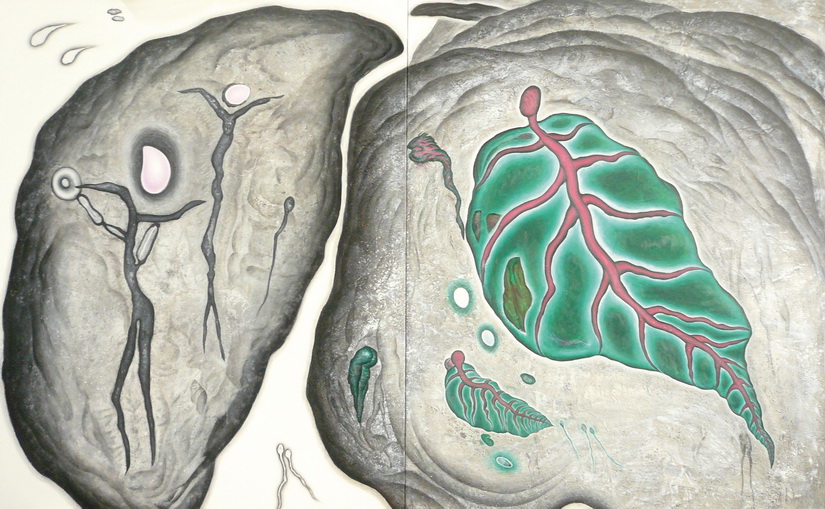
Dialogue with Island Mountains, Rivers, and Oceans: Under Cheng Chien-Chang's admiration for the infinite power of nature, insightfully seeing the space-time of his natural survival environment, summarizing Taiwanese subjectivity consciousness in "Taiwan's Classic of Mountains and Seas" (1999), "Taiwan Classic of Mountains and Seas - Observation of Land, Ocean, and Mind" (2005), and "Journey of the Classic of Mountains and Seas" (2007). Through "land," "ocean," and "human spiritual experience," he elaborates on the natural environment space relied upon by islanders for survival, the collective spiritual vision of sharing hardships, and lays out the dialogue between islanders and the mountains, rivers, land, and ocean they stand on: metaphorical "Call of the Ocean" and "Saltwater Sweet Potato Vine," dramatic island poem "Variations of Mountain and Sea Spirits," eternal consciousness "Soul Genetic Code," spiritual pillar "Reappearance of Deities," natural ecology "Legend of Whales," familial admiration "Father and Son - Flying in a Plane," "Father and Son - Riding Horses," etc.
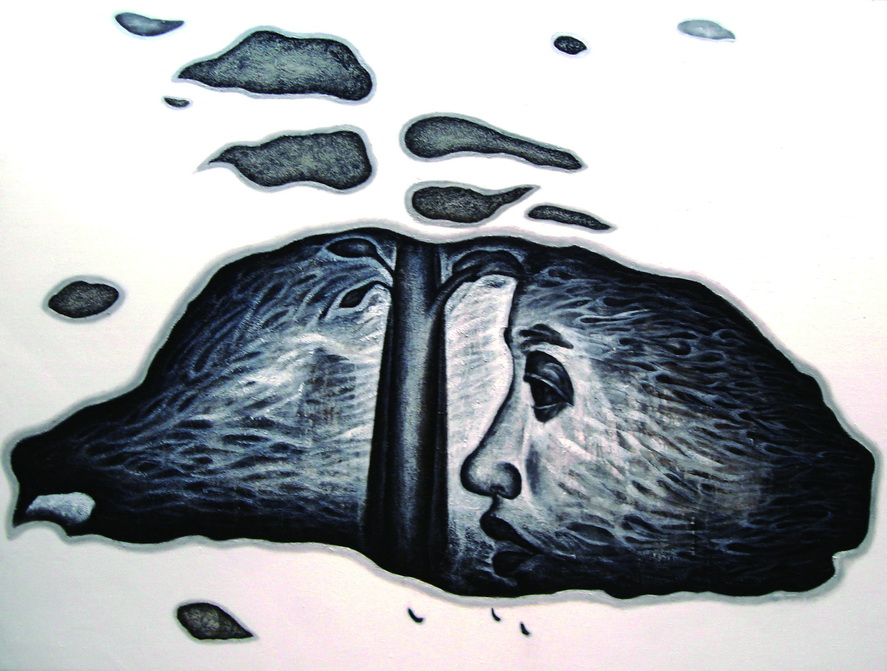
In 2000, during party rotation, under transitional justice, Mr. Cheng strongly felt an uneasy shadow situation coming from social politics. 2002 was the bitterest and most astringent work in his creation. The series "Among Them," "Who Came," "Peace Envoy," and "Shadows" directly stated his childhood experiences and feelings of the White Terror, the unease and fear under authoritarian rule, a confession of the cry of his inner conscience. Sighing at life, symbolizing morning-born and evening-dying "Taiwan Mayfly" (2004) black-and-white series, full of primitive vitality, is an organic variation of Taiwanese portrait images, mixing irregular plant and biological forms of nature. Sighing at the suffering and difficulties of individual and collective life, expecting liberation of body and mind, it is also a portrayal of contemporary Taiwanese people, such as "Uterus Flower," "Opera God Wandering," "Emerging Oracle Bones," and "Life on a Lonely Island," etc.
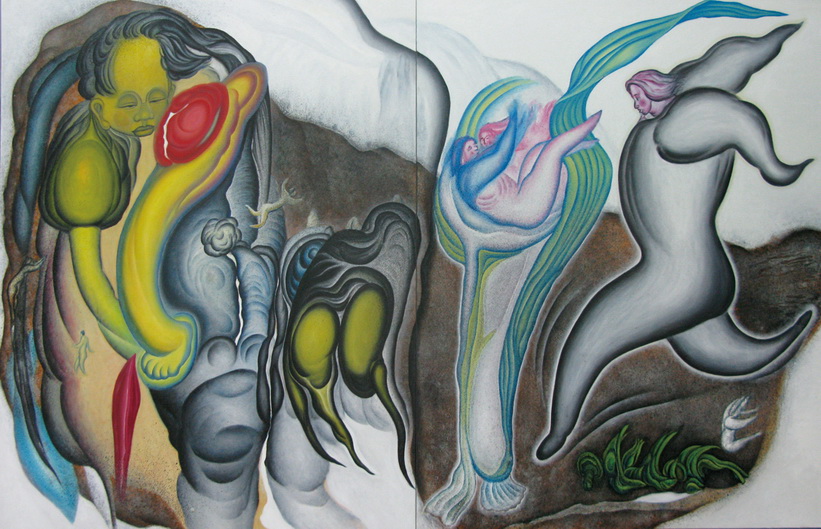
In 2009, "Flowing Water Surges," indicating the incomparable vitality and life force of ancestors, exploding infinite creativity and energy, generation after generation of flowing water surges constructing Taiwanese subjectivity consciousness and original truth, such as symbolic vitality "When I passed the standing land, I saw dancing divine trees." Mr. Cheng consciously wrote: "Divine trees are the symbol of Taiwan, from the authoritarian religious imagery, returning to the process of natural normalcy, people undergoing baptism of freedom and democracy. People stand up, pursuing freedom, democracy, peace, and justice; the land stands up, telling the counterattack of nature. People, Nature, Life, Ecology ~ are currently hot, divine trees are dancing, we are in history" (Note 12). "Jumping Life - Sweet Potatoes Falling to Earth, Roots Won't Rot" Taiwanese resilient life force and vitality, "Compressed Giant - Rising Up" awareness consciousness or "Newborn" inspirational qualities, etc. In 2010, the solo exhibition theme "The Land is Speaking" refers to the vision and beautiful dream of the Taiwanese nation, outlining the appearance of the newborn earth's original homeland, carrying the vision of the new era "Newborn Regeneration," retrospective and prospective "Dialogue between Advancing and Behind," eternal "Seed Source," painting a history of ancestors reclaiming wasteland, simultaneously pointing out the new vision of Taiwan's "Genesis" future.
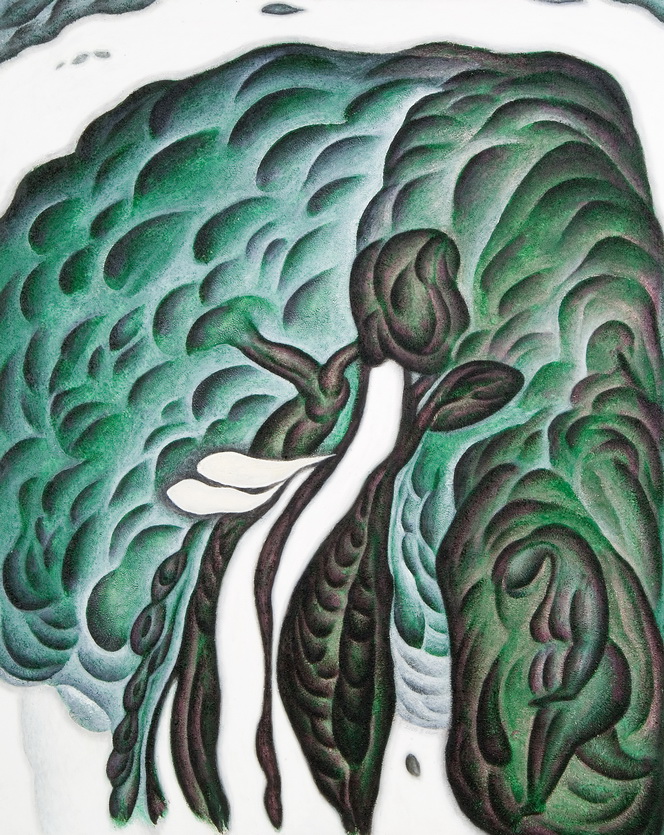
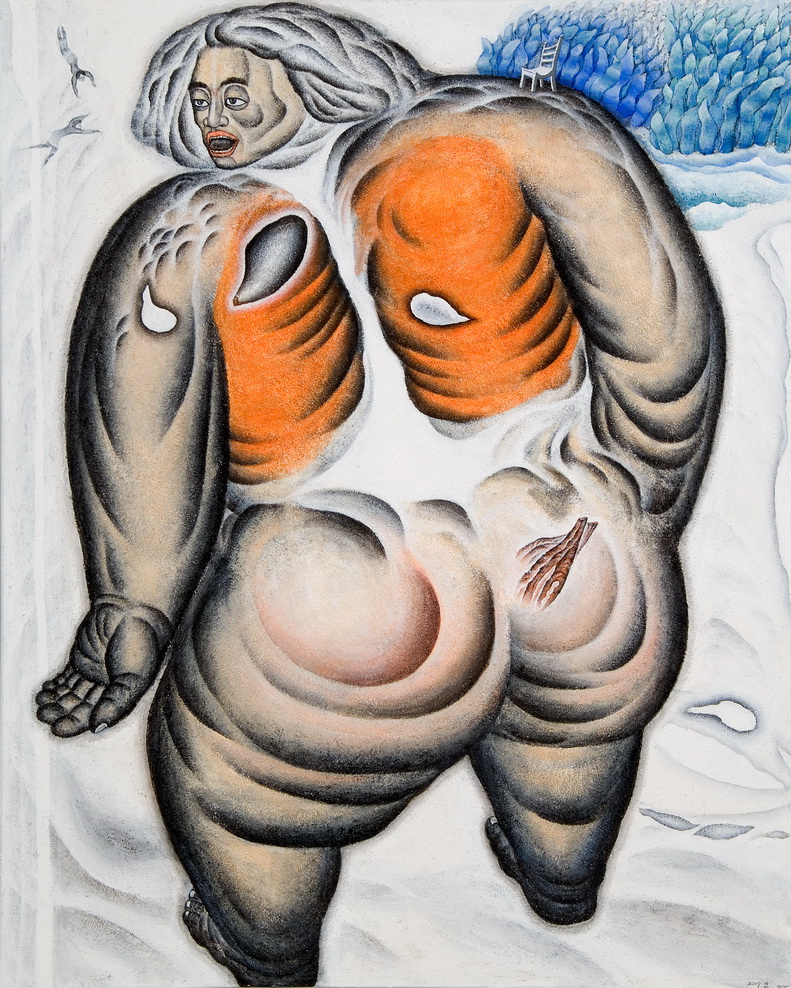
Dialogue with Teacher Da Kuai: Under the inspiration of the Genesis spirit in Christianity, Cheng Chien-Chang focuses on the relationship between humans and nature, the ontological connection between life and the universe, expanding his consciousness and love between humans and the universe, releasing the creator's greatest energy and will, arriving at a dialogue with the great teacher of humans and nature, and humans and the universe. The painter wrote: "Using the spiritual view, cosmic view, and contemporary spiritual psychological analysis of humanity over the years as warp and weft, as a reference for exploring the relationship between individuals and nature, individuals and the spiritual world, and the source relationship between individual prototypes and collective unconsciousness. Using tangible humans, land, rivers, trees... etc. as elements, connecting history and contemporary life as flesh and blood, adopting deformation and illusion methods, borrowing metaphors for invisible and infinite spiritual bodies: using substitution techniques of identity symbols, pursuing spiritual freedom beyond bodily constraints, letting external environmental factors dialogue with the primitive needs of the inner heart" (Note 13).
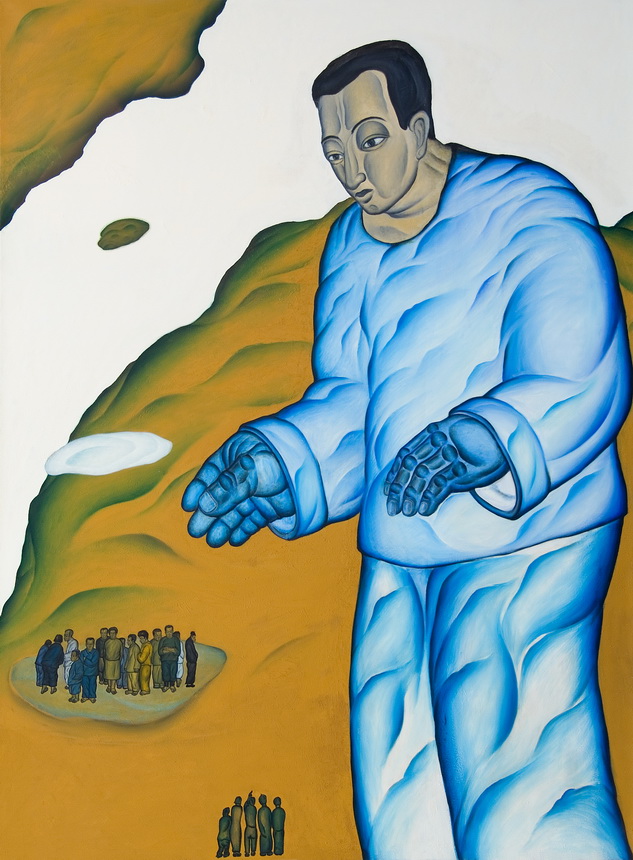
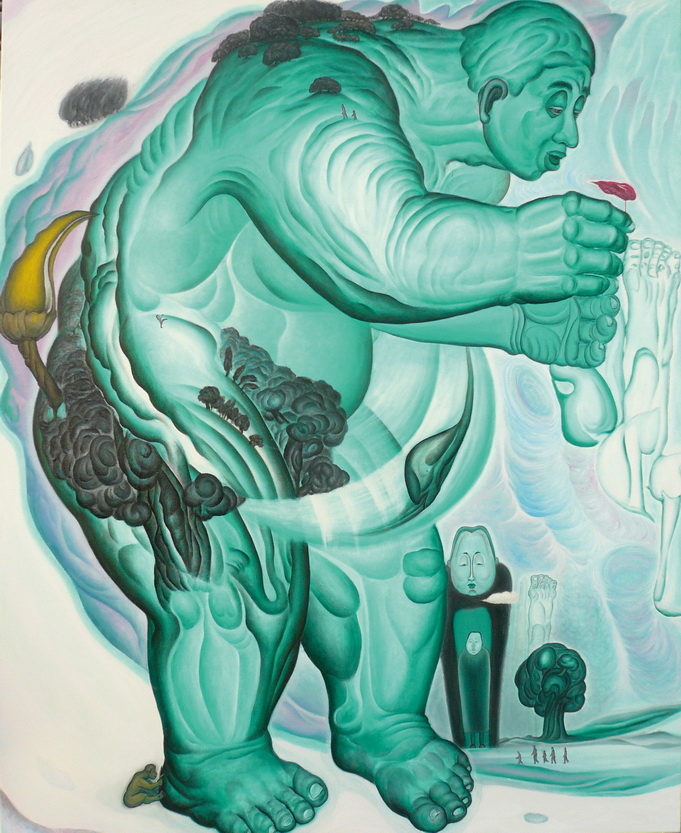
The term "Da Kuai" originates from Zhuangzi · Da Zong Shi: "The Great Mass carries me in form, labors me in life, rests me in old age, and gives me rest in death. Therefore, one who is good at living is one who is good at dying." "Da Kuai" is not "earth" nor "land," but "heaven and earth's creation." If explained in modern Chinese, it can be interpreted as: "The laws of nature's cycle." Zhuangzi's words about "Da Kuai" emphasize that humans must obey the operation of creation (Note 14). Metaphysical "Da Kuai" is full of imaginative space, possessing multiple metaphors and references: Creator or Maker, God of the Universe, ancestors of Pangu opening the sky, prophets of creating heaven and earth, incarnation of God, powers subduing heaven and earth, or human inner self, etc.
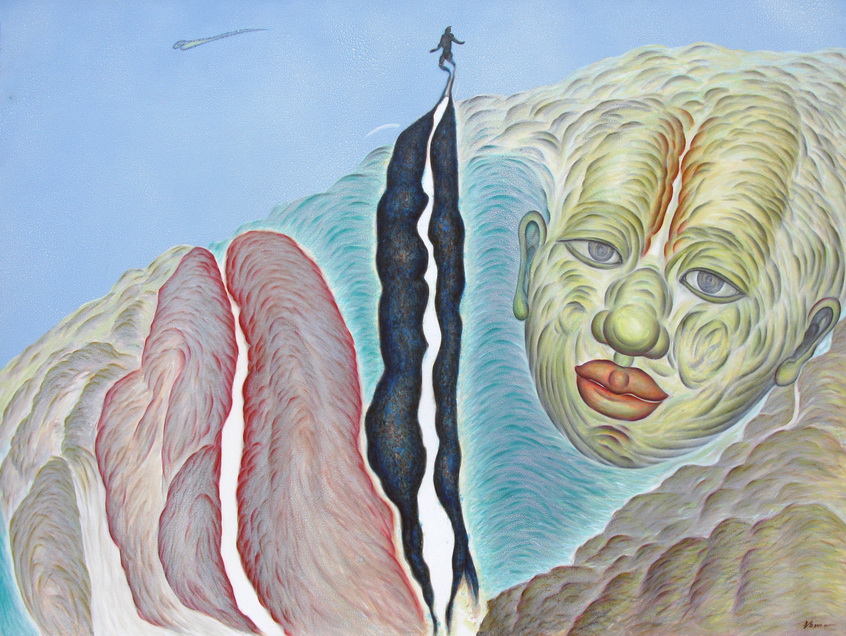
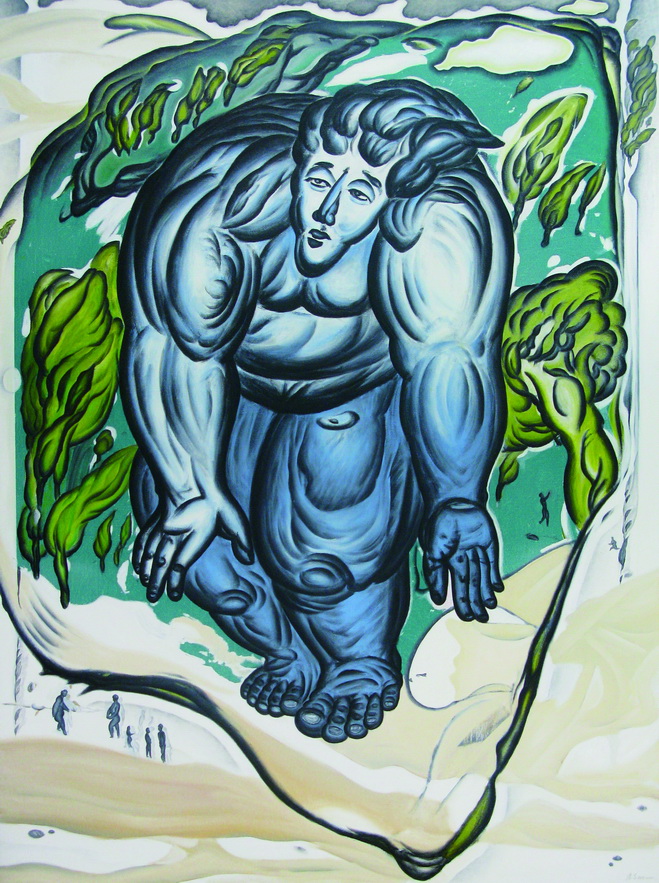
"Da Kuai" is a creative work of Cheng Chien-Chang between 2007 and 2010. Personified "Da Kuai" is a majestic, grand, superhuman giant, transforming nature's mountains, rivers, forests, and earth into his robust body and flesh. Humans are merely insignificant beings on Da Kuai, able to call wind and rain, metaphorically showing humans and nature as one. The natural rules of heaven remind humans to learn from nature's punishments. In 2011, with the solo exhibition theme "Da Kuai · Round God" and in 2013 "Dialogue with Teacher Da Kuai," he indicated his feelings and consciousness regarding the current human condition. Such as: hinting to learn from nature "Dialogue with Teacher Da Kuai — Step by Step," listening to the voice of nature and observing natural rhythms "Dialogue with Teacher Da Kuai," carefully protecting the environment and ecology "Da Kuai Imprint Attraction," violating heavenly principles will suffer heavenly punishment, metaphorically the irresistible power of nature "Attraction of Da Kuai," indicating newborn under heaven and earth's creation "Birth of Da Kuai's Son," etc. The painter said earnestly: "Volatile social phenomena highlight the energy and vitality of the era; earthquakes, wind disasters, floods, natural disasters, demonstrate the power of heaven and earth that must be revered. And what power do tiny people have that deserves to be seen and respected? I believe only by experiencing the world and connecting with eternal spirit, presenting the characteristics of eternal spirit in different eras, can human value be highlighted" (Note 15).
Local Spiritual Aesthetics: Cheng Chien-Chang's painting style is simple, gentle, restrained, peaceful, and tranquil, full of expressiveness, overflowing with rich emotion. Through internalization and purification, subjectively exploring the symbolic original appearance of local Taiwanese. Under his rich local vocabulary of humans, land, river areas, oceans, history, and spiritual painting forms. Colorful colors, rich tones, developed with land and nature as the keynote, under strong tones and unique color plane vocabulary, fine textures, patterned, symbolic, and iconic, intending to shape a prototype image of a "Beautiful New World." Between history and reality, memory and consciousness, collective and individual, thought and era, experience and challenge, vision and beautiful dreams, consciousness and symbols.
Cheng Chien-Chang, from postmodern art display, entered the local spiritual aesthetics under globalization, shuttling through history to reconstruct the collective memory and personal consciousness of Taiwanese people, evoking life awareness, constructing Taiwanese subjectivity consciousness and personal existence identity. Through the most symbolic vocabulary of the local island nation, he compiled a compassionate and magnificent epic saga of Taiwanese people, narrating his deep faith, hope, and love for this land he stands on, and care for humanity, moving the soul of Taiwanese people, historical consciousness, and responding to the call of the land. Under strong cultural "polysemous aesthetics," he witnesses the great spirit of the local.
Without land, there is no art. Existence constructs local consciousness and culture along with local mountains, rivers, and humanities. The land constructs the local spiritual field and life context. The land becomes the main axis and soul of local spiritual aesthetics. In creation, Cheng Chien-Chang experiences the subjectivity of Taiwanese people and himself. The painter wrote: "Earth — Land is one's own home,not allowing others to invade. And its land is ideal fertile soil (or red, or white, or earth-colored), a non-violent, non-noisy quiet world. And it is a community of land inheritance and shared life bloodline" (Note 16). However, Taiwan's beautiful home, through colonization and re-colonization, the land has been silently crying out. The founding of the land is the spiritual pursuit of artists, thinking presents the structure of spirit, nurturing local aesthetics. Art historian Xiao Qiong-Rui pointed out: "In Cheng Chien-Chang's creation, we see a Beautiful New World that has affection for the land, love for the people, forgiveness for history, and hope for the future" (Note 17). Optimistic, progressive, active, and healthy local spiritual aesthetics were born. In the new wave of art constructing local humanities and historical symbols, a unique creative route with unique artistic interest was carved out.
Note 1: Literary Heart, Li Min-Yong Essay p37, Literature Series 120, Chunhui Publishing House, published March 2012. Note 2: Ibid. Note 3: Cheng Chien-Chang Personal Background, 1996 Jiang Yu-Fang Interview Compilation. Note 4: Cheng Chien-Chang Personal Background, 1996 Jiang Yu-Fang Interview Compilation. Note 5: Localization of Contemporary Taiwanese Art — Starting from Cheng Chien-Chang's Taiwanese Images, Text by Lü Bing-Heng. Note 6: Cheng Chien-Chang Personal Background, 1996 Jiang Yu-Fang Interview Compilation. Note 7: Cheng Chien-Chang Personal Creative Concept. Note 8: Land · Round God — Cheng Chien-Chang's Creative Concern and Images, Text by Xiao Qiong-Rui. Note 9: Cheng Chien-Chang Personal Background, 1996 Jiang Yu-Fang Interview Compilation. Note 10: Cheng Chien-Chang Personal Creative Concept. Note 11: Land · Round God — Cheng Chien-Chang's Creative Concern and Images, Text by Xiao Qiong-Rui. Note 12: Cheng Chien-Chang Personal Creative Concept Brochure. Note 13: Cheng Chien-Chang Personal Creative Concept. Note 14: Metaphor of Hallucination — Cheng Chien-Chang's Brushwork of Da Kuai, Text by Cai Hong-Ming. Note 15: Cheng Chien-Chang Creative Self-Narration (Taken from Preface of 2010 "The Land is Speaking"). Note 16: Cheng Chien-Chang Personal Background, 1996 Jiang Yu-Fang Interview Compilation. Note 17: Land · Round God — Cheng Chien-Chang's Creative Concern and Images, Text by Xiao Qiong-Rui.
Appendix: Cheng Chien-Chang's paintings are like epics. Through touching images scene by scene, through the conscious and literary large titles of art exhibitions, through the deeply considered thematic sentences of each painting, he depicts and presents epics.