The Most Representative Artists of the Golden Age of the Renaissance
(Top left) Da Vinci, Holy Trinity, 103x75cm, Vatican. (Top right) Da Vinci, Madonna and Child, 141x104, National Gallery London. (Bottom left) Raphael, Madonna, circle 71cm, Uffizi Gallery Florence. (Bottom right) Michelangelo, Madonna, circle 120cm, Uffizi Gallery Florence. The most representative


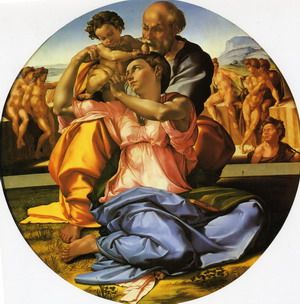
(Top left) Da Vinci, Holy Trinity, 103x75 cm, Vatican. (Top right) Da Vinci, Madonna and Child, 141x104 cm, National Gallery London. (Bottom left) Raphael, Madonna, circle 71 cm, Uffizi Gallery Florence. (Bottom right) Michelangelo, Madonna, circle 120 cm, Uffizi Gallery Florence. The most representative artists of the Golden Age of the Renaissance: Leonardo da Vinci (1452-1519), Michelangelo (1475-1564), Raphael (1483-1520), Donato Bramante (c. 1444-1514). Other well-known painters contemporary with the Golden Age of the Renaissance include Bellini, Giorgione, and Titian of the Venetian School.
Artistic characteristics of the Three Masters of the Golden Age of the Renaissance: Da Vinci: Profound and erudite; in art he explored the effects of understanding nature, using a method of painting by thought to grasp the mysteries of miraculous nature, particularly the delicate depiction of the inner emotional world of figures. In perfect, superb imagery, color, and optics, he presented an original and subtle atmospheric perspective, showcasing the most outstanding and exquisite humanistic beauty of the Renaissance. Da Vinci believed that painting is like a tool for understanding nature, and even more so, a manifestation of the inner spirit.
Michelangelo: Vigorous, bold, magnificent, and majestic. Full of passion, his paintings and sculptures were equally excellent and superb. His art was like a battle, manifested through extraordinary and heroic twisted nude forms amidst powerful bodies of reality and ideal, movement and stillness, anxiety and solemn sanctity, thereby ushering in Mannerism.
Raphael: Graceful, elegant, and poetic. Under the outstanding spirit of humanism, he achieved extraordinary success in clear, perfect forms and bright colors. He further opened up new possibilities for form/shape, becoming a model for all European art. His paintings offer kindness, balance, clarity, tranquility, and harmonious completeness.
Art historians made such vivid metaphors about these three masters: "If Da Vinci's art is compared to the depth of the unknowable sea, then Michelangelo's works are the steep ridges of high mountains. By contrast, can Raphael's paintings not be said to be vast, bright plains?" Da Vinci explored ideal forms. The dissolution of balanced color and line led him to merge form into color, forming natural atmospheric perspective through optical research. Michelangelo and Raphael both inherited from the past and pioneered the future, creating formal artistic forms that became models for all European art. Raphael's outstanding art could equal classical Greek art, imposing his idealism within its natural models. (Classicism: rationality, order, regularity, restraint, harmony, stability, elegance.)
The Roman school of the Golden Age of the Renaissance unquestionably focused on form. The Venetian school of the Golden Age of the Renaissance largely focused on color. Among them, only Da Vinci combined form and color in his most perfect way.