Exhibitions in Paris, Still Exhibitions
One scene from the Centre Pompidou special exhibition "Sculpture in Images"
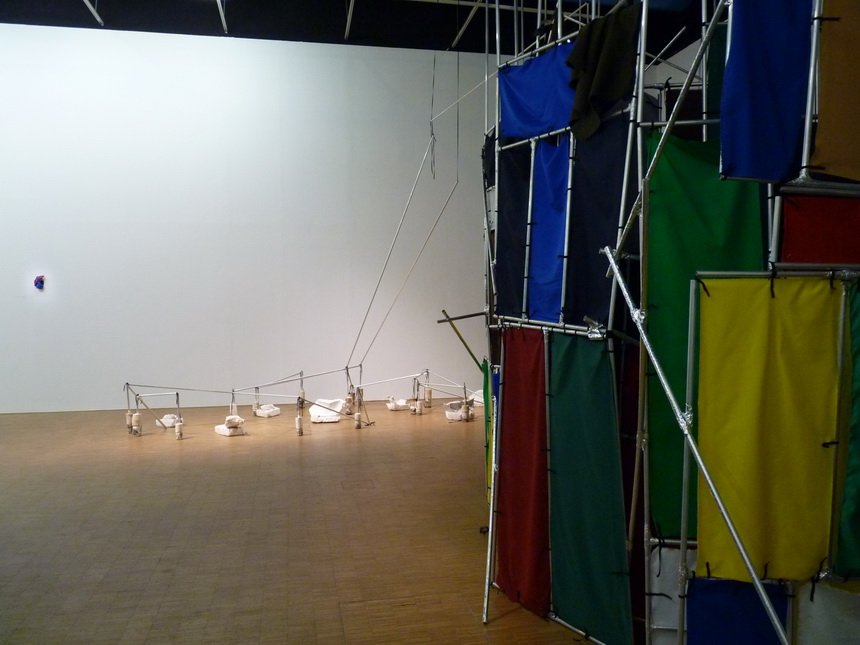
I am simply curious—unbearably so. This curiosity for the present enters through contemporary nerves; understanding requires immersing oneself in the exhibition space, facing works personally, moving within the field, and perceiving its atmosphere. One can approach works from various angles and viewpoints, happily blending into them. This is entirely different from sitting before a computer collecting reference images. Images always have limits; they are merely an introduction to initial recognition of certain things, unable to capture the true flavor. Viewing art exhibition pictures is like looking at recipes while hungry: it virtually fills the stomach, providing absolute satisfaction and enough to satisfy the viewer's curiosity. Images are not everything; they become fragments of cognition, opening pathways to knowledge and serving as advanced preparation for entering the spatial field of the works.
Seeing is a great enjoyment. Only by being on-site can one truly approach the reality of the work—right before your eyes, face-to-face. Opening your eyes, embracing the seamless fusion of the spatial field, you enter the work and perceive the profound depths of existence. Seeing is one thing; thinking is another discipline. Pure seeing first experiences the work’s present moment, which does not conflict with understanding. Through this interaction, one can deeply immerse oneself, and only then intervene with knowledge. Textual creation thus arises, echoing the work and attempting to explore the creator’s intentions and state of mind.
Each time I return to Paris, I enjoy exhibitions to the fullest—still exhibitions. From Palais de Tokyo, Musée d'Art Moderne de la Ville de Paris, Centre Pompidou, Grand Palais, Centre National d'Art Contemporain, foundations, or galleries, Paris indeed has endless exhibitions to see. As someone who loves viewing and is curious, I toil diligently, never stopping, intending to see as much as I can grasp. I start with galleries because their exhibition periods are shorter; museums naturally have longer runs and their own operational spaces. This year could be called the Op Art year. The Grand Palais hosts a grand Op Art exhibition (1913–2013) titled "Dynamo." Centre Pompidou Modern Art Museum features an exhibition by Op Art pioneer Jesus Rafael Soto (1923–2005). Palais de Tokyo presents another retrospective of South American Op Art giant Julio Le Parc, which is indeed grand, even extending to London’s Edward Gallery with a special exhibition responding to Op Art, "Light Show." The dazzling visual perception is something I was honored to witness firsthand across all four exhibitions. This visual experience is hard to imagine, leading to deeper cognition and understanding of Op Art. I often think that art is broader and more spectacular than art history.
Centre Pompidou offers yet another path for artistic pilgrimage. The South Gallery launches a new exhibition featuring the new generation’s insights and expansion of current sculpture, "Sculpture in Images," alongside Mike Kelley’s (1954–2012) European debut retrospective, the recently deceased American artist. The sixth-floor main hall exhibits a retrospective of contemporary famous designer Eileen Gray. Le Plateau in northern Paris presents the black-and-white themed exhibition "Paint it Black." Fondation Cartier showcases Ron Mueck’s dramatic super-realistic sculptures, the Australian-born British artist.
Gallery tours reveal rare French contemporary artists during these visits. Is this a phenomenon of globalization? Or has French art declined? The answer is obvious: it is the result of French contemporary art being overly institutionalized. Several important exhibitions follow: Italian artist Gianni Motti’s solo exhibition "Moneybox," an installation filling the entire gallery space with a single US dollar bill; Danish artist Jesper Just’s evocative video art; Brazilian artist Ivan Navarro’s visually striking neon light installations; Italian Arte Povera master Giuseppe Penone’s natural monument sculpture "Body of a Garden"; British sculptor Tony Cragg’s new release "Accurate Figure"; American video artist Joan Jonas’s solo exhibition "Reanimation," a video space installation; American artist Allan McCollum’s solo exhibition "The Shapes Project," focusing on objects and images; and young German artist Matthias Bitzer’s solo exhibition "Anato/echo," an object installation. The wonderful Louise Bourgeois exhibition "Rare and Important Works from a Private Collection" features unpublished works, making people look with new eyes. Belgian artist Jan Fabre’s solo exhibition "Gisante - Homage to E.C. Crosby and K.Z. Lorenz" is filled with an atmosphere of death. Korean artist Haegue Yang’s solo exhibition "Ovals and Circles" focuses on objects and space installations. African artist Barthélémy Toguo’s "Hidden Faces" features violent paintings and object installations. American artist Steven Parrino’s black painting installations are among others. Viewing exhibitions has become my alternative sport in Paris. Each time, I schedule half-day visits, carefully savoring the works exhibited in each gallery, taking photos for archival purposes. Each round takes about several hours. But every time I return fully loaded, enjoying myself and feeling fulfilled. Paris expands my horizons and allows me to grow through art.