Artistic Characteristics of the Venetian School
(Top) Giovanni Bellini, Lamentation, c. 1505, 65x90 cm, Accademia Gallery. (Left) Carpaccio, The Arrival of the Ambassadors, 1495, 275x589 cm, Accademia Gallery. (Right) Titian, Bacchus and Ariadne, 1518-1519, 175x193 cm, Prado Museum.
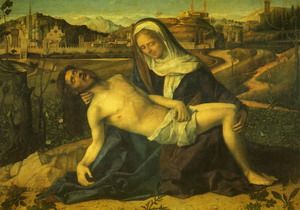


(Top) Giovanni Bellini, Lamentation, c. 1505, 65x90 cm, Accademia Gallery collection. (Left) Carpaccio, The Arrival of the Ambassadors, 1495, 275x589 cm, Accademia Gallery collection. (Right) Titian, Bacchus and Ariadne, 1518-1519, 175x193 cm, Prado Museum, Madrid collection. (Bottom) Tintoretto, The Body of Saint Mark Brought to Venice, c. 1562-1566, Milan Pinacoteca collection.
The artistic characteristics of the Venetian School: 1. They explored not the beautiful forms, perspective, and purely scientific concepts found in the Florentine or Lombard schools. 2. They proposed a pure visual beauty and joy directly from color, establishing an atmospheric light within softness and depth using a rich and magnificent palette dominated by reds and blues, thereby revealing a new humanistic sensibility, which became the unique face of the Venetian School. (If one asks what the greatest painting characteristic of the Venetian School is: is it not its vibrant colors?)
Venetian School paintings are larger, with more vivid colors. There are few Christian (religious) subject paintings (crucifixes, Madonna and Child, or biblical stories). Even when religious subjects are used, they are more secular, often relying on mythological stories for interpretation. The rise of historical paintings and sensual nude paintings was prominent. Magnificent colors were used to display Venice's wealth, grandeur, splendor, luxury, and glory.
The main painting themes of the Venetian School: Besides religious paintings, there are mythological stories, portraits, and landscapes. Their greatest feature is that female subjects appear far more frequently than male subjects. Religious sentiment and mystical thought are also stronger. Light and color, form and space, literature and aesthetics, poetic imagery, full of sensuality, grandly displaying Venice's glory. New materials: The impact of oil painting on the Venetian School.
Starting from 1475, new materials: Oil painting reformed the Venetian School's painting (due to Venice's humid climate, frescoes were difficult to preserve. Furthermore, the new material—oil paint—is easy to mix, blend, has rich tones, is bright and magnificent, transparent, and easy to preserve, etc.). This material was brought to Venice by the Neapolitan painter Antonello da Messina in 1475 (he had traveled to Flanders and studied under the Van Eyck brothers). Especially his use of oil painting and expression of form profoundly influenced the Venetian School. After 1475, Venetian painters increasingly painted oils on canvas, especially in the works of Carpaccio and Titian.
The beginning and end of the Venetian School: The Venetian School originated from the families of two painters, Jacopo Bellini and Antonio Vivarini, under whom the Venetian School was formally born. Venice's true Renaissance began in 1460, through Giovanni Bellini's painting reforms; it reached its peak with Giorgione and Titian, ending with the death of the painter Tintoretto in 1594, concluding Venice's Renaissance.
Two major early Venetian painter families: Jacopo Bellini (1400-1470), Gentile Bellini (1429-1507), Giovanni Bellini (1430-1516). Antonio Vivarini, Bartolomeo Vivarini, Alvise Vivarini, among whom Bellini was the most influential.
Most representative painters of the Venetian School: Giovanni Bellini, Vittore Carpaccio (c. 1455-1526), Giorgione (c. 1477-1510), Titian (c. 1482-1576), Tintoretto (1518-1594), Veronese (1528-1588) (among them were Sebastiano del Piombo (c. 1485-1547) and Lorenzo Lotto (c. 1480-1556); these were local Venetian painters who had long left their hometowns but occasionally returned to engage in artistic work).