Chin-Ho Huang – The Golden, Powerful Roll: Pioneer of "Taiwanese Aesthetics"
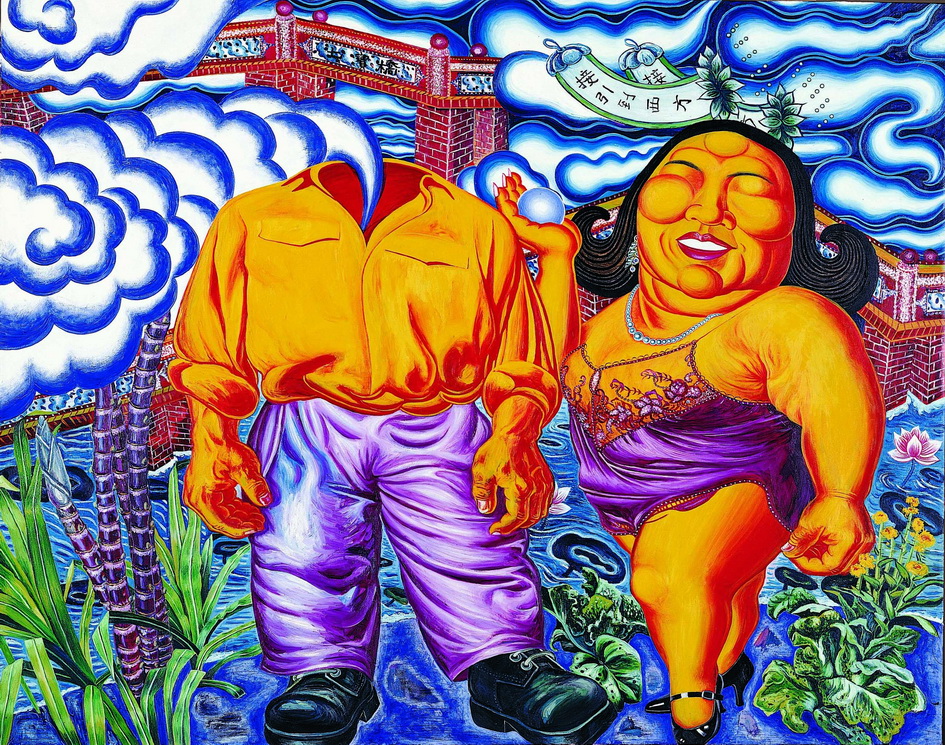
Guiding the West 165x210cm Oil on canvas 1991
"The next artistic innovation: is to assume its own language, culture, and race."
Contemporary French artist Ben
Written by Chen Chi-Hsiang | Foreword: Art is the expression of personal thought and action, and even more so, the artist's self-awakening and contemplation. Art does not only dialogue with environmental culture but also reflects the creator's state of mind and the context and consciousness of the overall social and political environment. Throughout Taiwan's art history, before affirming local culture, participation in political, social, and cultural liberation aimed to construct Taiwan's subjectivity, find the core values belonging to this land, and explore the vigorous vitality and unique appearance within Taiwan's cultural heritage. American anthropologists Sapir and Whorf pointed out: "Behind every language lies its unique logic of thought and cultural values; its users are deeply influenced and dominated by these values."
Huang Chin-Ho's art takes it upon himself to restore the self as a Taiwanese person, affirming confidence in local culture, exploring the core values of this land, and becoming his inexhaustible driving force for artistic creation, pioneering the original modernity of his own locality. His golden, powerful roll "Song Ge Wu La" (very Taiwanese) painting art clearly witnesses the political and social context from Taiwan's lifting of martial law to the present, participating in the battle of political, social, and cultural liberation, summoning the consciousness of Taiwan's subject culture, presenting the vitality, shock, smell, character, and attributes of the locality, constructing an authentic great Taiwanese spirit. Palestinian artist Mona Hatoum said, "Artworks are first feelings truly lived; their content and structure come from truly lived initiatives."
Finding the Core Value of the Taiwanese Self: In the 1977 Taiwannative soil literature debate, intellectuals were made to face Taiwan's special history and cultural appearance, conducting reflection, awakening local consciousness, and pursuing Taiwan's subjectivity, having a profound impact on Taiwan's culture until today's implementation of a diverse and pluralistic society. The 1970s ended with the Kaohsiung Formosa Incident (December 10, 1979), shaking the locality; the imprisoned souls gradually awakened from the severe closed walls of dictatorship and totalitarianism, awakening the Taiwanese people's awareness of sovereignty. In the 1980s, Taiwan entered a new era. The rise of New Taiwan Cinema in 1983 and the opening of the Taipei Fine Arts Museum, Cloud Gate Dance Theatre's My Homeland My Song in 1986, and on July 14, 1987, nearly two centuries after the French Social Revolution, Taiwan lifted the martial law that had lasted over 38 years, bringing an unprecedented breath of freedom. The May 20 Peasant Incident in 1988, the announcement of lifting press restrictions, the first election after lifting martial law the following year, the Wild Lily Student Movement in March 1990, and the abolition of Article 100 of the Criminal Code in 1991 entering true post-martial law. The Taiwanese people sacrificed blood and tears in struggle to find their core value. Lin Hsin-yi wrote: "Taiwan's modern democratic process is a typical struggle after struggle, fight after fight. No matter how suppressed, it cannot be flattened or killed!" (Note 1) In 1967, Shi Wei-liang wrote: "To restore oneself in music, one must first produce one's own music" (Note 2), demonstrating the intention to find the core value of the Taiwanese self and pointing out a path of creation. Huang Chin-Ho's art takes it upon himself to restore the self as a Taiwanese person. His personal awakening came from the Kaohsiung Formosa Incident; only then did he realize his identity as a Taiwanese person, not a Chinese person, experiencing the suffering and helplessness of being Taiwanese with body but no soul. Majoring in history, he suddenly understood and began to deeply understand the history of his native land, intervening in society, which hinted at the core value of his future artistic exploration and creation, because great art comes from the land where one resides. After a long stage of groping, he finally found the true face and character of the core value of the Taiwanese people.
Pioneer of the Golden, Powerful Roll "Taiwanese Local Aesthetics" – Huang Chin-Ho: Huang Chin-Ho (born 1956 in Minxiong, Chiayi) is the founding father of Taiwan's mostlocal-flavorTaiwan-style painting (Note 3). On the beautiful treasure island, golden light rolls powerfully, sharp energy stretches in a thousand lines. He is the chief assassin declaring the entry into the new sovereign era of Taiwan's local art, the most explosive and "Taiwanese," and the pioneer of "local aesthetics" of Taiwan's subject consciousness. Born into a poor rural family, he lost his father at age five. More than ten siblings were supported entirely by his mother, and he experienced the brevity of life at a young age. His brothers were all skilled at drawing; he tasted the joy of painting in childhood and was affirmed and encouraged by them, especially the influence of his second brother (who ranked first in all elementary school painting competitions). He showed his talent early, impressing teachers and often winning first place. Encouraged by teachers, painting accompanied his growth, planting the seed of artistic creation.
He started painting oil paintings in high school, painting frantically for nearly three hundred oil paintings, practicing techniques to lay a solid foundation, groping through sketching and expression, touching upon personal existential awareness. He failed to enter the fine arts department in university, retook the exam, and studied History at Chung Hsing University. He participated in Taiwan's epochal democratic social movements, experiencing Taiwan's lifting of martial law. In university, he fell in love with photography, using it to understand the development of Taiwan's history, recording many Taiwanese folk customs and conducting in-depth field surveys in local communities, becoming the source of inspiration for future thinking and integrated creation. After graduating from university, he painted abstract expressionism in the early 1980s, until 1985 when he switched to figurative expressionism, exploring personal uniqueness. In 1989, he took a desperate journey to New York. Knowing his hometown better elsewhere, he returned to the embrace of his homeland in just a hundred days, implementing local roots, reflecting on his Taiwanese identity, finding his existing soul, awakening local consciousness, and touching Taiwan's soul, character, value, emotion, smell, and subjectivity. Leading him to cut into Taiwan's painful history, he explored the true local forms, colors, and atmosphere of Taiwan, seeking unswervingly the true face of Taiwan and the self.
After returning to the country in early 1990, influenced by the SoHo warehouse studios in New York, Huang Chin-Ho was the first artist to move into Railway Warehouse No. 15 in Taichung and hold a solo exhibition there at the end of the same year. Because the high and spacious space of the iron warehouse was large enough, he was also the pioneer of giant-sized paintings in Taiwan. With hisoriginal new Taiwanese form, content, new appearance, and giant paintings, he became famous overnight, raising heated discussions in the art world. Curators from home and abroad flocked to him. Invited to the special exhibition at K18 Arsenal in Kaiserslautern, Germany, in 1992; the Taipei Fine Arts Museum's "New Trends in Taiwanese Art 1945-1993" in 1993; the Contemporary Art Gallery in Sydney, Australia, in 1994; representing Taiwan at the Venice Biennale in 1995; the Taipei Biennial in 1996, etc., he became the most prominent Taiwanese artist internationally. In 1994, he moved to Railway Warehouse No. 25. From 1998 to the present, he has used Railway Warehouse No. 5 in Wuri as his creative base.
Artistic Creation Background: Huang Chin-Ho's creative background, under the Western postmodern search for roots, amidst the rise of Neo-Expressionism, Transavantgarde, Bad Painting, and wall graffiti art, the rise of subculture and marginal culture, and the budding and growing of New Pop, was a moment of practice grounded in the locality and return to culture and tradition. Non-Western art was liberated from the shackles of Westerndominant culture. The most eye-catching exhibition highlighting non-Western art in 1989 was "Magicians of the World" (Note 4). Leandro M Bomio said: "European artistic techniques can be useful to us, whether painting, sculpture, or architecture. The condition is to avoid the crisis of depriving our own art and our personality" (Note 5). R. Tagre reflected in 1924: "Undoubtedly, for a long time there has been a dilemma: we no longer contact our own culture, and subsequently, Western culture is not in its true position... This is the current problem. Nothing can redeem itself whilegetting rid of others; only total unity can save, or total disappearance" (Note 6). Contemporary French artist Ben wrote: "The next artistic innovation: is to assume its own language, culture, and race." (Note 7)
Huang Chin-Ho's creative social background was right after Taiwan's lifting of martial law. The Taiwanese people were liberated from imprisoned souls, with waves of farmer-peasant and union demonstrations entering democratic social change and economic takeoff. Karaoke became popular, the era of crazy Da Jia Le lotteries, speeding, gambling, construction site shows, and pornographic beef markets, living rooms as factories, Asia's Four Little Dragons when Taiwan's money flooded feet. The whole society was filled with bizarre, supernatural, confused, materialistic, and decadent states. Huang Chin-Ho's painting exploration strengthened the dialogue relationship between art and social environmental culture, implemented locally, touching the vitality, smell, shock, and spirit of the Taiwanese local nerves, intervening in the practice of society and land, constructing local subject consciousness and the true face of genuine Taiwanese art.
Desperate Journey – Revelations from the New York Trip: Huang Chin-Ho came to the world art capital he had dreamed of – New York – in 1989, originally wanting to go all out. In three or four months, he tirelessly visited museums and SoHo galleries, witnessing America's great modern and contemporary art. American Pop Art had the most profound impact and shock. He constantly pondered the situation of Taiwanese art and the appearance of his personal artistic creation, suddenly realizing that Taiwanese culture was so uniquely outstanding. He decided to return to his hometown to create personal Taiwanese-style painting in a new way, implement local roots, overturn Western art trends and mainstream Taiwanese art values, and correct the concept of constraint that "values the West over the local, values Greater China over small Taiwan" (Note 8), liberating humble artistic creation concepts. Rooted in local culture, anti-establishment, anti-mainstream, and anti-aesthetics, he intended to construct a genuine new Taiwanese painting appearance.
Creation Core and Inspiration of the Taiwanese Soul: Huang Chin-Ho explores the true face and character of Taiwan and the self, awakening the Taiwanese soul. He looked back at Taiwan's art history; past and present elite creations had not touched the Taiwanese soul, almost never going beyond Westernization and Sinicization. Painters believed: "All great art in the world is local. Without the local, there is no subjectivity, and without subjectivity, where is the avant-garde?" (Note 9). Therefore, his greatest determination was to explore the true face of the Taiwanese self. Only thus could he create a completely new style and appearance.
The creation core of Taiwan's subjectivity comes from the commoner spirit of the folk heritage. Through the extraction of folk joy and funeral banquets, temple images, Daoist symbols, and social imagery, he created a local, genuine face, meaning, smell, character, and soul.
The most iconic "fat and bloated" figuremodeling inspiration in Huang's work comes from folk subculture, deeply influenced by Taiwan's golden puppet opera and black-and-blue Geza opera, especially those with strong symbolic meanings like the golden, powerful roll, fried rice with hairtail, or colorful gold. It showcases the unique, genuine taste of Taiwan. It also incorporates influences from simple couplets and reliefs in folk temples, Daoist talismans, folk embroidery, construction site shows and pornographic beef markets in modern society, electronic flower carts, betel nut girls, Ba Jia Jiang, KTVs, and the strong decoration of barbershops. Synthesizing Taiwan's joy and funeral banquets and welcoming gods and racing meetings, it presents the true face of the Taiwanese people. For example, the female image in "Guiding the West" comes from the image of Da Duo Lingling (and Ai Zai Cai) in Taiwanese TV dramas, or transformed from the papaya show poster of Chen Jinpei in the beef market. "Guiding the West" has become Huang Chin-Ho's iconic painting summoning the true face of Taiwan.
Establishing a New Milestone for Taiwan's Subjective Appearance: Huang Chin-Ho's debut upon returning from New York, "Thieves in the Sky" (1990), asks: Where are thieves in the sky? The sky metaphorically refers to the high-and-mighty local warlords (colonized regime and gentry) far from the emperor, lawless and bullying the weak while deceiving the superior. Adding thieves to the sky seems to refer to the arbitrariness of mainstream regimes and values, humorously satirizing the image that the whole of Taiwan is hijacked by thieves, attempting to subvert sacred icons. Using Neo-Expressionist techniques, dramatic forms of three abrupt, rough, distorted, and deformed thugs, it displays the general social context and imagery of Taiwan.
The new series "Guiding the West" opens a new creative milestone for Huang Chin-Ho, constructing Taiwan's character, values, emotions, and consciousness, displaying the "Song Ge Wu La" (very "Taiwanese") painting style. Headless men accompany fleshy, voluptuous, and glamorous women against a background of Taiwanese plants, flowers, grass, and ornate Taiwanese cemeteries, telling of the confusion, materialism, and value disorder of Taiwanese society. The headless man metaphorically represents a walking corpse, losing existential awareness, having a soul but no body, manipulated by others. Double metaphorically guiding the West, taking the ultimate paradise of reincarnation from a Taiwanese standpoint, indicating sending off mainstream consciousness, and another declaration of de-Westernizing art's secondary colonization, establishing Taiwan's self-core values and aesthetics.
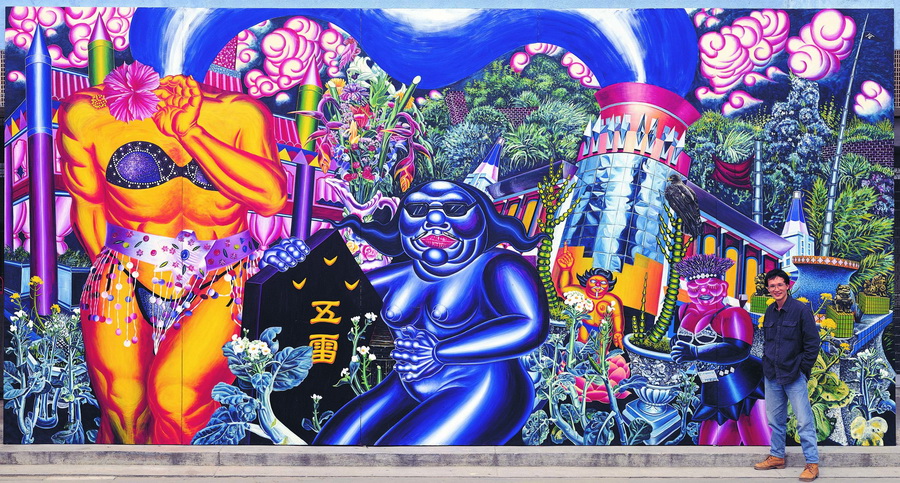
"Fire" (1991-92), a monument-form masterpiece, golden light rolls powerfully, colorful and vulgar, bustling and rolling colorful gold dazzling the eyes. One painting is not just one world, but also a reflection of the social and era consciousness released after the lifting of martial law. "Fire" encompasses the drunken dream death and spiritual decline of the entire social context after Taiwan's lifting of martial law; it is both heaven and hell. In the carnival-like bustling sense of turmoil, it presents the anxiety and unease of the intermediate state (Zhongyin). A weird woman with blue-blackVajra features, wearing sunglasses, emerging from a cartoon image, hides a fierce and vicious character in her cool demeanor, holding a Daoist Five Thunder Stele, metaphorically implying the "parable of the five thunders striking the top of the head." Standing beside her is a headless male dressed as a woman in earth-yellow body, indicating social confusion and decline. The two contrasting figures in a scene of high-rise buildings and covered subtropical plants dramatically display finding joy in bitterness and laughter with tears, scrutinizing the inner soul of the Taiwanese people.
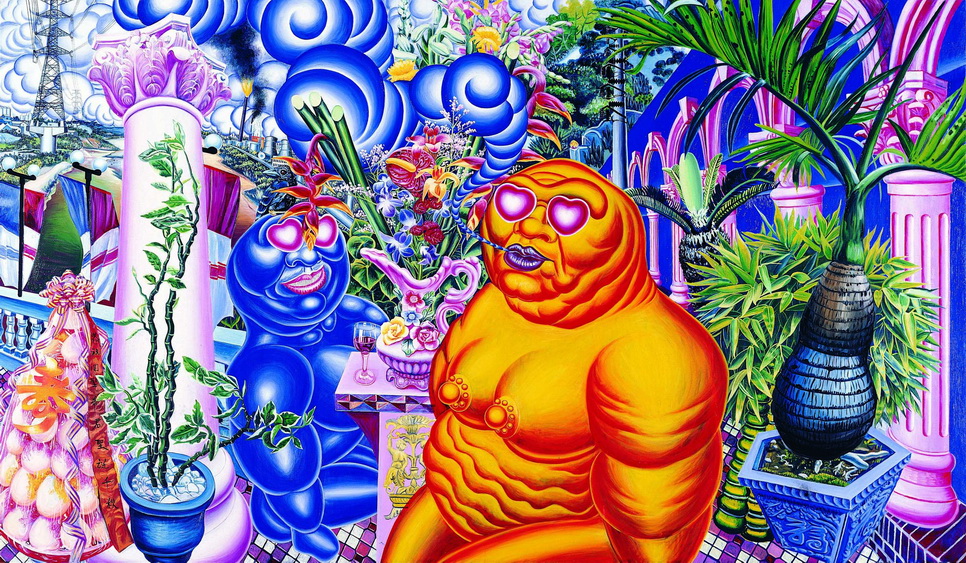
"Peach Blossom Township" (1993) is aportrait/reflection of the crazy fun and humorous satire of Taiwanese society after the lifting of martial law. On the vulgar surface, two gender-confused, neither-man-nor-woman, cartoonish, swollen, and fat characters show confusion and intoxication through their bewitching heart-shaped pink eyes and smoke spewing from their mouths, fully drunk and sunk in the gentle land of lust for wine, sex, wealth, and qi, hiding an inexplicable anxiety and self-consoling pleasure. "Peach Blossom Township" expresses the overall repression and loss of society, being the most classic close-up of Taiwan's collective hysterical mental state.
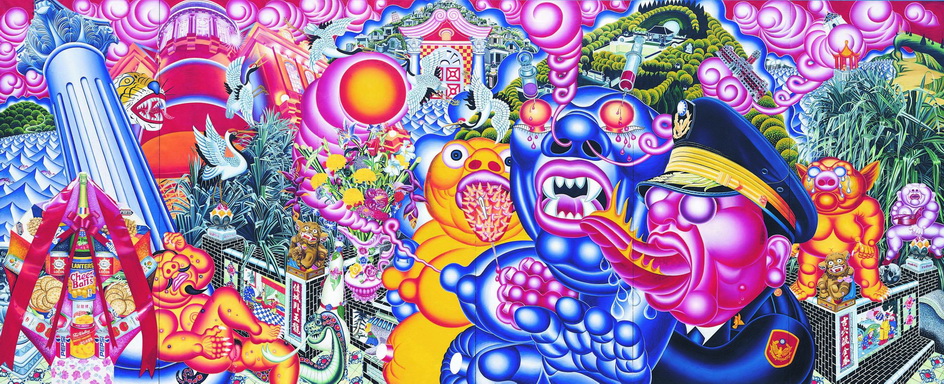
"Toxic" (1994-98) is another peak creation of Huang Chin-Ho, very dramatic, with demons dancing wildly, voices clamoring, and dizziness and enchantment. It meticulously performs a post-lifting-of-martial-law Taiwanese society thriller-horrifying black humor, flashy, rustic, and confusing grand play. A blind police officer spits a flame tongue (snake) from his mouth, closely flanked by two four-unlikedemon-monsters. With humor, parody, and satire, it criticizes the dictatorship and autocracy of the Kuomintang's martial law period. After the lifting of martial law, it continues to poison, destroy, and harm the new generation with twisted-value education, causing endless harm and continuing to poison Taiwan. The background is filled with various rustic and confusing local scenes: graveyards, cranes, memorial halls, pavilions, towers, Presidential Office, sugarcane fields, plants, flowers, and sacrificial objects, etc. Humor becomes the painter's tool for self-entertainment and mocking the regime. Russian thinker Bakhtin once pointed out: "What in the world is there to counteract the ruthless mockery of fate better than humor?" (Note 10)
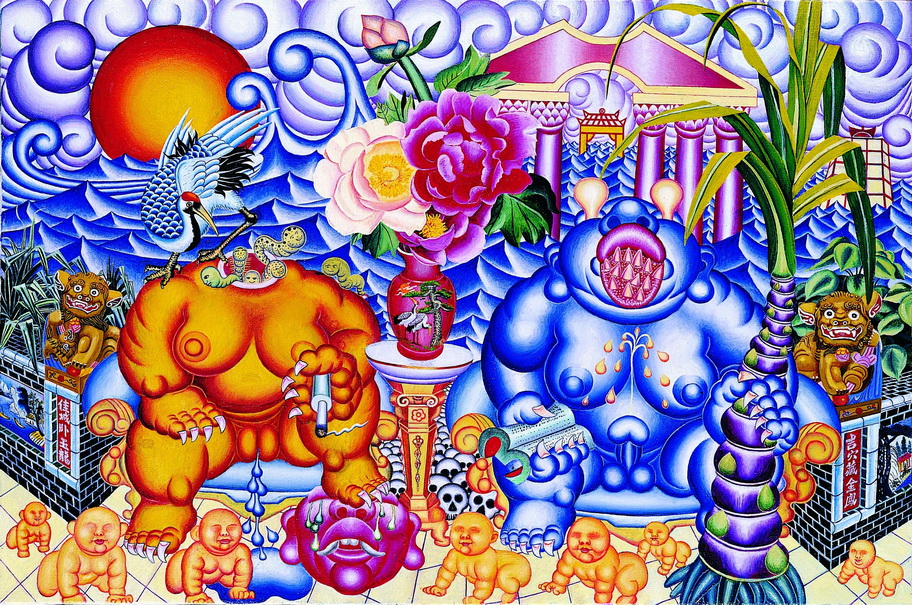
"Heaven and Earth Parents" (2001), a pair of unapproachable, soul-stirring dictatorial appearances, metaphorically colonial society, relying on power to bully the people, the bureaucratic system (also called parent officials) ugly faces. Heaven and Earth parents sit on a graveyard, skulls and babies underfoot, scrutinizing the red dust. The father (blue) with ambiguous full breasts, erect penis spraying semen between his legs, sitting on a sofa with claws and teeth, acting tyrannically, with a venomous and evil expression, holding a (Life and Death) book. Beside him sits the ridiculous fat mother (earth yellow), naked and full-bodied, smoking, stepping on crying heads with her feet, some caterpillars crawling out of holes in her upper body, a white crane standing on her shoulder. On the table in the middle are ornaments of a red peony flower symbolizing wealth and honor, high above, humorously displaying "the sky is high and the emperor is far," parodying the situational consciousness of the feudal autocratic era.
Huang Chin-Ho's paintings highlight a paradoxical, abnormal, bamboo-pole-dishes-knives, dao bu hao (not good), men ma hao (mother is good), and ridiculous Taiwanese confusing appearance imagery. He explores Taiwan's overall (positive and negative) subjectivity, displaying the cultural essence of local diversity. Cutting into history, colonial distortion, confusion, expansion, and patching cause the anxiety, unease, fear, gloom, greed, violence, hatred, disgust, cruelty, ruthlessness, anger, hypocrisy, pretense, cruelty, servility, alienation, etc., of the entire smoky society, showing the Taiwanese peopleat a loss in the Zhongyin situation. Another dilemma of subjectivity is that Taiwanese people to this day still have mute eating bitter melon, unable to call out the mother of the land – calling Taiwan, playing dumb, laughing with tears, sour-hearted, lingering on.
Transcendent Spirituality of Art: Looking at Huang Chin-Ho's works before 2000, they lean towards the confusing social and historical secular appearance of contemporary reality. Behind the vulgar colors and abrupt appearances of the golden, powerful roll, deeper spiritual consciousness of life and existence is hidden.
After his mother passed away in 2000, the painter felt guilt towards his mother and understanding of humanity, gradually turning towards internal spiritual exploration. He began replacing dizzying colorful hues with black-and-white charcoal, entering the life realization of existential awareness, devoting himself to the internal cultivation of Buddhist classics and the Tao Te Ching (he had contacted Master Yin Shun's living Dharma in college), practicing boxing, qigong, Tai Chi, yoga, meditation, sitting quietly, and Madhyamaka, meditating on the essential nature of life's existence, experiencing that all dharmas in the world are impermanent, the empty world of no birth and no death. The painter believes: "The truth of life – the emptiness in Buddhism – the greatest art should be how to express emptiness." (Note 11)
After his mother passed away, his creation came from the worldly-out methods of Buddhism and Daoism. "Death" became his topic of contemplation and creation, closely related to the artist's personal life experiences. Witnessing his father's death in childhood and contacting Daoist rituals, he realized the brevity and helplessness of life. His interest in Daoism, Dream Songs, and funeral services left deep imprints on his soul. During the process of sitting and cultivating the Dao, he had special feelings for Asubuddha (Non-Meditation/Impermanence observation). Asubuddha is observing one's own body from the soles of the feet to the head: bones, pus, and death. In the process of Zen meditation, how to stop and observe delusional desires, using wisdom to observe the connotation. Experiencing the illusion of existence's void and destruction, the emptiness of existence. For another experience and witness of life's existence, he believes: "Art is a product of the mind, consistent with cultivation and morality." (Note 12)
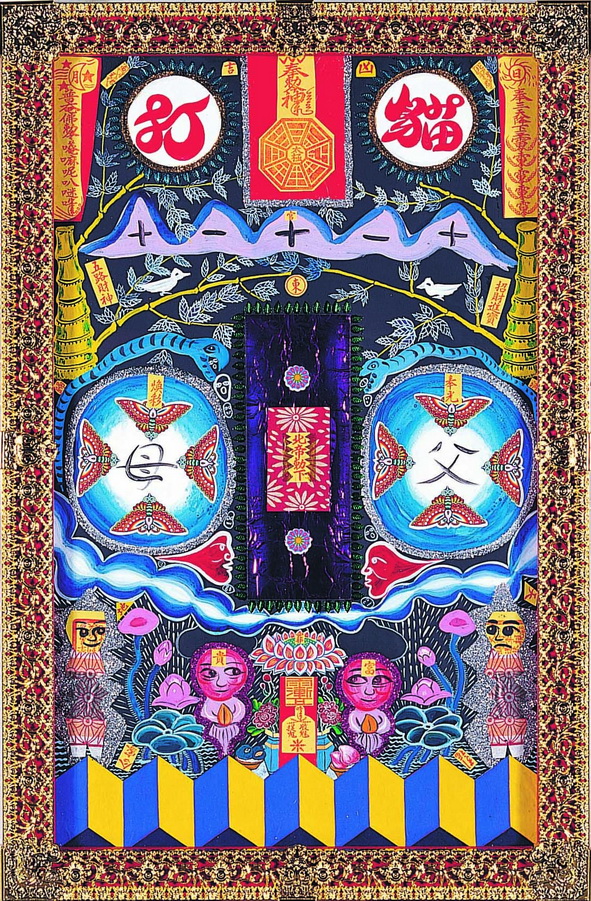
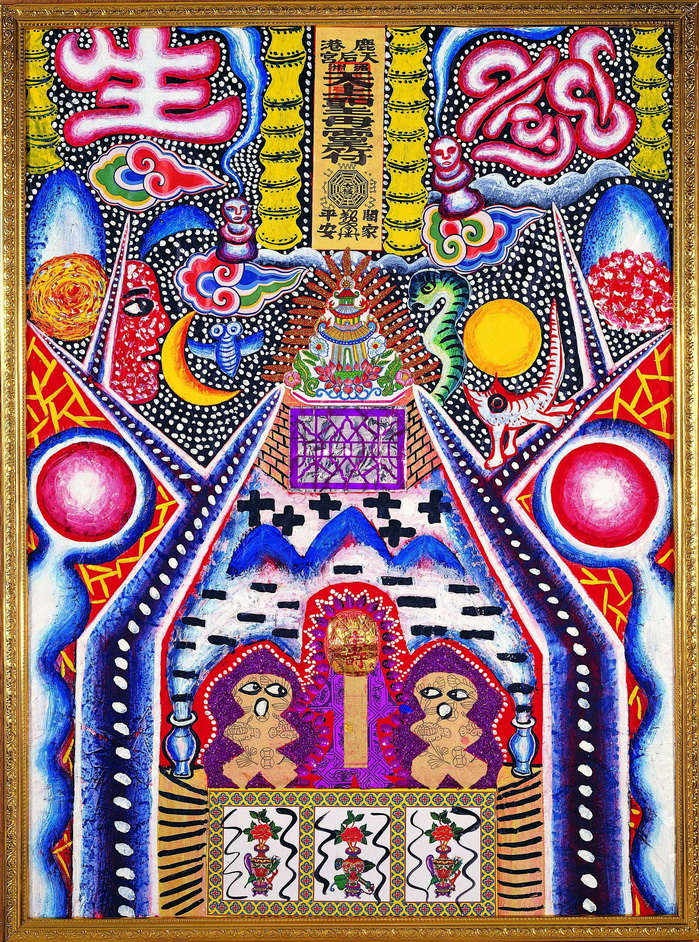
After his mother's passing, Huang Chin-Ho's creation revolved around the topic of death, transforming the folk funeral ritual "Voice and Face Remain" (2000), a rare spatial installation. The front hangs an embroidered silk carpet covering the holy body, framed as a painting. Three wreaths on top each write the surnames "Li, Huang, Lin." On the left and right are paper lotus seats, and below are red bricks forming a furnace for burning money. The solemn and sacred atmosphere, did the painter recall his mother or bid farewell to his past creative type ritual? Life's experience, sudden enlightenment of the impermanence of existence, opening a new horizon of creation.
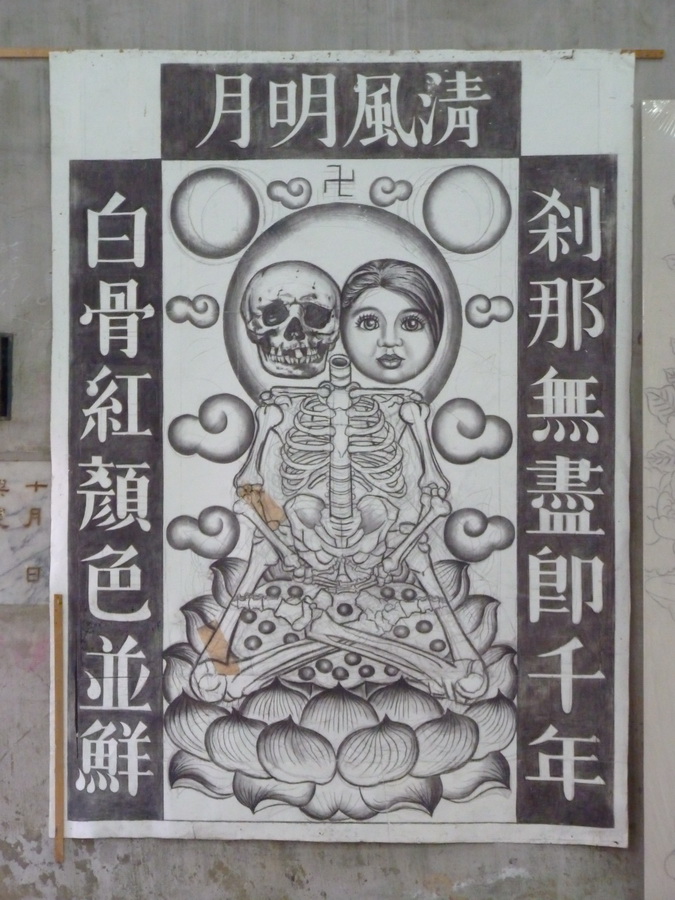
Then, exploring the life existence awareness of Asubuddha through the immortal way, "Clear Breeze Bright Moon" (approx. 2003), a skull sits meditating on a lotus seat, a skull and a young man's portrait above the head, a couplet on the border: "Instant infinite is a millennium, white bones and red colors are fresh," showing the realization of Buddha and Dao. "Brothers Harmonious and Joyful" (approx. 2005-06) inspired by the connotation of Japan's Seven Lucky Gods, displaying ships laden with gold and silver treasures on the sea waves, two chubby Seven Lucky Gods, both male and female, fishing on board, showing human prosperity and wealth, while the sea ship metaphorically implies the brevity of life and the impermanence of life. The studio wall expounds the awakening of existence: "It is so, it is that, not so, not that, all dharmas are empty" (Note 13).
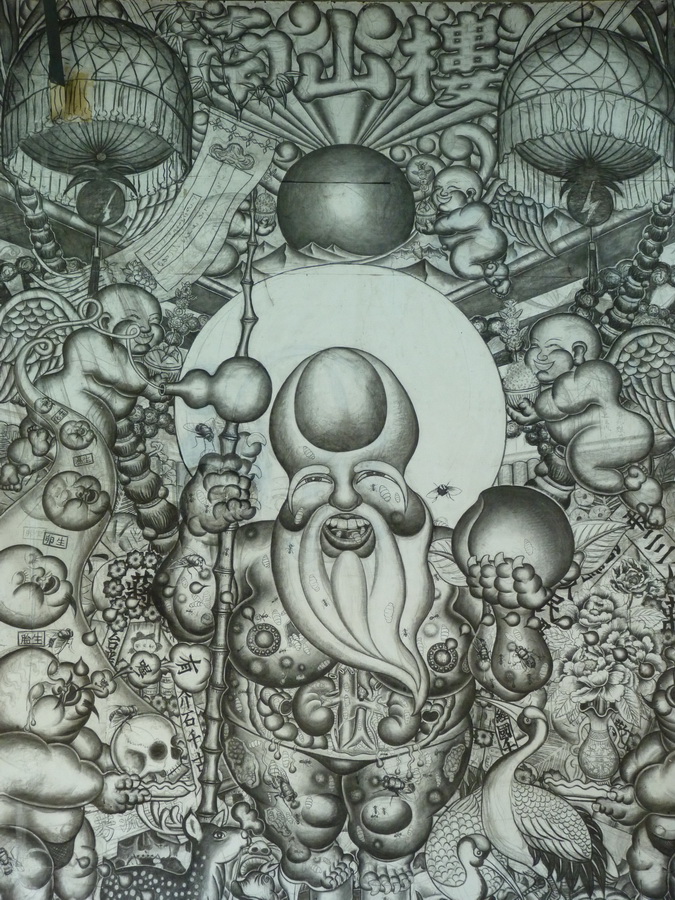
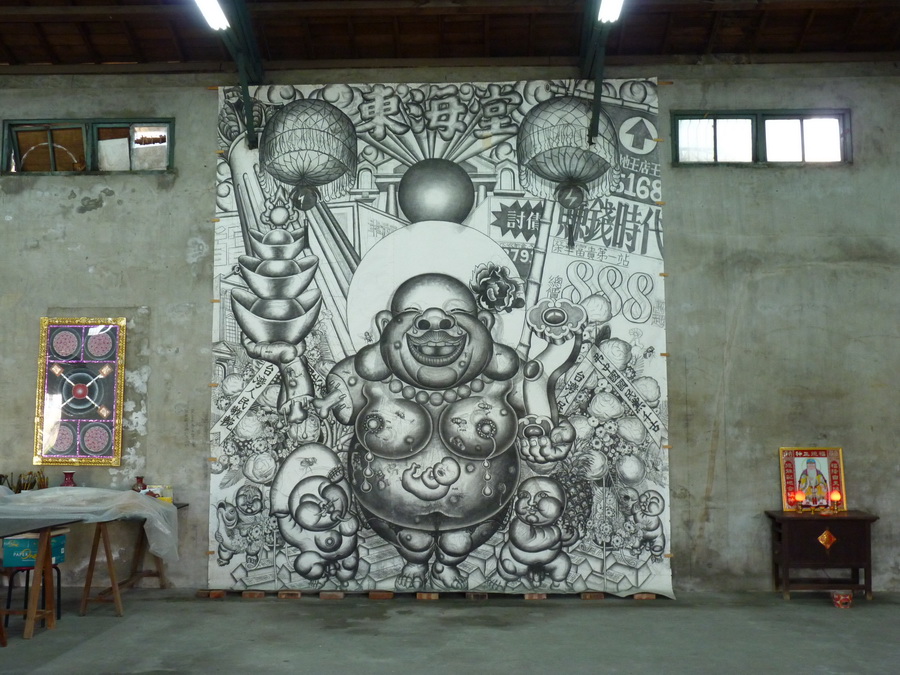
Monumental Nanshan Tower and Donghai Hall: From 2003 to the present, Huang Chin-Ho has drawn two extraordinary monument-form sketches, "Fortune as East Sea, Longevity Compare to South Mountain," thanking his mother for her nurturing grace. These two works, inspired by the folk image of theCloth Bag Monk and Drunken Maitreya, the God of Fortune lives in the East Sea, the God of Longevity – Nanji Xianweng (Immortal Old Man of the South Pole) lives in the South Mountain. Works in the last ten years have touched upon life and death and existential awareness, condensing the panoramic view of Taiwan's rustic, confusing society, politics, desire, and death, bringing personal creation into another life vision and reaching the pinnacle.
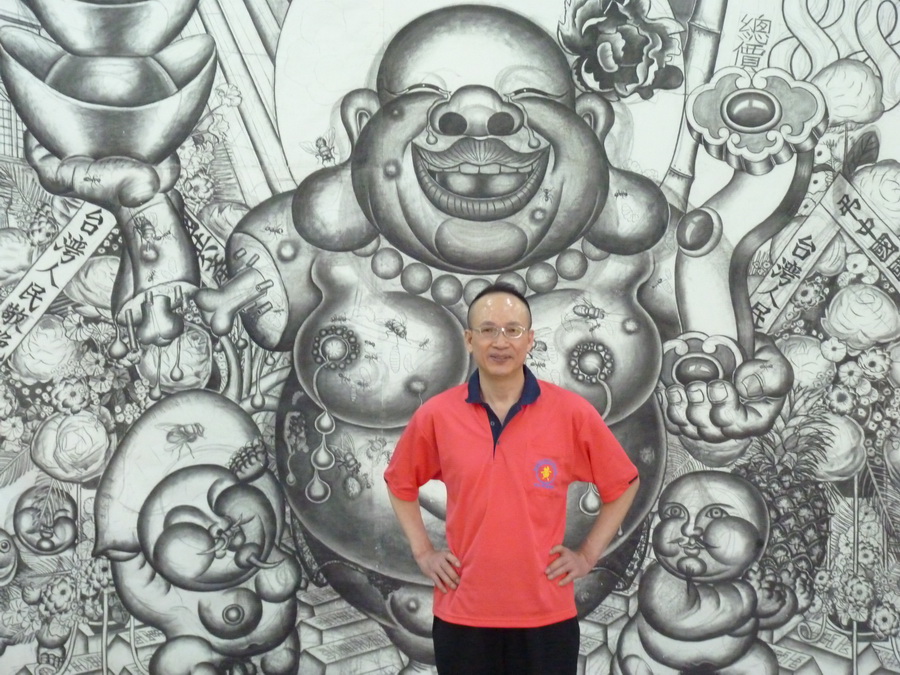
"Donghai Hall": Mouth open, eyes smiling, spring breeze on the face, left hand holding Jin Lu (Prosperity and Salary), right hand broken limb and arm supporting a fat female-male body of the God of Fortune with gold and silver treasures, sticking out a beer belly, two full breasts attracting flies dripping sweet milk, standing on ground full of gold, showing secular fame and profit. Decorated with lanterns and ribbons on the head, covered with various real estate developer advertisements and underground bank signs, reflecting Taiwan's society eager for quick success and instant benefits. Hanging on both sides of the God of Fortune are mourning blue flowers inscribed "Eternal Glory to the Kuomintang," burying the Republic of China, while the New Taiwan State