Five Flowers of Paris Spring
The tulip garden in the Parc Floral de Paris is an excellent place to view tulips in spring. The story of tulips: Mentioning the gorgeous tulips, people immediately think of the Netherlands, which is currently the world's largest producer and exporter of tulips, as well as a hub for European flowers
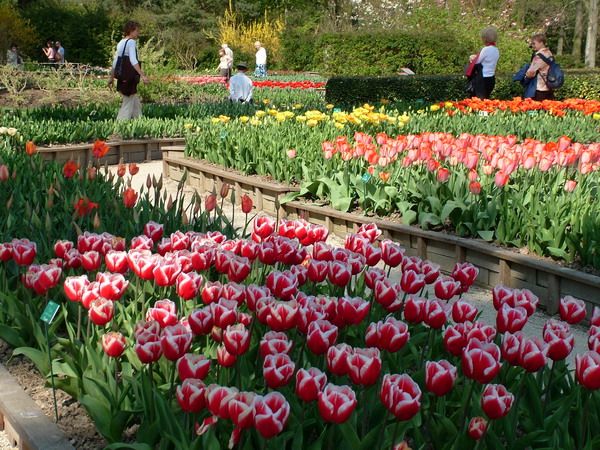
The tulip garden in the Parc Floral de Paris is an excellent place to view tulips in spring. The story of tulips: Mentioning the gorgeous tulips, people immediately think of the Netherlands, which is currently the world's largest producer and exporter of tulips, as well as a hub for European flowers. Tulips have been adopted by the Dutch for over 400 years; their original habitat includes Iran, Turkey, Turkestan, or the Caucasus mountains at an altitude of 3500 meters, where wild tulips can be seen on the Himalayas. Appreciation for this flower dates back to the era of the Ottoman Empire and its Sultans. Turkish tulips are ornamental plants with pointed, gorgeous petals, displaying a dignified and proud form. This flower was symbolic to the Ottoman Empire much like the "swallowtail" emblem was to the French royal family.
Tulips were introduced to Europe in the 16th century via Ferdinand I of Austria's diplomat, Ghislain de Busbecq. While negotiating peace in Turkey, he discovered tulips in a garden and brought back bulbs. It is said that tulips first bloomed in Europe in 1559 in Augsburg, Austria. Later, Charles de Lécluse, the head gardener and botanist of the Vienna royal court, took them to the Netherlands when he left his post, planting them in his own garden.
Soon, a craze for "tulips" swept through the Netherlands. To deter enthusiasts, Lécluse raised prices, but one night a flower thief stole his most beautiful tulips and bulbs, leading to product leakage. The thief successfully bred and sold them to other lovers, spreading tulips slowly. Discoveries of colorful varieties caused by viral diseases sparked obsession, making tulips highly sought after by nobles and the middle class, becoming prized garden items and reaching a fever pitch. Wealthy enthusiasts paid high prices for rare "parrot" tulips, while some merchants speculated, making just a few bulbs incredibly valuable. The market became so chaotic that neither sellers nor buyers knew who controlled it. This speculation ended dramatically in 1637 when a wholesale speculator flooded the market with bulbs, causing a crash similar to a stock market collapse, bankrupting many overnight and ending the crazy tulip story in the Netherlands.
The Netherlands became a center for bulb plant research and development. Early cultivated Turkish tulips were improved into round-petaled forms, then later into gorgeous six-petaled varieties. These colorful flowers quickly gained favor in neighboring countries and spread throughout Europe. Today, Lisse is most famous for bulb cultivation in the Netherlands. Centered around it, particularly between Haarlem and Leiden, there are 160,000 hectares of tulip fields, making it the world's leading tulip-producing country. (This section is from the article on Keukenhof Park in the book Western Gardening, published by Artist Publishing in 2003.)