Li Chun-Yang: Miao Gong Hu Lu Lu - "Original Flavor" Ye
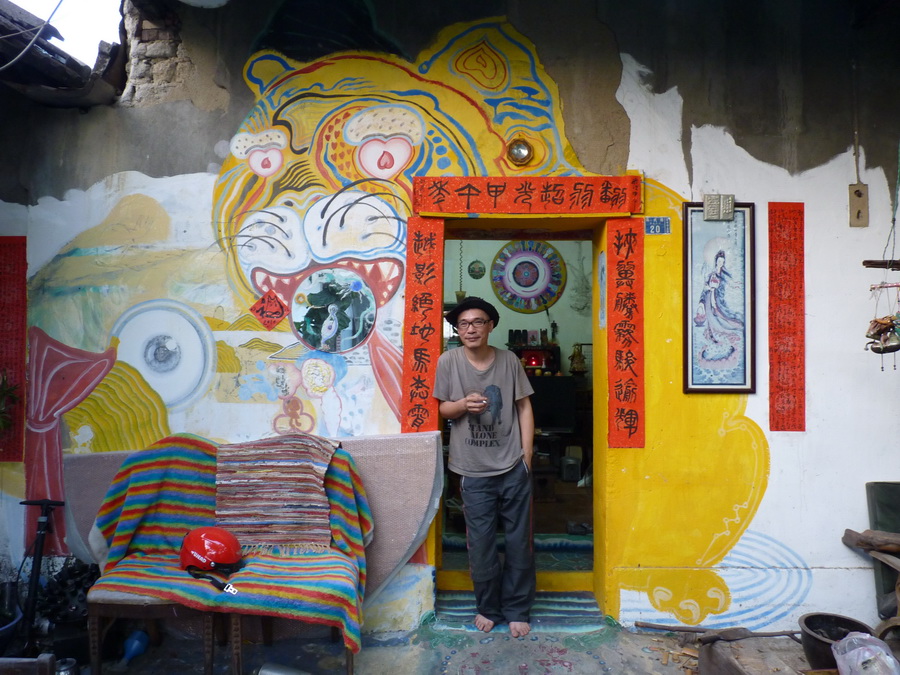
Miao Gong Junyang in front of his home in Taichung. Photographed by Chen Chi-Hsiang, 2014-03.
The Forgotten Ones
Intoxicated by color
Amidst the pigments of prejudice
Graffiti paints the dreams of worldly warmth and cold (Note 1)
Written by Chen Chi-Hsiang
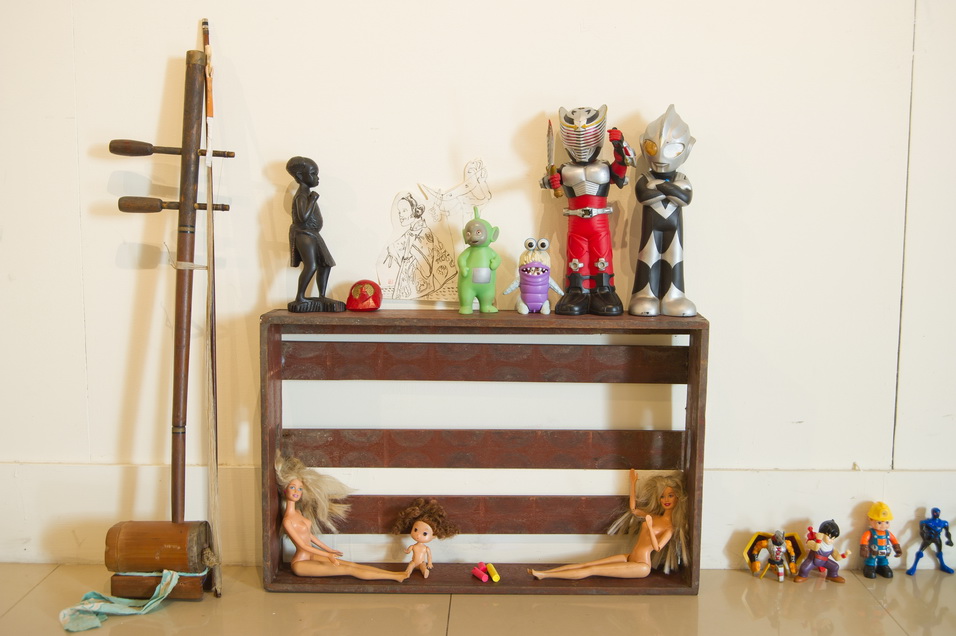
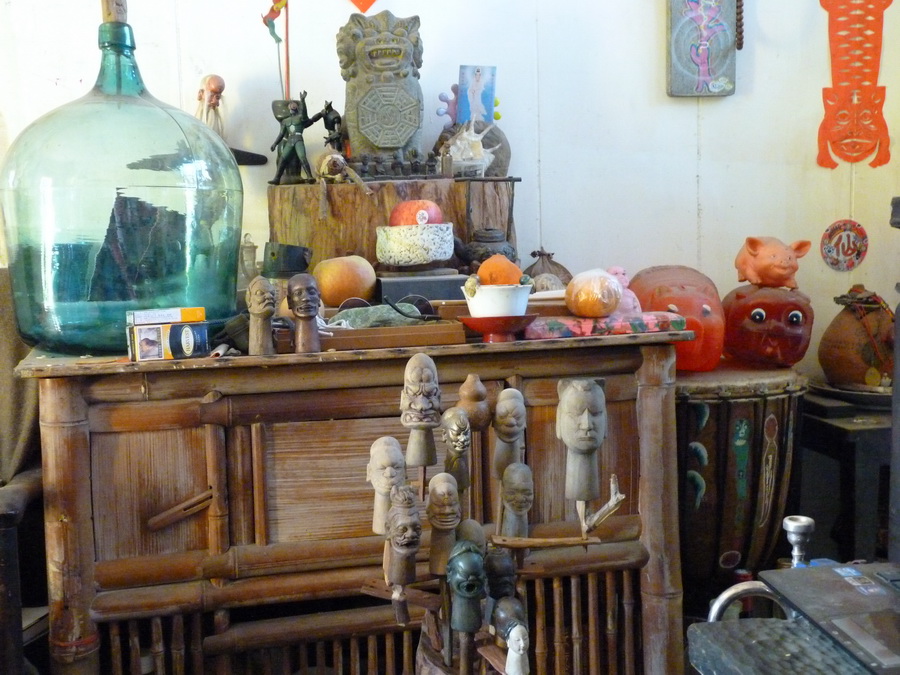
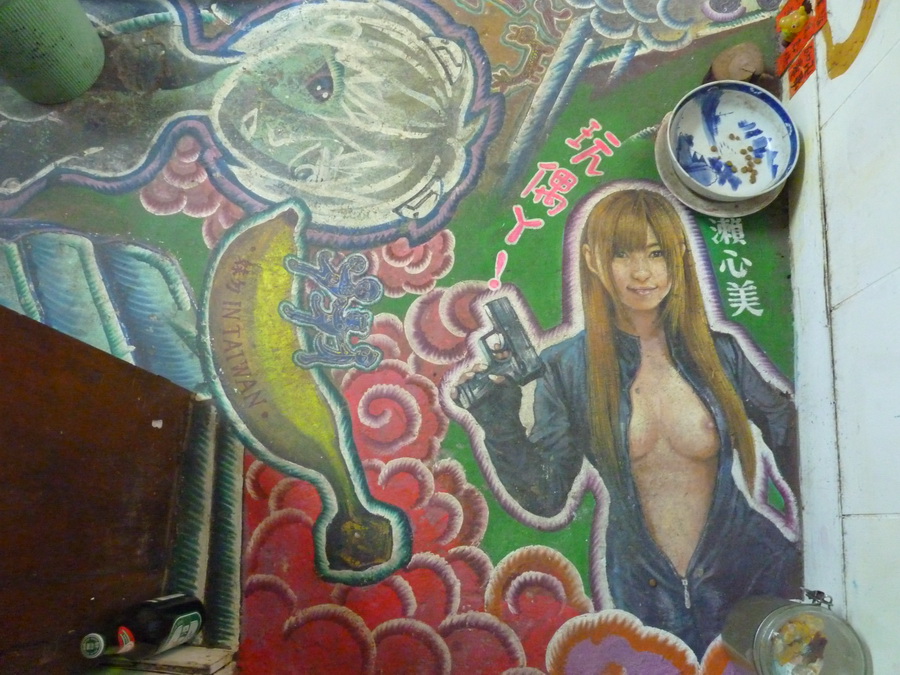
Preface: Life is more artistic than art itself. Clearly, without life there is no art; art enriches life, yet life creates art. Visitors to Li Chun-Yang are bewitched by this urban pearl’s earthen house and its colorful interior and exterior murals. Outside, under green shade, weeds grow lush with vitality. A kind-faced "Miao Gong Tiger" on the wall extends goodwill to guests. Couplets hang at the door, and a portrait of Guanyin greets visitors beside the house number, evoking the warmth of a hidden paradise. Alibaba’s living room features a Buddha-light table displaying an array of traditional puppet figures collected by Miao Gong, mixed with fallen deity statues and Invincible Iron Man toys. In front sits a large TV and small computer. Surrounding them are framed and unframed paintings, nostalgic photos, puppet heads, personal figurines, coloring images, guitars, erhu, guqin, masks, and various odds and ends. The poetic door painting depicts an image that is neither lion nor tiger. Miao Gong carved out a two-ping space as an art practice room, where he meditates, plays music, hosts guests, and creates. The floor is covered with his favorite cartoons, while Anime Beauty Sen no Ai accompanies him day and night, bringing him contentment. Artistic atmosphere permeates every corner; the kitchen, bathroom, and storage room are unique realms, blending life and art like a museum, dazzling the eye as if entering Miao Gong Junyang’s personal gallery.
Hu Lu Lu Ye "Original Flavor" – Miao Gong Junyang:
Li Chun-Yang (born 1967 in Taitung), also known as "Miao Gong Junyang," is an enigmatic, legendary, marginal figure. Versatile and playful, he loves exploring and digging into himself, indifferent to whether he is called an artist. With broad interests and unrestricted creation, he is a native oddity and heretic in Taiwan’s art scene. He calls himself "Miao Gong" (a homophone for "Temple Priest"), saying, "This way I can say I’m not an artist; I’m just a worker, at least a wonderful worker." (Note 2). He plays wildly like a mischievous child, believing art is made through play. There is freedom in games that unlocks creativity and imagination. His work stays true to inner feelings, seeking a peach blossom source deep within life, savoring the local "original flavor." His creative attitude becomes his value of existence, probing his spiritual depths. As an artist said: "He explores imagery in the inner world, feeling confused and lost about the essence and existence of life, tracing the footsteps back to life's origin." (Note 3).
Junyang plays with everything, mastering each skill seriously and diversely—painting, playing music (guitar, erhu, singing folk songs), carving puppet figures (making puppet clothes), making children’s toys, astrology, poetry, calligraphy, storytelling, performing puppet shows, temple murals, exhibitions, and more. Under the consciousness that life is art and art is life, he is a total artist, moving between visual arts, folk crafts, and music, combining traditional aesthetics, indigenous elements, and design, subverting tradition and crossing modernism, developing creative possibilities in conflict.
Miao Gong’s artistic source comes from life, not attached to form or style. His diverse artistic face evolves with circumstances: graffiti, comics, murals, ink wash, seal carving, calligraphy, acrylics, sketches, ready-mades, assembled objects, and spatial installations. Creation stems from daily life, arising from intuition, instinct, sensibility, spontaneity, and expression, showing unique magical power and consciousness. Curator Ruan Qingyue said: "Miao Gong Junyang is rare among artists for possessing strong intuitive energy; his works often connect with religion and supernatural forces, summoning things we have lost." (Note 4). His innovative art has strong local emotion, taste, consciousness, and resonance. Looking at his artistic signs: between amateur, folklore, tradition, modern, primitive, indigenous, material, spiritual, and mental, he created a unique style.
Art’s Origin and Circumstance:
Junyang’s family were popular movie billboard painters; his father was an outstanding one. Influenced by his father, painting became their family gene. He loved graffiti since childhood, and painting became their most primal existential energy. Both brothers became billboard painters. After his father died when Junyang was seven, the family moved from Taitung to Hualien Guangfu. After junior high, he learned motorcycle repair but was obsessed with drawing, finding it unsuitable. He became a billboard apprentice in Hualien. At seventeen, he went to Taichung to learn from his uncle, showing great talent and graduating in a year and a half. At that time, they painted movie billboards for six or seven theaters in Taichung. Recalling the past on Facebook: "Every day, every day, every day, the workplace smelled of toluene, so thick that my brother and I couldn’t smell it anymore... At night, I wanted to 'be myself,' paint, carve, make love, and then felt abnormally excited." (Note 5). Driven by curiosity, young Miao Gong attended Daming Commercial High School’s Art Department at night after painting billboards during the day, absorbing new knowledge, enriching himself, opening his horizons, exploring various materials, painting madly, realizing life’s preciousness and possibilities, hoping to break free from being just a painter and advance to creation.
Existence follows circumstance. During military service, he encountered puppet figures, sparking interest in Taiwanese folk art, and began carving wooden puppet heads and small deity statues, becoming another obsession in his life. After discharge, he delved deeper into folk arts, exploring and understanding them. By day he painted signs, by night he carved puppet heads or tried creating. Seeking development in Taipei, he opened new possibilities in the bustling metropolis, eventually moving to theater set design, gaining further cognition of craft, design, art, and culture, seeking new artistic momentum.
With technological progress, the billboard industry’s good times did not last. In the early 1990s, the digital age of computers and the internet arrived, replacing hand-painted signs with large computer output images, leading to the profession's decline. An artist said: "He became unemployed just like that, especially when he had just married and had children. To make a living, he did art for small theaters and painted stage sets for Haili Records... Yet his desire to create could not be suppressed. At night, he hid in his room and painted madly. Art creation gave him a closed world, blurring his wife’s repeated complaints." (Note 6). In this life circumstance, Junyang truly devoted himself to painting in 1993, letting go of emotions and repression. Two years later, he realized what art was, opening his spiritual consciousness, allowing creation to flow naturally. He drew many sketches and watercolors and held his first solo exhibition Passing Scenes and the Arrival of New Life at Ideal State Arts Space in Taichung, beginning his artistic journey.
Divorced in 1997, Junyang released his emotions and became free, starting to play art madly. Everything touched by his ingenuity became art. Creation moved from life into assembling discarded waste. The three-wheeled vehicle representing "life is art" became not only transport and a creation base but also total art, exhibited at Taichung X Generation Gallery with his most representative work Colorful Soul-Bewitching Sedan (Three-Wheeler). The following year, the Kaohsiung Museum of Fine Arts (now National Taiwan Museum of Fine Arts) opened, igniting his strong creative urge. He resolved to become an artist and devoted himself fully to creation. In 2000, he resided at Taichung Warehouse No. 20, crossing fields with "Ziwei Astrology" to contact "people," expanding his life consciousness, and holding a solo exhibition Survival in Desperate Situations: Black Pen Memorial at Warehouse No. 20. In 2003, he received the Asian Cultural Council Fellowship to study in the US, residing at Headlands Center for the Arts in San Francisco. In 2004, he engaged in temple murals, becoming (Temple Priest) Miao Gong. Before lifting martial law, Junyang played instruments and sang folk songs (harmonica and guitar), experiencing himself. In 2005, he began learning the huqin, making music an indispensable spiritual food. During a creative low point in 2008, he started seal carving and copying inscriptions, trying to regain creation. Driven by instinct, he drew a series of full-size sketches. In 2010, he participated in the Taiwan Mural Team at Qiaotou Baiwu in Kaohsiung (he and Nanao painter Li Junxian were founders), defending local aesthetic values and practicing local consciousness. Overall, his creation integrates life, liberates art, and transcends taboos.
The Driving Force of Artistic Creation:
Miao Gong Junyang’s creative source and inspiration come from Taiwan’s endless genuine folk and marginal aesthetic heritage, along with grassroots energy from within the soul, rooted in local cultural consciousness. It stems from the primal driving force of existence instinct, sensibility, and impulse, attempting to develop a unique indigenous art style. From the start, he delved into the local spirit, insisting on walking his own path, painting "his own paintings," which means exploring the local consciousness of "Taiwanese flavor," strongly implying Taiwanese subjectivity, intending to construct his own great local spirit and taste, creating a native new Taiwanese painting style. An artist said: "His local creation comes from the land, formed naturally, without needing external help," and added: "He fights for his own heart; what matters is what he wants to paint inside." (Note 6). Back-bone Miao Gong’s creation is not limited by style or attached to form, focusing instead on inner feelings. He wanders freely according to circumstances. He refuses quick fame and short-term artistic management models, saying: "Everyone has success experiences and is trapped by successful frameworks and stagnation." (Note 7). Clearly, he pursues expanding the continuous, vital stories of this land, thereby stating his value of existence and calling back the spiritual energy and resonance of this land.
Interactive Art Exploration:
Miao Gong Junyang’s artistic inspiration comes from classic legends and stories of the folk. Ideologically influenced by Buddhist sutras and Taoism, his images hide many visual symbols of Taiwanese and marginal cultural heritage. In the language of the land and folk thinking, within individual and collective consciousness, his diverse art is full of narrative, anecdotal, literary, expressive, and local allegorical meanings. Creative drive is readily available, driven by the unconscious, occurring and growing naturally. He emphasizes the freedom of hand-writing and personal inner feelings. Creation alternates and develops with the trend according to circumstances. Painting remains the main axis of his creation. Delving into folk traditions, between graffiti and free forms, he uniquely created personal mysterious and bizarre imagery. Expressive puppet statues find a traditional path, while ingenious children’s toys test the artist’s creativity. From single exploration to cross-field investigation, opening spiritual and imaginative spaces, creative momentum independently creates meaning under randomness. He is accustomed to interacting past creations to make installations, often transforming life circumstances into creative drive, combining painting, puppet statues, children’s toys, collected small toys, and objects into dramatic spatial installations, such as the most representative Colorful Soul-Bewitching Sedan.
Total Art – Colorful Soul-Bewitching Sedan:
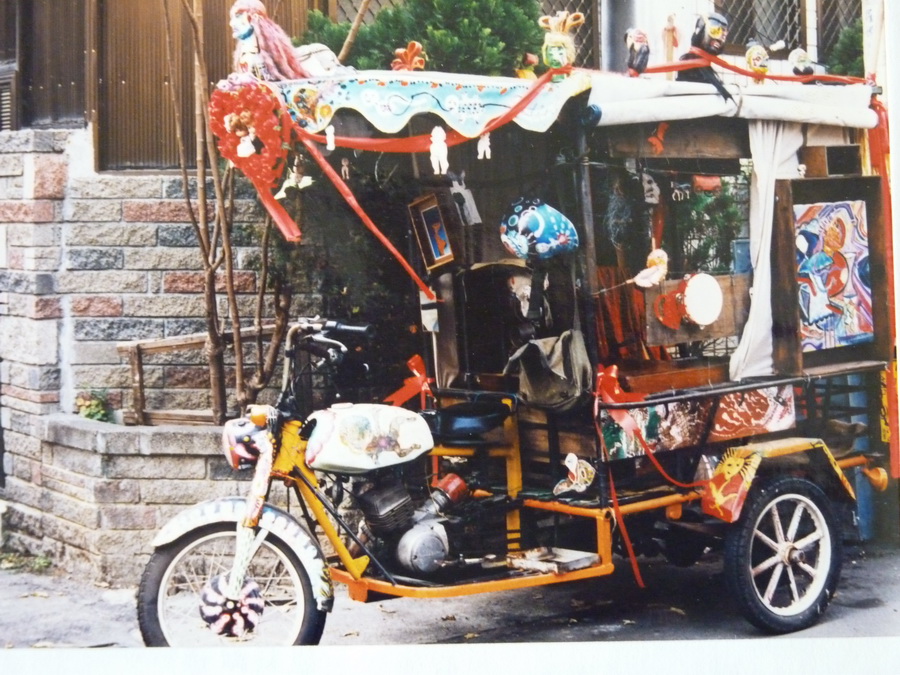
Hu Lu Lu Taichung has a fast three-wheeler. The cloth on top belongs to an old lady, but the owner of the Colorful Soul-Bewitching Sedan is "Temple Priest – Junyang." When the artist rides the three-wheeler, it transforms into the imaginative Colorful Soul-Bewitching Sedan. Isn’t that strange? This is where "art" is magical. The artist explains "Colorful" means a colorful, changing life; "Soul-Bewitching" represents a state of weakness and trance; "Sedan" symbolizes a mobile base filled with nostalgic sentiments (Note 8). It is his social experience and the clue to existing life memories, forming total art. The three-wheeler was a convenient mobile transportation tool of the past era, seen running around remote corners selling goods as a mobile vendor, or common vegetable stalls in traditional markets. The three-wheeler is full of metaphors for Taiwan’s lower-middle-class society, feeling familiar and approachable. My greatest impression of Junyang’s artistic creation is this Colorful Soul-Bewitching Sedan, which continues to ferment in my heart to this day. I believe it is one of the most "original flavor," locally emotional, and symbolic masterpieces of late 1990s contemporary Taiwanese art.
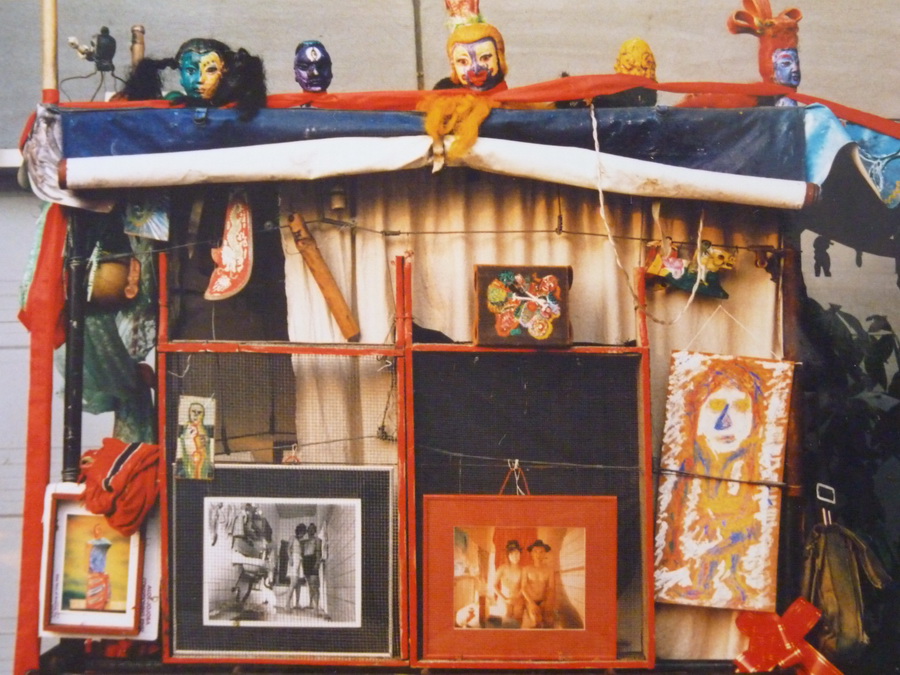
Miao Gong Junyang’s most symbolic Colorful Soul-Bewitching Sedan (1997) was inspired by Jianguo Market near his home. One day, seeing a vegetable vendor riding an assembled three-wheeler moved him inexplicably. It also awakened his childhood memories: sitting in a car painted with movie billboards, shuttling through streets with his father who painted billboards (Note 9). So he bought an assembled three-wheeler. Initially just for transport, he gradually beautified the plastic tarp canopy with bit-by-bit painting and decoration, forming colorful patterns and images. The iron frame was hung full of his puppet figures, small statues, bamboo joint men, gadgets, pictures, photos, and various dead bones (objects), transforming into Miao Gong’s creation base and mobile exhibition venue. Riding this vibrant vehicle, Junyang shuttled through Taichung’s streets, establishing new interactive relationships with people, stepping out of the studio and the ivory tower of the art system into the social field. He said: "At that time, I felt it was strange to put my things in museums and galleries. That three-wheeler is called the Colorful Soul-Bewitching Sedan. Art can walk up and down the street like selling vegetables; it doesn’t have to be in a museum." (Note 10).
The Colorful Soul-Bewitching Sedan is Junyang’s life platform, creation base, and action performance stage, like a miniature of Miao Gong’s personal gallery, and even rarer example of total art and interactive aesthetics in Taiwan. The sedan mixes living space, performance space, art space, social space, and public space. He likes to play, playing madly without worries, enjoying it thoroughly. Remembering when youth drama director A Cai got married, dramatically using the Colorful Soul-Bewitching Sedan as a wedding car, followed by six Mercedes-Benz cars, parading magnificently through Taichung City, humorous and full of folk social allegory. It presents Taiwan’s most original emotion, spirit, atmosphere, and individual and social collective consciousness. Life experience is more important than by-products. Life is a game, exploring all possible existences and experiencing every current situation. Between life and memory, private and public, indigenous and modern, action and display, situation and field, art and non-art, he subverts tradition and the art system.
Miao Gong Junyang’s other sister work Colorful Soul-Bewitching Sedan – Childhood Pink Mosquito Net (2000) is ritualistic and dramatic, presented through object installation and action performance. Puppet heads carved by him hang in orderly high and low positions on the car. Each rustic head has its own personality and symbolism, wearing white gauze below, faintly revealing yellow light. In front of the car, a pink mosquito net structure casts a light corridor. Inside the corridor stands an antique cabinet, metaphorically full of poignant sorrow. On the opening day, the artist sensibly wore a white robe half-naked, holding a scepter, "calling the spirit" around the work to summon heaven and earth, cleansing and liberating his own soul, awakening existential consciousness, releasing the shared emotions of Taiwanese people, showing local vitality and resonance.
Exploring Primal Images Deep in the Soul:
Driven by the unconscious, Miao Gong Junyang explores primal images deep in the soul, creating meanings that retain greater vitality, galloping with infinite imagination. An artist said: "I attribute that to creation returning to or entering a wild state of life." (Note 10), naturally releasing all energy and creativity, pioneering Miao Gong-style local language free forms. Painting is intuition, instinct, sensibility; painting is also the antenna of the soul and the neural pain of existence. He never creates in a specific way, alternating freely as he pleases. Painting is no exception: sketches, ink wash, murals, acrylics, calligraphy, and sketchbook documents. Exploring with circumstances, diverse forms present from the heart the confusion and loss regarding the essence and existence of life, tracing the footsteps back to life's origin, uniquely demonstrating magical power and consciousness.
In 2004-2005, Miao Gong Junyang exhibited in Co4 Taiwan Avant-Garde Documents Exhibition - "Art Transfer." Using titles Brothers and Sisters Superstars – Roaming the Four Seas Wandering Performing Spiritually Connecting Three Realms Phantom Formation and Colorful Soul-Bewitching Wonder – You and I Are the First Sperm Running to the Zhi Gong, he performed live using the refined skills of a movie billboard painter, incorporating portraits of nearby artists and curator friends into the paintings. In front of two huge canvases stood his most symbolic Colorful Soul-Bewitching Sedan (carrying a statue of God Qiye), expanding artistic consciousness in play.
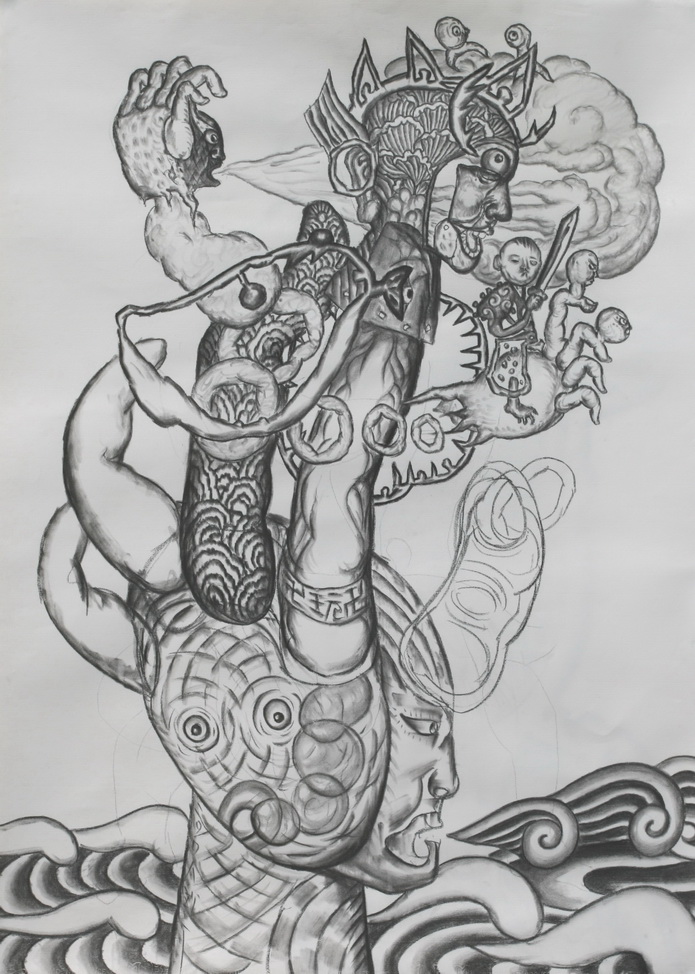
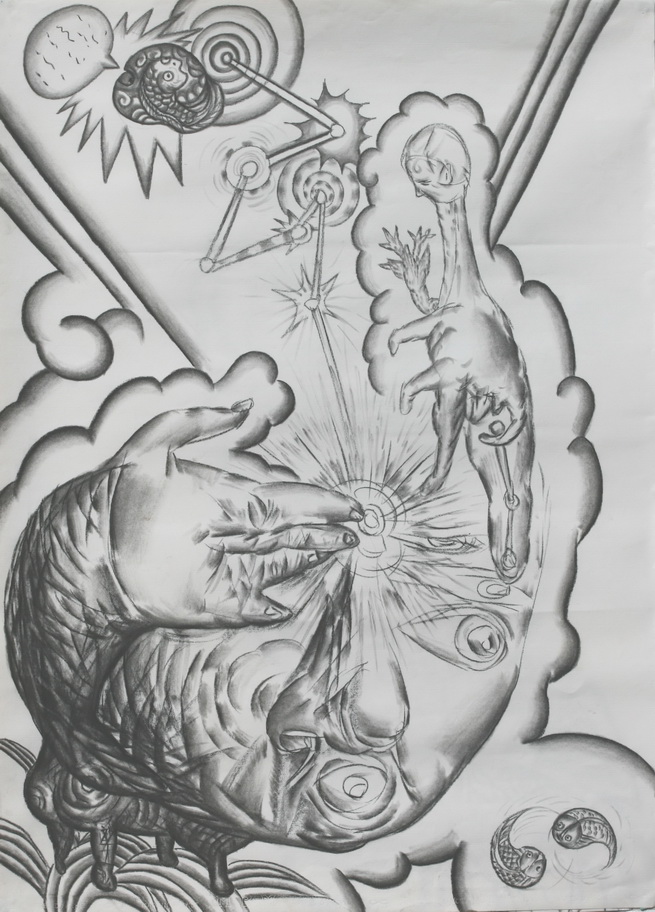
In 2006-2009, with casual ink wash and calligraphy series, he deeply entered tradition and stepped out of modernity to express his sensibility. Along with the 2008 Miao Gong Hu Lu Lu Pencil Line Drawing Series, amidst playful and teasing graffiti, he mixed various cartoons, folk totems, puppet idols, bamboo joint men, and modern life consciousness symbols, shifting material attributes. Clumsy and wondrous brushstrokes outlined bizarre imagery, presenting a novel free form. In 2009, at Taipei Kuandu Museum’s Green Wild Fairy Trail Kuandu Part One - Driftwood Installation Art group exhibition, a monument-style spatial installation "Me - Earth Spirit, Outstanding People - Dear Land God Our Earth" spanned two walls. Between the color planes transforming into pictographic divine temples and mysterious, bizarre figures, under the Hu Lu Lu context, he elaborated on the realm of heaven, earth, and man’s illusory ocean waves rolling through worldly dust.
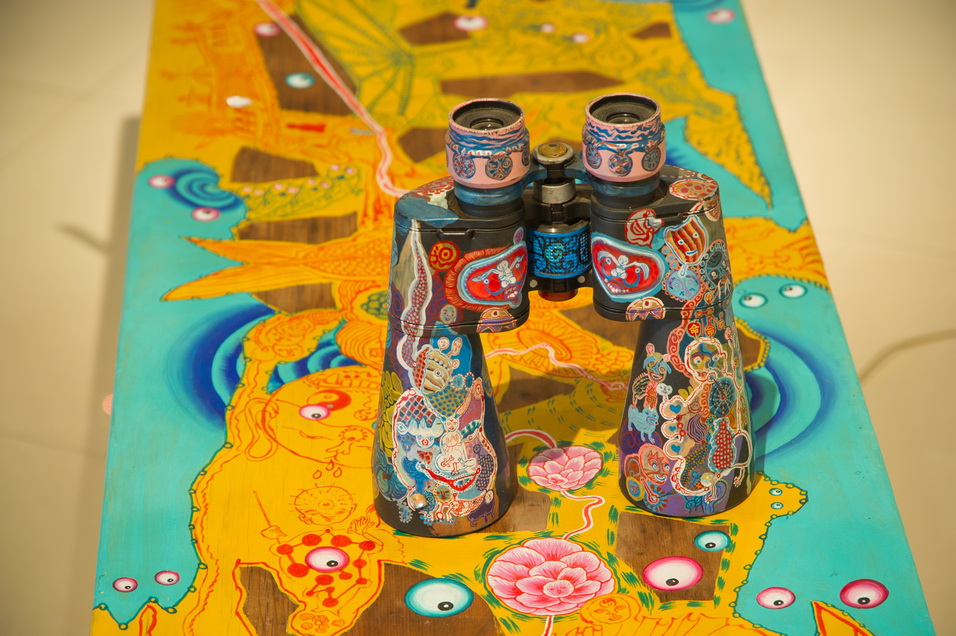
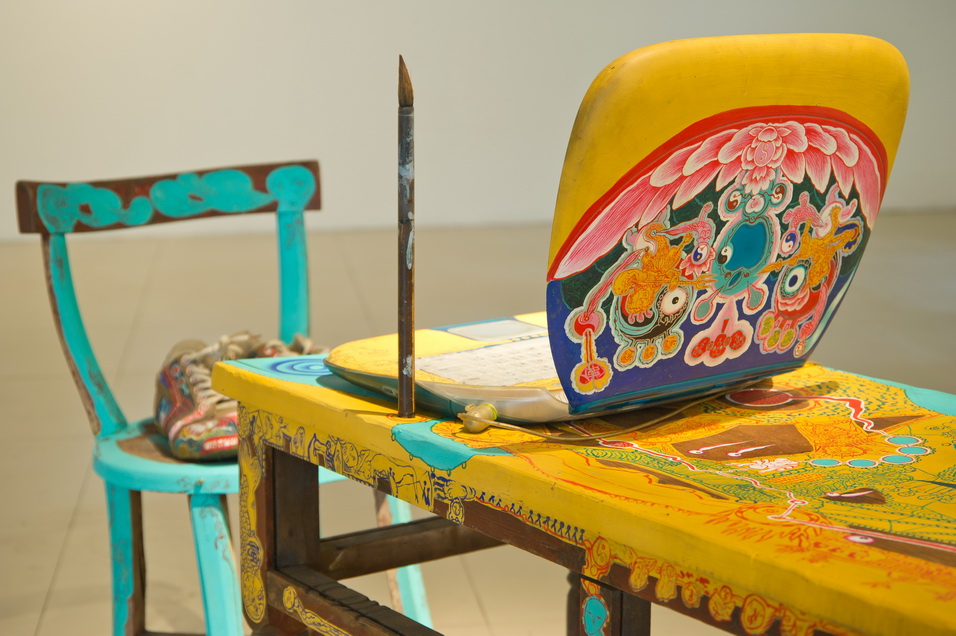
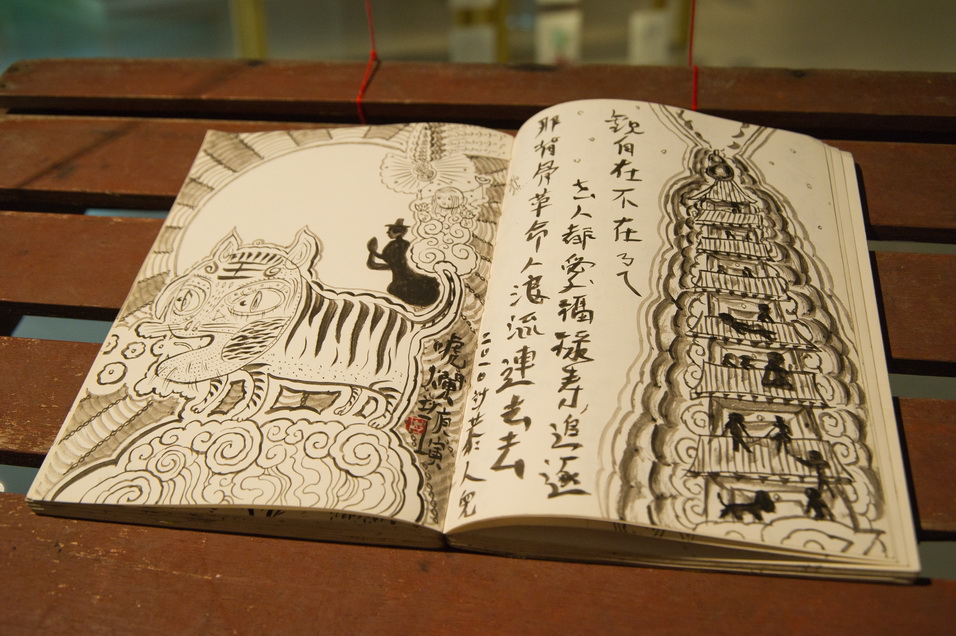
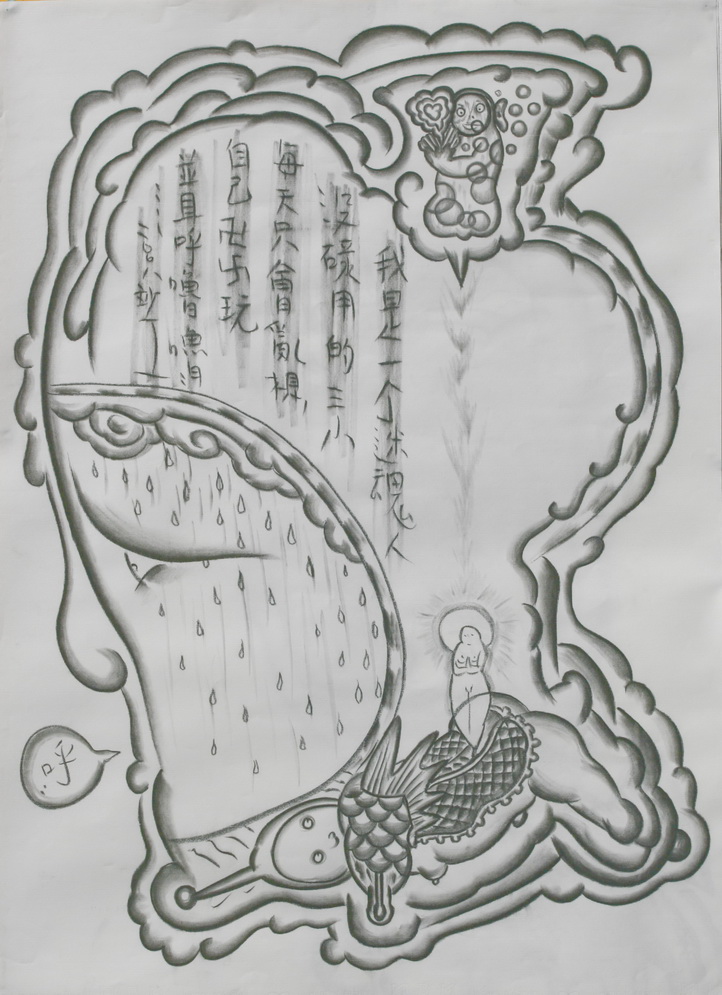
Miao Gong’s creation goes with the flow, painting on any readily available object like tables, chairs, laptops, shoes, pen barrels, and bamboo joint men. Most paintings are on paper and sketchbooks, rarely on canvas. Only after joining the Qiaotou Taiwan Mural Team in 2010 did he start using acrylic/canvas, releasing strong local emotion. The 2010 sketchbook series was presented in a sensitive, free-writing manner, text and image together, showing current situations and consciousness. His works are humorous, witty, bizarre, and playful, soft, delicate, and elegant. Patterned, they are referred to as "soft silk," touching current neural consciousness between imagery and mental image, instinct and sensibility, expression and lyricism, consciousness and subconsciousness, literature and anecdote, situation and field, material and spirit.
Miao Gong’s exhibitions do not stick to conventions. He has high sensitivity to space, habitually using past creations as installation elements. He often puts surrounding photos, objects, and paintings all into the exhibition. For example, in the 2010 Kaohsiung Gao Yuan University of Science and Technology Arts Center Miao Gong Hu Lu Lu solo exhibition, sketches, photos, and objects were mixed and hung as facade installations, or personal collections of small toys, figurines, puppet figures, children’s toys, and various odds and ends were all included in the venue. He believes "An artist’s life can also be exhibited" (Note 11), indicating in methods of expanding art concepts that life is more artistic than art.
Puppet Dance Life – Puppet Statues:
Junyang’s life is like a puppet dancing through life. During military service, he fell into puppet carving and couldn’t extricate himself. When painting reached the bow, he would turn back to embrace his passion—carving characters from Taiwanese folk legends (Liao Tianding Legend, Xiluo Seven Mountains, Lintou Sister, Zhou Cheng Crossing Taiwan), exploring the characteristics of form and role, and discovering the mysteries of human roles, thereby understanding the meaning of life. When he delved into Taiwanese puppet figures, he found they were actually not very "Taiwanese," motivating him to seek the root of "Taiwanese flavor" puppet idols. Thus, in 1999, he held his first solo exhibition Genuine Taiwanese Puppet Idols at Yilan Drama Museum, reinterpreting the possibility of classical puppets in Taiwan. He said: "I want to find traditional carving techniques from classical puppets, so I created characters in the Liao Tianding puppet show, including tailoring puppet clothes myself, finding many modern changes from traditional paths." (Note 12). In the dream of life, he regains the Hu Lu Lu Taiwanese original flavor full of vitality. Puppet statues become metaphors for individuals and society.
Note 1: Interview record of Li Chun-Yang’s Taichung studio – Junyang wrote the poem written by his father to me, 2014-03. Note 2: Issue 682 Apple Daily "Very Human Language" written by Wang Jinhua, 20140617. Note 3: New Taiwan News Weekly Issue 324, Jiang Guanming, 2002/06/10. Note 4: Issue 682 Apple Daily "Very Human Language" written by Wang Jinhua, 20140617. Note 5: Miao Gong Junyang Facebook, 2013. Note 6: New Taiwan News Weekly Issue 324, Jiang Guanming, 2002/06/10. Note 7: Interview record of Li Chun-Yang’s Taichung studio, 2014-03. Note 8: Taiwan Installation Art 1991-2001, Li Junyang section, written by Yao Ruizhong. Note 9: Taiwan Installation Art 1991-2001, Li Junyang section, written by Yao Ruizhong. Note 10: Art Perspective Magazine 2008 Autumn Issue "Post-History Art Special: Freedom - Art", Author/Cai Wanxuan. Note 11: Interview record of Li Chun-Yang’s Taichung studio, 2014-03. Note 12: New Taiwan News Weekly Issue 324, Jiang Guanming, 2002/06/10.