Shih Chin-Hua: The Man Who Walks the Pen
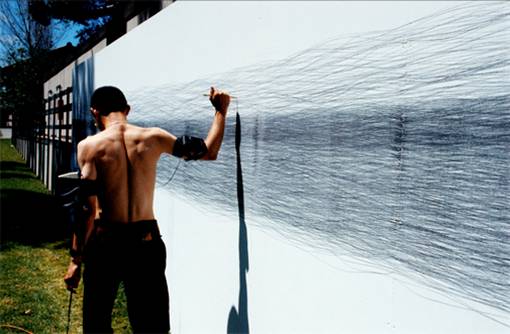
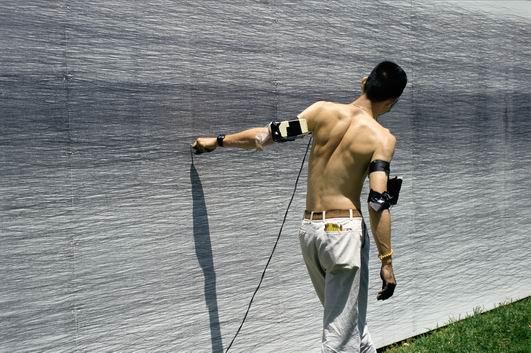
The Man Who Walks a Pencil, 1996–present. Photographs documenting the walking pen process.
"The greatest happiness in engaging in art is—being able to recognize great souls." (Note 1)
Preface: What is art? How is it possible? Under what conditions and in what ways does it present itself? What is the relationship between life and art? What role and meaning does life play in art? How does art shape life and witness existence? The relationships among art, the body, life, and spirit. Painting is the alchemy of life, the measure of existence, and consciousness. For Shih Chin-Hua, painting refers to the body; bodily behavior tests endurance and willpower, realizing the cultivation of one’s existence, witnessing that "life is a path, and the body is the dojo." To him: "An entire life is a continuous process of discovering revelations and the true meaning of fables" (Note 2). He pursues not only the essence of art but also deeper questions of life, tracing back to the meaning of existence. As Chen Shih-Ming said: "Art is the ultimate meaning of life, the call of life's spiritual energy" (Note 3). Shih Chin-Hua believes: "The best artists are usually very brave people, people who are sincere" (Note 4). Indeed, without humility and honesty, nothing new can occur. For him, possessing religious sentiments, a sincere response to life is walking the pen—an action. Art serves as an outlet for the soul or spirit, transcending the possibilities of existence, becoming a way of liberation from life.
The Man Who Walks the Pen – Shih Chin-Hua: Shih Chin-Hua (b. 1964) is the most unique "walking pen" artist and life artist in the Taiwanese art scene. His series of referential "Walking Pen" works stands out alone. Within his humble and sincere religious sentiments, concept precedes action. Through artistic behavior, he transforms and sublimates life. He crosses boundaries, integrating concept, behavior, attitude, and performance; people call him a conceptual performance artist. He often compares himself to a tightrope walker: Is the body the temple of the soul, or its prison? Of course, anything can be discarded, except the body, which cannot be thrown away. He had to face the harsh tests of life early on. His creation is closely related to his congenital diabetes and inseparable from measurement and recording, forcing him to sincerely face severe life-and-death situations. Since age 17, he has injected insulin, testing and recording blood sugar day after day without tiring. The physical and mental torment forced the artist to treat his life state seriously. Life was full of setbacks; struggle and pain often inspired people to break through their dilemmas and transcend themselves. Thus, the body naturally became his artistic tool, and his works transformed into the body. By walking the pen and measuring, he tested his existence. Is he a man walking the pen, or a tightrope walker?
Shih Chin-Hua is one of the leading conceptual performance artists in the Taiwanese art scene. He devoted himself to bodily artistic expression, using wise, rational, dialectical concepts as the creative driver. Behavior drove his actions, and attitude became the posture of his artistic life. Immersed in the context of Buddhist practice and chanting scriptures, he reflected an extraordinary spiritual volume. Conceptual meaning indicates that these works favor a unique expressive power, whether narrative, descriptive, anecdotal, or visual. They reveal a core of thought within those rules, symbols, and languages.
Origins and Creation of Artistic Factors: Everyone is an artist, possessing potential infinite creativity and instinct. Every artistic factor is buried deep in the soul, blooming and bearing fruit naturally when conditions arise. Shih Chin-Hua’s artistic path was winding. He loved art since childhood. Living under Taiwan’s social values at the time, he endured the bitter pressure of college entrance exams as a teenager. At the end of his first year of high school, a car accident began a period of drowsiness and fatigue. During the summer vacation, he lost over twenty kilograms. Tests revealed low-type diabetes, like a nuclear explosion in his life. He relied on insulin injections to control blood sugar, facing survival challenges daily with no hope and unhappy days.
In high school, Shih Chin-Hua lived under helpless and constrained circumstances, facing fatal threats and harsh setbacks. This shaped his hesitant, withdrawn, inferior, uneasy, anxious, fearful, and depressed closed personality, deeply affecting his life. Reflecting on his own situation, after graduating high school, he determined his future. Influenced by his second brother, he applied for the Fine Arts Department. He entered Teacher Li Chuen-Hsien’s "Riverside Studio" to study painting and practice art; Li became Shih Chin-Hua’s mentor. He failed the first joint college entrance exam, but passed the next year to enter Fu Jen Catholic University’s Applied Fine Arts Department. He began repeatedly contemplating artistic creation and resolved to become an artist. He took a leave of absence to prepare for retaking the art department entrance exam, started painting oil paintings, and awakened his talent, winning the Lion New Artist Award. This encouraged and affirmed his talent, giving him immense energy. Finally, wearing the crown of the Lion New Artist Award, he entered the National Taiwan Normal University Fine Arts Department.
Full of confidence, Shih Chin-Hua entered his dream school, NTNU Fine Arts Department. He quickly became disappointed with the stagnant art education. Awakening from broken dreams, he realized learning depended on himself. Mutual stimulation and collision among students sparked creativity and thinking. He independently sought his own path. Works from this period revolved around personal bitterness, loneliness, and a closed self. During NTNU, he openly confessed his physical condition, trusting the world and opening his heart to welcome light, giving him more energy to learn and create. The deepest influence on Shih Chin-Hua was during his sophomore and junior years, the visiting Japanese teacher Lu Ming-Te in the Composite Media class. Especially the creation project proposals, thinking about the expression of text and sketches, opened the door to "Conceptual Art" for him. Observation, awareness, exploration, and discovery could save the soul, and were also the way of creation. The British literary giant Oscar Wilde said: "Only perception can heal the soul, and only the soul can heal perception." Thus, the object of art does not represent essence; attitude and conditions determine "art." The confusion, reflection, tests, and enlightenment during NTNU, because creation came from conception and face-to-face discovery and formation, affirmed the present, walked out of life’s shadows, faced things openly, and untied knots step by step.
In the first half of 1992, residencies in New York (East Coast) and San Francisco (West Coast) opened Shih Chin-Hua’s artistic vision and new creative consciousness, such as the conceptual performance record work "San Francisco Hiking Diary" (1993). From East to West Coast, he began seeking and exploring the meaning and value of life. Religion could not solve his life’s issues, so he turned to ancient Chinese Lao-Zhuang philosophy, such as the unity of heaven and earth in the Qi Wu Lun, gaining breath and relaxation. Soon after, he encountered Buddhism. After the residency, he chose to continue his studies at the University of California, Irvine’s Art Institute, convenient because his eldest sister lived there. Southern California was the headquarters of West Coast conceptual art, free, open, and diverse: homosexuality, new feminism, people of color, colonialism, and art power. Art emphasized speculation and criticism, believing contemporary art was a sharp weapon for social battle. Concepts were discussed through literature, film, and video regarding concepts and poetry, or images as imagination. Shih Chin-Hua took root in this conceptual speculative logic, constructing his unique creative method for the personal body, pioneering his conceptual performance, and opening his most original "Walking Pen Series."
NTNU made Shih Chin-Hua see the truth clearly and forge his own independent path. The UC Irvine Art Institute opened the living source of his creation. Creation came from conception and face-to-face discovery, forming in daily discoveries. The concept of conceptual art formed at NTNU, such as "Bones for Sale" in the graduation exhibition. Objects were not the place of meaning and value, but their attitude and conditions. It was at UC Irvine that he truly implemented conceptual performance creation, such as the "Walking Pen Series" and "The Man Who Walks a Pencil."
Shih Chin-Hua had already shown his talent before entering NTNU, winning the coveted Lion New Artist Award and leaping onto the art scene. In 1992, his first solo exhibition at the Taipei Fine Arts Museum, "Costly," pioneered the fashionable interactive relational aesthetics of the 1990s. The following year, he participated in the "Taiwan 90’s New Concept Group" group exhibition. In 1994, he resided in California, West Coast. In 1996, he participated in the Taipei Biennale – "Taiwanese Art Subjectivity." In 2002, he participated in "CO2 Taiwan Avant-Garde Document Exhibition – Ko Tse-Hai Solo Exhibition." From 2003-04, he resided at MoMA PS1 Contemporary Art Center in New York, USA. In 2007, he led the way, winning all major art first prizes in Taiwan: "Taipei Art Award," "Kaohsiung Art Award," and the 10th Li Chung-Sheng Foundation Visual Art Award, becoming the most promising new star in the Taiwanese art scene. In 2010, he participated again in the "Taipei Biennale – X Trees of Taipei." The following year, he was nominated for the 9th Taipei New Art Award "Annual Visual Art Award" with "Contemporary Art Alchemy Trilogy – Shih Chin-Hua Solo Exhibition," establishing his unique artistic style and status.
Turning Point of Life – From Christianity to Buddhism: Shih Chin-Hua was born into a traditional Christian family, a humble and sincere Christian. Facing his body strictly from a young age, in a cruel life, he sincerely experienced the emptiness, disillusionment, and impermanence of existence, asking what life is really about. Realizing art could not solve life’s issues, he said: "Artists can only save themselves, not the world," and "Artists are people who save their own souls." Furthermore, "Because art cannot save artists, the meaning and value of life are not in art" (Note 5). Usually, he liked reading biographies and stories of artists and literati, making friends with ancients, seeing the power of existence and inspiring examples. The San Francisco residency was a turning point in the artist’s life. From then on, he truly sought the meaning and value of life, opening the way of liberation.
He formed ties with Buddhism at his sister’s house who studied Buddhism. Contacting scriptures and Buddhist magazines, he began studying Buddhism diligently, immersing himself in Buddhist thought. He converted to the Tibetan White Sect, worshipping Buddha, meditating, and chanting sutras and Buddha names. From the Lao-Zhuang philosophy of the unity of heaven and earth to Buddhism’s compassion for all beings, he focused on studying Buddhism, sublimating existential consciousness. Buddhism completely targets individual mind cultivation, revealing the true nature. Awareness returns to past life cultivation, observation, and verification, resilience, and openness. Buddhism’s compassion and wisdom inspire submission to existence, liberating the artist’s inner anxiety and distress, soothing the soul, and transforming Shih Chin-Hua’s existence. Without complaint or regret, under vows and mental power, his life was completely changed. Art became a subject of life, reflecting the revelation of true nature. He believed: "The meaning of life is waking up from a dream." (Note 6)
Referencing Life’s Impermanence – "Walking Pen Series" (1994-): The "Walking Pen" series, with Buddhist sentiments and mental portrayal, is Shih Chin-Hua’s most symbolic masterpiece. It was pioneered in autumn 1994 while at the UC Irvine Art Institute, using pens personified to metaphorically depict the body’s state of old age, illness, and death. Walking the pen comes from bodily thinking. Its core kinetic energy comes from the violent force deep within life, presenting somatic vocabulary, wandering through realms of time and space, glimpsing true nature. Walking the pen tests the artist’s physical strength, endurance, and willpower. Starting from early self-life’s mandatory instincts, it treated, expressed, and stabilized internal conflicts (bitterness, uneasiness, anxiety, and repression), accompanying him through the most depressing times of his life. Slowly, it restrained his nature, transforming and sublimating existential consciousness. Painting became his path for quiet meditation and cultivation, practicing body and mind. Walking the pen is the multi-dimensional medium of the body, the relationship between human and world, human and self, life and art, body and soul. Ernst Cassirer believed "Artworks are the intuition of humanity and inner life, the manifestation of the sensuous form of images. In the pure aesthetic intuition of the artwork’s form, one can see oneself and the whole world."
Shih Chin-Hua’s "Walking Pen" inspiration started with the pen used to write diaries for many years (a gift from his brother). Instinctively doodling and walking the pen on white letter paper until the ink ran out, the first "Last Painting of Life" walking pen work was born. With personified feelings, he wrote a poem dedicating this pen and the artist’s shared memories. In this unconscious construction of creative experience, he subsequently experimented with brand-new ballpoint pens and charcoal pencils, doodling under a chaotic heart, exhausting the pen on single or multiple sheets, subduing the heart’s uneasiness and fear. Thus experiencing: "One pen can metaphorize a phase of life (a lifetime) or a subject (I). The traces of brushstrokes are like a lifetime’s actions, and the worn-down pencil is the flesh’s destiny" (Note 7). Walking the pen – intent precedes the pen, intent leads the realm. The pen dances with consciousness, symbolizing the impermanence of existence. Painting becomes flesh and blood, an outlet of energy. In action, embracing one’s own soul, recording contexts of time and space and life consciousness, the artist said, "The greatest happiness in engaging in art is—being able to recognize great souls." (Note 8)
The "Walking Pen Series" forms according to the pen’s wandering directions across heaven and earth. Continuous lines construct his world: vertical lines, parallel lines, winding curves, or self-rotating circles. All repeat walking the pen until the pen is exhausted, full of vital energy, presenting concrete, imagistic, abstract, and other diverse forms. Often pasted with symbolic pencil shavings, broken pen cores, etc., possessing yin-yang rhythmic aesthetic symbols. Brushstrokes are traces of the heart, marks of life’s existence, within instinct and sensibility, consciousness and emotion, tension and energy. The "Walking Pen Series" is the artist’s sigh at life’s futility and impermanence, self-redemption. Under mental power and vows, it explores the path of truth, wisdom, and compassion. The Walking Pen Series is often displayed in pairs: "Walking Pen Drawing" and "Walking Pen Document" (photography and text collecting the immediate context records as documents), fully referencing the ups and downs of life’s context and state, hiding an invisible spiritual force behind it.
Walking the pen is like the artist’s daily Buddhist practice and scripture chanting rehearsal. Walking the pen becomes a ritual of quiet contemplation, washing the artist’s soul again and again, purifying consciousness, crossing realms of time and space. With Buddhist views, the "Walking Pen Series" has been ongoing for nearly twenty years from 1994 to the present, undoubtedly the best record and portrayal of Shih Chin-Hua’s life journey. The pen becomes life, painting transforms into the body. The artist wrote: "Life is like being given a pencil to write and draw, and the process is old age, illness, and death. No matter what, this pen will eventually wear down." Therefore, a pen symbolizes a lifetime. The paths walked may be similar, yet each different, but the destination is always the same, returning to the starting point of reincarnation – just like human life. (Note 9)
The "Ksitigarbha Bodhisattva Portrait Project Series" began in late 2011 after Shih Chin-Hua’s father passed away. He began chanting the Ksitigarbha Sutra dedicating merit to his father, aiming to chant 1,720 copies. For every copy of the Ksitigarbha Sutra chanted, he drew a Ksitigarbha Bodhisattva with a pencil. When the pencil wore out, he sharpened a new core and pasted the pencil shavings on paper. Repeating this process, like a daily Buddhist chanting ritual. Until 108 repetitions completed one portrait set, presenting Ksitigarbha portraits of the same size. By extrapolation, this plan would take about four or five years to complete. To this day, he repeats chanting the Ksitigarbha Sutra thousands of times. This series possesses strong religious sentiments and spiritual volume. Humble attitudes surpass the portraits; the behavior records the artist’s daily life context and states of time and space.
Quietly Contemplating Life – "The Man Who Walks a Pencil" (1996-): Walking the pen is bodily thinking expanded into body-mind-spirit action. The "Walking Pen Series" is somatic; "The Man Who Walks a Pencil" is corporeal.
Shih Chin-Hua’s "The Man Who Walks a Pencil" extends from the 1995 extreme bodily behavior experimental performance "Jump Squat Walking Pen." That is, repeatedly jumping and squatting in front of a narrow wall to walk the pen at the highest point for one stroke, until the legs cramp and go numb. The body becomes a tool for creation and testing space. The monumental work "The Man Who Walks a Pencil" from 1996 to the present (2015) spans nearly twenty years, rehearsed sixty to seventy times. The work, from all-white, through repeated walking of the pen, from sparse to dense until all black, reveals spirit and power. This work was trapped due to lack of execution space and never completed.
"The Man Who Walks a Pencil" is a display of Shih Chin-Hua’s willful ascetic repentance behavior. The artist, in front of a huge white paper screen, holds a pencil and walks back and forth without complaint (as if life is endless rotation), standing or squatting, horizontally walking the pen, endlessly drawing one parallel line after another, densely covering the space. Simultaneously, he chants the Huayan Repentance Verse: "All evil deeds created in the past are born from endless greed, anger, and ignorance. Arising from body, speech, and mind, I repent for all in my births." As a start, while walking the pen, he recites mantras and the Heart Sutra, or chants the names of Buddhas and Bodhisattvas (Note 10). Continuously repeating this process of sharpening pencils, walking lines, and chanting scriptures, each action lasts about two hours and fifteen minutes. The intention is to soothe his own body and save his soul, sublimating life and experiencing himself in creation. Both the "Walking Pen Series" and "The Man Who Walks a Pencil" contain deep metaphors: Each pen represents a lifetime of reincarnation. If the record work "San Francisco Hiking Diary" has no theme, only verbs, needing no adjectives, then "Walking Pen" is both theme and verb, having non-literary literature. "The Man Who Walks a Pencil" is Shih Chin-Hua’s Buddhist worship and scripture chanting mental cultivation ritual, awakening humanity’s deep consciousness. Rather than something internal and spiritual, it far transcends material form and the authenticity of beauty. Thus: "May I eliminate the three obstacles and all afflictions. May I attain true wisdom and clarity. May all disasters and obstacles be eliminated for all. May I practice the Bodhisattva Path in every life." (Note 11)
Pilgrimage to Sacred Mountains – "Gangkar Boqi Peak Circumambulation Walking Pen Series" (2008-): Everyone has a sacred mountain in their heart. Life is a pilgrimage journey, striving towards that unreachable peak, doing the impossible because existence is all possibility. In Shih Chin-Hua’s heart is a spiritual mountain belonging to him – Gangkar Boqi Peak (altitude 6,638 meters). Magnificent and majestic, located in western Tibet, the peak is snow-white year-round. The terrain is imposing, possessing powerful spiritual and visual shock. It is where spirits reside. Devout Buddhists firmly believe that circumambulating the sacred mountain clockwise in the Tibetan Buddhist tradition of prostrating with five limbs touching the ground can wash away sins from past and present lives, accumulating infinite merit.
The "Gangkar Boqi Peak Circumambulation Walking Pen Series" is Shih Chin-Hua’s attempt in 2008 to use meditationthought to climb that peak his body could not reach. The mountain is a symbol, representing a goal to transcend from reincarnational life. A pen winds and turns, metaphorically circumambulating the mountain. The pen becomes the path of life, and the paper becomes the dojo of spiritual pilgrimage. Under mental power, vows, endurance, and persistent attachment, overlooking all life experiences, witnessing this holy journey of life. Sincerity splits metal and stone, intending to transcend that unreachable sacred peak in life, glimpsing the profound mysteries of existencenot trivial. The artist wrote: "In a dream, indeed there is a mountain, and I indeed exist. But if I do not try my best to do this impossible thing, climb that mountain, I cannot wake up from the dream." Reincarnation has no meaning; the only meaning of life is waking up from the dream of reincarnation. (Note 12)
Note 1: From Shih Chin-Hua interview, 2015-02-02, Kaohsiung. Note 2: CH6 Fable of Life, Conclusion - p379. Note 3: From letters between Teacher Chen Shih-Ming on Life and Art. Note 4: From Shih Chin-Hua interview, 2015-02-02, Kaohsiung. Note 5: From Shih Chin-Hua interview, 2015-02-02, Kaohsiung. Note 6: From Shih Chin-Hua interview, 2015-02-02, Kaohsiung. Note 7: Floating Life Not Resting – Shih Chin-Hua Solo Exhibition New Manuscript, Small Gallery 2014. Note 8: From Shih Chin-Hua interview, 2015-02-02, Kaohsiung. Note 9: Walking Pen – Creative Self-Statement, Dedicated to a pen that accompanied me for a whole life. Note 10: CH1 - The Man Who Walks a Pencil, p120. Note 11: Medicine Masterglazed light Tathagata Original Vow Merit Sutra. Note 12: CH6 Fable of Life - p357, 2015-02 Chiayi.