The 2007 French Presidential Election, Part 10: Interlocking Alliances
Street posters from the 2007 French presidential election: (top left) Socialist candidate Ségolène Royal. (top right) UMP candidate Nicolas Sarkozy. (bottom left) UDF centrist François Bayrou. (bottom right) National Front far-right candidate Jean-Marie Le Pen. The French presidential election enter
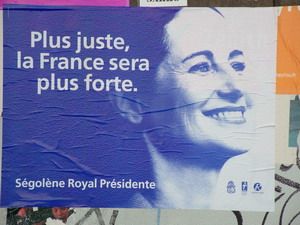
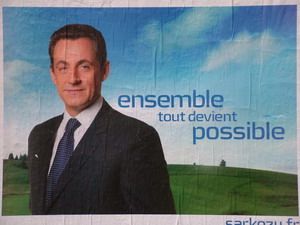
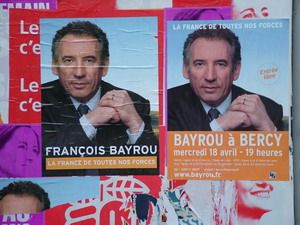
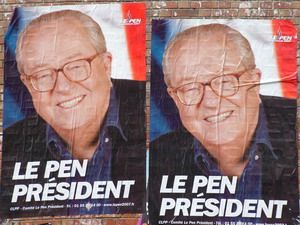
Street posters from the 2007 French presidential election: (top left) Socialist candidate Ségolène Royal. (top right) UMP candidate Nicolas Sarkozy. (bottom left) UDF centrist François Bayrou. (bottom right) National Front far-right candidate Jean-Marie Le Pen. With one week remaining in the French presidential election, all candidates are launching their final sprint, engaging in ceaseless policy speeches and media interviews. Clearly, the political and social visions of the left and right differ; the right leans toward liberal policies, while the left follows a socialist path. Traditionally characterized by alternating power between the two, this election features a surprising surge by the centrist faction, standing out under the perspective of "cohabitation" (as seen currently in Germany). This seems to align with the international political climate of globalization, leaving it to the voters' foresight and will, which will profoundly influence France's governance over the next five years.
Never has a French election been as clouded as this campaign. With voting just a week away, nearly 47% of voters remain undecided. This year's campaign is particularly notable for its populist strategies aimed at winning broader influence and public support, making political commentary unpredictable and often venturing into far-right territory. For instance, UMP candidate Nicolas Sarkozy stated that discussing French national identity is certainly not a dirty word, yet it sounded more like a myth, clearly encroaching on the stronghold of the far-right National Front's Jean-Marie Le Pen to woo far-right votes. Furthermore, Sarkozy repeatedly invoked the socialist ideals of Jean Jaurès, leader of the Socialist Party, likely to appease left-wing voters. His flip-flopping created ample room for imagination, constructing a decisive map through these highly strategic commentaries, which have become indispensable actions for winning the current campaign.
For the Socialist candidate Ségolène Royal, being a woman in a patriarchal and traditionally right-leaning French society was already difficult. While spectators hoped she would stumble, she fought harder as the campaign progressed. Operating independently with unconventional realist political discourse—deviating from traditional left-wing views—she faced fierce attacks from the right and criticism from the left. Under such arduous tests, her leadership image and posture became undeniable. However, Royal also made missteps; when responding to the right on French identity, she raised the flag issue and sang the Marseillaise loudly at various events, becoming mere interludes in the election theater.
This year, the far-right National Front (FN) positioned itself as a moderate traditional right wing, successfully masking its racist image. Most notably after the North Station riots, FN leader Jean-Marie Le Pen absorbed French anxieties about the future and dissatisfaction with politics, capturing the hearts of the traditional right. He clearly recognized that Nicolas Sarkozy was encroaching on his territory. To win the first round, he had to reclaim the legitimacy of the traditional and far-right bases. In this final critical week, he launched a fierce attack solely against Sarkozy, unleashing unusual racist rhetoric without restraint. He claimed Sarkozy was not a true Frenchman, mocked his thuggish politics, called for ending birthright citizenship, implementing zero immigration, restoring borders, abandoning the Euro for the Franc, and argued that France was colonized by the EU. Was this a misstep? Hard to say, as it aligns with the "France First" approach and far-right vision. In a 20-minute interview, he did not rule out an alliance with Sarkozy, hinting that the National Front would join the government if the nation were in crisis, suggesting a possible pragmatic division of power.
François Bayrou of the UDF steadily advanced under the vision of "All Our Strength for France," aiming to build another republic based on ideal cohabitation between left and right. His appeal confused not so much the right as the left. This week, former Prime Minister and current MEP Michel Rocard publicly suggested that only an alliance between the Socialists and centrists could defeat Sarkozy. Shortly after, former Health Minister and Médecins Sans Frontières founder Bernard Kouchner echoed this, proposing a new social democratic line (a center-left political route). However, Socialist candidate Ségolène Royal and party leader François Hollande did not agree. Bayrou positively responded that after the first round, all impossibilities in politics would become possible under the new situation. Thus, the outline of a new French political landscape seems to be forming: Could the traditional right marry the far-right National Front? Or could the Socialists and UDF form a new social democratic alliance? This confusing election theater is entering a new phase. Through the struggle and interlocking alliances of these four candidates, a new political map for France's future is being constructed. Who will be elected president? The first round is unpredictable, but in the second-round finale, no one can win without alliances.