Twelve of the "2007 French Presidential Election": Tomorrow at War (Elysée 2007
(Top) Ballot. (Bottom) Twelve presidential candidates (from top left): Olivier Besancenot, postman for the Revolutionary Communist League (LCR); Francois Bayrou, UDF centrist; Nicolas Sarkozy, UMP; Jean-Marie Le Pen, FN far-right. (...)
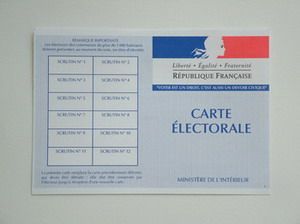
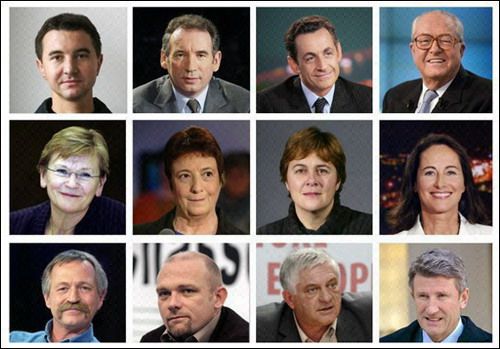
(Top) Ballot. (Bottom) Twelve presidential candidates (from top left): Olivier Besancenot, postman for the Revolutionary Communist League (LCR); Francois Bayrou, UDF centrist; Nicolas Sarkozy, UMP; Jean-Marie Le Pen, FN far-right. (Middle, left to right): Marie-George Buffet, Communist Party (PCF); Arlette Laguiller, Workers' Struggle (LO); Dominique Voynet, Greens; Ségolène Royal, Socialist Party. (Bottom, left to right): José Bové, anti-liberal; Fréderic Nihous, CPNT hunters' party; Gérard Schivardi, Workers' Party (PT); Philippe de Villiers, MPF far-right. Image from www.metrofrance.com.
After six months of relentless political commentary, the first round of the French presidential election has reached its end this weekend. Last night was the final debate of the first round. The "Big Four" were all concentrated in southern France: UMP candidate Nicolas Sarkozy was in Marseille, where he claimed to have entered the final stage amidst cheers and applause from over 25,000 people, stating, "The first round is just a warm-up." Socialist candidate Ségolène Royal was in Toulouse, cheered on by over 20,000 people. Spanish Prime Minister Jose Luis Zapatero strongly supported her, saying, "Ségolène Royal's freshness and optimism are the embodiment of social-democratic success," adding that she represents the Socialist Party of the 21st century.
UDF centrist candidate Francois Bayrou was in his hometown of Pau, where over 5,000 locals and supporters waved flags. He declared, "I am the only one who can defeat Nicolas Sarkozy; I carry the ideals of many French people." Far-right National Front candidate Jean-Marie Le Pen chose Nice, a stronghold of the right and far-right, where 2,500 loyal supporters chanted "Le Pen President." He fiercely attacked the others, claiming that Nicolas Sarkozy, Ségolène Royal, and Francois Bayrou are all the same, merely restarting the cycle.
All that needs to be heard, seen, compared, participated in, understood, and confirmed will inevitably lead to choices. Voters have a clear outline of each candidate's platform. On April 22, voters will cast their sacred vote without further doubt. Many seem particularly anxious about a repeat of the 2002 incident, while around 35% remain undecided. In today's globalized era of ideological conflagration, the distinction between left and right is no longer so clear-cut. Left-wing utopias have been submerged by consumerism, and liberal capitalism prevails. However, French society clearly worries about the shifting geopolitical landscape under globalization. The rise of traditional conservative right-wing politics suggests that everything seems measured by self-interest and subtle social consciousness when casting this sacred vote.
This vote represents the most impartial manifestation of democratic society. It is not absolutely perfect, but it is at least the decision of the majority. Whatever the outcome, it must bear the consequences of reality; this is currently the most credible form of democratic society. Wise voters choose based on careful deliberation of political ideals, personal party beliefs, social ideologies, or candidates' basic governing abilities and personalities. These are the basic conditions for selecting the virtuous and capable. In an era of pervasive mass media, voters should have sufficient information to compare and choose approaches closer to their own sensibilities and rationality, deciding on their ideal society and national future.
Every French presidential election is dramatic and exciting. After the unexpected Social Party failure in 2002 and the shocking victory of the far-right National Front in the runoff, this year's election has attracted even more attention, especially from European allies. Looking at the polls on the last day (Friday, April 20): Le Parisien reported Nicolas Sarkozy (UMP) at 27%, Ségolène Royal (Socialist) at 26%, Francois Bayrou (UDF) at 17%, Jean-Marie Le Pen (FN) at 16%, Olivier Besancenot (LCR) at 5%, José Bové at 3%, Marie-George Buffet (PCF) at 1.5%, Dominique Voynet (Greens) at 1.5%, Fréderic Nihous (CPNT) at 1%, Philippe de Villiers (MPF) at 1%, Arlette Laguiller (LO) at 1%, and Gérard Schivardi (PT) at around 0.5%. Blank/abstention votes accounted for 19%.
Metro's poll (Thursday, April 19): Nicolas Sarkozy (UMP) at 27.5%, Ségolène Royal (Socialist) at 26.5%, Francois Bayrou (UDF) at 19%, Jean-Marie Le Pen (FN) at 11%, with blank/abstention votes at 14%.
20minutes' CSA poll (Friday, April 20): Nicolas Sarkozy (UMP) at 27%, Ségolène Royal (Socialist) at 26%, Francois Bayrou (UDF) at 17%, Jean-Marie Le Pen (FN) at 11%.
BVA poll (Friday, April 20): Nicolas Sarkozy (UMP) at 29%, Ségolène Royal (Socialist) at 25%, Francois Bayrou (UDF) at 15%, Jean-Marie Le Pen (FN) at 13%.
Ifop poll (Friday, April 20): Nicolas Sarkozy (UMP) at 28%, Ségolène Royal (Socialist) at 22.5%, Francois Bayrou (UDF) at 19%, Jean-Marie Le Pen (FN) at 12.5%. Whether these indices are accurate will be verified tomorrow evening at 8 PM.
European neighbors also paid special attention to the French presidential election due to its implications for the EU's future. The UK and Germany leaned toward the right-wing Nicolas Sarkozy, while Belgium and Spain favored the left-wing Socialist candidate Ségolène Royal. At the critical final moment, major French media outlets took sides. The right-leaning Le Figaro favored Nicolas Sarkozy, while Le Monde, Nouvel Observateur, and Libération strongly backed Ségolène Royal. Marianne stood with Francois Bayrou, while Express, Le Point, and Le Parisien remained neutral.
French elections require voters to be at least 18 years old and registered at their local town hall to exercise voting rights. Thus, voting is not passive; some live to 50 without ever having voted. Voting is an active civic duty. After registration, voters receive a ballot before the election. To vote, one must bring the ballot and ID for verification and signature before casting the sacred vote. Before the election, voters also receive sample ballots from the electoral commission, including lists of the 12 candidates with their platforms, to help voters carefully consider their sacred vote.