Qiu Liangcheng – The Dream of Recovering One’s Original Heart
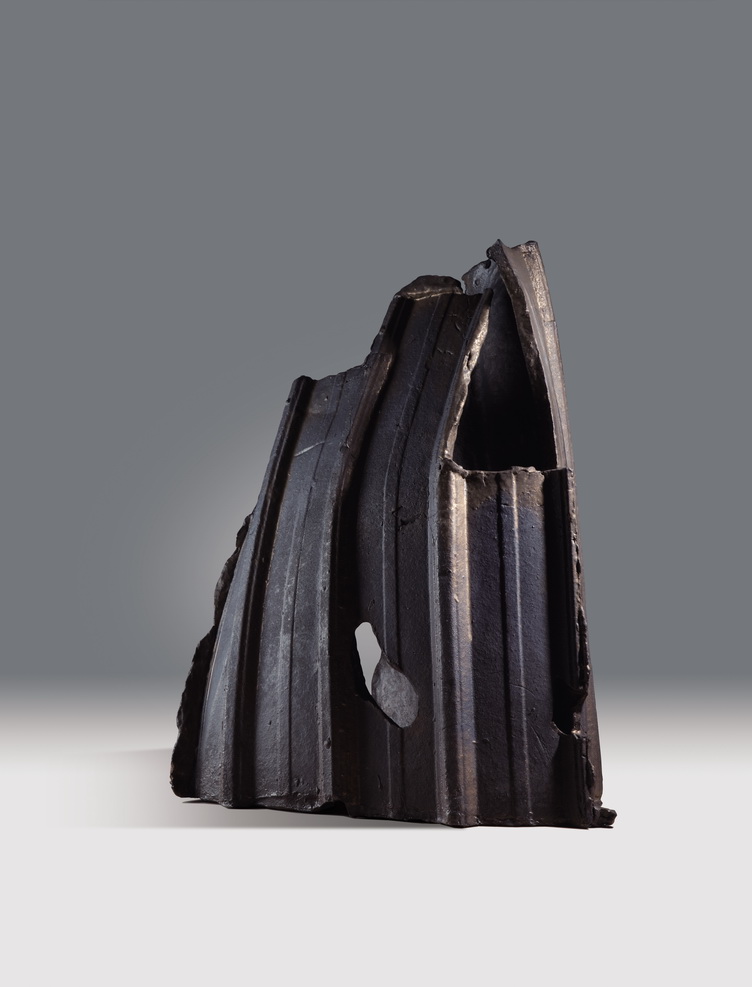
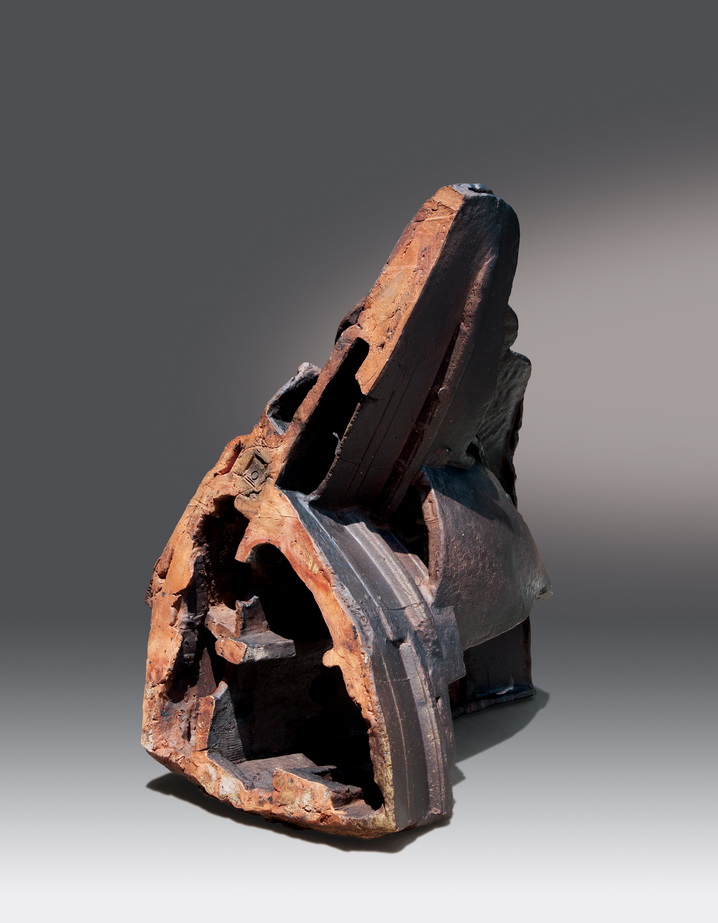
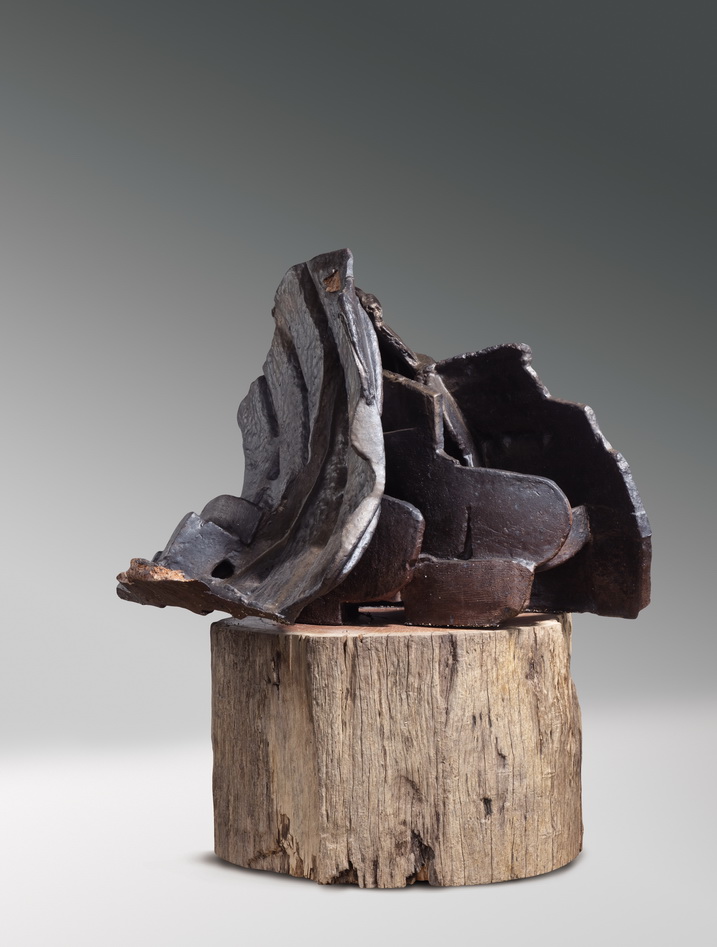
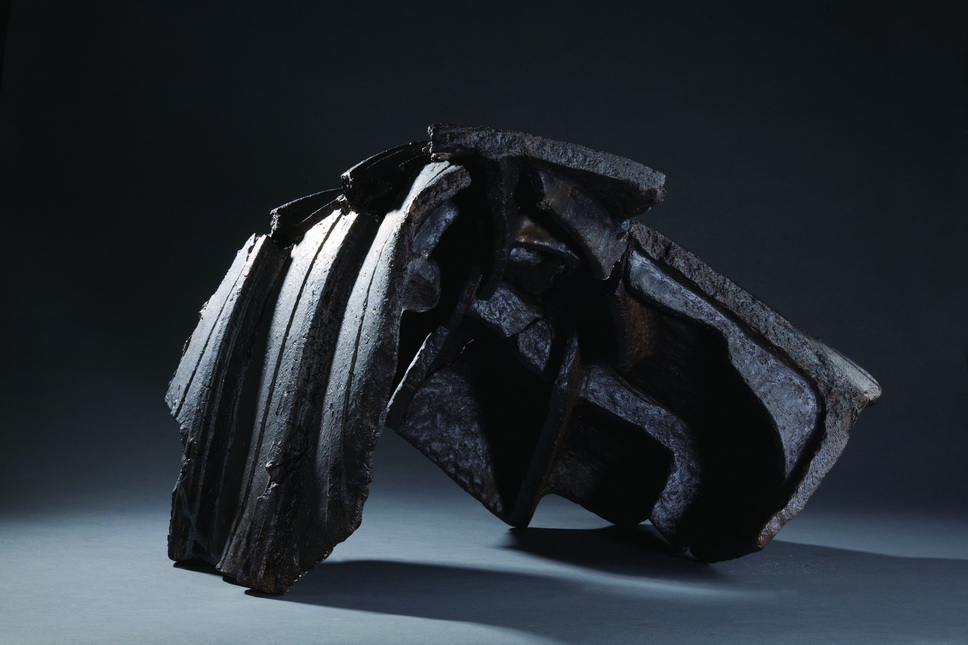
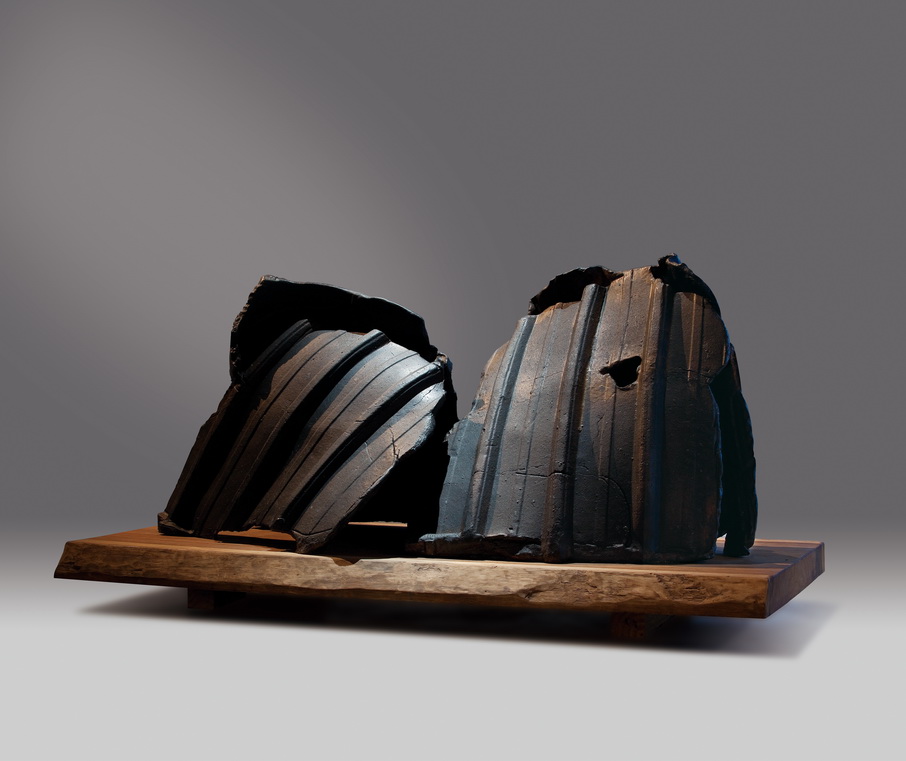
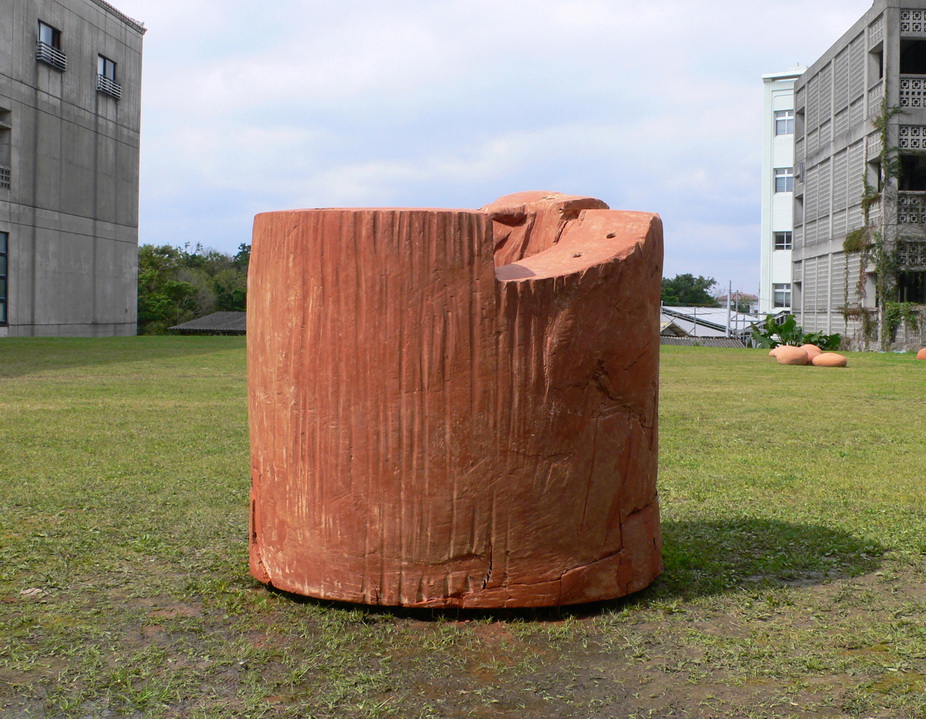
Non-Vessel Series X H90x78x50cm 2012 Clay, reduction firing, grog clay, gold-copper glaze at 1250°C
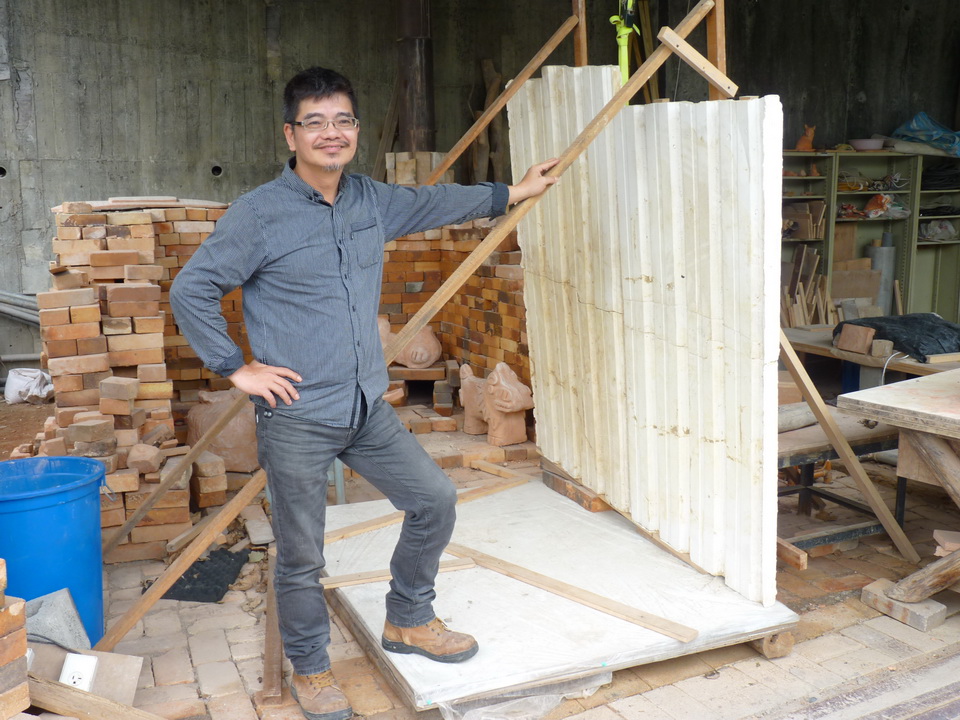
“When you discover yourself, you become yourself.”
By Chen Chi-Hsiang
Preface: Ceramics uses “earth” as a creative medium. Earth is shaped, glazes are painted, and the kiln fires the piece. Traditional ceramics generally focus on functional vessels, while modern ceramic art creation almost exclusively produces non-functional ceramic sculptures, focusing on exploring new forms (purely for visual appreciation, viewed as three-dimensional sculpture). Ceramics are purely handicrafts, manufactured through physical labor and technical kiln processes. Like alchemy, “earth” transforms into “ceramic” under the refining effects of fire and time. The firing process often involves accidents; one can only rely on intuition and experience. Modern ceramic art creation in Taiwan is widespread, but the pioneer who entered the field of contemporary art creation is undoubtedly Teacher Yang Yuan-tai. Outstanding ceramic sculptors who have carried forward this tradition, such as Chen Cheng-hsun or Xu Yong-xu, have achieved remarkable exploratory results. Qiu Liangcheng follows Teacher Yang Yuan-tai’s creative path to recover the dream of his original heart.
The Enlightenment of Art and the Dream of the Original Heart: Qiu Liangcheng (born 1962 in Puzi, Chiayi) liked copying from a young age. Starting with images of Guanyin Bodhisattva among Buddha statues at home, he studied painting with art teacher Xiao Tu-long in elementary school, participated in various competitions, became obsessed with painting, and developed a deep affection for fine arts. He continued studying with Teacher Xiao in junior high school. In high school, he was fortunate to meet art teacher Yang Yuan-tai, who guided and influenced his entire creative life. Teacher Yang is a leader in modern ceramic sculpture art in Taiwan. It was no surprise that Qiu Liangcheng embarked on modern ceramic creation. Under Teacher Yang’s artistic inspiration, he learned about Western art and modern sculpture. Most importantly, he experienced the enlightenment of Taiwanese subject consciousness. Later, Teacher Yang went to the United States for further studies. Before leaving, he said something thought-provoking to his students: he asked them to deny their previous teachings and sharing, leaving the students confused. This shocking break from the “jar-like” teaching method intended to cultivate students’ ability to be independent and autonomous. Years later, he suddenly realized that the truth of creation lies in self-exploration and forging one’s own path.
Influenced by Teacher Yang, he dedicated himself to sculpture. In high school, he missed admission to the Arts and Crafts College by one point, shattering his sculpture dream. Disappointed, he was admitted to the Art Printing Department. His heart was not in art education, so he continued to focus on his beloved painting. He associated with friends majoring in fine arts, Huang Hong-de and Li Feng (Wen-bin), and frequently interacted with sculpture friends, gaining foundational knowledge and exploration of sculpture. The Art Printing Department allowed him to focus on design and photography. He began making prints, especially screen printing, which influenced his subsequent painting (especially the appearance of black lines). After completing military service, he opened a studio with friends in Taipei, then worked at a design company. In 1986, when Teacher Yang Yuan-tai held his solo exhibition “Earth Suite: Spring,” he invited Qiu Liangcheng to design the invitation card and photograph the works, including opening outdoor work photography (Teacher Yang’s classic ceramic sculptures were all photographed on beaches).
In 1989, he joined Lion Art as an art editor, utilizing his professional expertise in art design. The following year, he went independent, founding Wuyang Design Company, now famous for designing art catalogs and exhibition posters for various museums. He helped artists and galleries compile catalogs and design exhibition posters. The first was the Zhang Wan-chuan catalog for Dongzhi Gallery. Today, he has become an authority in editing and designing catalogs and exhibition posters for Taiwanese artists. Caught in the currents of society, unable to control his own fate, he devoted himself to design for practical living. His passion for art or desire for creation could only satisfy his impulses and express his emotions during leisure time. After creating sporadically for over ten years, in 1997, he and fellow painter Li Feng held a joint solo exhibition at Meiling Art Museum in Puzi. During this transitional period of suppression where design and creation could not be balanced, he began contacting Buddhism and practicing Zen retreats, immersing himself in Buddhist scriptures, exploring consciousness of life, and attempting to find an outlet for creation.
After more than ten years of striving, the business of the design company stabilized. In 2005, drawing on rich experience from design, Qiu Liangcheng created the “Flying City: Inner Landscape” series using computer post-processing. He tried various aspects and enthusiastically began painting oil paintings, igniting the fire of his creation. Two years later, he and Yang Shang-feng (son of Teacher Yang Yuan-tai) held a solo exhibition at Pier-2 in Kaohsiung. Managing and arranging the space allowed him to experience the uniqueness of site-specific spaces, opening up his concepts and consciousness of three-dimensional space. In 2008, he and teachers and students from NTUA visited the Japan Modern Art Museum and ceramic studios, witnessing contemporary art and the ceramic sculpture he loved. Driven by artistic creativity, as Jung said, “Humans have a desire to return from ‘material expression’ to the complete ‘true essence’ of the inner self.” In April 2009, at the age of 47 (resolutely determined to walk the path of creation), he entered the graduate school at NTUA to recover his original dream, find creative energy, and choose three-dimensional sculpture—like Teacher Yang, he began making ceramic sculptures.
Indeed, creation is a matter of vision and cognition. Through years of compiling catalogs and designing exhibition posters, he cultivated his own power of artistic appreciation and taste, which deeply influenced his future creations. Experiencing creation and Buddhism formed naturally; the state of mind during the creative process constructs the appearance and form of the works. Deeply influenced by Teacher Yang Yuan-tai in creation (“Find yourself”), he expects the driving force of creation to come from himself, unrelated to academia. Qiu Liangcheng says: “When you discover yourself, you can become yourself” (Note 1). Artistic creation has become his attitude towards life and the consciousness and energy of existence.
Local Cultural Representation “Non-Vessel Series” (2010–13): The works submitted for NTUA admission—a ceramic sculpture series—stemmed from organic natural form thinking long hidden within him, refined and purified. Influenced subtly by Teacher Yang, these were also Qiu Liangcheng’s debut works in three-dimensional pieces, opening the path to three-dimensional ceramic sculpture creation. The representation and imprinting inspiration for the “Non-Vessel Series” came from construction sites, specifically the marks left after pouring concrete into wooden molds and drying, or from an accidental cement wall partition (Note 2). Non-Vessel uses readily available metal corrugated sheets in Taiwan, assisting representation and imprinting as his visual vocabulary and reference for modeling. Through the plasticity of earth: curling, tearing, flipping, expanding, and repeating flexible characteristics to organize and construct, he creates diverse and rich formal shapes and spatial types that flip inside out, between representation and structure, sensibility and rationality, space and consciousness, imagery and abstraction. He emphasizes novel surface linear texture vocabulary, solidifying the appearance of time, presenting local cultural representations.
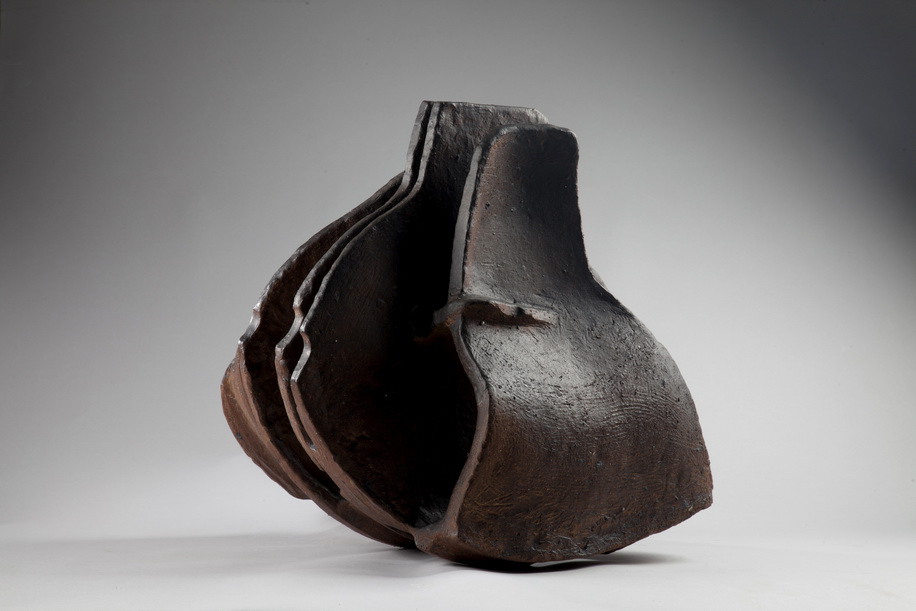
The Non-Vessel Series uses wave plates to press concave-convex textured lines as representations. The greenware earth serves as a support frame. After drying, it is coated with gold-copper glaze and fired in a gas kiln for 24 hours. Non-Vessel has a texture similar to cast iron, an illusion caused by the gold-copper glaze firing. High-temperature refining at approximately 1250°C fully reveals the color. Applied thickly, it becomes gold; applied thinly, it becomes black, creating a matte black glaze surface that radiates an iron-like texture and deep metallic luster, full of imaginative space, manifesting a modern sign.
Non-Vessel is a natural image of deconstruction and reconstruction, becoming a turning point in Qiu Liangcheng’s artistic creation. He attempts to construct a personal style using the visual vocabulary of imprinting. The concept of Non-Vessel comes from Zhuangzi’s philosophy, interpreting “the method without method, the utility without utility.” With an open attitude towards creation, maintaining a random and accidental nature in inclusive creation without presetting positions, it presents the philosophy of life in flux. As the Diamond Sutra says, “All conditioned phenomena are like dreams, illusions, bubbles, shadows, like dew or lightning; thus should one view them.” Creation is purely natural, stemming from intuitive prototypes. During the manufacturing process, possibilities of form are constructed based on present awareness. The creative process maintains open possibilities, randomly and accidentally shaping concrete sensory imagery in this flow, presenting subconscious memories somewhat similar to dreams, showing fragments of local history and culture.
Cross-Cultural Monuments: The grand monument “Non-Vessel – Cultural Imprint I-II” (2012) was created by Qiu Liangcheng during his residency at the Graduate School of Art, University of the Ryukyus, Okinawa, Japan, in 2011. Adapting to large-scale works, he personally learned the firing methods of an Anagama kiln. Created through bodily labor with the most grounded physical sensation, these two large works are pale red, half-section cylindrical bodies, simple and powerful. “Non-Vessel – Cultural Imprint I” features straight lines imprinted from corrugated sheets, resembling Western divine columns, constructed through cutting and reassembling lines. “Non-Vessel – Cultural Imprint II” is even simpler on the surface, cutting the column surface into irregularities to present lively lines, showing traces and marks of cross-culture and daily life. This gave the artist the opportunity to once again experience the grounded feeling of living on the land, the sense of history and nature, strongly contrasting land and history. The Non-Vessel Series concludes with the grand monument “Non-Vessel – Cultural Imprint” (Note 3).
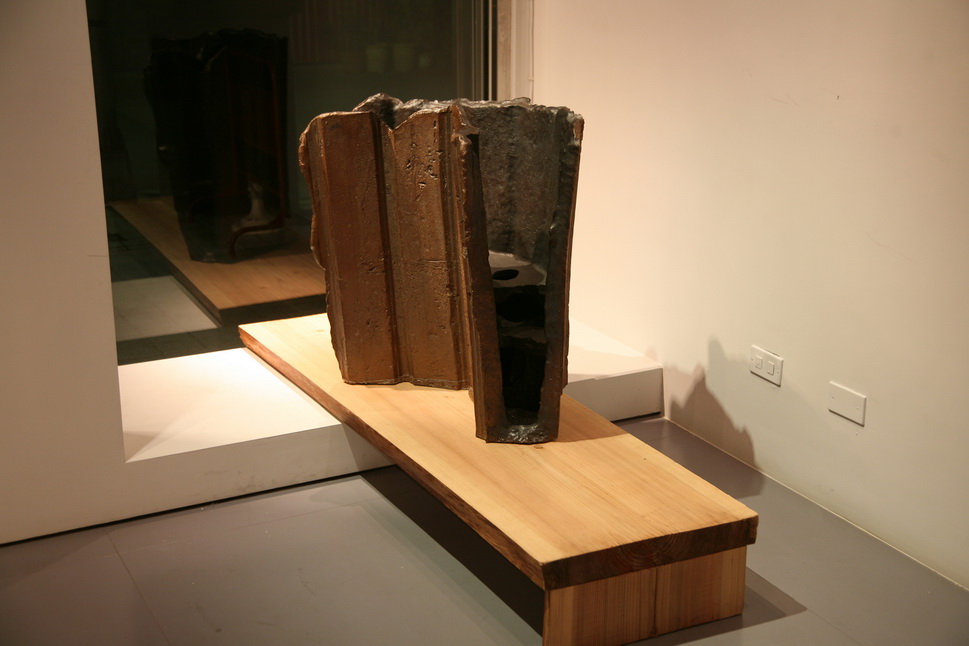
From Painting Space to Sculpture Space: The signs of the Non-Vessel Series are three-dimensional sculptural forms, possessing obvious planar painting spatial attributes. This stems from the translation accumulated over many years by painter or graphic designer Qiu Liangcheng. Emphasizing the “surface imprint” plane and lines over three-dimensional space, especially those imprinted lines, the light and shadow lines under lighting form the beauty of visual rhythmic rhythm, such as Non-Vessel-II, -V, -VI, -VIII, etc. Quickly, from Non-Vessel-III, one could glimpse sculpture space. It was truly an unexpected surprise, simply because this piece cracked during the kiln firing, leaving only this fragment resembling a broken giant hand. Accidentally, he crossed from planar painting space into three-dimensional sculpture space. Subsequently, Non-Vessel-IV and -VIII stably presented space within triangular structures. Until 2012, in the combination and construction of Non-Vessel-X and -XI, sculptural space was established. The surface imprint planes and lines became the largest sign of this series of works.
Inner Hills “Zhu Di Series” (2013–): Qiu Liangcheng’s “Zhu Di Series” continues to deepen the exploration of Non-Vessel forms and space, expanding representational surface imprint style elements: corrugated sheet pressing, followed by bending, reassembling, and constructing new forms. Or flipping the corrugated sheets into large plaster molds, then using the plaster mold as a formwork to remold and shape, strengthening novel structural formations, transforming into architectural and industrial technical structural vocabularies. Creation welcomes all possibilities with an open attitude. Through cutting, penetrating, intersecting, reassembling, and reconstructing, the fertility of space, these techniques make the works, beyond “sculpturality,” embody the characteristics of human-made space and “architectural structuration” (Note 4).
As works grew larger, exceeding the limitations of general gas kilns, he went to Japan to learn Anagama methods, building kilns on-site to develop large-scale works. Coincidentally, in 2012, NTUA held the “Anagama Research Camp” (Note 5). Afterward, Qiu Liangcheng had the opportunity to delve into experimental exploration of large Anagama kilns. Not only did he learn to build kilns on-site, but he also technically improved Anagama firing techniques, breaking through the temperature limits of Anagama kilns. The “Zhu Di Series” is not only fired in Anagama kilns but also challenges high temperatures (1250°C). This series is all fired at high temperatures using locally built Anagama kilns, presenting metallic colors like copper statues or ironware, some with strange reflective textures. Colors are deeper than the Non-Vessel Series, tones richer. Works are deep and restrained, appearing uncertain like metal at first glance.
Qiu Liangcheng’s “Zhu Di Series” inspiration comes from magnificent landscape paintings of the Tang and Song dynasties filled with momentum. Feeling the broad-mindedness of painters like Fan Kuan, Guo Xi, and Li Cheng in expressing the vast space of landscape paintings, he reflected on what kind of mindset and grand perspective a creator needs to face other eras. Can one, while facing the era, also construct “writing the hills and valleys in his heart” (Note 6), as his self-expectation for creative expression? After the cross-cultural experience in Okinawa, Japan, returning to the original emotion for local land and scenery, the Zhu Di Series was born. He returned to pure formal exploration, through form, lines, color, light and shadow, structure, space, and texture combinations, constructing his concept of “Taiwan’s Inner Landscape.” Between history, humanities, and nature; sensibility and rationality; space and structure; non-figurative and abstract; sculpturality and architecturality, it reflects humanity’s alienation and neglect of nature after civilization evolved, intending to restore the instinct, sensibility, and joy of human existence, serving as spiritual comfort.
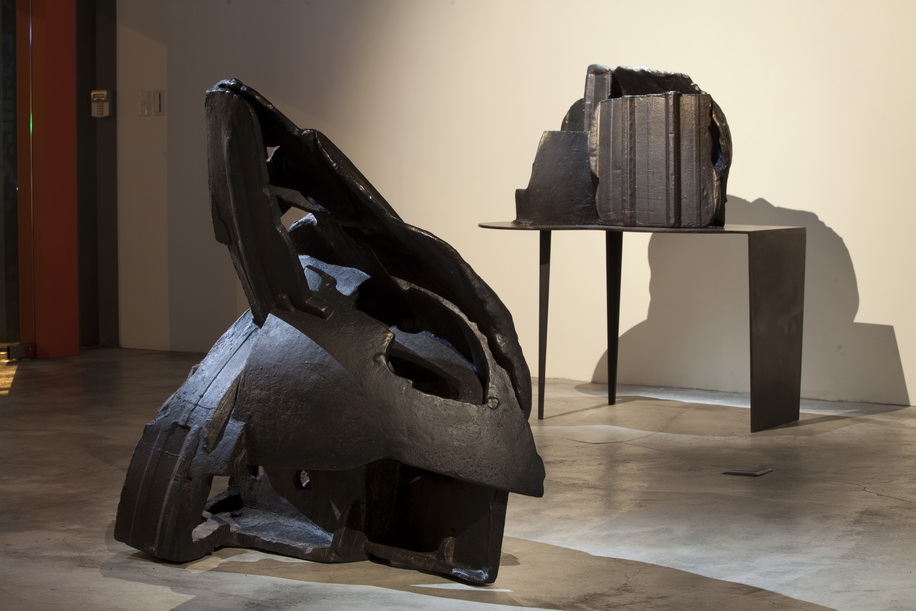
From Sculpture Space to Architectural Space: From the spatial exploration and experience of the Non-Vessel Series, Qiu Liangcheng realized that the possibility of open compositional forms must be formed through specific organizational structures—to construct the so-called three-dimensional sculpture space. For example, the triangular Non-Vessel-X expands new consciousness of sculpture through cutting components, or Non-Vessel-XI, double-triangle composite components. In the Zhu Di Series, he chose to expand spatial forms using component modes. For example, Zhu Di-I organizes planes and lines, void and solid, volume and texture, presenting perfect spatial structure. In 2013, he suddenly saw the light and crossed into a new horizon of space. For example, Zhu Di-II—the structure of tilted triangles—is thick and heavy, with hollow sections revealing internal support organizational structures. Inside and outside form contrasts in form and color (gold-copper tone and red), constructing complex, fertile spaces. Zhu Di-III and -VII, flipping inside-out spatial structures, degraded representational imprinting, strengthening the construction of inside-out organizational structures, forming multiple formal horizons, constructing dialogue between void/solid and light/dark, organic lines and inorganic space (Note 7). Zhu Di-IV—the surface imprint disappears, entirely composed of simplified planes and lines (vertical lines, curves, and diagonal lines)—crosses into architectural space, presenting an industrial and architectural technical formal vocabulary. Zhu Di-V and -VI—organic forms between nature and architecture, diverse forms mutually reassembling, reconstructing, and intersecting in complex structures, reversing inside-out space, inviting reverie.
Internalizing Local Formal Vocabulary: Qiu Liangcheng’s local cultural representation comes from a cement wall, visible in the artist’s keen observation and perception. Cement is the greatest sign of modernization, symbolizing the changes of the times, the decline of urbanization and rural villages. His creation uses “earth” as the medium of thinking, internalizing Taiwanese earth into emotion and plasticizing local consciousness, radiating the energy of Taiwan’s modernization. The “Non-Vessel Series” is built upon the modernized living environment surrounding us, revealing the experience of “drifting from the land” amidst the alienation of humans and nature. The “Zhu Di Series” writes the hills and valleys in his heart—“Taiwan’s Inner Landscape,” highlighting the imagination of tracks and situations of industrial development. He believes: “Sculpture is a problem of space, an attitude towards life, personalized sensibility (that is, warmth, care, and concern)” (Note 8).
Qiu Liangcheng’s internalized formal vocabulary mixes images of nature, humanities, and history. Among the fixed and unfixed forms of organic and organizational construction, he discovers numerous triangles, squares, twisted bodies, spiral bodies, cylinders, irregular and geometric forms, etc. Glimpsing local imagery such as stable mountains, wriggling creatures (like pupae or snails), nameless quasi-architecture (city walls and divine columns), abandoned ruins (broken chapters and remnant walls), etc., full of imaginative space and reference. Representational imprint patterns are not just visual lines, light and shadow, brightness and darkness, or references, but metaphors of time. Also, in his unique formal vocabulary, he often emphasizes the construction of void and solid, using partial or fragmented pieces as the whole of “void having substance.” Using his unique internalized local formal vocabulary, he evokes the most subtle beauty and sorrow of Taiwan.
Establishing Position – Evoking the Spirit of the Exhibition Domain: Qiu Liangcheng is particularly sensitive to space. The management and arrangement of the Pier-2 solo exhibition space allowed him to experience the possibilities of site-specific space, establishing future planning for exhibition domains. When grasping exhibition space conditions, he thinks about integrating works into the domain space, intending to evoke the spirit of the site. During exhibitions, he pays special attention to the relationship between works and pedestals, texture, height of sightlines, position, and space. He specially made black and white hollow thin iron pedestals. Some works are displayed directly on pedestals; some works are padded on thick wooden boards or wooden pillars to become pedestals (such as Zhu Di-III). Height arrangements construct a rhythm, establishing position to present fluid space. In the 2014 non-gallery solo exhibition, he displayed the monumental Zhu Di-II directly on the ground. Most striking was the 2011 solo exhibition at Bema Gallery, where he placed the vertical, thick Non-Vessel-VIII work on a wooden seat spanning a white platform at a corner, constructing a vertical and parallel architectural spatial framework. Or in the 2013 joint exhibition at Taiyu Aesthetics Hall in Chiayi, he displayed two associative mountain peaks of Non-Vessel-XI (on wooden seats close to the ground) in front of a water wall, calling forth a grand natural imagery. Clearly establishing the position and space of works, evoking the consciousness and spirit of the spatial site.
The Birth Procedure of Works: After kneading clay, he uses corrugated sheets to imprint and shape, retaining the vitality of the form after pressing, not adding decoration, preserving the original state, strengthening the back support structure to become another side space. Once the work is formed and dried, he applies gold-copper glaze, covers the kiln, and performs reduction firing. Thick application becomes gold, thin application becomes black. From black to gold, multi-layered color changes, oxidation turns it into a plastic-like texture. Gas kiln firing (firing for 28 hours), gradual temperature rise. Anagama kiln firing requires 48 hours. Relatively, the kiln is larger, and more works are fired (but the kiln must be dismantled after firing). Both series belong to high-temperature (1250°C) critical line firing methods. Firing often involves accidents, cannot absolutely guarantee wishes come true, but the moment of excitement upon unloading the kiln often brings many unexpected surprises.
Anagama Kiln: Built on-site from red bricks (a removable gas kiln). The size of the kiln depends on the capacity of the works to be fired. Internal space, fire (16 burners), and smoke outlets (two), etc., design will all affect the firing results. The Zhu Di Series is made through reduction firing. Reduction firing means controlling the effect of smoke through fire control adjustment. When rising to 950°C, one must control the fire and let the smoke have a reducing effect. Fire reaches 1250°C. Each firing requires careful care and detailed temperature records. Day and night, 48 hours of firing process, the refining of fire and time, dismantling the kiln to take out works is the exciting moment. Anagama kilns are refined in the arduous process of repeatedly covering and dismantling the kiln.
Note 1: From the artist Qiu Liangcheng interview in April 2015. Note 2: From “Research on Ceramic Sculpture Space from Non-Vessel to Zhu Di” Creative Discourse p18 Republic of China 104-01. Note 3: From “Research on Ceramic Sculpture Space from Non-Vessel to Zhu Di” Creative Discourse p52 Republic of China 104-01. Note 4: From “Research on Ceramic Sculpture Space from Non-Vessel to Zhu Di” Creative Discourse p38 Republic of China 104-01. Note 5: In 2012, NTUA held the “Anagama Research Camp,” guided and hosted by Professor Wenhui Shangtiao of the Anagama kiln at the University of the Ryukyus, Okinawa. Note 6: From the artist Qiu Liangcheng interview in April 2015. Note 7: From “Research on Ceramic Sculpture Space from Non-Vessel to Zhu Di” Creative Discourse p26 Republic of China 104-01. Note 8: From the artist Qiu Liangcheng interview in April 2015. October 2015, Paris