"2007 French Presidential Election": Paris Districts in a Dead Heat
Paris's presidential race ended in a dead heat, with the west turning blue and the east red. Image from Matinplus news, May 9. France's new president is decided; Nicolas Sarkozy of the right-wing UMP was elected. Paris voted enthusiastically, with an 86.4% turnout in the second round.
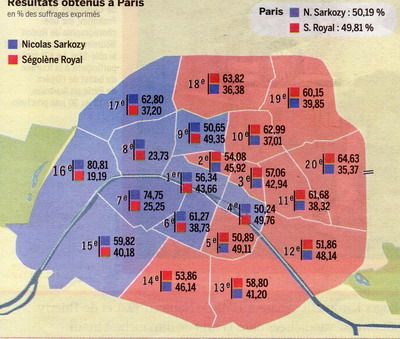
Paris's presidential race ended in a dead heat, with the west turning blue and the east red. Image from Matinplus news, May 9. France's new president is decided; Nicolas Sarkozy of the right-wing Union for a Popular Movement (UMP) was elected. Paris, like other municipalities, voted enthusiastically this year, with a high second-round turnout of 86.4%. Blank ballots accounted for only 3%, while abstentions reached 13.6%, marking the most active French presidential election to date. In this contest, where the left-right divide was nearly even, UMP's Nicolas Sarkozy narrowly won with 50.19%, while Socialist candidate Ségolène Royal received 49.81%. This margin represents the highest vote share ever achieved by a left-wing candidate in a French presidential election (compared to François Mitterrand's 46.44% in 1981). This result clearly tests the approval ratings of the current coalition government of the Socialists and Greens in the Paris City Hall.
Election results are typically polarized, and international metropolises like Paris are no exception, dividing into upper-class (or asset-holding) areas and mass-population zones. Generally, the middle class in such cities tends to shift rightward, prioritizing pragmatic self-interest over leftist utopian ideals. It is natural that people act in their own interest; otherwise, they face social condemnation. The Parisian middle class is clearly concentrated in the city's core, extending across the western half. Within the magnificent Haussmannian architecture of the 19th century, these are the most expensive real estate areas, favored by elites and dignitaries, effectively becoming markers of social status. These districts host embassies and multinational corporations, serving as traditional strongholds for right-wing forces.
Conversely, the eastern half and northern/southern parts of Paris are largely mass-population zones, characterized by diverse ethnicities and multicultural harmony, reflecting France's social melting pot. Paris is divided into 20 arrondissements. In this presidential election, the blue sky (the color of the UMP) led in 9 districts, while the red ground (the color of the Socialist Party) dominated 11. The western half of Paris turned entirely blue. From the core 4th and 9th arrondissements, which were nearly tied at 50.65% or 50.89%, the gap between left and right widened further west. The 16th arrondissement saw the highest blue vote at 80.8%, followed by the 7th and 8th arrondissements at 74.7% and 76.3%, respectively. Other western districts included the 17th at 62.8%, the 15th at 59.8%, and the 6th at 61.2%.
The east turned entirely red. The 20th arrondissement in the far east had the highest vote share for the Socialist candidate at 64.6%, followed by the 10th at 62.99%, the 11th at 61.6%, the 3rd at 57%, and the 2nd at 54%. To the north, the 19th arrondissement recorded 60.15%, and the 18th recorded 63.8%. To the south, the 12th had 51.86%, the 13th 58.8%, the 14th 53.8%, and the 5th 50.89%. Ultimately, Nicolas Sarkozy (blue) narrowly won with 50.19%, while Ségolène Royal (red) received 49.81%. The fierce competition resulted in an almost even split across Paris's electoral landscape, suggesting that next year's Paris mayoral and municipal council elections will be another closely contested battle.