You Benkuan – Pioneer of Taiwanese Fine Art Photography
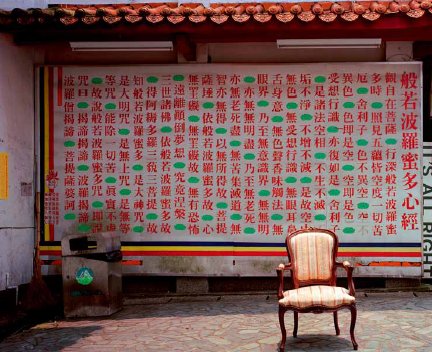
One of the "French Chairs in Taiwan" series, 1997–99
Text by Chen Chi-Hsiang
"Facing photographs, confront photography. A single image is truly insufficient to view, and thus one naturally thinks little. My photography is not documentation, nor communication, nor entirely expression. It is a meditation on art."
Fine Art Photographer: You Benkuan
Foreword: Under today's digital revolution, human life has entered an unprecedented new era of images. Photography has become a ritual of daily life; images have completely changed people's views of reality and their vision of the myriad phenomena of the world, awakening new awareness and consciousness. This stimulates artists' imagination and horizons, moving from the depiction of objects to the expression of subjective consciousness. Furthermore, the recent development and prosperity of post-production techniques (such as Photoshop software) have brought new opportunities to contemporary art. The post-production of images in the digital age provides more diverse possibilities for artistic creation. The essence of photography is discovery and recording. Since the early 20th century, many artists have actively explored the mysteries within photographs, questioning "What is photography?" and challenging the possibilities of the "Pandora's Box." In the early 1920s, Alfred Stieglitz asked: "How can photography achieve an artistic feel?" Duchamp stated more explicitly: "(...) I like to see someone coming to despise painting, until something else makes photography unbearable" (Note 1). Early photography intended to continue the artistic tradition of painting. Since the 1970s, the diverse use and interpretation of photographic mirrors have changed the perception of images. Photographs broke free from painting to become a medium for directly conveying thoughts and concepts. Post-modernism, in an era of cross-boundary fusion and digital revolution, with its diverse media and forms, has made photography a prominent field for contemporary artistic exploration and expression.
So-called fine art photography refers to image creation without commercial considerations, possessing attributes of artistic exploration. It probes the possibilities of photography; the camera is a tool for transmission and expression, and the photograph is a carrier of thought—subjective, emotional, spontaneous, and instinctual. It pursues deep formal vocabulary internally, strengthening form, concept, consciousness, or spatial planning, demonstrating strong expressiveness.
Guided by Pandora's Box: You Benkuan (born 1956 in Keelung) treats photography as an art creation akin to religious faith and is a pioneer of Taiwanese fine art photography. He has unique academic research on fine art photography and actively promotes it widely, advocating how to turn photography into "more effective art." His creations are based on the environment where he was born and raised, attempting to find local vitality and resonance, the scent of the times, and dialogue with the environment. His work directly touches the soul, consciousness, and energy of this land, opening Pandora's Box to discover the miraculous depths of Taiwan. He delves into the deep cultural heritage of the Taiwanese people, reflecting current situations and the entire social atmosphere, while engaging in dialogue with the era and environment in which he resides.
You Benkuan becoming a fine art photographer seems to be arranged by life. He was born into a family that already had cameras; his father enjoyed photography, and family portraits or travel photos were all taken by him. The most memorable scene for You was when the family stood at the historic site Changchun Shrine, and his father took out a light meter to measure and adjust the aperture—a moment deeply imprinted in his mind. Thus bewitched by the magical Pandora's Box, his photography was subtly influenced by his father. He played with cameras since sixth grade, proudly taking responsibility for their elementary school graduation photos; pressing the shutter seemed natural. In middle school, he often led the photography during class outings. Having never taken a photography course, he did not take the matter seriously, yet Pandora's Box accompanied his growth.
Admitted to the Department of Fine Arts at the National College of Arts, he continued to peek into the magic of Pandora's Box. The more he played, the more enthusiastic he became, shooting whenever possible, becoming a photography enthusiast. His themes revolved around the people, events, and things in the living environment where he grew up. After military service, he returned to his alma mater as a teaching assistant for a few years. In 1981, he participated in his first group exhibition. Deeply contemplating his future prospects, before going abroad, he held his first solo exhibition in photography at the Taipei American Cultural Center in 1984. Fascinated by European photographic art, especially the British surrealist master Bill Brandt, he resolutely went to Greylands in the UK in 1985 to study photography and held a solo exhibition at the school. Not admitted to the Royal College of London, he painfully left Europe.
He then turned to the graduate program at Ohio University in the United States, majoring in Photography within the Communication Department. After completing his coursework, he interned in New York, the capital of contemporary art, during the summer. Shocked by famous works in numerous museums and called by the spirits of masters, he realized the importance of the essence of art. Thus, he unhesitatingly returned to school to knock on the door of the art academy again, beginning another stage of baptism in artistic creation. He also held a solo exhibition at the Siegfried Gallery at the university, initially exploring the depths of fine art photography and meditating on art. He broke the shackles of images (from single photographs to multiple image juxtapositions) and engaged in spatial installation design. The "Image Composition" series opened up avenues for his exploration of fine art photography. The following year (1989), he was invited to exhibit by the First Art Gallery in New York.
In 1990, You Benkuan returned to his beloved hometown. Impacted by the political, cultural, and environmental shifts in Taiwan (from martial law to lifting martial law), and armed with ambitious new artistic ideals, his long-lost sensitivity gave him greater confidence to understand what people on this land were really looking at and thinking about. He entered observation and began to dialogue with the environmental space through creation. A surge of creative energy drove him to realize his so-called photographic art creation. He held solo exhibitions at the Taipei Fine Arts Museum and the National Museum of Fine Arts, realizing his artistic thinking and implementing so-called fine art photography.
Before returning to the country, You met his American wife, whom he later married and lived with in Taiwan. They had two children; the eldest even attended elementary school in Taiwan. In 2000, they moved back to the United States. From then on, he spent one-third of each year in the US, frequently shuttling between the US and Taiwan. Immersed in American culture, he enriched his cross-East-West cultural experience. He often maintained a keen heart to observe the land he loved, feeling both intimate and distant towards Taiwan. He said: "I can keep photographing the land of Taiwan because after detaching myself, I can re-observe these things I have seen many times" (Note 2). Under the experience of transcultural perspectives, he deeply observes and interprets global-local subtleties. Series such as French Chairs in Taiwan (1998–99) and Taiwanese Grooms (1999–2005) are representative works of transcultural expression.
The Axis of "Concept" Creation: You Benkuan centers his creation on "concepts," using series to explore and interpret in depth. His images carry geographical, humanistic landscapes, and living environment fields. His visual vocabulary is rich and speaks; one image is worth a thousand words, containing all local existential anecdotes and allegories, highlighting collective living cultural consciousness. It hides life philosophy, anthropology, sociology, geography, and aesthetics. Deeply influenced by Duchamp and fascinated by conceptual art of the 1970s, his creation yields similar effects to the German conceptual artists Bernd and Hilla Becher. He favors systematic and thematic series-based data collection, constructing powerful formal vocabularies based on shared attributes of form, material, shape, structure, and function. Through series of photographic typologies, clear narrative statements are displayed. Additionally, he was deeply influenced by John Baldessari, who focused on the descriptive and narrative aspects of continuous photographic series in the Eastern US, especially his comprehensive exploration of meaning in photographic images. Baldessari said: "I hope to simply retain the elements of a work... it will inevitably raise many questions and open up diverse readings" (Note 3). Examples include the French Chairs in Taiwan (1998–99), Taiwanese Grooms (1999–2005), Taiwanese Houses (1999–2007), and Taiwanese Landscapes with Water Towers (2008–2011) series, among others. Photographic documentation becomes creative notes; images become artistic elements, combined and constructed into the thinking vocabulary of art. Time and space become indispensable cornerstones for display.
The artist wrote: "Facing photographs, confront photography. A single image is truly insufficient to view, and thus one naturally thinks little. My photography is not documentation, nor communication, nor entirely expression. It is a meditation on art" (Note 4). From his photographic creation and artistic practice works, there is a tendency towards conceptual art discourse. "Concept" implies that these works favor a unique expressive power—narrative, descriptive, anecdotal, or visual—demonstrating a core of thought within those rules, symbols, and vocabulary. His most forward-looking conceptual art exhibition was in 2003, the construction of Private Exhibition. The activity detached from physical photography; via mail, two exquisite photography books, Between Truth and Falsehood and Taiwanese Grooms, sized like formal exhibits, were sent simultaneously to nearly a hundred domestic and foreign viewers and readers. After allowing them private reading for three months, the books were returned free of charge.
Dialogue with the Social Environment: You Benkuan's creation takes Taiwan, where he was born and raised, as the object, established upon the public fields of local life. He captures the relationships between people, events, and things in the environment, deeply reading contemporary Taiwan through creation. He said: "I want to express the difference between myself and the previous generation of Taiwanese documentary photographers. They cared about disappearing things, recording the past. I focus on what is happening in contemporary Taiwan" (Note 5). He faces this land with a positive attitude, experiencing life on this land with empathy, accepting the vigorous state of the land with a normal heart. He looks at how objects are used, how space and vessels dialogue, and marvels at Taiwan's absurd or "outrageous force" environments beyond imagination. He smiles knowingly before reality; sometimes reality is more artistic than art, more shocking to the heart. He personally testifies to the true life and aesthetic experiences of Taiwanese people. Through the camera, he intends only to share the life wisdom, lifestyle concepts, and aesthetics of this land with others.
His creations involve personally experiencing and exploring the environment, immersing himself in the vigorous vitality of Taiwan, experiencing its subtle existence and resonance. He intends to share with the audience the joy of perception and images found by the artist, seeing greatness in the ordinary. The artist said: "Holding a camera in my hand, walking on this land, what am I thinking? What am I looking at? What am I searching for? In this turbulent environment, I am looking for that side of simple creativity" (Note 6), setting his eyes on the aesthetics of the common people, retrieving the scent and aesthetic experience of Taiwan. Photography has made him cherish his survival environment and care for worldly matters, touching the deep cultural heritage of Taiwan, getting close to the tangible reality of this land, and thereby realizing the great reality of the local.
New Topographics Photography of Taiwan: Truth is hidden in the real environment. People lose their sensitivity to truth under familiar circumstances. The environment is the reflection of the collective consciousness of those living on this land, a crystallization of various local living conditions. You Benkuan's new topographics photography explores through anthropological fieldwork methods. "New Topographics Photography" means restoring the truth under a cold lens without making a sound, objectively transmitting precise, clear, and concise messages. The photographer explained: "Often pointing the lens at landscapes that show 'human presence,' distinct from 'natural-style' 'pure' and 'quiet'... Their deliberate indifference and 'non-designed' formal presentation actually present the true face of modern people's lives" (Note 7). "I attempt to restore the truth in my eyes. Using a 6x9 format camera, the resulting 2:3 ratio is closer to true existence" (Note 8).
Photography directly contacts the local consciousness and energy of this land, opening the discovery of the miraculous depths of Taiwan. Images reflect the documentary state of mind at the time, which, after review, become media and elements for re-creation. Thus, from the initial encounter with the stunning subject to the subsequent process of contemplation of images, he gets closer to the tangible reality of this land. His solid and diverse creations touch the truth of this land. The works possess anecdotal, referential, metaphorical, and artistic qualities, speaking of endless emotions and consciousness, existing between literature and philosophy, aesthetics and humanities, virtuality and reality, imagination and perception.
Opening the Creative Thinking of Fine Art Photography: The "Image Composition" Series (1987–90): This series breaks the shackles of images and space. He stepped out of single photographs and two-dimensional space, juxtaposing and arranging multiple photographs to establish exhibition space. He realized there are more possibilities for fine art photography, opening up thinking for fine art photography and creating a world for You Benkuan's artistic creation. Photographs are not just media but also formal elements. They no longer perform a solo act but can marry and construct form, or strengthen visual tension and connotation through series. They do not need to stand in rows on walls; they enter architectural spaces, lie on the floor, or hang from the ceiling, cleverly crafted into installations. This involves not just the content of individual images but fully presents the artist's overall creative intent, situation, imagery, space, and concepts. The series becomes his most impactful mode of expression.
Collecting natural, humanistic, and living image situations photographed in daily life, he systematically and thematically constructs philosophical arrangements based on feeling, form, color, and vocabulary. Starting with nine black-and-white staircase photographs titled "Duchamp Going Downstairs" in 1987, he highlighted his so-called "conceptual" photography. Next came color series: such as "Endless," combining natural scenery and daily outdoor life photos; "Red Dye No. 5" (1988), combining bright red flowers, red bath towels, and red doors with indoor and outdoor landscapes; and "Regarding Gauguin" (1989), using an indoor table as the core, appropriating images of Gauguin's Tahitian women and Renoir's combing figures with natural landscapes. Arranging from nine to twelve to twenty pieces, he wove literary and anecdotal vocabulary, opening up diverse readings. Clearly, the form and expressive techniques of this series were very American.
Among them, the most conceptual example is a set of eighteen shadow pictures displayed on the ground, titled "Nineteen Works of Light"? He included the shadows of the viewers in the work. The images are elusive but imaginable. Another set consists of twelve fish images hanging from the ceiling in a spiral shape, showing the imagery of swimming fish. Turning the corner, the photographs are neither thick nor black-and-white, giving people different feelings and perceptions, full of imaginative space. The image might look like peaks from the side and ridges from the front; the plane transforms into a solid facade.
Cultural Context under Globalization: The French Chairs in Taiwan and Taiwanese Grooms series are directorial photography works. Through signs, they elucidate the cultural context under contemporary globalization. French Chairs in Taiwan signifies the one-sided cognition and consumerism of foreign cultures. The lens focuses on French chairs, but the background highlights the Taiwanese environment, presenting a cultural landscape. Taiwanese Grooms is an autobiographical observation of life by the artist, elucidating the helplessness of cultural differences and the inability to adapt effectively. Although the lens surrounds the outside world of a foreign land, the arrow points inward to oneself.
Cultural Context Series French Chairs in Taiwan (1997–99): This series elucidates the artist's personal insights on cultural issues over a long period. It was specially created for the theme exhibition "You Speak, I Listen," jointly composed by contemporary Taiwanese and European artists, and debuted in France. This involves issues of cultural translation and cognition. Compressed into images from here to there, the images of French chairs went to France for exhibition. Exploring the "two-way cultural import and export," it investigates the cognitive significance of the hidden journey of culture.
The inspiration for this series came from a French chair, indicating the sign of foreign culture. The artist transported French chairs to various scenic spots or living environments to take photos, implying the hurried nature of tourism culture and one-sided, fragmented cultural cognition. Does this highlight some absurd, surreal situation of French chairs in the Taiwanese environment? Discovering the strong contrast of cultures, it highlights the position of local Taiwanese culture, discussing the contemporary person's attitude towards foreign culture, replacing reality with fragments and virtuality. The artist wrote: "Under the strong contrast between Chinese and Western heterogeneity, not only does it gather and integrate the fragmented messages in the images, but it also causes those scenes ignored by locals due to being too familiar to produce another kind of introspective tension after careful viewing" (Note 9).
Self-Life Observation Series Taiwanese Grooms (1999–2005): This series is You Benkuan's complex of self-life observation regarding his overseas marriage, expressing the helplessness of cultural differences and the powerless feeling of trying to adapt—an autobiographical portrayal. Taking a symbolic Taiwanese puppet opera doll dressed in a traditional groom's red robe as the protagonist, it stands in various daily life scene theaters of his American natal home in Pennsylvania, performing scenes of cultural differences. The doll refers to the photographer himself as a husband of an American, representing his state of being in American society and cultural environment. Marriage relies on emotion; home becomes the haven of life, and the family (where children are) is the core of life. He works in Taiwan but must commute between the two places every holiday. Due to cultural differences, values, interpersonal relationships, and incompatible life turning points, it tells of the alienation and anxiety of being in a foreign culture, presenting the artist's personal experience, situation, and specific context of cultural issues. At the same time, it unintentionally reflects the changing appearance of the American middle-class society.
Revealing the Original Image of Taiwan's Cultural Mirror Series: These series are products of the collective consciousness of Taiwanese society, realized and nurtured from the French Chairs in Taiwan series, implemented in the exploration of the entire Taiwanese society. It is an expansion of the concept of social sculptural form art, regarded as Joseph Beuys's so-called "Social Sculpture." Taiwan—the "Mother" whose name cannot be called—has been suppressed and anxious under colonial and sub-colonial policies for a long time. With unclear identity and confused values, it manifests the long-term melancholy and depression of the entire Taiwan (social and natural environment), collective karma, and the situation in absurd scenes that are illusory yet real. The Taiwanese Houses and Taiwanese Landscapes with Water Towers series are like the bodies of Taiwanese society; Between Truth and Falsehood and Taiwan Public Art - Landmark Edition serve as the humanistic situations of the illusion and disillusionment of local society; Mirror Talk • Lines, my "Restricted" photo series, manifests the collective spiritual consciousness state of Taiwanese people; the You Qian Jian Xun Lu series is the philosophy of hiding and revealing to settle down under the helpless mirror of life. Taiwan's social sculpture is heavy as a mountain or light as a goose feather.
You Benkuan uses the camera to record the living environment and life philosophy of Taiwanese people. His concern for this land has always been the focus of his personal creation. With comprehensive social observation, he gazes and reflects on the understanding of the present. With systematic recording and collection over time and space, he attempts to understand what this land is? How do people live? What aesthetic experiences do they present? He said: "Although the camera lens faces outward, the film faces inward; treating images as a tool for self-reflection; a frame for examining surrounding culture" (Note 10). The original phase of culture is a realistic reflection of local life, constructing You's unique cultural vocabulary and local artistic thinking.
Local Imagination Series Taiwanese Houses (1999–2007): Art is everywhere, yet it has nothing to do with art. Without life, there is absolutely no art. Houses are the spaces where people live; they are appearances formed by geographical environment and culture. Every place's houses relate to local living customs and aesthetic experiences, presenting surface tension in the landscape. Taiwanese houses are the external manifestation of local survival, the most outstanding landscape art or social sculpture of Taiwan's collective consciousness? The Taiwanese Houses series is You Benkuan discovering the astonishing, bizarre, illusory yet real scenes of Taiwanese houses. Classified into: civilian residences, businesses, religious buildings, etc. Curiosity lies nothing more than in the combination of appearance, shape, and gorgeous colors. He sincerely admired the creativity and confidence of the homeowners, giving him a closer sense of the tangible reality of this land. Although somewhat mixed and appearing ugly, it shows the vigorous vitality of the local and the most unique aesthetic view of the place.
Absurd Scene Series Between Truth and Falsehood (2001): This series is the artist's shock facing the local environment of Taiwan, sighing at the illusory yet real absurd scenes before his eyes that are more magical than imagined? His creation is built on the contemporary environment, highlighting the super-realistic, absurd, and unreal situations of specific artificial objects (dinosaurs, tigers, leopards, Guanyin statues, Buddha statues, and electronic flower carts) misplaced in certain fields. Humorous and witty, he attempts to "see the big through the small," showing an extraordinary "outrageous force" dramatic effect, possessing strong environmental consciousness. Art critic Lü Qingfu said of this series: "It creates an environmental effect, a power, causing viewers to have strong feelings and vivid impressions of their familiar environments again... it is a way of dialogue between the author and the viewer" (Note 11).
Taiwanese Landscape Series Taiwanese Landscapes with Water Towers (2008–2011): This series is an extension of Taiwanese Houses. When you look at Taiwanese houses, water towers installed right in front of your eyes become apparent. The proliferation of water towers on the roofs of households in general urban and rural areas has become one of the most special natural landscapes for Taiwanese people. Taiwan's small water towers have a strong local character: silver-white, semi-cylindrical domes, with shapes and sizes quite consistent, also reflecting the current situation of the local tap water industry. Indeed, no matter how luxurious or simple Taiwanese houses are built, topping them with a small water tower or adding an air conditioner makes any colorful house appear absurd and abrupt. Is this a sign of the aesthetic of the folk cultural environment of Taiwan? Although the original phase may be unsightly, it is the most real. Indeed, photography is to discover, to learn, to experience, and to retrieve one's true face from it.
Unofficial Postcards Series Taiwan Public Art -- Landmark Edition (2009–2011): Landmarks are identity markers for each area, standing out prominently at intersections. Regional landmarks are the names of counties, cities, townships, and villages. Erecting steles becomes the entrance imagery for county, city, town, and village entrances, all crude and stereotyped (becoming promotional items for competitive wishing by Rotary Clubs or Junior Chambers of Commerce). Local or regional markers convey tourism imagery through local scenic spots like Alishan Scenic Area or Guanziling Hot Springs in Tainan, or position themselves through unique agricultural and seafood products, such as Pingtung Fangliao—the hometown of black pearls, Pingtung Donggang—the hometown of black tuna, and Yilan Zhuangwei—the hometown of cantaloupes. Using agricultural and fishery products as landmarks, they are both intimate and warm, with the taste of a local hometown. The "landmark" scenery is visualized and realistic, with distinct marks and easy identification, spread throughout every corner of Taiwan. Especially those non-metropolitan city markers carry local emotions, life aesthetics, and taste. The artist intends clearly to understand what the true landmarks and environmental aesthetic signs of Taiwan are, highlighting those landmarks that are taken for granted and overlooked. The Taiwan Public Art series also includes: Overpass Edition, Bus Shelter Edition, Wall Edition, etc.
Life Philosophy Series You Qian Jian Xun Lu (2012): The series embodying the pinnacle of aesthetic realization is one of You Benkuan's most mature series. He presents double-juxtaposed photographs with the internal philosophical reflection of photographic mirrors. Stepping out of the connotations and imagery of single images, creation has greater possibilities. Images open the eyes, reverse the mind, and transform with the insights of life's growth. Life philosophy or metaphysical intent is neither hidden nor concealed; it enters the realm of existential consciousness, a direct natural manifestation of introspection. In life, intentions follow the heart, sometimes hidden, sometimes revealed; mirrors are the same. Photography is the beginning of creation, not the end. Whether the lens faces outward or inward, what you shoot or juxtapose is always yourself. The object is guided by subjective consciousness. Whether the content is concrete and identifiable or blurry and out of focus, it can be viewed as a conversion of the author's broad inner spirit. The most mysterious place in the graphic world is: even if the "form" does not have too special meaning, the artistic expression of the "image" often exceeds the form itself. And the intent is beyond words, unspeakable. He wrote: "The emotion of digital images comes from the potential humanistic atmosphere, not doing rapid translation of linguistic surfaces, nor serving as small footnotes for cultural information" (Note 12).
Social Conceptual Art Series Mirror Talk • Lines My "Restricted" Photos (2014): This series touches the deep cultural heritage of Taiwan and the feeling of the entire social atmosphere at that time. It is regarded as the local spiritual consciousness melancholy state and humanistic situation in Taiwan's social sculpture. It is a product of Taiwan's collective consciousness, full of sociological implications, can be called the most socially shaped conceptual art in Taiwan. You Benkuan explores living text in the environment as the theme, "Words in the mirror, talk in the picture." Lines (Taiwanese or Minnan dialect) challenge people's perception and imagination. The colloquial textual power of straightforward, outrageous force surpasses the image, aiming directly at the heart. Behind these concise vocabularies, mirror talks, lines, mutterings, and slang texts, there is full of political metaphor and references to minor erotica. It is the artist's teasing insight into current social phenomena, also witnessing the profound meaning and tension of Taiwanese oral language and text.
Expression of Implicit Emotion Series Uncle Jiu-Jiu's Album (2015): A series full of aesthetic experience, it examines his personal "conceptual photography" creation, extending the exploration of double-juxtaposed images in You Qian Jian Xun Lu. The creation is more restrained, precise, full of vitality and pleasure, and the aesthetic intent reaches perfection. It elucidates personal life philosophy, teasing personal feelings about family and society upon entering middle age. In the three sub-themes "Father Adding Clothes (8+1)," "Morning Dream Spring Nine," and "Nine-Nine Never Disperse," plus the design named with the phonetic character 9, it intends to bring out the phenomena of "long-lasting" and "repeating cycles" in life. It manifests his life philosophy: not destined, living seriously, knowing heaven's mandate, understanding effort, going with the flow, no need to worry, sunrise and sunset "repeat in cycles."
Note 1: Pandora's Box - Alternative Photography Theme Exhibition, curated by photographic artist Jan Dibbets, Special Exhibition at Paris Municipal Modern Art Museum, March 25, 2016 to July 17, 2016. Note 2: Interview with You Benkuan, November 23, 2015, Taipei. Note 3: Art Movements from 1945 to Present, written by Hervé Gauville, published by Hazan Press, Paris, 1999, p. 149. Note 4: Catalog for You Benkuan's Image Composition Exhibition, published 1990. Note 5: Interview with the Promoter of Taiwanese Fine Art Photography, Photography World - Cross-Border People's Records, Bodet Interview, October 2014, China. Note 6: Interview with You Benkuan, November 23, 2015, Taipei. Note 7: You Benkuan, "Introduction to Landscape Photography," provided by the author, November 23, 2015. Note 8: Interview with the Promoter of Taiwanese Fine Art Photography, Photography World - Cross-Border People's Records, Bodet Interview, October 2014, China. Note 9: French Chairs in Taiwan, Artist's Statement and Remarks, You Benkuan / Summer 1999 / Taipei "Yitong Park". Note 10: French Chairs in Taiwan, Artist's Statement and Remarks, You Benkuan / Summer 1999 / Taipei "Yitong Park". Note 11: Oral account by Lü Qingfu, organized by Liu Mingzhu, "Environmental Consciousness in You Benkuan's Works," Discussion on You Benkuan's Image Creation, published by the author, 2000, pp. 22–29. Note 12: Juxtaposed View of Qian • Lu, You Benkuan's Creative Statement, 2011. June 9, 2016, in Paris.