Wu Chi-Chung – New Media Image Poetics
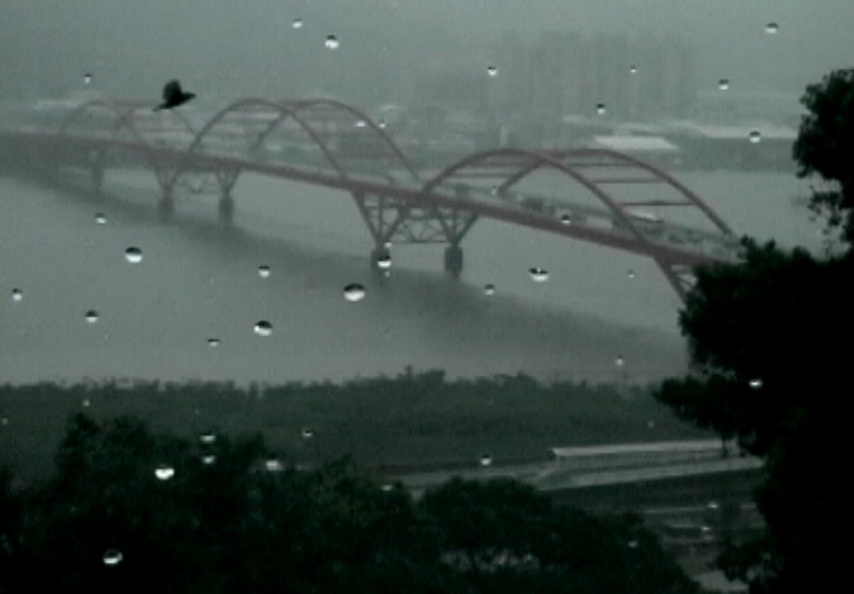
"Rain Scene" (2002), a single-channel video work exploring imagery, approx. 13 minutes.
Text by Chen Chi-Hsiang | Images provided by the artist
"All art is experimental; otherwise, it is not art." — Gene Youngblood, American film and video critic (Note 1)
Preface: After the liberation of modernism and avant-garde movements, modern or avant-garde art has long broken away from tradition and updated aesthetic categories, making artistic creation more radical and diverse. Modernism continuously expanded the scope of art, experimenting with new materials of the era, repeatedly updating the vocabulary and perception of plastic arts. Avant-garde art not only subverts tradition but questions art itself, constantly developing new media materials and experiments to challenge people's perceptions and sensations. With the avant-garde spirit that "all art is experimental; otherwise, it is not art," it unhesitatingly explores the concepts, forms, spaces, and consciousness of the times. Postmodernism broke the dogmatic jar of modernist evolutionism, liberating itself from repression and asceticism to restore intuition, sensibility, and humanistic traditions. Integrating historical imagery and emphasizing craftsmanship, postmodern thought prioritized content over form, displaying an eclectic and diverse face. Postmodernism was not a successful deconstruction of modernity but a cultural plot stemming from the corruption of modern ideas. No longer possessing the Oedipal spirit of self-liberation like modernism, it made artistic creation colorful and varied. From postmodernism to the current globalized internet new media era, whether local or global cultural traditions and imagery have become common human assets. Opening up all references, combined with the full creative vision brought by the digital image revolution, the cross-boundary integration of new media materials opens up creation for the new generation.
New Media Image Poet - Wu Chi-Chung: Wu Chi-Chung (born in Taipei in 1981) is a rising star in Taiwan's new media art. Skilled in photography, video, installation, painting, and stage design, he is dedicated to exploring the essence of imagery, famous for his elusive, ethereal illusions of light and shadow. Passionate about new media, he studies material science, exploring experimental new media, developing new methods, processes, and concepts. He believes that "new media are not just creative elements but also a vocabulary" (Note 2). Against the backdrop of traditional calligraphy and painting, landscape imagery becomes the hidden axis of his creation. Within conceptual rational critical image frameworks, he often returns to handle Eastern and Western painting traditions, integrating Eastern traditional ink wash and Western landscape forms, spaces, and concepts to pioneer visual plastic vocabulary for the new generation, update temporal perception, and dialogue with traditional painting art.
Wu Chi-Chung is an active child who could not follow rules. His mother guided him into painting; he started drawing and practicing calligraphy at four or five years old, drawing whatever he saw. Painting allowed him to focus and enjoy himself. His mother soon realized this child could only calm down when painting, so she encouraged him. At nine or ten, he formally studied painting, beginning contact with sketching, watercolor, and ink wash training. Even as a small child, he was obsessed with "painting." His learning process went smoothly from the Xinpu National Elementary School Art Class, then recommended to the Affiliated Middle School Art Class. Due to independent recruitment, he entered NTUA early, later admitted to the Architecture Department of NTNU through recommendation. After studying for two years, feeling it was a waste of life, he dropped out.
Possessing a rebellious personality as an artist, he never passed any joint college entrance exams, yet he was despairing of the art enlightenment education he received. The art education from middle school to high school focused heavily on skills, hardly qualifying as art, especially those erroneous art concepts that buried countless talents. He frankly stated: "I cannot bear my future children being educated in Taiwan, especially taking some inexplicable art classes. After all, the first teacher I clashed with was the third-grade elementary art teacher, which cultivated a lifelong hobby, clashing all the way to graduate school, and now still continuing to clash with those playing tricks..." (Note 3).
When Wu Chi-Chung entered NTUA (1999-2004), he gradually lost interest in painting, often feeling constrained by his art education concepts, unable to express or break through, lamenting his creation. For a while, he worked as an assistant to Teacher Ni Zaiqin (a thinker of Taiwanese art, whose insightful quote "Western Art Made in Taiwan" aimed to reverse and implement local art trends). This art thought enlightenment opened his vision and imagination for ink wash painting, after which he seriously painted ink wash for a period. At the corner of artist formation education, he encountered Teacher Yuan Guangming (an important Taiwanese media art creator) in a video art course. Encouraged by him, he devoted himself wholeheartedly to new media, observing carefully, shooting diligently, and seeking thorough understanding, intending to find methods and possibilities for creation. During image experimentation, his first video work "Rain Scene" (a sophomore project) was born, opening his path to new media video creation.
Wu Chi-Chung possesses the rebellious personality and exploratory spirit of modern art, sensitive and precocious, demonstrating his talent during student days. Entering the exploration of new media art, he outlined the possibilities of video art creation. The following year, extending from video methods, he developed the dynamic light and shadow projection "Wire Mesh" series (2003). This series won the First Prize of the Taipei Award in 2003, not only affirming his creation but also opening the door to his new media art creation.
Creating Realms - Updating Imagery Narratives and Perception: Creation cannot be separated from materials; materials are the medium conveying thought. Each modern or traditional material has its own attributes and signs. The medium, manipulated and transformed by the artist, becomes a unique vocabulary, referring to and metaphorizing its signifiers, constructing situations and spaces through installation. In this technological age, Wu Chi-Chung's creation starts from new media (cameras, photo cameras, video recorders, and projectors). From the video "Rain Scene" to the "Small Album Pages" series, through object projection "Wire Mesh" series to the mechanical dynamics theory of the "Crystal City" series, he explores the essence of "images" in a stratified era. Simultaneously, he moves between manual craft development and imaging - the camera-less photography "Cun Fa Exercises" series, and deconstructing the imagery narratives of traditional Western painting materials - the "Fabric Texture Exercises" series. His creation is built on new media exploration, research methods, handling video, installation, and images, establishing a framework based on conceptual thinking and experimentation, redefining the boundaries of reality seen and video illusions, constructing the volume of time and space, opening new perceptions and providing viewing experiences.
His creations all stem from his early background in calligraphy and painting, forming two core axes: Media art explores through imagery, developing context, investigating its conceptuality and methodology, tending towards internal ideological structures. The other explores material media and corporeality. Deconstructing - the narrative, context, imagery, space, and situation of media; Creating realms - the image poetics of the technological age. The "Cun Fa Exercises" series deconstructs traditional ink wash painting, while the "Fabric Texture Exercises" series deconstructs Western oil painting traditional elements and aspects. Just as he deconstructed the simple structure of the projector's imaging principle during the Wire Mesh series projection, or deconstructed images through speed.
Opening Image Exploration "Rain Scene" (2002): The bizarre "Rain Scene" (single-channel video) is a work from Wu Chi-Chung's sophomore student days. He used a camera to record the rain scene on the Guandu Bridge over the Tamsui River outside the window. At first glance, it looks plain like a documentary, but the raindrops in the foreground dance strangely, creating an illusion. The foreground and background are in different temporal senses, broken into two worlds, a bizarre illusory situation. The artist repeatedly emphasized, "This is a scenery seen purely through the camera's eye" (Note 4). In this digitalized era, reality produced by the camera shutter challenges what people see with their eyes. Images go beyond our imagination, opening people's perceptions and changing our understanding of things and attitude towards truth. How to view images while reviving our awareness of image technology and the media intervening between us and the object? This is an important task (Note 5).
Starting from "Rain Scene," Wu Chi-Chung began to explore the relationship between viewing and understanding the real world through image technology. What is the essence of "images" in a stratified era? How do images transform people's imagination, the distance between reality's truth and illusions before the lens, and rationally critique what is seen in reality? This has always been the main axis explored by Wu Chi-Chung in his creation. American writer Ayn Rand wrote: "Only the most ignorant and foolish people believe in the saying 'seeing is believing.' What you see is precisely what needs to be doubted first" (Note 6).
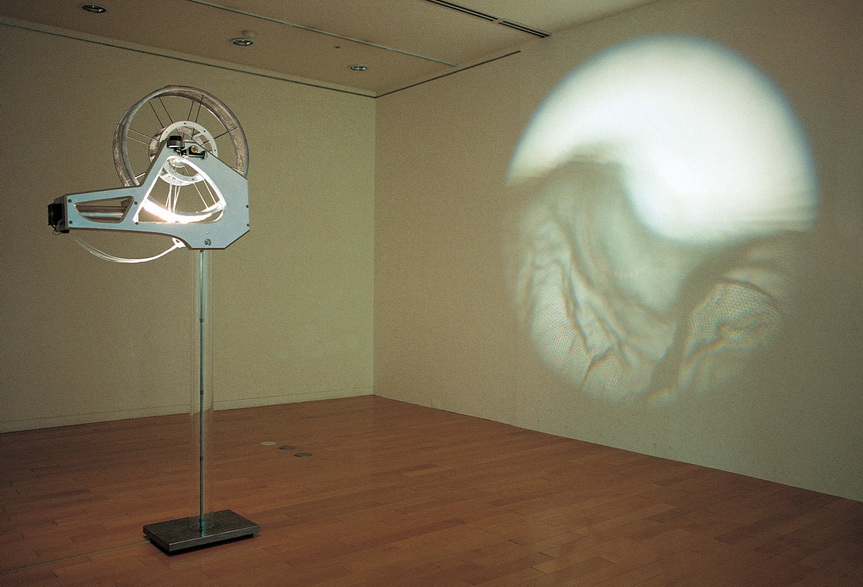
Landscape Creation - "Wire Mesh" Projection Series (2003-2009): The "Wire Mesh I-II" series (2003) projection installation is an extension of video projection. Here, what is projected is not a film, but a tiny piece of wire mesh. Through projection, it transforms into a lyrical, ethereal abstract and hazy artistic conception similar to grand mountains and large waters. "Using a certain medium to achieve an unusual excavation process of ordinary experience (even subtle experience)" (Note 7). Investigating image viewing and conversion, daily life perception issues, through the back-and-forth movement of lens focal lengths, delicate light and shadow changes, spatial deduction of images, endowing Wu Chi-Chung's emotions and consciousness. In the artist's creative statement, he wrote: "However, a small iron wire mesh no more than ten centimeters square (the actual projected area is even smaller), and the image presented through the projector, become a strong contrast... The development of media constantly changes the way we look at the world and our attitude towards truth. Like the projector converting the image of the wire mesh, giving a new space where spirits can be projected" (Note 8). This series deconstructs the shell of the projector, making the process of image generation clear to everyone, implying a certain symbolism. "Wire Mesh I" equipment (deconstructed ready-made) presents a rectangular structure, fixed wire mesh, projecting with moving focal lengths. "Wire Mesh II" shifted the creative focus gradually from image to equipment. The rotating wheel equipment (intentionally constructed shape) fixed focal length, causing different focal length effects through the circular rotation of the wire mesh in place. Besides the poetic landscape freehand brushwork situation, the special shape of the equipment is a model of modern sculpture, intentionally highlighting the exploration of sculpture, installation, image, and space.
"Wire Mesh III" (2007) deepened and expanded the characteristics of using tools, adding speed and sound to the full-field space, strengthening the exploration of bodily perception and consciousness. Placing the self-rotating projector in the center of the exhibition space, projecting onto the walls of a 360-degree ring space, rotating slowly, the projection resembles lighthouse beams sweeping through the darkness late at night, revealing segments of landscape light and scenery. As rotation accelerates, the louder the machine sounds, at extreme speed, the flickering, shaking, blurred scenery eventually becomes a whole sheet of calm light, the image unfolding on the ring walls. After a period, the speed gradually slows, thus repeating. The artist intended to deconstruct images through speed, creating light and shadow contexts, imagery, spaces, and situations, asking what exactly are images in the technological age? What do people really see? In the illusory sound and light situation of virtual and real dissipation, what does the body perceive?
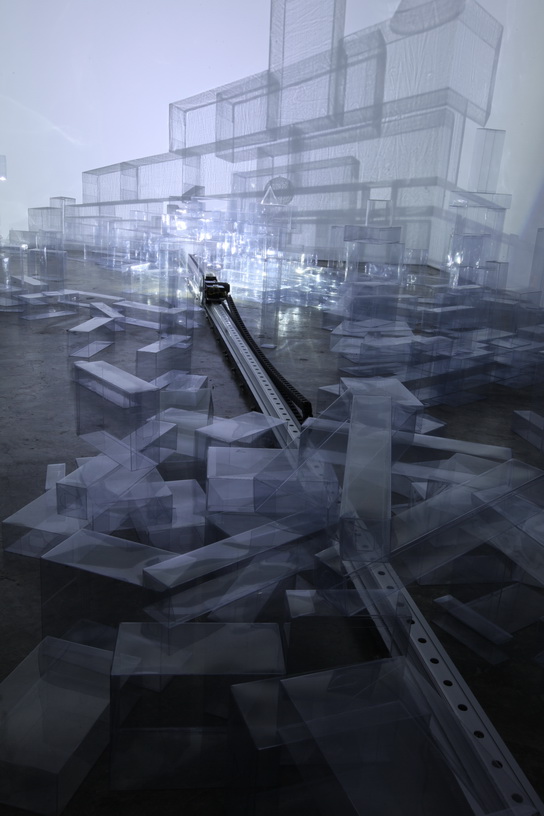
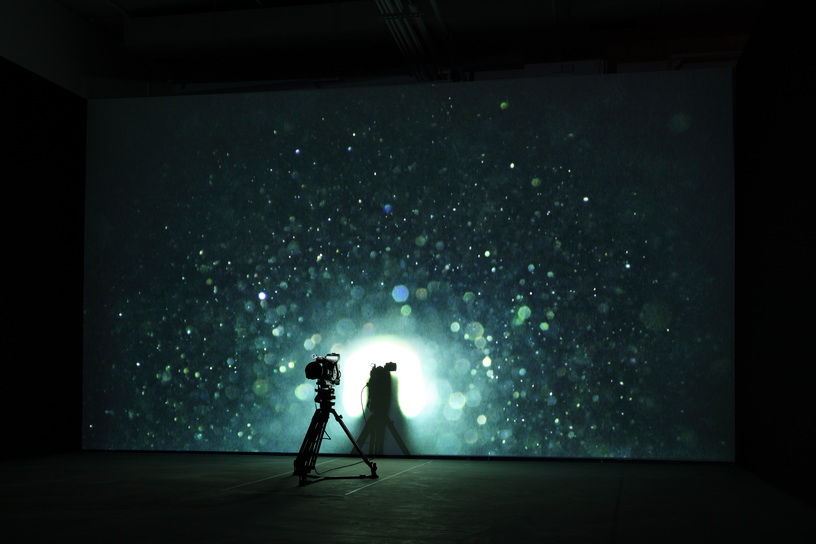
New Era Space - "Crystal City" Series (2009-2016): Driven by curiosity about light and shadow, Wu Chi-Chung explored new lighting media in 2009, playing with LED lights (having sharp and pure light texture characteristics, its spectrum like a rainbow, mainly blue wave bands, the light texture having a digital feel). The appearance of new works in the "Crystal City" series, mechanical theory assisted by motor and track operation power, through light point angles and intensity light imaging, targeting the new era space concept constructed by the internet, code programs, media, and messages. "Crystal City" is the artist's proposition for that invisible world. Crystals have internal laws, external shapes presenting polyhedral geometry, logically automatically derived from structural derivation, spreading endlessly. This series handles the discussion of new media visual vocabulary and contemporaneity and spatiality, implying the unavoidable reality of urbanization, environmental space, and human survival conditions, etc.
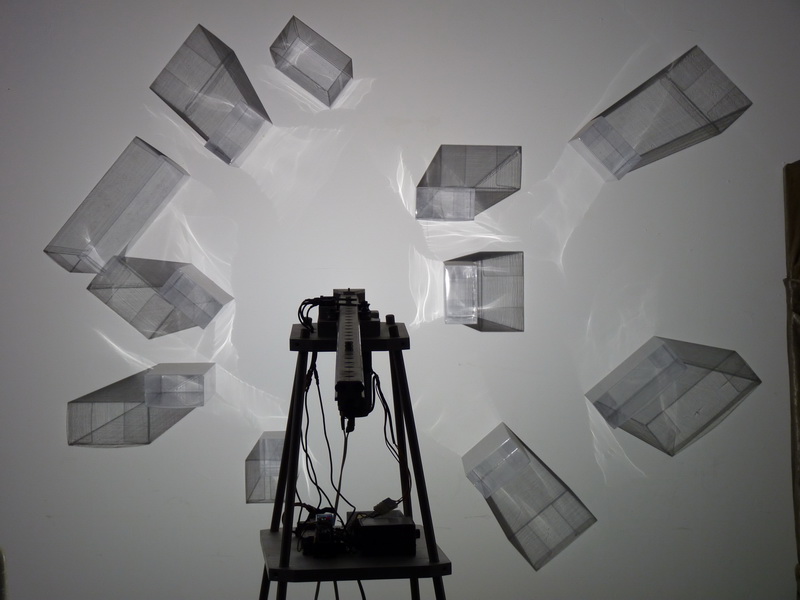
"Crystal City 001 - Roaming" (2009), "Crystal City 003 - Navigation" (2010), "Crystal City 004" (2013) environmental space installations: Piling up transparent plastic boxes of varying heights on the ground (like skyscrapers in the city), light sources placed on central tracks. As one walks, the light slowly moves back and forth, casting shadows of the plastic boxes on the surrounding white walls, stretching and transforming, forming a complex illusory city imagery, displaying panoramic views of environmental space. "Crystal City Special Edition - Wasteland" (2013) environmental space installation, mixing transparent plastic box objects and waste, elucidating the unavoidable environmental reality of urban life and reflection on existential consciousness.
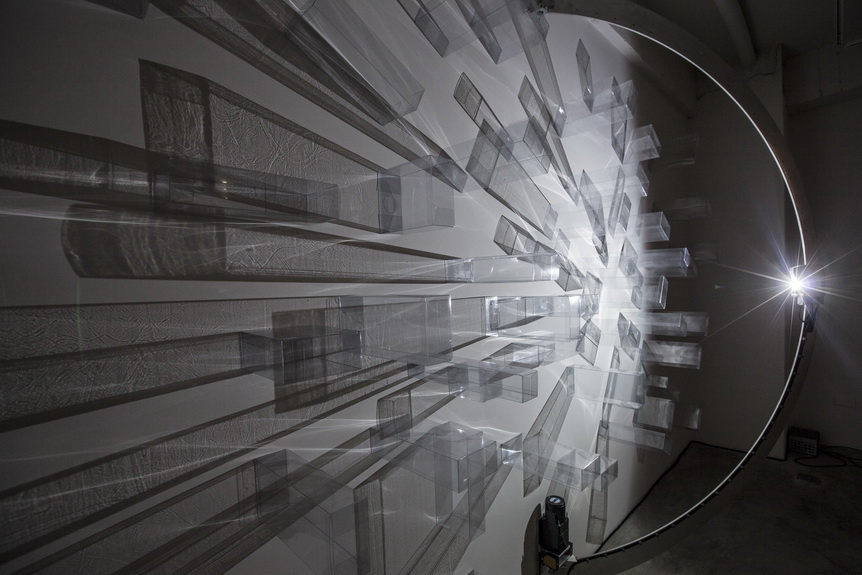
"Crystal City 002 - Floating" (2009), "Crystal City 006" (2013), "Crystal City 007" (2015) wall installations: Transparent plastic box devices mounted on walls. The first two works had light sources mounted on tripods, light moving slowly back and forth, wall plastic boxes stretching and transforming with light and shadow. Later works had light sources structured on semi-circular racks, slowly extending left and right to create imaging. Light and shadow formed perspective states stretching and changing, poetic and picturesque, lightly floating on the wall, like mirage situations, the concept of environmental space, creating a completely new field of vision, presenting a blurry virtual network world, contrasting with shifting black and white light and shadow somewhat corresponding to traditional ink wash.
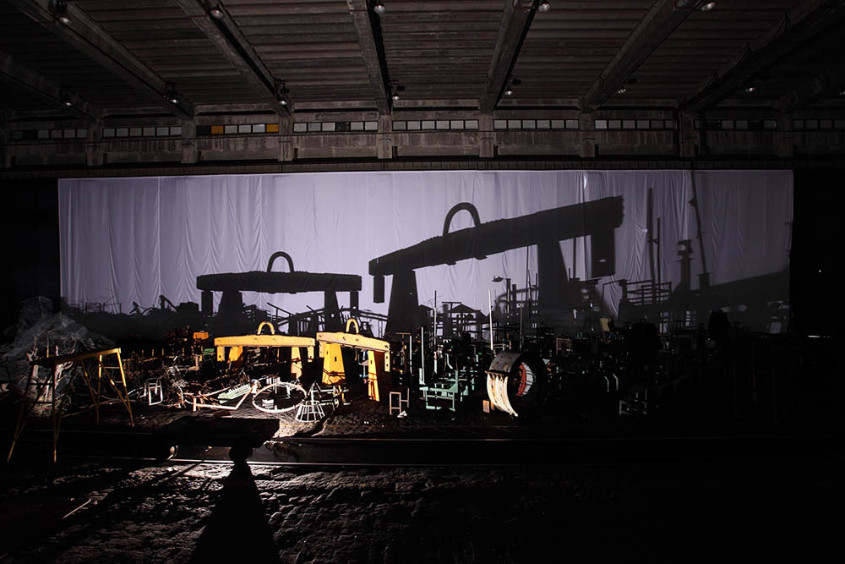
"Aurora Border" Ruins Environmental Space Installation (2014): Commissioned by the Taipei Railway Culture Festival, Wu Chi-Chung collaborated with artist Chen Shu-chiang. The creation site was the Taipei Railway Diesel Factory. Continuing the creative concept of Crystal City, arranging scattered equipment, instruments, iron frames, tools, and various items in the factory. Installing light sources at the front, moving slowly along the track cart, light and shadow uniquely reflected on the background curtain, staging a drama of time, space, and situation regarding railways, cities, mountains and seas, local and foreign, presenting a journey interwoven with emotion and consciousness.
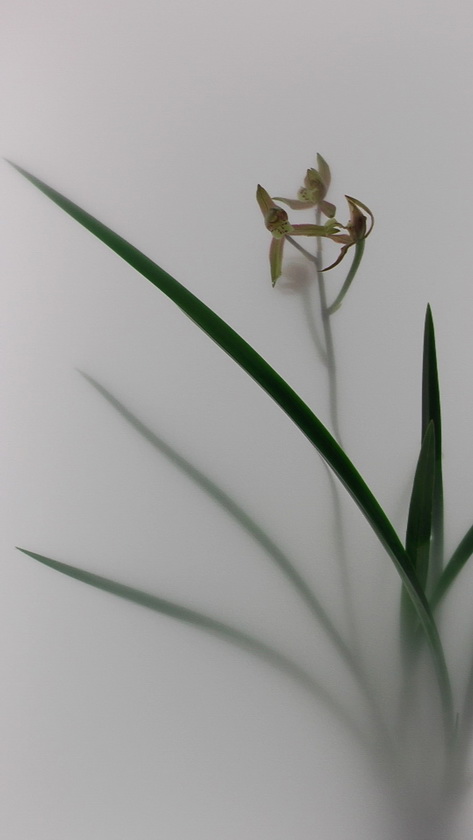
Dialogue with Chinese Traditional Painting "Small Album Pages" Series (2009): In the same year, contrasting with the Crystal City series, the elegant "Small Album Pages" video series was born. This is the reversal of Wu Chi-Chung's mechanical dynamics theory, a director-style manufacturing process, with no post-production of images. Directly placing the shooting subjects in water, slowly rising until emerging from the water surface, the camera lens develops from a blur of white fog (water) layer by layer, until penetrating the dense smoke to appear, the ethereal cloud and mist artistic conception coming from the gradient effect of water. This series is the artist's nostalgia for his love of calligraphy and painting, possessing some indescribable emotions and memories, incorporating the linear structure of painting into video. The subject matter comes from the Four Gentlemen of traditional ink wash painting: Plum, Orchid, Bamboo, Chrysanthemum, focusing on line and ink texture, blurry smoke and mist, light and shadow, and blank space, containing ink realms with strong Eastern traditional ink wash painting situations and imagery, updating the perception of ink wash, subverting traditional forms and concepts.
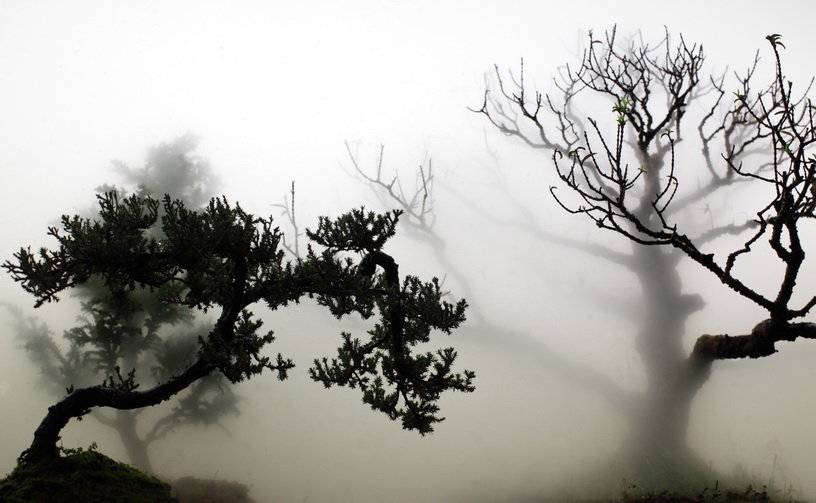
The concept and techniques of the Small Album series extended to "Smoke Forest Map" (2012). Accompanied by the slow, profound rhythm of the lens, dealing with the pictorial series amidst chaos and flying, empty blank space, poetic tree silhouettes, presenting natural imagery scenes of floating light and phantom, the flowing and shifting forest space situation of misty clouds. This series' inspiration came from Corot's (French nineteenth-century Barbizon school) poetic and picturesque landscape painting imagination, blending with the charm of ink wash landscapes, attempting to recreate the possibility of new landscape paintings.
Developing Imaging - "Cun Fa Exercises" Series (2011-2015): In today's digitalized revolutionary era, photographic imaging subverts camera and imaging traditions. Developing imaging and darkroom exposure are no longer secrets, questioning "what is photography?" People can directly create images through digital computer programs, drawing, scanning, medical tomography, magnetic resonance imaging (MRI) functional imaging technology, ultrasound images, positron emission tomography scans, or Kirlian Photography, plus the development and prosperity of post-processing image technologies (such as Photoshop software), 3D stereo photography, and holographic technology development, bringing new opportunities to contemporary art.
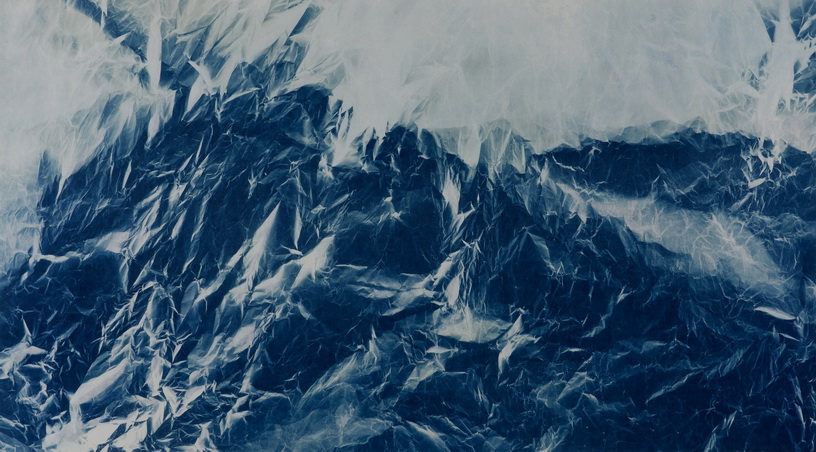
But Wu Chi-Chung goes against the stance of contemporary digital images, constructing his developing imaging "Cun Fa Exercises" series (2011), despising modern photography forms (camera mechanisms and post-production procedures), finding the living source of traditional ancient photography techniques, exploring contemporary images using developing imaging methods similar to camera-less photography (Photogram). Using Cyanotype, he sprayed blue photosensitive material directly onto rice paper, then crumpled it into a ball, spread it under sunlight for exposure. After time-dependent (about thirty minutes) developing imaging, washing, and fixing, random creases and folds created natural infinite reveries of mountain peaks and cliffs. Between painting and photography, concept and behavior, concrete and abstract, reality and imagination, he reinterpreted the concept of traditional landscape Cun fa.
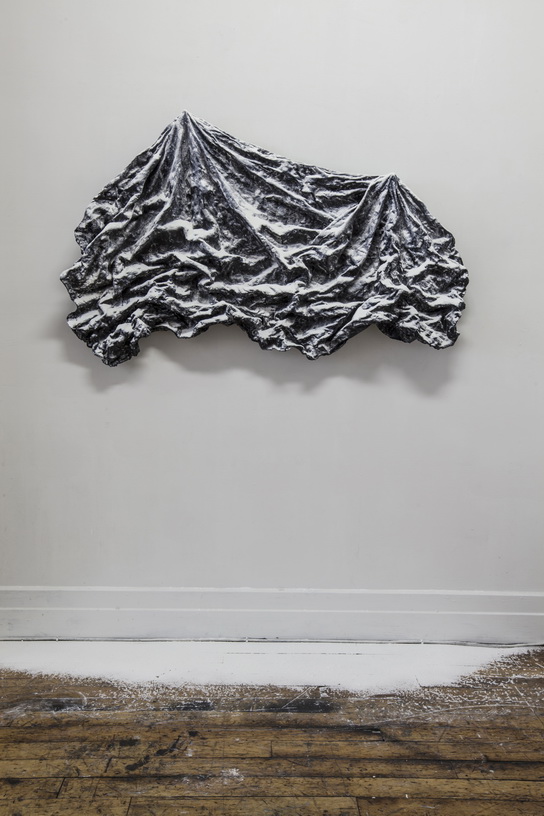
Imagery Narrative - "Fabric Texture Exercises" Series (2014-): Landscape imagery becomes the hidden axis of Wu Chi-Chung's creation. Cun fa is the physical structure of landscape painting. The "Fabric Texture Exercises" series is the experimental extension result of "Cun Fa Exercises," returning to handle painting problems, continuing to deeply explore the relationship between materials and tradition and technology, experimenting and expressing their possibilities. With the development of the methodological process, deepening and constructing its concepts. This series restores traditional Western painting material media (canvas and oil paint, acrylic and pastel), randomly and accidentally folding canvas wrinkles to create fabric textures, black and white monochrome tones, inner frame and no inner frame natural forms, organic forms amidst chaos and flying, opening another path for natural rock and cliff imagery, between pictorial relief and objects, uniquely conveying an abstract and expressive landscape signifier. The true core of discussion in this series is exploring material science and research methods. Under the conceptualization of contemporary art, deconstructing traditional materials and liberating existing concepts of media, returning to the expression of material media, updating the perception of painting, pioneering new visual plastic vocabulary. Cun pattern - Fabric texture inspiration comes from the drapery folds of ancient Greek statues and the Cun fa of Chinese landscapes, integrating Eastern and Western art traditions, between painting, relief, and space, intending to conduct an aesthetic experience dialogue with classical, modern, and contemporary.
Note 1: New Media Art by Michael Rush, p.7 Introduction, Art Series, Thames & Hudson London, UK, published 1999, French version Christian-Martin Diebold, 2000. Note 2: Taipei Studio Interview, 2016-01-15. Note 3: Wu Chi-Chung Facebook post, 2016-08-09. Note 4: Essay on Illusions and Their Flaws: Wu Chi-Chung's Image Works by Yu Wei (Yu, Wei, Modern Art no.124, 2006, p.14). Note 5: Ibid. Note 6: Currency War 2 - Money Rules the World by Song Hongbing, Yuanliu Publishing House, 2009, p.342. Note 7: Lifting the Curtain of Perception: Discussing Wu Chi-Chung's Creation, Text by Zheng Huihua, Modern Art no.124, 2004-04. Note 8: From Wu Chi-Chung's personal creative website - Creative Statement. August 2016 in Paris.