Paris Asset Day - "A Tree"
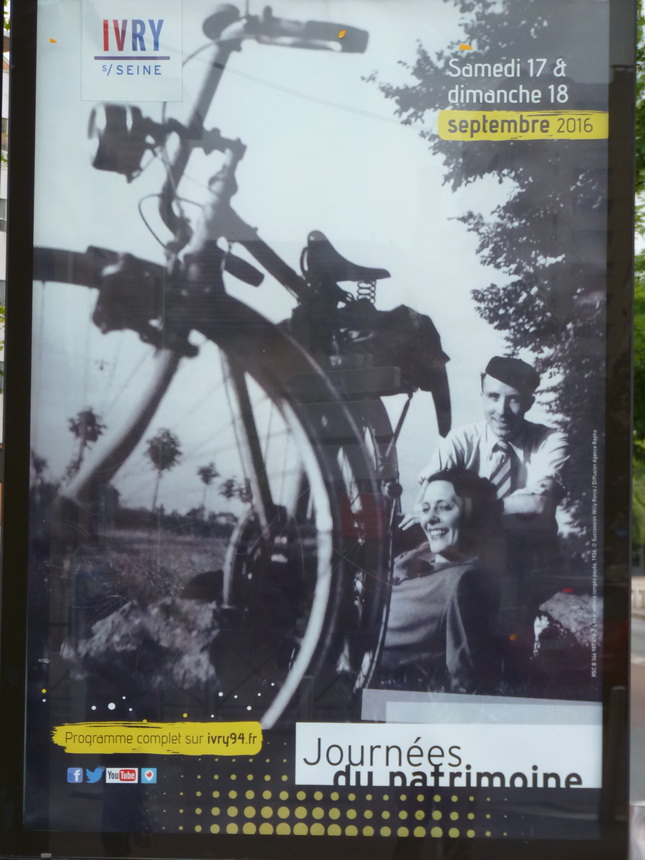
The charming poster for the Ivry Asset Day.
Text and photos by Chen Chi-Hsiang. The annual World Heritage Day usually involves visiting historic sites or mansions once inhabited by dignitaries, such as the Élysée Palace (the President’s office), residences of prime ministers and ministers, or rarely open historical spaces of metropolitan celebrities. Almost everywhere is crowded with long queues. I always choose less crowded places to avoid waiting and wasting time. I prefer exploring original spaces for hidden gems. This year, the most special experience was visiting “Ivry to See a Tree,” along with touring a newly opened contemporary art exhibition.
Having lived south of Paris for over thirty years, my area is near Porte d’Ivry. Living adjacent to Ivry, this southern suburb has become part of my living space, where I buy groceries at the mobile market, watch movies and theater performances, visit contemporary art exhibitions, and attend concerts. Since World War II, the southern suburbs of Paris have been governed by the French Communist Party, serving as its stronghold. From my perspective on culture and arts, this area is the most active for cultural activities in the Paris region. It hosts numerous performance spaces: theaters, film libraries, art centers, galleries, and even the captivating MAC VAL (Museum of Contemporary Art of the Val-de-Marne) in the greater Paris area, as well as future theaters. This is also the most important district for artists’ studios in Paris, featuring our favorite Lucie Film Library, which screens first-run and experimental films. After watching movies, I often have the opportunity to discuss and converse directly with directors and producers. Regular sandwich picnic concerts in the city hall lobby and regular contemporary art exhibitions are among my obsessions, where I meet many contemporary artists and frequently participate in enjoying these regional cultural events.
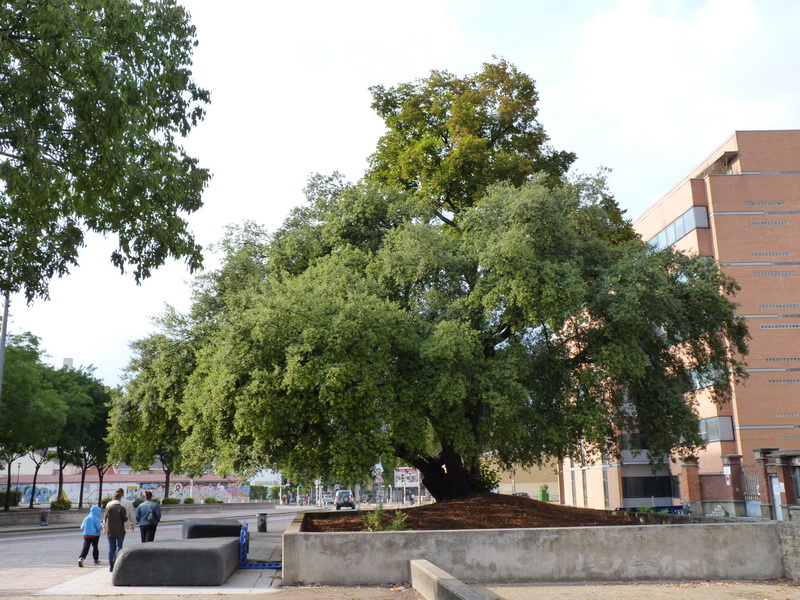
Last year, I visited the cellars in Ivry, former large beer storage warehouses witnessing the progress of the greater Paris metropolis. This year, I visited the basement of the city hall, an underground air-raid shelter dug during World War II. Then, I went to see a tree, lush and dense beside the road behind the city hall, quite eye-catching. It stands directly opposite the contemporary art center, surrounded by high concrete walls for protection. It is the only remaining century-old tree in the area, currently the city hall’s sole precious green asset. Without careful attention, it might seem like just an ordinary, dense tree. However, because this tree was planted around 1789 during the French Social Revolution, it is a rare green oak. Calculating its age, it is already a 227-year-old veteran tree. Under the torrent of time, human civilization witnesses France’s transition from monarchy to democracy, as well as the evolution of French history. With this additional layer of historical significance, this “Tree of Liberty” becomes the only living cultural asset of the French Social Revolution in the greater Paris area.