The Appointment and Formation of France's New Government
(Image) The energetic new French Prime Minister François Fillon and new Foreign Minister Bernard Kouchner, image from the UNP website. After taking office, President Nicolas Sarkozy immediately formed his new government...
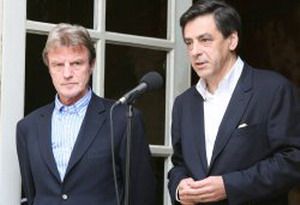
(Image) The energetic new French Prime Minister François Fillon and new Foreign Minister Bernard Kouchner, image from the UNP website. After taking office, President Nicolas Sarkozy immediately formed his new government. Amidst the fresh atmosphere of new leadership and a complete renewal of power, French politics displays a vibrant and optimistic vitality. The entire nation hopes that this new regime will practically fulfill its election promises, bringing France into a new era of opportunity, confidence, and vigor. On May 17, the President appointed the new Prime Minister, François Fillon, who is not only a trusted confidant but also a political strategist for President Nicolas Sarkozy. Born in 1954, he is of the same generation as the President, currently 53 years old, representing the younger-middle tier of French politicians, sharing with the new President a vision and perspective on French politics. Subsequently, the new Prime Minister established the new government. In keeping with the promise to save national resources and expenditures, the number of ministers was reduced from 31 to 15, along with four Secretaries of State and one High Commissioner. Nearly half of the ministers are women, aged between 39 and 97. Interestingly, despite the impression given by President Nicolas Sarkozy’s campaign rhetoric of being a hardline right-wing or neo-conservative politician, the new government’s appointments reflect a slightly more open policy leaning toward the center, recruiting centrists and left-leaning figures. Whether this is a strategy for the upcoming parliamentary elections or reflects other governance ideals remains to be seen.
The members of the new French government are primarily drawn from the Union for a Popular Movement (UMP), the party to which the President belongs, and are mostly his trusted allies, including ministers, mayors, and parliamentarians. Only two come from other parties: First, Prime Minister François Fillon (53), currently a Senator, has previously served as a Member of Parliament, Minister of Defense, and Minister of Education. The second-in-command in the government is Alain Juppé (61), the only minister at the national level responsible for Environment and Territorial Planning. Jean-Louis Borloo (56), former Minister of Employment, is now Minister of Economy, Finance, and Employment. Michele Alliot-Marie (60), former Minister of Defense, becomes Minister of Interior and Overseas Territories. Bernard Kouchner (67), the only leftist participating in the new government and founder of Médecins Sans Frontières, becomes Minister of Foreign Affairs. Xavier Bertrand (42), the President’s spokesperson during the campaign, becomes Minister of Labor, Social Relations, and Solidarity. Hervé Morin (45), from the centrist UDF, is appointed Minister of Defense. Christine Lagarde (51) is Minister of Agriculture and Fisheries; Xavier Darcos (60) is Minister of Education; Rachida Dati (41) is Minister of Justice; Valérie Pécresse (39) is Minister of Higher Education and Research; Roselyne Bachelot-Narquin (60) is Minister of Health and Sports; Eric Woerth (51) is Minister of Budget, Public Funds, and Civil Service; Christine Boutin (63) is Minister of Housing and Urban Affairs; Christine Albanel (51) is Minister of Culture and Communication; Brice Hortefeux (49) is Minister of National Identity, Immigration, and Integration.
The four Secretaries of State are Roger Karoutchi, under the Prime Minister’s office handling parliamentary relations; Dominique Bussereau, under the Ministry of Environment, Development, and Territorial Planning handling transport; Jean-Pierre Jouyet, under the Ministry of Foreign Affairs and European Affairs handling EU affairs; and Eric Besson, under the Prime Minister’s office handling public politics, progress, and prospects. The single High Commissioner is Martin Hirsch, the only civilian appointee, formerly an administrator of Emmaus, specifically tasked to address poverty issues in France.
The primary task of the new government is to win the upcoming parliamentary elections. Securing a majority in parliament will provide advantages for future governance and policy implementation, facilitating reforms in the political system and social issues. According to recent polls, the Union for a Popular Movement (UMP) is poised to capitalize on the presidential election victory to secure a majority, reflecting the consistent wish of the French people. The new government currently serves as an interim administration, awaiting the results of the new parliamentary elections, while a new force of innovation waits in the wings.