Mysterious Memories: Exploring "Bangka" Through Narrative Traces
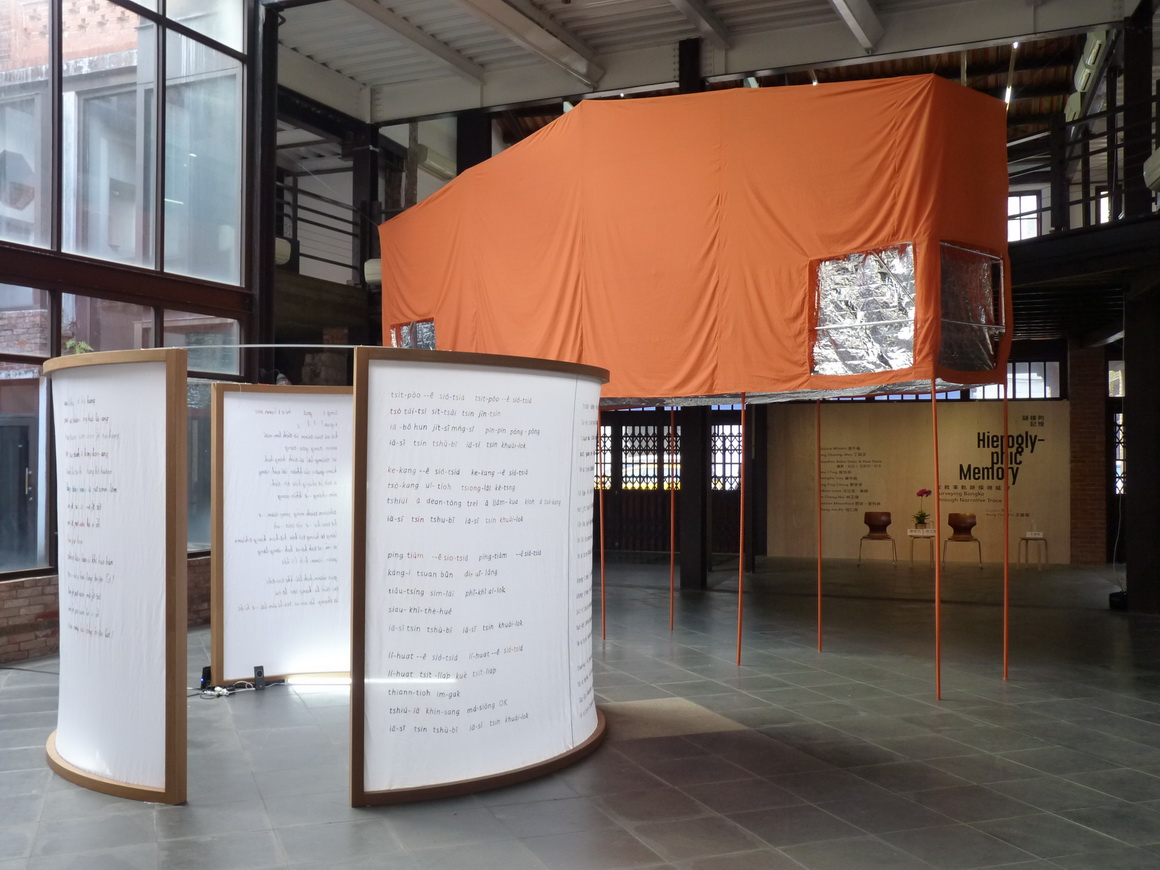
Front - Hou Yi-Ting All Ladies 2016 Back - Fabien Lerat Bangka House 2016 Object Spatial Installation
Text/Photos by Chen Chi-Hsiang. Curator: Wang Jun-Qi. Exhibition Dates: December 22–30. Venue: Pizailao Historical District, Wanhua.
Taiwan’s emerging art scene shows two trends: one is a flood of small stories and grand narratives in painting, often soft and shallow under dreamlike or realistic styles, lured by market mechanisms, lacking visual vitality and adventure. The other, the mainstream, explores art’s possibilities through diverse perspectives and multi-media—sculpture, video, photography, performance, and interactive spatial installations. This approach radiates youthful energy and creative power, leaning toward behavior, attitude, and conceptualism, probing unknown fields within social, political, historical, anthropological, and archaeological contexts to reveal the spirit of the times. The artists in Mysterious Memories: Exploring "Bangka" Through Narrative Traces belong to this latter group, aiming to expand their artistic inquiry under a global-local cultural awareness.
The historical shift from "Bangka" to "Wanhua": In Taiwan, a place that undervalues its own history, monuments, and humanities, how can distant historical memories be revived through archival research, fieldwork, folk tales, artifacts, architecture, and audio-visual materials as creative texts? Inspired by postmodernism and globalization, the rise of regional subjectivity and identity has led to exhibitions focused on local cities. This aligns with global consciousness and practices local cultural awakening. This exhibition focuses on "Bangka" within Taipei, using artistic imagination to discover the past and glimpse the future within its specific cultural-historical framework.
Known as "Oneprefecture, Two Lu, Three Bangka," Bangka was Taipei’s birthplace. Indigenous Pingpu people used dugout canoes to transport agricultural products like sweet potatoes for trade with Han Chinese, earning it the name "Sweet Potato Market." The riverbank became a hub for handicrafts and commerce, making it a major commercial center until the mid-19th century. Northern Taiwan’s export of tea, sugar, and camphor shifted the island’s focus northward, allowing Taipei to rival Tainan. In 1875, Taipei Prefecture was established. "Bangka" comes from the Ketagalan word for dugout canoe, later adapted into Hokkien. In 1920, Japanese administrators renamed the area "Wanhua" because the Hokkien pronunciation resembled the Japanese reading of the Buddhist term "Banka." Locals still call it "Bangka," distinguishing it from the administrative district of Wanhua. Once a prosperous trade zone alongside Dadaocheng, Bangka faded over time.
For nearly three centuries, Bangka has been a repository of history, layered with immigrant customs and colonial influences. Longshan Temple (built 1738), the oldest temple in Taipei, serves as the spiritual core. It has long been a site of political resistance, from the 1895 Declaration of the Republic of Formosa to protests during the martial law era. Today, it shelters economically vulnerable urban homeless populations.
Mysterious Memories: Exploring "Bangka" Through Narrative Traces, curated by rising Taiwanese curator Wang Jun-Qi, treats the site as a research project. Artists explore the city’s changing history, investigating local history, society, and environment. They unearth forgotten fragments from the old city, akin to geological sampling or archaeology, rewriting history through evidence and imagination to broaden the artistic vision of the locale.
Both local and non-local artists begin with historical data, conducting deep fieldwork around the Wanhua Railway Station area. Walter Benjamin described memory as a tool for exploring the past theater, requiring an excavator’s posture to uncover images buried in sediment. These images, cut from previous associations, exist like precious fragments in a collector’s tube.
The exhibition is held at Pizailao, an old settlement at the corner of Guangzhou Street and Kangding Street, asserting its own subjectivity. Through curatorial discourse and artists’ use of Bangka as a text, the show weaves cultural texts via environmental space and performance, presenting the synchronicity of Bangka’s history. It invites viewers on a journey through time, imagining colonialism, capitalism, and post-colonial social contexts.
Ten groups of artists and teams participated, representing active younger generations globally. Taiwanese newcomers include Hou Yi-Ting, Ding Chang-Wen, Cheng Ren-Pei, Lin Zheng-Wei, and Zheng Ting-Ting (all around age 33). International participants include Korean artist Joongho Yum, Japanese artist Chihiro Minato, German duo bosediva (Elisa Duca and Robin Detje), French artist Fabien Lerat, and British artist Duncan Mountford.
Local artists exhibit strong Taiwanese subjectivity, addressing rare topics: Hou Yi-Ting explores the transition of female labor; Cheng Ren-Pei examines the rise and fall of the sugar industry; Zheng Ting-Ting traces the identity and ancestral soul of the Basay people through sound archives; Lin Zheng-Wei uses floorboards and ghostly sounds to recount past lives; Ding Chang-Wen dialogues material and history, revealing cultural self-awareness.
Non-local artists grasp local attributes through perception and imagination: Joongho Yum captures landscapes of marginal architectural ruins; Chihiro Minato documents green mold and moss on old walls; Fabien Lerat proposes social relationships between individuals and groups; bosediva constructs life-based installations; Duncan Mountford addresses the historical memory of the garment manufacturing industry.
Hou Yi-Ting (b. 1979) presents All Ladies, a cylindrical white curtain based on a piece from her "Contract Weaving Field" project. Embroidered with Romanized lyrics of the song "All Ladies," it invites audience participation. Needles and red thread are provided for locals to continue stitching. The work reflects the expansion of female labor during Taiwan’s economic takeoff, when home factories and processing zones thrived.
Fabien Lerat (b. 1960) created Bangka House, a social spatial installation of bright red cloth and thin red frames suspended in air. Symbolizing "home" and fluid connection, it references the plight of the homeless opposite Longshan Temple. Lerat states, "I want to deal with questions like 'Who are we?' and 'Where are we?' In this context, the issue of the homeless in Bangka is indeed a theme I care about."
Joongho Yum presents Bangka: Strangers in Daily Life, a non-documentary photography series. With a keen eye for the unusual, he finds traces of living existence in daily details or overlooked areas. The images depict landscapes of marginal architectural ruins, devoid of emotional metaphor, capturing historical traces and absent figures with abstraction, humor, and satire.
Cheng Ren-Pei (b. 1983) uses Promised Land, an object-spatial installation of sugar cakes, to discuss Wanhua’s history and the importance of Taiwan’s sugar industry. As a key distribution center for raw materials and sugar, Bangka’s fate changed with the completion of the Taiwan Mainline Railway in 1908. She uses the melting weight of sugar cakes to metaphorically interpret the transformation of the sugar industry (from export to import) and the impact of colonial policies.
bosediva (Elisa Duca & Robin Detje), coming from theatrical cross-form arts, merge art and life. Process/Bangka is an installation of various objects left after a performance, serving as a bodily domain. It evokes a disturbing sense of discoordination, order in chaos, and sacred/secular conflict, responding to local conditions. "All boundaries we know are flowing and disappearing here. Other boundaries appear in unexpected ways."
Lin Zheng-Wei (b. 1984) presents Floor, an object, photograph, and steel ball kinetic sound installation. It summons lost legends and memories. Floorboards salvaged from building ruins record the memory of years through texture, transporting viewers to the past. The eerie sounds of empty buildings awaken collective consciousness, recalling childhood folk tales and shared Taiwanese memories.
Chihiro Minato (b. 1960), also a curator, presents Mold Network: Memory Garden for Toshio Ikeda. Under macro lenses, he focuses on small remnants in old rooms—walls and objects covered in ash, green mold, and moss. Dedicated to amateur folklorist Toshio Ikeda, the series describes the passage of time and gazes back at what has disappeared into the wrinkles of time.
Duncan Mountford presents Singer, featuring a magician’s cabinet filled with vintage sewing machines. Multiple round lenses allow viewers to see fragments of the machines, symbolizing objects separated from context. Viewers must move to focus, realizing the process of seeing. The machines reference the area’s garment manufacturing history. Imagining the mechanical sounds as passionate singing creates a poetic and magical atmosphere.
Ding Chang-Wen (b. 1979) presents Remnant Genealogy, a white peeling fragment object installation named after Pizailao (where Fuzuki cedar bark was processed). It examines the recycling of residual objects in daily life, linking past and present. It imagines the quilts and cardboard carried by the homeless before Longshan Temple. "This plan reassigns multiple relationships and realistic positions to objects in the torrent of time."
Zheng Ting-Ting (b. 1985) aims to recover the Basay "Original Sound." Her sound installation Unable to Broadcast uses sheet music, photos, text, and a vinyl player. It features a recording from Japanese anthropologist Tsuchiya Keigo’s 1936 archive. Denied access to the Basay audio files from the National Taiwan University Museum of Anthropology, she titled it "Unable to Broadcast." Using language as identity verification, she hopes to spark discussion on political and colonial histories.
The curator’s painstaking management and diverse perspective: Curated by Wang Jun-Qi, a Taiwanese curator based in Berlin for many years, the exhibition benefits from her cross-cultural experience and international contemporary art vision. It is a grounded, intellectually rigorous, and academic thematic exhibition with a global-local scope. The three-part spatial layout suits each context, with works precisely placed. Despite short duration, it is a rare quality exhibition.
Despite budget constraints, the exhibition was well-planned, with comprehensive academic discourse. Performative installations like Hou Yi-Ting’s All Ladies and bosediva’s Process-Bangka involved audience participation. Experts were invited for talks: Prof. Lin Zhi-Ming and Chihiro Minato discussed "Cultural Cities"; Assoc. Prof. Hou Shu-Zi and Hou Yi-Ting discussed "From Body Images to Laboring Bodies"; Assoc. Prof. Shen Bo-Cheng and Ding Chang-Wen discussed "Relational Fields - Art and City"; critic Xu Wen-Rui and Assoc. Prof. Kang Min-Jie discussed "Rebel Cities" regarding heritage protection. These discussions clarified the past and envisioned the land’s future.
A bilingual brochure guides visitors, containing serious interviews with artists. Sharp critical questions were posed, such as to Zheng Ting-Ting: "Your work often concerns political and colonial issues... Creating political and critical practice in a system adept at co-opting criticism is discouraging. What capacity does contemporary art have to challenge power structures or thinking modes?" The concise introduction of each artist’s exploration helps viewers deepen their understanding, reflecting the curator’s dedication.
Notes:
- Ron Honson, Mysterious Memories: Exploring "Bangka" Through Narrative Traces Brochure, p.9, 2016-11.
- Mysterious Memories... Brochure, p.44, 2016-11.
- Mysterious Memories... Brochure, p.33, 2016-11.
- Mysterious Memories... Brochure, p.29, 2016-11.
- Mysterious Memories... Brochure, p.52, 2016-11.
February 10, 2017, at Zhuoluo City