The French Legislative Elections
(Top) Campaign posters on the wall of Tolbiac University in the 13th arrondissement. (Bottom) Official election boards in front of a primary school, which serves as a polling station. The legislative elections are the most important national vote after the presidential election...
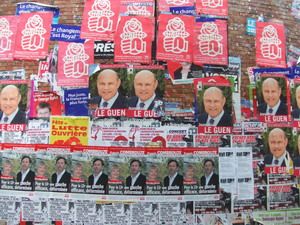
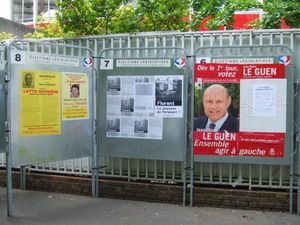
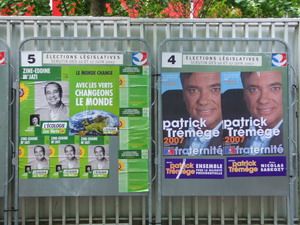
(Top) Campaign posters on the wall of Tolbiac University in the 13th arrondissement. (Bottom) Official election boards in front of a primary school, which serves as a polling station. The legislative elections are the most important national vote after the presidential election, because the formation of a new government requires public trust and affirmation to implement various new reforms. On this sunny Sunday (June 10), the entire country once again entered polling stations to cast their sacred votes.
The results of the French legislative elections have finally been revealed. The Union for a Popular Movement (UMP), aligned with President Nicolas Sarkozy, capitalized on the momentum of the presidential election to achieve unprecedented victory. The blue wave of the UMP nearly overshadowed all other parties, securing 45.8% of the seats. The Socialist Party plummeted to its lowest point in decades at 28.6%. Most notably, the Communist Party secured only 5%, the Greens 2.8%, and the far-right National Front 4.6%, all suffering decisive defeats. The former centrist UDF, now reorganized as MoDem, was almost wiped out, taking only 4.9%.
With 577 seats in the National Assembly, the UMP is expected to hold between 303 and 447 seats, while the Socialists are projected to have 126 to 185. Other parties will become isolated; MoDem may hold only 1 to 4 seats. The Communists, Greens, and Democratic Movement seem to vanish from the political landscape, an unimaginable outcome given that nearly 100 candidates from the UMP list won outright in the first round (compared to just one for the Socialists). All ministers in the new government participated in these legislative races, subjecting themselves to a true test by the people: if they failed to win, they would automatically step down. Except for four who did not secure a majority in the first round, all others were elected immediately, and those few are expected to pass in the second round. This demonstrates the charm of the new government and public sentiment. The results provide the trust and affirmation needed for comprehensive reforms. President Sarkozy’s campaign promises and the policies led by Prime Minister François Fillon will now be implemented with greater force, opening doors for institutional reform and economic revitalization. We await further validation through next week's ballots. Regrettably, voter turnout reached only 60%, the highest abstention rate in over ten years; we hope participation will be more vigorous next week.
The French legislative elections appeared quite calm. Candidates held regional policy forums and dialogues with citizens, occasionally appearing in public places like mobile markets or shopping streets to solicit votes or distribute flyers. Mostly, party workers distributed election leaflets in public spaces and on streets, or posted campaign posters. It was common to see battles over poster placement—where someone tore down a poster only for another to replace it—or party workers distributing flyers before and after mobile markets, reminding voters of candidates' speeches and policy schedules.
Parisian streets remained as calm as usual. Without the randomly posted campaign posters, election boards in front of schools, or media reports and editorials reminding people of the election, citizens might not even realize an election was happening. Everything seemed to proceed silently, yet everyone was aware of when to vote and understood the importance of the election.
This stands in stark contrast to the grassroots nature of Taiwanese elections. When elections arrive in Taiwan, streets fill with competing campaign vehicles and support teams creating carnival-like noise. Supporters set off firecrackers in rallies, parading endlessly through neighborhoods with loudspeakers causing disturbance. Streets are cluttered with abrupt, aesthetically unpleasing portraits of candidates and colorful flags, disrupting visual landscapes and imposing grievances on citizens, becoming a poor habit without civil resistance. Is this the quality of democracy? It is hard to imagine how the tropical preference for liveliness intensifies during elections. While the French method is not perfect, the excessive noise and frenzy of Taiwanese campaigns drive society to madness. Should this electoral culture be reviewed or improved?