The Spatial and Temporal Context of the Northern Renaissance
(Top) Van Eyck's most famous Mystic Lamb Altarpiece, 350x461 cm, painted 1425-1432, held in St-Bavon Cathedral, Ghent, Belgium. (Second Left) Van Der Goes' Adoration of the Magi with the Infant Jesus, 147x242 cm, held in Staatliche Museum, Berlin, Germany. (Second Right) Gerard David...



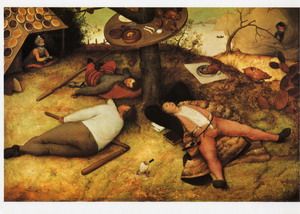
(Top) Van Eyck's most famous Mystic Lamb Altarpiece, 350x461 cm, painted 1425-1432, held in St-Bavon Cathedral, Ghent, Belgium. (Second Left) Van Der Goes' Adoration of the Magi with the Infant Jesus, 147x242 cm, held in Staatliche Museum, Berlin, Germany. (Second Right) Gerard David's The Baptism of Christ, 130x96 cm, circa 1507, held in Bruges Municipal Museum, Belgium. (Bottom) Bruegel the Elder's Earthly Paradise, 52x78 cm, 1567, held in Alte Pinakothek, Munich, Germany.
- From the thirteenth to fourteenth centuries, the only other rising popular force besides Italy was Flanders (covering present-day Netherlands, Belgium, and northern France). Due to the discovery of new continents and Indian spice routes, Bruges and Antwerp on the Atlantic west coast became one of Europe's largest commercial cities. In this free, open, and economically prosperous environment, a new vitality emerged, giving rise to a new art form and establishing it as another humanist center on the west coast.
- However, Flanders' emergence as an art and cultural movement for the new era was not accidental. As early as the twelfth century, Flanders had already nurtured Gothic art (such as Gothic stained glass and tapestries originating from Flanders).
- By the early fifteenth century, Flemish painting had reached a considerable level, particularly through their adoption of new materials—oil paint. While Italian painters admired Byzantine art, they were also awestruck by Flemish painting; consequently, many Italian painters traveled great distances to study there (such as the famous Antonello da Messina).
- Within the open humanist ethos, amidst religious crisis consciousness during the Reformation and Counter-Reformation, they tended toward religious reform, especially under the significant influence of Martin Luther's Protestant Reformation.