Artistic Characteristics of the Northern Renaissance
(Top) Jan Van Eyck, *Lucques Madonna*, 65.5x49.5 cm, 1435, Städelisches Kunstinstitut Museum, Frankfurt, Germany. (2 Left) Van Der Goes, *Original Sin*, 33.8x23, c. 1469-70, Kunsthistorisches Museum, Vienna, Austria. (2 Right)…


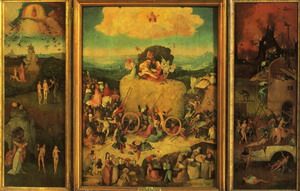

(Top) Jan Van Eyck, Lucques Madonna, 65.5x49.5 cm, 1435, Städelisches Kunstinstitut Museum, Frankfurt, Germany. (2 Left) Van Der Goes, Original Sin, 33.8x23, c. 1469-70, Kunsthistorisches Museum, Vienna, Austria. (2 Right) German painter Albrecht Dürer, Self-Portrait, 67x49 cm, 1500, Alte Pinakothek Museum, Munich, Germany. (3rd image) Bosch, The Hay Wagon, 135x190 cm, c. 1500, Prado Museum, Madrid, Spain. (Bottom) Bruegel the Elder, The Blind Leading the Blind, 86x156 cm, 1568, Naples Museum, Italy. They attempted to understand the mysteries of the world through a sensitive observation of reality, leading to depictions of inner depths and every detail. This involved direct, careful observation and understanding of nature, painting what they could see within this approach close to natural realism. This stands in contrast to the Italian Renaissance: because the Italian Renaissance was built on anatomy and geometric perspective, mastering rational and scientific exploration, thereby constructing an almost internalized image. Before Leonardo da Vinci, Flemish painters had already pioneered tonal color modulation and spatial perspective, creating deep landscape spaces and entering a three-dimensional illusion. Their focus was on consistency of form, color, volume, and light (or unified light).
Northern Renaissance Painting Themes: Although the economy in Northern Europe was developed in the 15th century, natural disasters and human calamities (the Black Plague, war, famine) still existed. People's fear was like information from God's anger, so religious painting remained the main axis. However, under the tide of humanism, secular paintings, interior scenes, portraits, and landscapes gradually became the themes of Northern Renaissance painting. Folk secular paintings also became another theme, especially in the works of Bosch and Bruegel, which were rich in sentimental rustic atmosphere. In a pastoral world, full of symbolism and imagination, they opened up new paths for Northern secular painting.
Beginning and End of Northern Renaissance Painting: Northern Renaissance painting began with the extreme realism of the Van Eyck brothers, who opened the way, but ended with Pieter Brueghel, who was full of symbolism and imagination.