Samson Young's "Songs for Disaster Relief World Tour" Solo Exhibition
Poster for Samson Young's solo exhibition "Songs for Disaster Relief World Tour," an audiovisual journey.
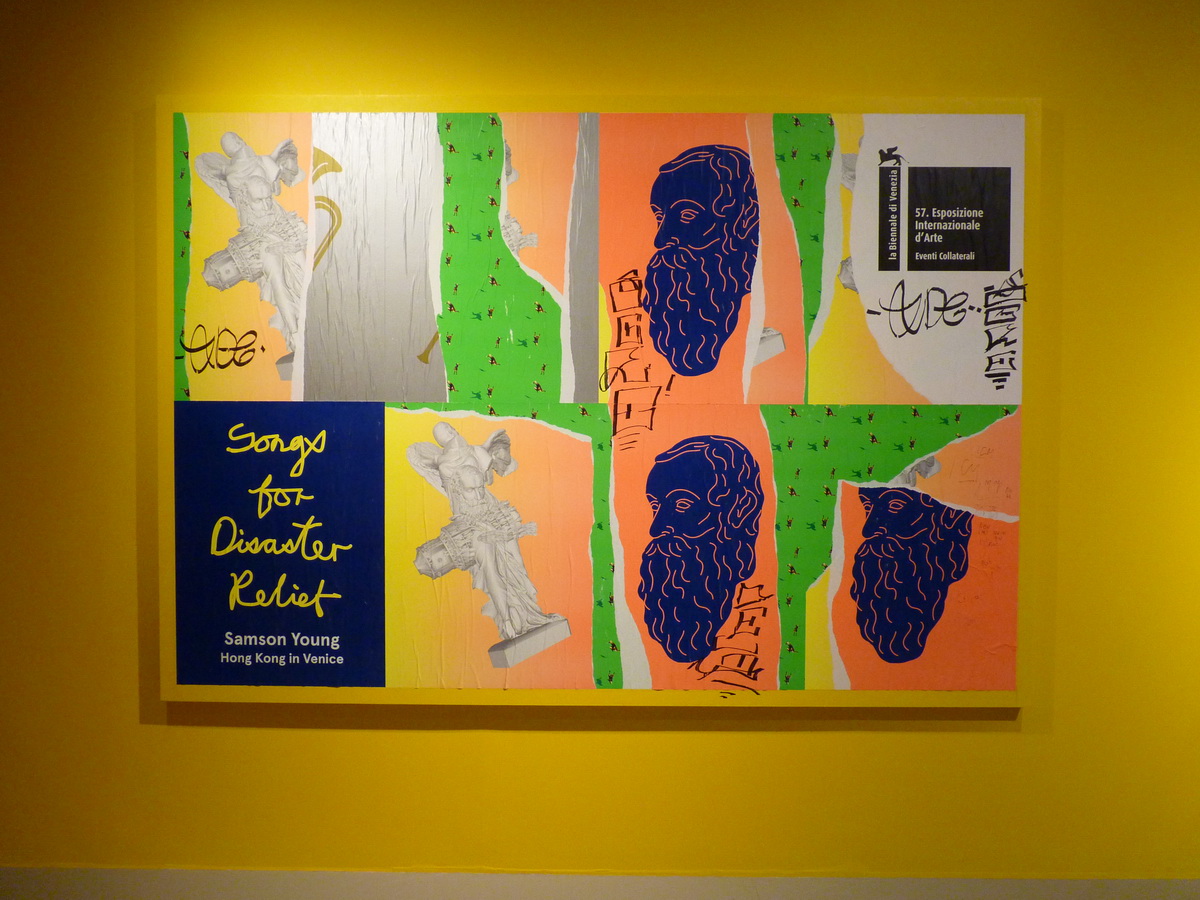
Text and photos by Chen Chi-Hsiang. Samson Young’s Songs for Disaster Relief World Tour: February 9 to May 6. Location: M+ Pavilion, West Kowloon Cultural District. Guest Curator: Irene Kwok (M+).
Preface: During my visit to Hong Kong in early March, I frequently saw posters for “Samson Young’s Songs for Disaster Relief World Tour” on the subway. Initially, I thought it was a grand pop concert, but it turned out to be the most impressive cross-disciplinary visual art exhibition I had seen upon returning to Taiwan and visiting Hong Kong. The artist’s keen observation of the world, his innovative artistic thinking, rich cross-cultural contexts, and his method of linking history and spatiotemporal regions through sound left an indelible impression on me. In this temporary venue located at the construction site of the emerging cultural district in Kowloon, with the company of my good friend momo, after some hassle, I finally got my wish. Samson Young’s Songs for Disaster Relief World Tour is a follow-up exhibition held after Hong Kong’s participation in the 57th Venice Biennale, featuring new works as a way to give back to the local Hong Kong community.
A Visual and Audio Journey: Samson Young’s Songs for Disaster Relief World Tour: The exhibition resembles a spectacular theater with rising climaxes, creating scenes that unfold according to spatial contexts, series of objects, and accompanying musical or sound performances. Through sculptural installations, objects, photographs, lighting, curtains, household items, video, and soundscapes, the artist constructs a unique audiovisual experience. Re-examining the once-popular phenomenon of the 1980s where numerous artists recorded “charity singles,” he uses creative misreadings and repurposing of old songs to link historical and contemporary events between the virtual and the real. He explores multiple “charity singles” from the 1980s onwards, seeking the social, political, and philosophical meanings embedded in classic songs within rich cross-cultural contexts. (Note 1)
Tribute to the Myth-Maker Who Falls for the Myth (2017) as if it were a music album: The spectacular theater opens with the foyer piece Tribute to the Myth-Maker Who Falls for the Myth. Greeting visitors is a giant statue lying diagonally inside a closed glass display case with a mirrored surface. This postmodern assemblage consists of various elements: a melting winged goddess figure, two slightly disproportionate busts (Philolaus and Reagan), and a hybrid of a military horn and a space station. Reagan serves as a symbol of the conservative era of the 1980s, while Philolaus, the Greek sage, mathematician, and music theorist, represents the universal value of music. (Philolaus advocated that celestial music integrates metaphysical philosophical principles; mathematical relationships express spiritual qualities or tones, manifested in numbers, visual angles, shapes, and sounds all connected in proportional graphics. Note 2) Here, Philolaus refers to sound without a source—heard but unseen. Legend has it that Philolaus taught behind a curtain so students would focus on listening. Samson Young combines various objects, sounds, videos, fictional narratives, and personal experiences to shape the concrete image of Boomtown Gundane, the protagonist of fake news. (Note 3) This trophy-like object serves as the visual promotional material for Boomtown Gundane’s non-existent song, linking the entire exhibition of Samson Young’s Songs for Disaster Relief World Tour across time, space, and the dissolution of reality and illusion.
The Scene Points to the Virtual Musician’s Position: In another scene within Tribute to the Myth-Maker Who Falls for the Myth, a carefully arranged domestic living space creates a warm and comfortable atmosphere. A living room with pink and blue-purple lighting tones is surrounded by curtains on the walls. A marquee-style screen continuously plays illusory music videos. Two sets of leather sofas, flowers and magazines on the coffee table, flower lamps, brass instruments, and drums under the lights are among the objects. The domestic scene seems to reference the taste and lifestyle of the absent virtual musician. In both halls, screens play animations based on the original cover art of Do They Know It’s Christmas?, showing a boy and a girl endlessly flipping and dancing aimlessly. This seems to imply that no matter how hard they try, everything is futile, reflecting their unfulfilled ambitions. (Note 4)
We Are the World (2017) – The Essence and Metaphorical Association of “Muting”: Passing through the next door, one enters a cinema-like space, startled by the Hong Kong Federation of Trade Unions Choir singing Michael Jackson and Lionel Richie’s hit We Are the World in a muted manner. Muting is the effort to suppress “voice,” becoming a hoarse, grassroots sound. The artist subverts the audience’s accustomed audiovisual reception; the sound quality instead gives viewers a gentle and delicate feeling. By deconstructing the melody and structure of the famous song, the artist elucidates a unique essence and emotion of sound. Under creative misreading, this may metaphorically represent the muted state of certain political illusions in society after Hong Kong’s return. Why choose We Are the World? What kind of world is it? Is it the world of Hong Kong people? Did the artist unintentionally question the gap between the original intention and the final result of Hong Kong’s return? This work also seems to correspond to the Mao Zedong quote displayed outside the courtyard (Neon Light Work): “The world is yours, and it is ours, but ultimately, it is yours.”
Interpreting Local Hong Kong Disaster Relief Sentiment – Rivers of Love (2017): Through the adjacent glass door, one enters a video installation space resembling a recording studio. The video is placed in a rectangular window. Viewers can watch the video and listen via headphones while standing at the front desk before the window, gazing through the window towards the view from the foyer to the outdoor atrium. Today, disaster relief donations around the world are broadcast through television programs, making TV donation drives a tradition. Hong Kong is no exception; whenever someone donates, the TV ticker rapidly displays the donor’s name and amount. Hong Kong’s most representative charity song is Rivers of Love (1991), adapted from Simon & Garfunkel’s Bridge over Troubled Water to respond to the floods in East China. Here, artist Yang uses creative video repurposing of old songs. The artist becomes the protagonist of this work, standing on the bow of a boat at the maritime border between China and Hong Kong, facing away from the camera, gazing at the vast sea and distant lighthouses, expressing feelings through song, conveying the tense relationship between the two places, which are both far and near. Past natural disasters in China often stirred the spirit of solidarity among Hong Kong people. This song can be considered a summary of a passing era. (Note 5)
Musical Life Carillon (2018): For this Hong Kong solo exhibition Songs for Disaster Relief World Tour, the artist specially created a new work Carillon. Viewers see an automatically playing piano, upon which are displayed the artist’s daily life objects: a gold record with a cover, letters, composition notes, manuscripts, and materials, presenting the daily context of his musical life. Here, the piano’s intermittent timed automatic playing action, and the energy shift from movement to sound, just echo the choir’s muted performance in the previous hall.
The Paradoxical The World Is Yours (2017): In the outdoor atrium, there is a distinctive neon light installation work inscribed with Mao Zedong’s words: “The world is yours, and it is ours, but ultimately, it is yours.” This paradoxical sentence suggests that the world should be ours, so why ultimately yours? Hidden within this contradiction is a mystery, like a Zen koan, inviting viewers to ponder it themselves.
Who is Artist Samson Young: Samson Young (born 1979) is a new generation Hong Kong cross-media artist and composer. During university, he immersed himself in his passions for music, philosophy, and gender studies, later choosing composition as his profession. Holding a PhD in Electronic Music from Princeton University, he quickly crossed boundaries. His artistic creation is not confined to any specific medium or form, carrying a strong experimental nature, built upon his profound professional background in music and composition. Rarely approaching diverse social, political, and historical issues from a musical perspective, he uniquely links history and spatiotemporal regions through sound, attempting to explore various possibilities. His explorations revolve around audiovisual spatial installations, with each exhibition unfolding a unique audiovisual feast. (Note 6)
Notes: Note 1: Exhibition introduction for “Samson Young’s Songs for Disaster Relief World Tour.” Note 2: From Wikipedia Music Universe. Note 3: www.westkowloon.hk “Samson Young’s Songs for Disaster Relief World Tour” Irene Kwok curatorial text. Note 4: www.westkowloon.hk “Samson Young’s Songs for Disaster Relief World Tour” Irene Kwok curatorial text. Note 5: www.westkowloon.hk “Samson Young’s Songs for Disaster Relief World Tour” Irene Kwok curatorial text. Note 6: Referencing WWW.westkowloon.hk - Samson Young’s Artistic Practice.