The Second Round of the French Legislative Elections
(Top) Alain Juppe, Minister of Ecology and Sustainable Development, defeated in the legislative elections. (Middle) Segolene Royal, Socialist presidential candidate, officially divorces Francois Hollande, father of her four children and party leader; this intimate photo of the MP remains. (Bottom) L

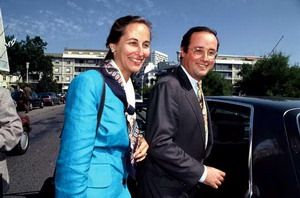
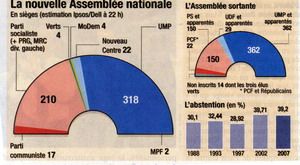
(Top) Alain Juppe, Minister of Ecology and Sustainable Development, defeated in the legislative elections. (Middle) Segolene Royal, Socialist presidential candidate, officially divorces Francois Hollande, father of her four children and party leader; this intimate photo of the MP remains. (Bottom) Legislative election chart: blue represents the right-wing Union for a Popular Movement (UMP), the left-wing Socialist Party is pink; comparing with the 2002 National Assembly proportions in the upper right corner reveals the current political landscape. All images from www.20minutes.fr.
The second round of the French legislative elections was revealed on the evening of June 17. Polls throughout the week had claimed that an overwhelming blue tsunami swallowing the National Assembly was inevitable, predicting between 400 and 500 seats. However, this wave hit a reef and became merely a small ripple. The right-wing Union for a Popular Movement (UMP), belonging to the new President Nicolas Sarkozy, secured a majority with 318 seats. Adding the pro-blue Nouveau Centre’s 22 seats and the far-right MPF’s 2 seats, the right wing totaled 342 seats.
The left, having faltered, concentrated its fire in this second round on the new government’s tax proposals and articulated the crisis of impending one-party rule in France. They earnestly urged citizens to step forward so the Socialist Party could become a strong opposition force in the National Assembly, effectively checking and supervising the regime. Unexpectedly—given the Socialist Party’s modest expectation of losing gracefully with only 120 to 150 seats—a unprecedented new reality emerged. The Socialist Party won an unprecedented 210 seats, shocking the public and restoring the party’s dignity and social influence. More remarkably, the Communist Party, considered doomed, staged a resurrection with 17 seats, while the marginalized Green Party survived with 4 seats. The new centrist UDF, renamed MoDem, like the Greens, secured only 4 seats. As for the far-right National Front, it was completely wiped out.
Compared to the previous (2002) National Assembly proportions, although the right-wing UMP retained a majority, its seats dropped from 362 to 318, a loss of 44. This signals public vigilance toward the new government and a more cautious interpretation of public opinion regarding future reforms. Prime Minister Francois Fillon declared, “The election is over. We will free ourselves from all past reasons and taboos of our country, unite together, and the time for a new chapter has arrived.”
The Socialist Party increased from 150 seats to 210, a gain of 60. This was not a gift from heaven but rather the democratic consciousness of the French people, imposing the responsibility on the Socialist Party to play the role of a strong opposition force to balance the new regime. Segolene Royal stated, “French voters have given a sense of democracy through their ballots… consciously demonstrated in this second round.” Party leader Francois Hollande declared, “The alleged blue wave did not materialize in the new National Assembly as imagined, which is excellent. Diversity and multiple perspectives are good for the nation; France walks on two legs.”
The most dramatic aspect of this election was that almost all ministers in the new government were elected in the first round, leaving only four. Among them, Alain Juppe, the second-in-command in the new government and the sole national-level Minister of Ecology and Sustainable Development, unfortunately lost to a candidate close to Segolene Royal, demonstrating the latter’s influence. Even more dramatic and exciting on election night was the official divorce of Segolene Royal, the Socialist presidential candidate, from Francois Hollande, the father of her four children and party leader. Rumors of marital strife had long circulated. Although this is a personal family matter, it involves future challenges to the Socialist Party leadership and changes within the party. Segolene Royal is determined to divorce and confidently seize the initiative through her influence. The political theater continues with compelling performances.
Minister of Ecology Alain Juppe will submit his resignation to the Prime Minister. The new French government is operational and about to be formed. The bugle call for various economic, political, and social reforms in France has thus sounded.