2007 Tour de France
(Top) The demeanor of Spanish dark horse Alberto Contador, who won in 2007; image from www.liberation.fr. (Bottom) The intense finale on the Champs-Élysées in Paris. This year's Tour was more dramatic than usual...
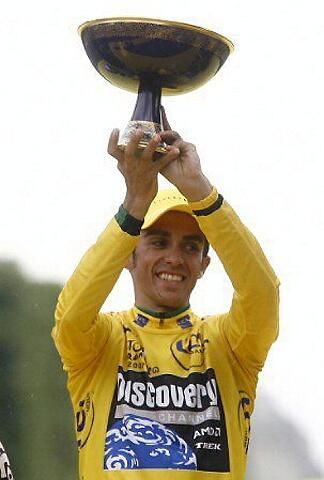
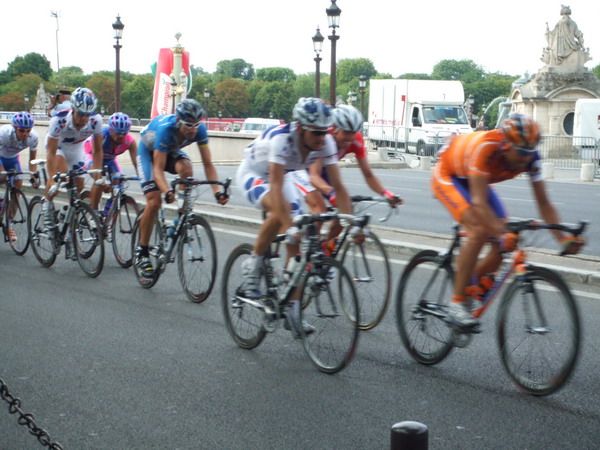
(Top) The demeanor of Spanish dark horse Alberto Contador, who won in 2007; image from www.liberation.fr. (Bottom) The intense finale on the Champs-Élysées in Paris. This year's Tour de France was more dramatic and explosive than the usual summer sports carnival for the public (150 riders, lasting three weeks, is the most watched sport in France during summer). The race itself possesses full sporting drama, as stage competitions require every rider to sprint fiercely against distances between 150 and 300 kilometers daily under hot weather. Riders push their physical limits at speeds of 40 to 50+ km/h, climbing mountains and winding through curves. It is hard to imagine such "ox-like" or "horse-like" stamina and power, which are beyond ordinary human capacity. To win the yellow jersey seems to require borrowing "divine power—doping," because today's society demands the strongest, richest, and most beautiful. Athletes under such extreme pressure hope to stand out or leave a legacy forever, resorting to doping without hesitation. Thus, it can be imagined that modern sports have become distorted (like today's society). Therefore, the Tour de France has always raised questions about the positive meaning of this sport. In recent editions, such as last year's winner Floyd Landis being exposed for doping, or American rider Lance Armstrong's seven titles being questioned, the 2007 Tour de France had continuous issues from the start until the end remained unclear, with doping suspicions lingering. Since the 1998 Tour aimed to eradicate doping, it failed to cure the root cause, as "as virtue rises one foot, vice grows ten." Now, the Tour de France is widely debated, and this year's champion, Spanish rider Alberto Contador, is still shrouded in doping doubts.
This year's Tour started in London, crossed the English Channel, circled northern France to Belgium, then headed south to the Mediterranean, and finally went north through the Central Massif to Paris, covering 20 stages. As usual, each stage attracted thousands of cheering spectators lining the streets, with live broadcasts of the race (televised in 185 countries worldwide), and special introductions of stage winners and the yellow jersey leader receiving flowers and kisses from beautiful women, creating enviable scenes. For the first seven stages, the yellow jersey was held by Italian rider Cancellara, but he later lacked strength. From stage 8 onwards, Danish rider Michael Rasmussen took the yellow jersey and led far ahead, becoming the most likely champion this year. With superhuman stamina and lightning speed, he defeated rivals relentlessly. Spanish rider Alberto Contador also followed closely, taking the lead in stage 14. At stage 13, a dark horse (not a real horse), Alexandre Vinokourov, unexpectedly appeared and challenged the race, winning two consecutive stages. His rapid climbing and abundant energy were astonishing, forming a tripartite balance of power.
However, this year's summer carnival was particularly unexpected. Doping clouds hung over the race schedule, and random drug tests by organizers found anomalies. Media began to suspect and point fingers at core figures, causing panic among the dominant riders. Spectators lining the streets unusually criticized the Tour de France riders, cursing them at every stage, especially those with guilty consciences. On July 24, Belarusian rider Alexandre Vinokourov, who won two stages, disappeared mysteriously due to the pressure of doping suspicions (officially proven to have used doping on July 28). On July 25, Danish rider Michael Rasmussen, the yellow jersey leader who won stage 16 and led far ahead (this mountain stage expert had missed four drug tests in the past eighteen months, leading to widespread speculation of his doping involvement), was dramatically fired by his Rabobank team the next day, losing his qualification to continue (he had recently been expelled from the Danish national team). He was suspected of using doping. Rabobank spokesperson Bergsma stated, "Michael Rasmussen was banned from racing for violating internal rules. He was involved in doping suspicions and refused to cooperate with drug tests, making outsiders increasingly doubt that he really used doping." Other teams, such as Cofidis, also had riders announced as having positive drug tests, or German riders tested positive for testosterone. This severely damaged the credibility of this year's Tour de France, casting a shadow over it. The public began to mock the cynicism of the Tour de France, hoping to give justice to legitimate riders.
Two of the most hopeful contenders for this year's Tour de France were eliminated with only four stages left, opening a new intense final battle for this year's Tour de France, leaving a bright future for Spain's dark horse Alberto Contador (also suspected of doping). Finally, on the 29th, in the final stage on the Champs-Élysées in Paris, he won the championship. The runner-up was Australian rider Cadel Evans (only 23 seconds behind Contador), followed by American rider Levi Leipheimer, ending the stormy and dramatic 2007 Tour de France. One spectator declared, "The wind and clouds of doping cannot stop us, because the Tour de France is still the grandest folk carnival. There are still many upright riders. It is for them that we are still here, although they cannot be sure to get on the podium... etc." This year's Tour de France should remember this lesson and remain vigilant. Organizers assured the media that next time it would be flawless.