Several Major Reform Projects in Current French Politics
(Image) French President and his subordinate Prime Minister, Minister Secretary-General Eric Besson responsible for public politics. Image from sarkozy2007.com. French political reform is underway with great vigor under the full commitment of President Nicolas Sarkozy. To adapt to new global trends,
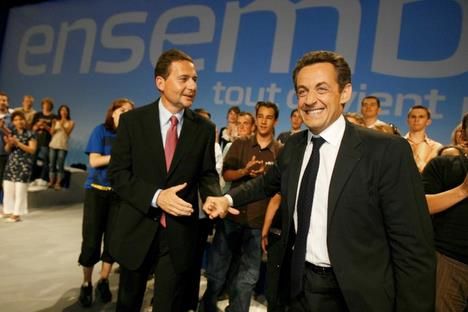
(Image) French President and his subordinate Prime Minister, Minister Secretary-General Eric Besson responsible for public politics. Image from sarkozy2007.com. French political reform is underway with great vigor under the full commitment of President Nicolas Sarkozy. To adapt to new global trends, these comprehensive reforms are essential. France's conservative society is positively facing this extraordinary shock, which will not only change the entire structure of French society and construct a new social situation, but also deeply affect the rights and interests of various social strata and individuals.
The several major reform projects in current French politics are based on President Nicolas Sarkozy’s election platform. To fulfill his campaign promises, he goes all out, standing at the forefront to personally and strongly push forward the execution of reform plans with a comprehensive, fight-to-the-end stance:
First, regarding the general "inheritance right" of society, the right-wing government abolishes inheritance and gift rights for 95% of the French population in terms of taxation. It also targets reforms of inheritance rights for non-direct relatives. Previously, if the heir was not a direct relative, a high tax rate of 60% would be deducted. The government considers this too high, especially given the inability to confirm inequalities in inheritance within parent-child relationships, hoping to lower this percentage. Leftists question whether this is a big gift from the government to the middle-class wealthy (attracting many middle-class votes regarding inheritance rights).
Regarding "salaries": The presidential election slogan is "work more (overtime), earn more money," advocating that overtime will no longer be taxed in the future, allowing everyone to earn an additional 25% overtime pay outside regular hours. These extra jobs will exempt all social and tax contributions, benefiting both employers and employees as a win-win outcome. This responds to three aspects: "restore work in France, restore purchasing power for the French, make companies run smoother." By incentivizing individual income through overtime, it attracts many lower-middle class and laborer votes.
Regarding "employment": Establish a more flexible single employment contract to encourage company hiring and protect employees. Because this ensures security for everyone, on the other hand, it simplifies dismissal procedures, accompanying staff with gradual rights and past expertise to protect employment and unemployment benefits.
Regarding "retirement": Reform special retirement systems (such as those for railway workers, subway personnel, electric company employees, etc.). These reforms will balance pensions for 25% of the elderly and increase small pensions. That is, railway workers, subway personnel, electric company employees, etc., can retire after serving 37.5 years (general private companies require 40 to 45 years of service). In the current tight situation of French pensions, this special retirement reform is an urgent priority for the government. Of course, touching upon this issue, almost all unions will base their actions on protecting their own interests, leading to social struggles brewing among these special retirement unions.
Regarding "justice": Reduce most penalties. The president hopes to reform juvenile criminal law because since 1945, all minors who have violated the law have been tried by children's courts, with sanctions prioritized on education, which no longer fits the times. A 17-year-old today is fundamentally different from one twenty years ago. This juvenile law will reform so that multiple offenders starting from age 16 must bear adult responsibility and be tried by lighter courts, with stricter and enhanced sanctions compared to past children's courts.
Regarding "immigration": Strictly regulate legal immigration and impose stricter family reunification rules. Since at least 2,500 people enter France annually for family reunification, the president hopes that those seeking reunification must first take language tests at local French embassies. However, the immigration law recently passed by Minister of National Identity and Immigration Brice Hortefeux in parliament is even stricter than this proposal, advocating that family-reunification immigrants must undergo genetic testing and possess adequate housing and a salary sufficient to support the family.
Regarding "social insurance": French social insurance has always shown a deficit. The government seeks a "logic of responsibility" from the French people; otherwise, universal social insurance will collapse. When exceeding the annual social insurance budget amount, patients will be required to pay responsibly themselves. The government will propose legislation, which will also cause dissatisfaction among doctors and patients, aiming to achieve a balanced reform of the social insurance budget. (Refer to Le Croix newspaper, May 16-17 edition, pages 2 and 3, Events section.)