Art under Globalization (Lecture Outline)
(Left) French artist Etienne Bossut, Bomb Head, 2005. (Right) Chinese artist Wang Du, Entrance, 2004.
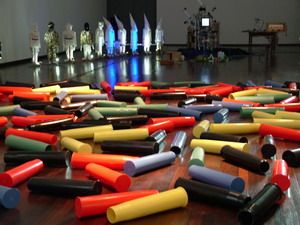
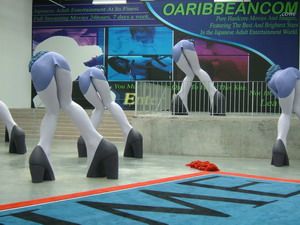


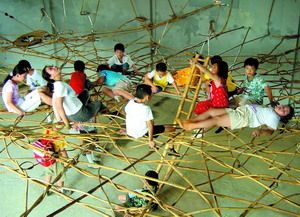
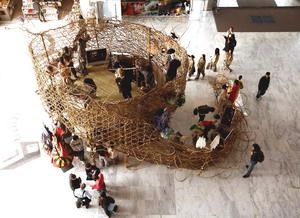
(Left) Wang Wen-chih, Teng Yun Jia Wu, 2003. (Right) Wang Wen-chih, Po Jian, 2007. The surging globalization: Globalization is the obvious political reality of today’s international landscape, a world trend encompassing everything from realpolitik and economic layouts to cultural industries and consumer society. Neoliberalism acts like a powerful torrent sweeping across every corner of the globe; Asia’s overall social and economic structures have been clearly impacted, and Taiwan, naturally, cannot avoid this trend. Under this torrent, the global political and economic multi-layered upheaval is unprecedented. What is “globalization”? Why “globalization”? Generally speaking, globalization is “Westernization,” more precisely “Americanization.” It is omnipresent in daily life—food, clothing, housing, transportation, and entertainment—even within general modes of thought. Informatization, economization, consumerization, institutionalization, standardization, colonization, or sub-colonization. Or the common characteristics of globalization: popularization, representation, universalization, uniformity, networking, vulgarity, consumerization.
Seeking roots and origins, locality: The great twentieth-century writer D.H. Lawrence wrote: “Every continent has its own great local spirit, and every nation has its local character; that is home, that is homeland. On this earth, different places have different vitality, different vibrations, different chemical smells, different stars, different characteristics; you may call it whatever you like, but the local spirit is a great reality.” In the 1980s, the French contemporary artist Ben believed: “The next artistic innovation: is to assume its own language, culture, and race.” Ben conceived that the “differences” among races are elements that cannot be ignored in current art. Within his concepts regarding life and total art relations, the new and the different are primary values; difference becomes one of the most important assets and identities of postmodern “globalization,” and even an inexhaustible driving force for artistic creativity. If there is a lack of glocalization practice, cultural globalization easily falls into the trap of Western hegemonic dominance. What are the signs and meanings of glocalization and localization?
The greatest sign of globalization in art: narrativity and anecdotal nature; the development and exploration of new media materials; the world of images—digital images, digital photography, possibilities brought by the Internet; the infection and display of KTV, MTV, contemporary comics, and pop culture; in worlds of television, digital TV, digital images, virtual images, and the Internet, etc., diverse images become richer and more ubiquitous, dazzling people and deeply changing how people live and observe the vast world. In this era of media where all flowers bloom under globalization, and with multifunctional digital technology, infinite impacts and new prospects are brought to contemporary artistic creation. Adopting composite spatial installations: sculpture-object-painting-image-photography-video and sound-body-performance; constructing participatory and relational aesthetics: dramatic and theatrical forms; questioning style based on diversified exploration: painting, sculpture, installation, video, and performance, etc. Commodification and industrialization of culture: art commodification based on auction markets. (This article is the lecture outline for the Art Departments of National Changhua University of Education and National Chiayi University.)