The French Public's Confusion About Future Prospects
The French president says: work more and earn a bit more money, yet this seems to be merely a political advertising slogan. Nowadays most French people are struggling, just like this French Communist Party poster. Recently prices have been rising steadily, exceeding people's imagined indices. Salari
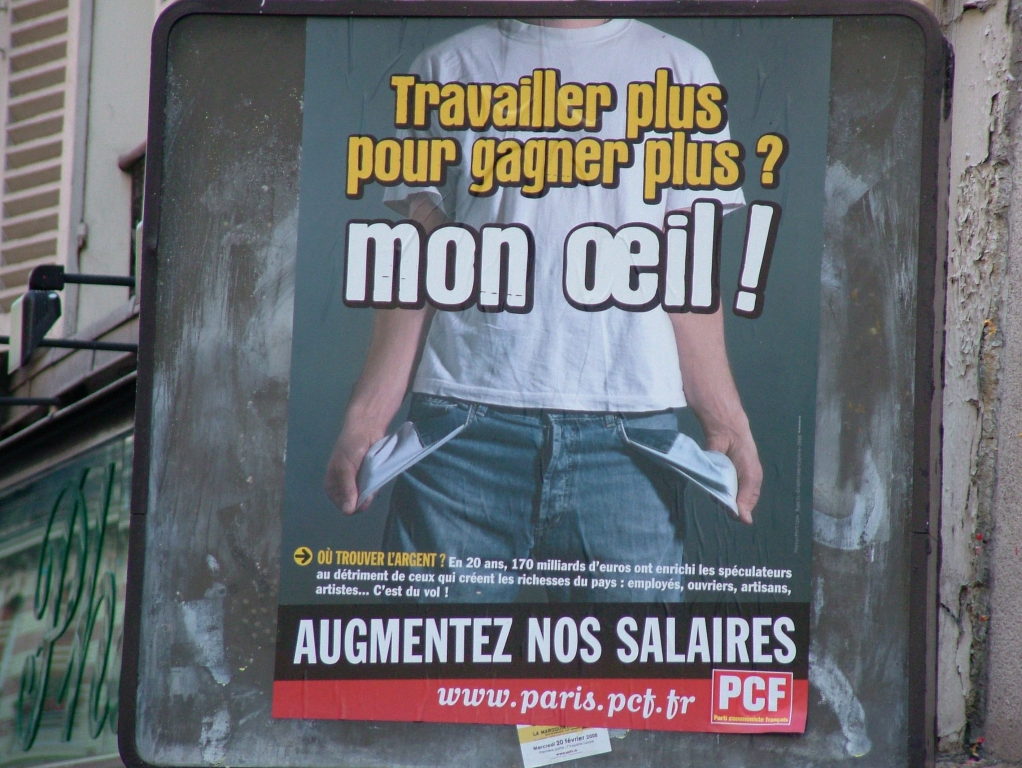
The French president says: work more and earn a bit more money, yet this seems to be merely a political advertising slogan. Nowadays most French people are struggling, just like this French Communist Party poster. Recently prices have been rising steadily, exceeding people's imagined indices. Salaries have not been adjusted, or the adjustment indices fall far short of the times. Everyone's wallets are tightening. French purchasing power has weakened and dropped to its lowest point in over twenty years, with inflation exceeding two percent. Add to this the recent stock market storm that shrank the middle class overnight, and economic growth has somewhat stagnated. This winter's big sales were not as optimistic as imagined; the social downturn is obvious.
The shadow of the major national strike in France at the end of last year has not yet been resolved, especially since the demands of national civil servants have not received an appropriate and reasonable solution. Last week, on January 24, national civil servants, particularly public education employees, once again took to the streets, demanding salary increases from the government and insisting that people cannot be asked to keep tightening their belts. The majority of the public supported this strike action, but this time the government implemented the most basic school services for the first time — that is, local municipal personnel opened schools to care for students who needed supervision (while their parents went to work).
A further concern is that, in order to trim the national budget, the government's plan to streamline public education personnel has made the future prospects of many civil servants even gloomier. They all hope to secure meetings with the Minister of Education and the Minister of Public Budget.
Since the new government came to power, it has invited economic experts and scholars from various quarters to propose plans to revitalize the social economy. When Attali proposed a comprehensive economic recovery plan, the part concerning the liberalization of the national taxi system — that is, massively opening up taxis in major cities — was something everyone agreed Paris taxis should increase (indeed, it is very difficult to hail a taxi on the streets of Paris). Unexpectedly, once this plan was proposed, the national taxi drivers' union angrily declared it would fight to the end for its own interests, absolutely refusing to endorse this new plan, and called a nationwide taxi strike on January 30. On that day, all taxis crawled at a snail's pace on the roads or blocked major traffic arteries, bringing all of France's major cities to a complete standstill, protesting the implementation of this plan and hoping to secure negotiations with government authorities.
As one can imagine, these are the larger-scale social demonstrations. Smaller ones — by vagrants, the homeless, those without legal status, anti-capitalists, anti-globalization activists, and so on — are social actions that occur almost every day. In this free and democratic society, demonstrations, strikes, and school strikes have become the very nature of social struggle. This force seems to have become the sole channel for venting social discontent. Nowadays, under a strong government and capitalism that protect their own interests, the force of social counterbalance also seems to be somewhat declining.
Safeguarding one's own rights and interests is a matter of course, but society should move forward in step with global developments. Social reform has its own necessity, and the reasonableness of reaching a compromise requires wisdom and dialogue from both sides — this is the very foundation of democratic social evolution.