The Third Mind: Non-Mainstream Consciousness at the Palais de Tokyo, Paris
Ronald Bladen 1965 Three elements
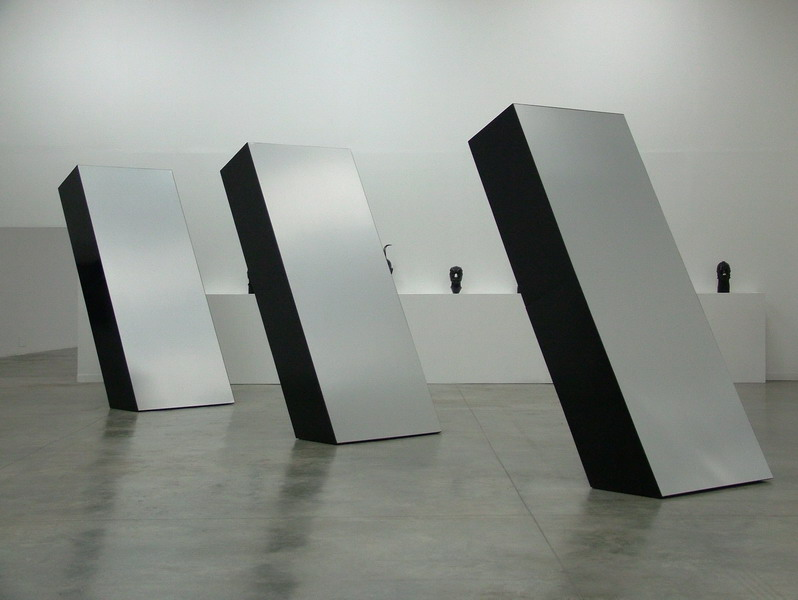
Ronald Bladen 1965 Three elements

Ronald Bladen 1971 Cathedral Evening
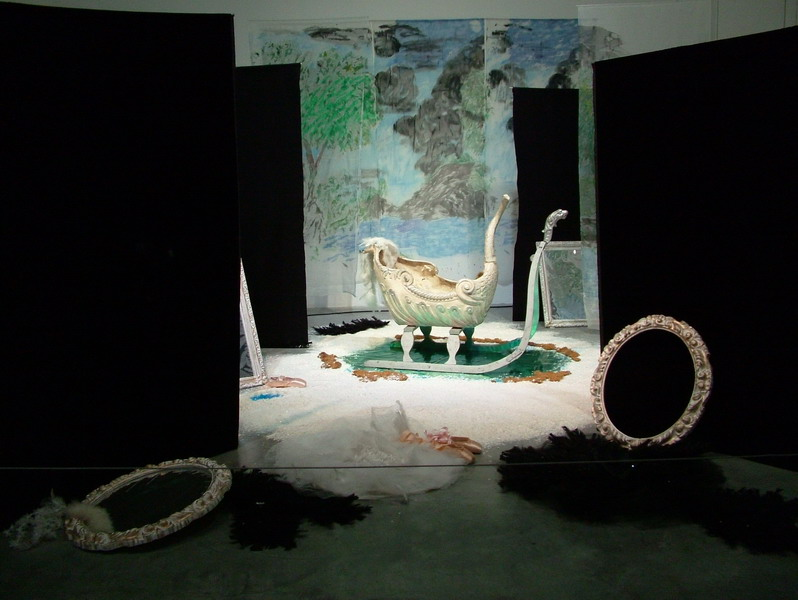
Karen Kilimnik 1992 Swan Lake
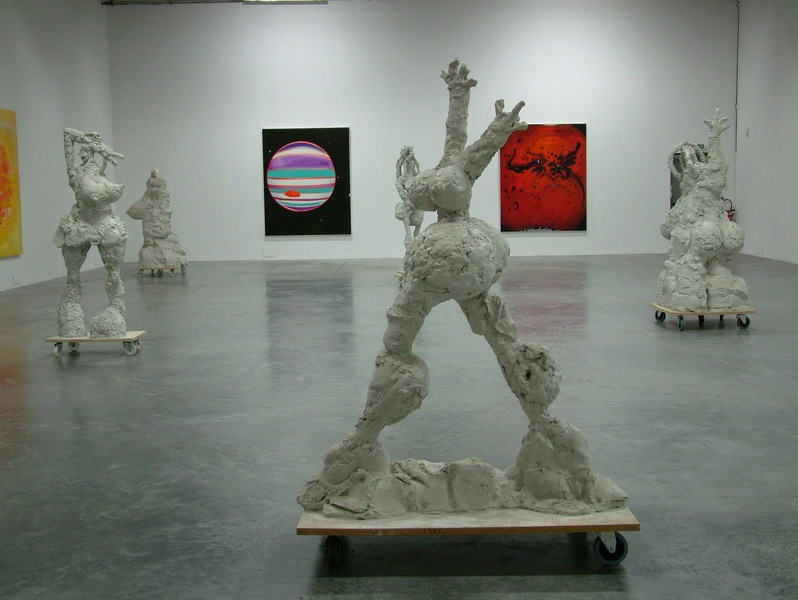
Rebecca Warren Work
Foreword: The "Third Mind" exhibition was grandly displayed at the Palais de Tokyo Contemporary Art Center in Paris from September 27 to January 3, 2008. This special exhibition is the most promising since the Tokyo's public debut; the exhibition itself leans towards a non-mainstream consciousness within the mainstream of current art, appearing exceptionally fresh and original. Under the wise artistic vision of Director Marc-Olivier Wahle, artists become the core masters of the exhibition (unlike many current special exhibitions that revolve around the curator's main axis of thought, where works become tools to elucidate ideas). Swiss artist Ugo Rondinon, residing in New York, was invited to curate this special exhibition, presenting a type of map-drawing of current art led by the artist. It clearly demonstrates the curator's artistic will, concerns, and concepts. This artist-curated exhibition is first manifested through unprecedented creative processes and aesthetic verification. Of course, it also carries an extraordinary perspective, elucidating not only our reality and daily life but equally the creation on the part of his contemporary artists.
Curatorial Concept: This extraordinary "Third Mind," the theme itself implies the mystery of another world. Using the third-person "other" as memory seems to metaphorize a memory not of you or me, but of all living beings, within human consciousness, non-consciousness, and the subconscious. Curator Ugo Rondinon compares this Third Memory to a metaphor of an insect called "Youpketcha." The legs of this insect have atrophied due to disuse, and it survives by eating its own feces: its method of sustenance is possible through its very slow metabolism, allowing nutrients in the feces to ferment over time. "Youpketcha" uses its special antennae for self-rotational movement. Thus, it continues to excrete and feed cyclically. The curator uses the metaphor of "Youpketcha" to reflect a primitive existential dilemma, contrasting this situation with humans themselves: constantly entangled between hostility and pain. The heavy anxiety and unease within ourselves, no matter how we try to divert them, are useless; they spin within this cyclical evolutionary system. Of course, the most primary and effective way is to thoroughly achieve true balance from within.
Ugo Rondinon does not directly explain this exhibition, using "Youpketcha" to indicate this ineffable metaphor. Of course, the exhibition itself is the best explanation, through language, images, space, and silence, especially when its prototype is the most rich in metaphor. Implied volume, inherent metaphors, and extraordinary meanings will bring speculative inference and achieve true feeling. Metaphor speaks of everything concisely and fully, with profound emotion prevailing over debate and logic. Like in a dream of soaring freely, metaphor requires brevity, free composition, and shared resonance. It seeks meaning deep within the realm of composition, in a theater-like manner of spiritual intimacy. "Third Mind" allows us to transcend the realm of human science, via transformation and assistance, approaching an extraordinary space capable of sheltering the late night, where, in a collective term of solitude of similar things, every voice can become our echo. In this space-time, every artist can represent all humanity. Images or text find or do not find their true echo: these similar dilemmas and the harmony found or not found in opposites will be irrelevant. (Note 1)
The "Third Mind" exhibition attracts artists from the US East and West coasts and Switzerland as the main body (no French artists are visible). Gathering three generations of old, middle-aged, and young artists, there are 32 in total, among whom Andy Warhol is the most famous. Diverse presentations include painting, sculpture, objects, video, film, collage, and installation. Obviously, this thematic exhibition has no single main axis. Just as curator Ugo Rondinon plays his due role in these diverse approaches spanning heaven and earth, finding or not finding resonance, it appears more lively and varied. This further proves that today's abnormal and unusual art is in an unprecedented state of a hundred flowers blooming. Of course, it also makes people deeply question the daily schizophrenic symptoms of current art.
A World of Hundred Flowers Blooming: Upon entering, one is immediately attracted by Josh Smith's (born 1976) densely coded text paintings. This series uses the artist's name as a continuously repeated writing theme, opening up a possible path of painting amidst fluidity, humor, brushstrokes, unique irregularity, and self-contradiction. On the other side is Sarah Lucas's (born 1962) car and underground garage photo scene installation. The entire white sedan has broken glass doors; violence becomes the core of the work, indicating fragile human (or female) bodies, exposing relationships between men and women and gender discrimination. Pop superstar Andy Warhol (1928-1987) exhibited Screen tests series video art created between 1964-66. He experimentally explored surrounding friends by filming them for three minutes, displayed by continuously playing on more than ten televisions. On the wall are Bruce Conner's (born 1933) novel photographs, presenting figures behind the screen through qualitative changes in light, expressing a metaphorical physical phenomenon. Next, a small exhibition room displays works by Brion Gysin (1914-1986) (painter, sound poet, founder of the famous Dreamachine) and William S. Burroughs (1914-1997), two forgotten avant-garde artists. Under the pioneering spirit of Dadaism, they developed cut-up technology in the late 1950s, constructing through collage of text sentences and images, deconstructing systematic and standardized text trends, shifting the boundaries of reality and retaining a reason for endless hesitation. The theme "Third Memory" comes from the title of their 1965 work.
Next is Valentin Carron (born 1977), a new generation of Swiss artists specializing in exploring Swiss farm culture and its symbolism, through images and objects. Here he displays two large wooden crosses, abnormally composing religious language and minimalist abstract symbols. Jay DeFeo (1929-1989) explores weight and volume, nature and power, presented in two powerful angular and semi-circular form abstract paintings in gray and black. The most dramatic is Martin Boyce's (born 1967) white neon light space installation on the ceiling, woven into a large spiderweb form, inviting the audience to roam in this imagined landscape world. Another exhibition room features Hans Josephsohn's (born 1920) rough, materially full sculptures in the reclining pose of figurative and abstract female models, strongly demonstrating substantial materiality. The walls are surrounded by Lee Bontecou's (born 1931) extraordinary relief paintings, mixing figurative concepts, organic forms, and mechanical forms, filled with mystery and a bit of unease in an unnatural and imagined world. Jean Frederic Schyder (born 1945), a Swiss painter, references art history and folk art, constructing his beautiful new world with a humorous and witty technique. Here he displays a large series of "Train Waiting Room" paintings, pausing temporality and emptying all existence within rigorous structures. Attracting attention is Urs Fischer's (born 1973) environmental object installation "Mrs. Fischer." The Swiss artist dramatically reconstructed his studio during his residence in London, UK, in 2000 according to the scene (tables, chairs, works, grids, various objects, etc.), transforming life into art in the process of creating readymades. Andrew Lord (born 1950) exhibits a series of bottle-shaped sculptures, painted with beeswax like ceramics, under strong forms and considerable materiality. Entering another exhibition room, one is immediately attracted by Rober Gober's (born 1954) ordinary everyday objects. Reversing Duchamp's famous urinal, here two variations of sinks are displayed, becoming seductive objects and sculptures. Two large drawings by Toba Khedoori (born 1964) on the wall transform elements of architecture, cities, or everyday objects, lightly sketched like basic architectural designs or geometric cubes, reaching perfection in minimalism with delicate caution. In the center of the exhibition room, Laurie Parsons (born 1959) presents a pile of objects including wood boards, ropes, and garbage dust in behavior and attitude, which are memories of the artist's daily life walks. In the inner exhibition room is Emma Kunz (1892-1963), who occupies a special position in art history. Her works are confirmed to have decorative styles with symmetrical changes, with form serving as rhythm, symmetry, symbolism, and primary metaphor. Paul Thek (1933-1988), a minimalist or conceptual artist, was even a pioneer of 1970s installations. His work revolved around space and matter, often placing objects in long rectangular yellow plastics, symbolically and metaphorically resembling monuments of personal memory.
In the large exhibition room, the most striking is Ronald Bladen's (1918-1988) monumental sculptures. He and Tony Smith are considered founders of Minimalist Art, establishing space in geometric prototype forms. Here is displayed the spectacular "The Cathedral Evening" (1971) work, with a huge triangular form, an open-door structure welcoming the audience, through which people can pass. Also is "The Elements" (1965), a tilted single triangular prototype, full of rhythm and somewhat unstable, quite dramatically seeming about to collapse. Cady Noland's (born 1956) works on the wall are like anthropology of American society, all in the face of extreme social violence. His art does not state moral standards, yet depicts this social violence through the rhetoric of mass media images. Here are exhibited "Oozewld" (1989) and "Untitled" (1994), which are famous political violent events in the US. Nancy Grossman (born 1940) focuses on collage, sculpture, and assemblage. Her entire creation revolves around the sex and violence of the body. Here she presents her most famous and bewitching "Head" series, dressing all male heads in black leather disguises, like worn masks and tools of the body, revealing only high noses and bright eyes. Identity is reduced to zero, strongly demonstrating human savagery and aggressiveness, full of metaphors of latent violence in contemporary society.
Following is another large exhibition room, welcoming people with Bruno Gironcoli's (born 1936) dramatic giant sculptures. In an extraordinary world of organic and mechanical, natural and artificial, ancient and modern imagination, synthesized under the image of silver and gray mysterious impossibility, full of suggestive and symbolic exploration connected to "sexuality." On the wall are Sue Williams' (born 1954) series of paintings, all revolving around the human body, more specifically "sexuality" and the relationship between men and women in contemporary society and feminism. The works are quite erotic and satirical, hiding a violence and intimate anger. In the last exhibition room, the most striking is Rebecca Warren's (born 1965) rough, comical, provocative ugly female statue series. Under absurd and masculine imagination, she constructs this prolific contemporary goddess, or equally praises female sexuality under the image of ugliness. On the wall are Vija Celmins' (born 1938) series of paintings from folk culture and Genesis mythology, creating a childish and whimsical world, especially the operation of cosmic planets, such as Monday being Moon Day, Tuesday being Mars Day, etc., combining Greek and Roman divine figures to construct her imagined world and poetic mood. Beside them are Vija Celmins' (born 1938) unreachable cosmic planets, galaxies, and comets, displaying this infinite imagination in abstract poetry. In another corner is Karen Kilimnik's (born 1955) very poetic "Swan Lake" scene installation. Her bewitching works often mix fairy tales and contemporary stars. Here, under painting sets, objects, and lighting installations, she perfectly interprets Tchaikovsky's ideal realm.
Conclusion: The "Third Mind" exhibition itself leans towards a non-mainstream consciousness within the mainstream of current art. Because this exhibition does not take mainstream artists as the main body, what attracts attention is that there are more and more wonderful explorations in the non-mainstream consciousness of the mainstream, which are often deliberately ignored or not faced squarely in international big expos or mainstream exhibitions. Here, for the first time, this hegemony of the mainstream is corrected, and it is proposed that the mainstream is not so mainstream, attempting to prove the paranoia and closure of the dead-end of the international contemporary art system, because current art is much more diverse and rich than we imagine. This exhibition's big star, Andy Warhol, is not the treasure of the exhibition, but rather affirms his pioneering exploration in video art. Although this series has temporality, it is still very current. Artists overlooked by mainstream art history are re-affirmed in their status, such as the minimalist pioneer Ronald Bladen, or the historical significance and value of unlocatable art by Brion Gysin, William S. Burroughs, Paul Thek, and Emma Kunz. It proposes the possibility of painting forced into a corner or other viewpoints. Not only affirming the exploration of new material media and having a broader understanding of traditional sculptural materials, it also re-proves or encourages the diversity and preciousness of the colorful faces of these mainstream edge (non-mainstream consciousness) works. Finally, it attempts to break the hegemony of the art system and expand the scope of the system. The most regrettable thing is that the range of invited artists is too narrow, but such an exhibition category and concept are worth studying and cheering for, not only paving the way for future new exhibitions but also suggesting the possibility of all new viewpoints.
Appendix: Curator Profile: Ugo Rondinon (born 1964) is a Swiss artist residing in New York, USA, and is one of the most representative figures in the current art world. His overall creation is built on the abnormal contradictory relationships of the contemporary world and extraordinary psychological and psychoanalytic effects, mixing brilliant colors and melancholy feelings, abstract and light narrative, in pop and slightly cynical cynicism, presented through forms such as painting, photography, sculpture, objects, drawing, articles, and installation. In a minimalist, playful, poetic, and abnormally complex world, he walks out all types of art.
Note: This text comes from the exhibition press release.