Manet - Boy with a Whistle
Boy with a Whistle, 97×160 cm, 1866. Held at the Musée d'Orsay, Paris. After traveling to Spain in 1865, Manet became particularly interested in Spanish painting...
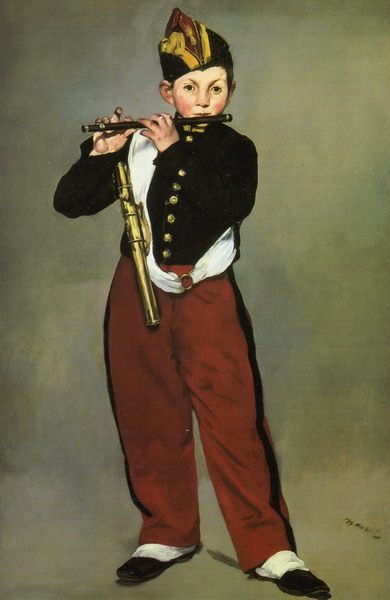
Boy with a Whistle, 97×160 cm, 1866. Held at the Musée d'Orsay, Paris. After traveling to Spain in 1865, Manet became particularly interested in Spanish painting (especially Velázquez and Goya), especially regarding spatial exploration. Of course, he was also deeply influenced by the flattening and color-blocking of Japanese ukiyo-e prints, as well as photographic imagery. In his works, Manetti uses vividly flat-painted large color fields (red and black...) to handle the composition. Furthermore, within the vibrant contrasting colors of the white backpack, shoe covers, and black hat with gold trim, he expresses the modern vitality of the entire work. The figure in the painting seems to merge with the space (only a small shadow under the left foot), presenting deep space and full of characteristics of modern art. The poet Baudelaire wrote about Manet thus: "People do not know if you are doing this reasonably, but those who believe that this is the first innovation in the realm of painting, you seem more talented than the writer Chateaubriand and the musician Wagner? People often mock them, but they did not die." Then the famous French writer Zola wrote: "Our fathers mocked Courbet, we now stand drunk and bewildered before him. We now mock Manet, our next generation will stand drunk before his paintings." Today, Manet's status in the history of modern painting is like Titian, Velázquez, and Goya. Contemporary modern art inherits Manet's exploratory achievements, proving the vision and historical foresight of these two avant-garde writers.