Monet - The Rouen Cathedral Series
One of the Rouen Cathedral series, 99×65 cm, 1892–1893. Collection of the National Gallery of Art, Washington.

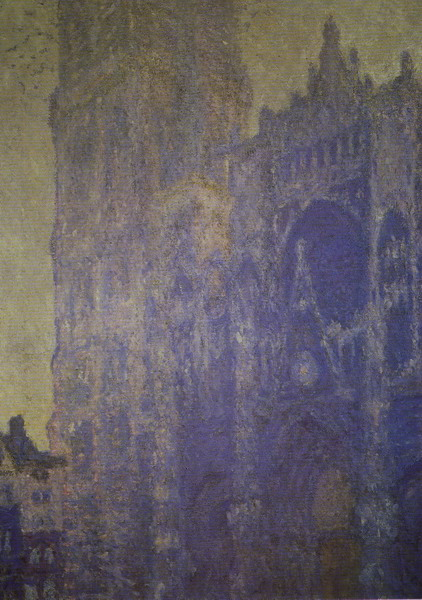
Rouen Cathedral Series - Morning Sunlight, 106×73 cm, 1892–1893. Collection of the Musée d'Orsay, Paris. Starting in 1890, Monet created a series of paintings depicting the instantaneous changes of light on objects within natural landscapes. Thus, a series of twenty Haystacks, followed by a series of over thirty Rouen Cathedrals, played out like a suite of time. Here, Monet’s handling of color and light surpassed the subject itself; he touched upon the essence of art. In these series, we see the rich colors of the changing seasons, from bright sunshine to dusk, or the various effects of light from midsummer to winter snow! Is it haystacks, cathedrals? No, it is light, color, silhouettes of time and space. No, these are independent paintings, an extraordinary series guiding modernism. When this series was exhibited at the Durand-Ruel gallery in Paris, nearly all nearby painters such as Cézanne, Degas, Renoir, and Pissarro were filled with admiration. Pissarro wrote thus: "This work has a willful, calm effect that is extraordinary. It pushes this unusual exploration to its extreme, as if no artist had ever painted before." In 1912, after viewing the Haystacks series, the twentieth-century abstract painter Kandinsky wrote: "In my life, there have been two most outstanding events: first, Monet's Haystacks, where I opened my eyes for the first time to see a painting." Years later, the suprematist artist Malevich saw these works and described them thus: "Monet's cathedral series is a decisive turning point in the history of art."