Monet - Japanese Bridge
Japanese Bridge, 89x93 cm, 1889. Held at the Musée d'Orsay in Paris. After artistic experiences in London and Venice, Monet retired to Giverny...
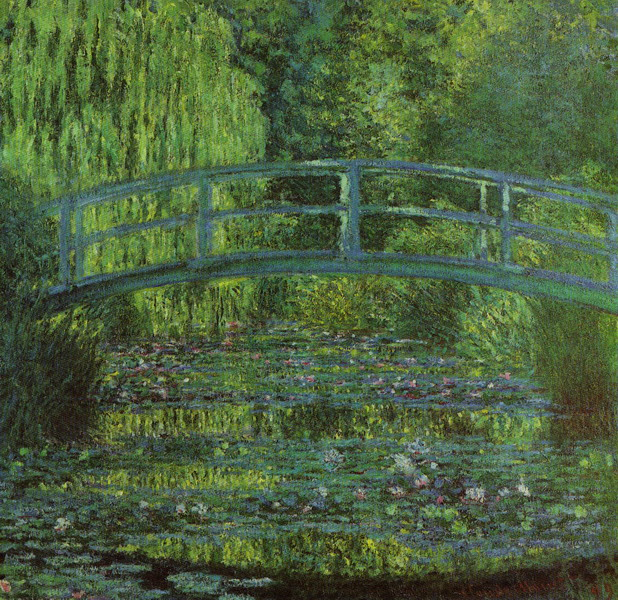
Japanese Bridge, 89x93 cm, 1889. Held at the Musée d'Orsay in Paris. After artistic experiences in London and Venice, Monet retired to Giverny, the holy land of Impressionism. He lived and created in his beloved Giverny garden, where every scene and object in the vibrant, brilliant garden became a painting subject, especially the lotus pond with its shimmering water reflections and the Japanese bridge. Friends who have visited Monet's garden in Giverny would surely be fascinated by the dazzling lotus pond. The poetic, Oriental-style Japanese bridge by the pond was a favored painting theme of Monet, as captivating as his eye-catching "Water Lilies" series. Among the many colorful depictions of the Japanese bridge, the earliest, "Water Lily Pond with Green Harmony" (1890) (at the Musée d'Orsay), depicts the interplay of the Japanese bridge and greenery along the pond amidst shimmering light and shadow within a lush green theater, presenting sparkling light effects and a fresh atmosphere through rough yet orderly blue-green-lavender colors. Two other versions, "Japanese Bridge" from 1918 and 1924, held at the Marmottan Museum in Paris, under liberated forms and colors, are quite freehand like Chinese landscape paintings, revealing the arched Japanese bridge in a hazy color atmosphere. In contrast, the other is more lyrical and liberated, with forms dissolving into fiery colors, like a mesmerizing firework; the vibrant, brilliant colors overflow with the artist's deepest sensibility, heralding the arrival of Abstract Expressionism and Lyrical Abstraction in the 1950s.