Monet - Water Lilies Series
Evening Light, 202x630 cm, 1910, Zurich Museum of Fine Arts Collection

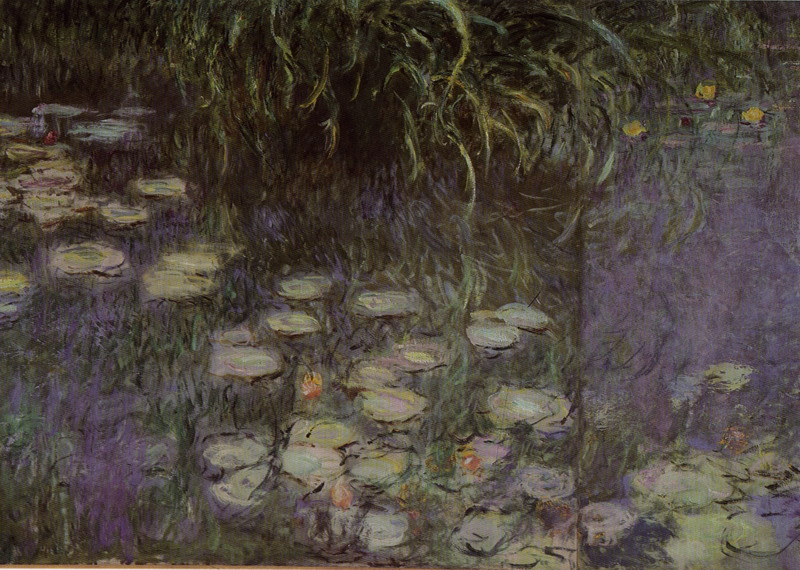
Water Lilies Series - Morning Detail, 197×1200 cm, 1918-1926, Musée de l'Orangerie Collection. Since 1893, Monet had been immersed in the water and light illusions of his garden at Giverny, attempting to decipher the mysteries of these serene and elegant water lilies, exploring the extraordinary transformations of poetic lotuses and shimmering reflections. Through subjective forms and emotional colors, he sought to directly probe the essence of painting. Starting with smaller "Water Lilies" from 1897-1898 and 1903, akin to his Rouen Cathedral and Haystacks series, he attempted to capture the context of time and space. In this work at the Marmottan Museum in Paris—a vast night scene with two pure white water lilies floating on the dark water, accompanied by two poetic green leaves—he presents a harmonious, tranquil, and perfect realm. Another "Water Lilies": a tranquil pond, clear as a mirror, reflecting the lush green willows and blue sky along the banks like a natural theater; some indeterminate pink flowers float on the surface. Immersed in this series, Monet painted for over ten hours a day. He said, "I continue to paint even in my dreams at night; I wake up exhausted every morning because painting is so difficult." In 1908, he told his friend Gustave Geffroy: "Do you understand? I am so completely absorbed in this work. The pond and its natural scenery of water and light are entangling me. Beyond all the strength of an old man, I still have feeling. I paint again and again, exerting all my strength, hoping to create something."
"Water Lilies and Weeping Willows" (1916-1919): Liberated from the bewitching effects of the night atmosphere, it features highly expressive subjective forms and emotional colors. Parallel rows of water lilies are divided by vertical lines of weeping willows, presenting an extraordinary natural scene. "Water Lilies" (1917-1919): As Monet's late works became bolder, especially after his cataract surgery, he liberated natural forms. Here, they become a mass of chaotic, broad brushstrokes, resembling an indeterminate lyrical abstract painting form, effectively displaying extraordinary water and light illusions. Painting became the dominant core of the work.
Monet's famous "Water Lilies Series" (1918-1926) is housed at the Musée de l'Orangerie in Paris. Surrealist painter Yves Tanguy once called the Orangerie the "Sistine Chapel of Abstract Art," allowing one to imagine the charm of these eight large panels (approximately 2 meters × 12 meters). To paint these monumental works, Monet built a special large studio in his later years (1915). These unusual canvases follow the horizontal format of Chinese painting, grand and spectacular like a cinema screen: the first gallery faces East with color reflections, West with sunset, South with morning, and North with clouds; the second gallery faces East with two willow trees, West with tree reflections, South with dawn, and North with morning. Under the liberation of form, symbolism, and emotional color, within substantial blue and green tones, the scenes of the pond with its water and light illusions are almost entirely abstract and extraordinary in their spatial and temporal settings. Sometimes foreground elements (willows or clumps of weeds) suggest spatial relationships between front and back; sometimes the view extends infinitely into the void; sometimes contrasting flowers or colors dot the deep blue or emerald green surface. Bright light flickers within the rough, indeterminate brushstrokes. The tonal construction creates the atmosphere of time and space and indicates temporality. Through the "Water Lilies Series," Monet ultimately explored painting itself; painting finally became painting alone, becoming the highest manifestation of Monet's art, because painting itself was the subject.